
In recent years, vibe coding has become a viable startup idea. Moreover, today, it’s used by 92% of US developers (and here, we're highlighting only the country where the world's best IT talents reside!). Indeed, with the increasing size of context windows in AI for coding, companies have begun to doubt the need for human engineering teams. But is it worth it? And, most importantly, what risks does it carry on? Let's find out.
Why Startups Are Turning to Vibe Coding
Today's market demands extreme capital efficiency from founders, making vibe coding the main tool for early-stage projects' survival. Startups move away from hiring expensive developers, as AI agents provide near-zero marginal cost of code generation and compress MVP launch times from months to mere hours. The founder describes the business logic in text, and the AI designs the backend and pushes the build to production. A global rethinking of the vibe coding meaning in software development is underway.
Thus, today, non-technical developers can build complex applications without any knowledge of syntax of specific frameworks and architectural details and keep full ownership of the codebase via a dialog-based interface. Where any unique feature is copied instantly by the competitors, the one who implements the iteration wins. With the vibe coding, startups can redesign their product overnight based on daily analytics and gain the flexibility they would not have from traditional IT departments.
At the same time, our experience suggests that AI is only good for solving specific problems. What can we say if a casual conversation about legal loopholes might raise doubts in your assistant – how can it then be trusted to build an enterprise-class system from start to finish? However, let's move from metaphorical doubts to facts.
Tasks AI Coding Tools Already Handle Effectively
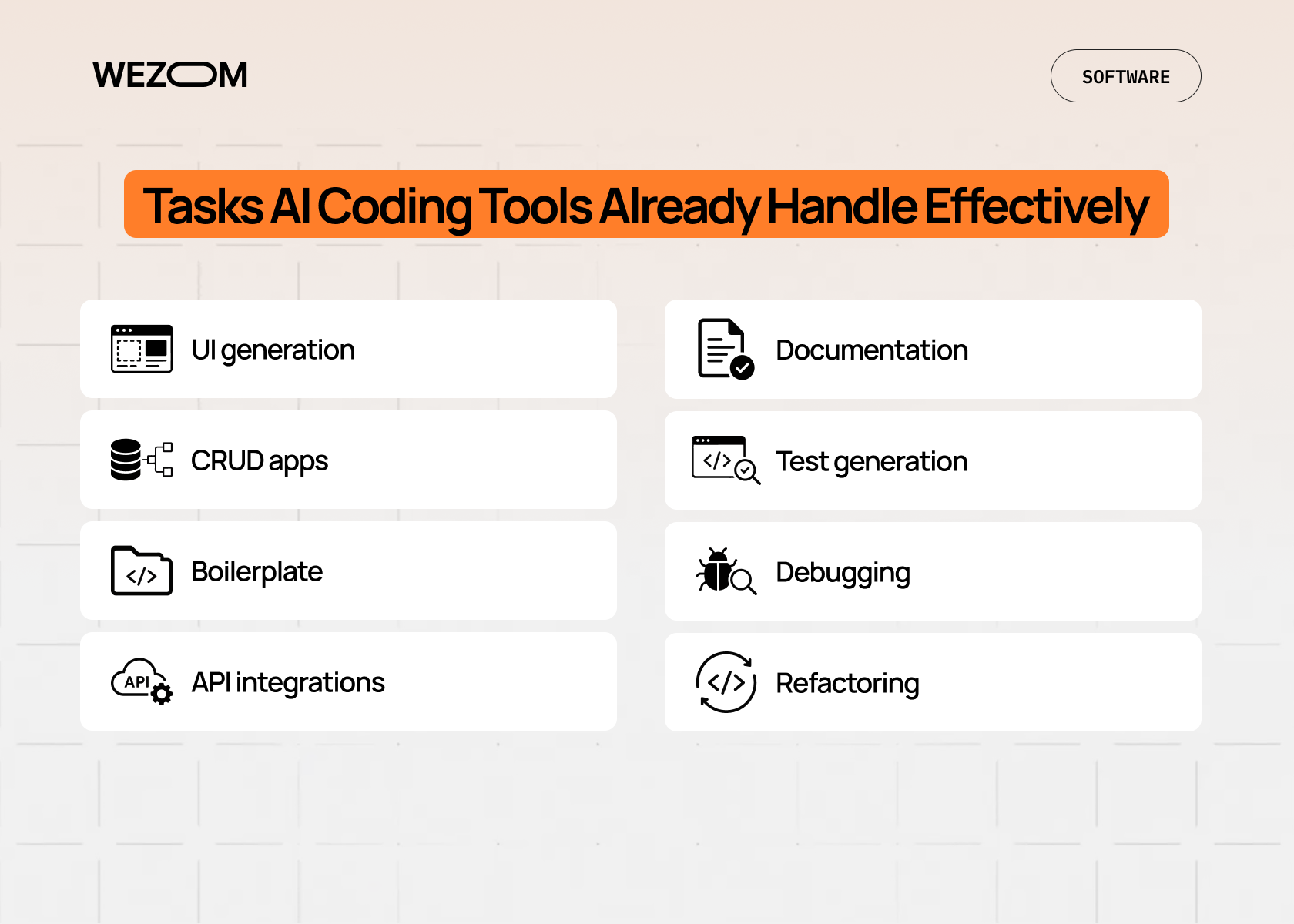
Today, AI agents are context-sensitive entities that perform specific engineering tasks, changing the development workflows we're accustomed to:
- UI generation. Multimodal models instantly transform screenshots and mockups into a working responsive frontend; along with this, AI can generate code in React/Next.js in combination with Tailwind CSS/Radix UI, eliminating the tedious work on layouts.
- CRUD apps. AI agents deploy standard data processing architecture in seconds based on a text description; they can also design database relationships and create typed routes.
- Boilerplate. Setting up configs and repositories, as well as connecting authorization libraries, is now a one-second task – this boilerplate code no longer needs to be written manually.
- API integrations. Agents have up-to-date knowledge of all public SDKs and specifications; moreover, AI builds end-to-end integrations with third-party services and writes webhook handlers with signature verification.
- Documentation. Technical documentation writing is automated with 100% consistency; AI tools analyze the project structure and generate detailed README.md files, as well as interactive Swagger specifications, updating them with each commit.
- Test generation. The AI analyzes the abstract syntax tree of the codebase and covers the code with unit/integration tests; also, it identifies boundary conditions and emulates user behavior.
- Debugging. The system operates in self-healing mode, so if a runtime crash or build error occurs, the logs are fed directly to the AI network; there, the root cause will be localized, so you'll get a patch and run tests to apply the fix.
- Refactoring. AI can take on execution of architectural refactoring of legacy/complex code; also, it can be tasked with rewriting state management logic or separating client/server components to address performance issues.
- Automation. Using AI, you can build CI/CD pipelines for automated deployments (without involving DevOps experts); all you have to do is provide a text description of what to automate.
Where Vibe Coding Still Fails in Real Product Development
The AI-generated code works perfectly in isolated demo mode, but rapidly degrades when the system begins to scale. The machine optimizes it for a specific, immediate prompt and ignores planning. As a result, the entire concept faces problems:
- Scalability. AI doesn't build horizontal scalability into its architecture; under peak loads, the backend crashes due to suboptimal RAM usage and a lack of connection pooling, causing scalability to drop to a critical level.
- Architecture inconsistencies. Without strict human supervision, AI produces heterogeneous patterns; different modules of a single project may simultaneously use fundamentally conflicting approaches to state management and data transfer, breaking the overall system architecture.
- Security. Neural networks are trained on publicly available code with vulnerabilities; AI misses input sanitization and allows leaks through SQL injection or direct object reference vulnerabilities.
- Poor maintainability. Code readability for humans drops to zero; after a couple of months of use, vibe coding in software development turns into a huge set of strings that no one can understand.
- Technical debt. The release speed leads to rapid debt accumulation, and instead of fixing bugs, the AI begins to layer new lines of code to the point where the system locks itself up.
- Lack of business logic understanding. The model doesn't understand the business context – functions are written based on the developer's textual instructions, so the AI can't assess how a change in one module will affect the overall margins of the digital product (or the business it belongs to).
- Unstable integrations. Third-party services regularly update their APIs; at the same time, the AI often uses outdated SDKs, which leads to broken integration logic due to protocol changes not accounted for in the training set.
- Hallucinations. When faced with a non-standard task, the AI begins to invent new methods and config parameters, presenting broken syntax as a working solution.
- Performance bottlenecks. Redundant abstractions and duplicated logic lead to memory leaks and N+1 DB queries.
- Compliance risks. AI knows nothing about regulatory requirements; deploying a generated backend to production without an audit risks violating generally accepted standards.
Can One AI Engineer Replace an Entire Development Team?
It's already clear: artificial intelligence won't destroy the programming profession – it will change team structures and approaches to software development. For example, we're already seeing the implementation of AI-augmented hybrid workflows, where a single engineer uses vibe coding tools to manage a fleet of AI agents.
AI has learned to write code, still, it cannot create products. Product development is about managing constraints and empathy with the user. A human team provides the product with structure and systems thinking, which AI lacks. So, all engineering is moving to the meta-logic control level.
The main paradox is that the complexity of software systems grows faster than the autonomy of AI. The more code a machine generates, the higher the skill requirements for the human validator. In hybrid workflows, the senior engineer moves up the value chain, conducting regular reviews of all automatically generated modules.
Finally, some words about ownership. AI cannot be held legally or financially liable for a downed server or, for example, leaked customer data. The final decision always rests with a human.
Vibe Coding vs Traditional Software Teams
Choosing between vibe coding AI development and a traditional team now is a matter of tailoring to business needs. The table below provides a comparative analysis of both approaches, where we evaluate vibe coding software development based on operations metrics.
| Criteria | Vibe coding | Team of real engineers |
|---|---|---|
| Speed | High | Moderate |
| Cost | Minimal, limited to subscriptions/API token usage | High, including salaries, taxes, software licenses, and so on |
| Scalability | Low, as AI creates code without further business planning | High, as architecture is designed with horizontal scaling/fault tolerance in mind |
| Code quality | Unstable, as the code is filled with duplicates and logical bugs | High, as code is maintained through code reviews and standards |
| Maintenance | Too difficult, as the codebase turns into a blackbox | Manageable, as the entire code is well-documented |
| Collaboration | The interaction loop is limited to owner-AI only | Team-oriented |
| Security | High probability of security flaws or deprecated package use | High, thanks to security best practices and audits |
| Flexibility | Absolute, as the tech stack can be swapped overnight | Low, as any pivot requires careful redesign |
| Ownership | Blurred | Clear, so engineers have ownership over the codebase |
| Reliability | Low, with risks of cascading failures | High, as stability is guaranteed by automated testing and properly chosen architecture patterns |
| Growth | Limited, due to rising tech debt | Infinite, as the architecture is ready to evolve from the outset |
As we can see, the capabilities of the AI we have today are quite limited. It can easily build a spectacular prototype that can be proudly demonstrated to investors, but you'll still have to redo everything from scratch when your project takes off and faces real-world workloads that the AI didn't initially anticipate.
Industries Where Vibe Coding Works

Vibe coding development has captured a huge industry sector where speed is more important than flawless reliability. Specifically, it delivers a high ROI in:
- Internal tools, like CRMs/task trackers;
- MVPs, to demonstrate them to stakeholders and/or investors;
- Prototypes, for testing UX/UI on real TAs.
- Marketing tools, like interactive widgets;
- Dashboards for analytics without real-time loading requirements;
- Automation solutions (for example, for DB migration and data syncing);
- Micro-products, like API wrappers.
Of course, this isn't a complete list of possible solutions where this development approach will benefit you. It's far more important to understand the next insight: its long-term viability is definitely untenable, as it won’t ensure your system’s resilience. Unless you only provide services for creating demo versions that are then completely reworked by real software engineers.
Why are low-risk products more adaptable?
In low-risk products, a potential system failure doesn't have catastrophic consequences for the business. Standard prototyping testing allows for quick identification of necessary features.
If a bug causes an internal marketing dashboard or a custom CRM to crash for half an hour, the company won't lose its reputation and millions of dollars or face lawsuits. Another manual backlog of tasks is unnecessary. The error can be corrected with the next AI prompts in the normal course of business. The absence of strict requirements for regulatory compliance and personal data processing frees founders' hands. Under such conditions, the extreme speed and low cost of development outweigh any architectural imperfections in AI code.
When Is a Traditional Team Better?
Now, let's debunk the universality of the AI approach in programming with practical examples. Specifically, there are industries where the slightest error can cost millions or even threaten human lives:
- Fintech/banking. Financial transactions require absolute mathematical precision, which AI often misses;
- Healthcare. Medical systems cannot provide strict quality control of every line of code;
- Cybersecurity. Data protection systems require expert human thinking to counter sophisticated hacker attacks; AI is not yet capable of checking code for logical vulnerabilities, so security remains the responsibility of humans;
- Enterprise SaaS. Large B2B software operates with complex business scenarios, where the architectural chaos of AI code instantly paralyzes clients' operational processes;
- Logistics. Supply chain management rely on complex and computationally intensive optimization algorithms;
- Government systems. State registries and citizen databases require strict access control;
- High-load infrastructure. High-load platforms won’t survive on AI code due to strict requirements for memory utilization and hardware optimization.
When Businesses Should Use Vibe Coding and When They Shouldn't

To help tech businesses navigate, the criteria for choosing between AI generation and human development can be boiled down to two clear scenarios.
Good Fit
Vibe coding tools will become your main competitive advantage if the project is launching short-term lifecycle research and is unencumbered by commitments:
- MVPs. When you need to build a working version over a weekend to show the product to your first customers or jump on the hype train;
- Prototypes. Creating interactive concepts to test product hypotheses within the team;
- Internal tools. Custom scripts for automating routine tasks and internal admin panels, the failure of which will not hinder the company's sales;
- Validation-stage startups. Projects in the pre-seed stage, where the founder's main task is to find Product-Market Fit before the minimum hosting budget runs out.
Poor fit
You absolutely cannot rely on vibe coding for AI development and must hire a traditional engineering team if your product includes:
- Enterprise systems. Resource management systems for large corporations, where downtime costs millions;
- Regulated industries. Any software subject to the oversight of government regulators/financial monitoring agencies/medical commissions;
- Complex scalable platforms. Products whose architecture initially implies an audience of millions and a microservice structure;
- Mission-critical infrastructure. Life-support systems, transportation hubs, energy systems, communication nodes, and any other industry, where failure is unacceptable.
Conclusion
Vibe coding has built a border between boilerplate routine and man-made programming. Therefore, the future of tech companies belongs to hybrid teams where engineers still remain responsible for the entire product roadmap.

FAQ
What is vibe coding in software development?
It's an approach to software development where a human formulates product requirements in text format, and AI handles coding, architectural design, and app deployment.
Can vibe coding completely replace developers?
AI effectively automates routine, but it lacks strategic thinking, understanding of deep business context, and is incapable of bearing legal or financial liability for critical errors.
Is vibe coding suitable for enterprise software?
Absolutely not, as enterprise solutions require strict compliance and a microservice architecture.
Which AI tools are best for vibe coding?
The market today offers tools divided by use cases: for autonomous out-of-the-box development, for professional engineers, and for agent orchestration.
What are the risks of AI-generated code?
While AI-generated code works perfectly in demo form, under real-world load, it leads to technical debt and exposes cybersecurity vulnerabilities, and a complete disregard for regulatory compliance.
