
Modern drone ecosystems rely on continuous telemetry, command exchange, and real-time communication between UAVs, Ground Control Stations, companion computers, and cloud platforms. Whether supporting inspection missions, mapping operations, delivery services, or fleet management, reliable communication is essential for maintaining safe and efficient flight operations.
At the center of most PX4 and ArduPilot deployments is MAVLink, the industry-standard messaging protocol used to transmit telemetry, navigation data, mission updates, and control commands. However, developers can interact with this ecosystem in different ways depending on project requirements. Some applications require direct protocol access through MAVLink, while others benefit from higher-level tools such as MAVSDK or Python-based frameworks like PyMAVLink.
Choosing the right approach affects development speed, software architecture, scalability, maintenance effort, and overall system flexibility. A mobile drone application, for example, may prioritize rapid development and simplified APIs, while a telemetry processing platform or research project may require direct access to protocol messages and low-level communication controls.
This article compares MAVLink, MAVSDK, and PyMAVLink, explains their roles within the drone communication stack, and provides practical guidance on selecting the best option for MAVLink telemetry integration, mavlink api integration, and modern UAV software development projects.
Understanding the Drone Communication Stack
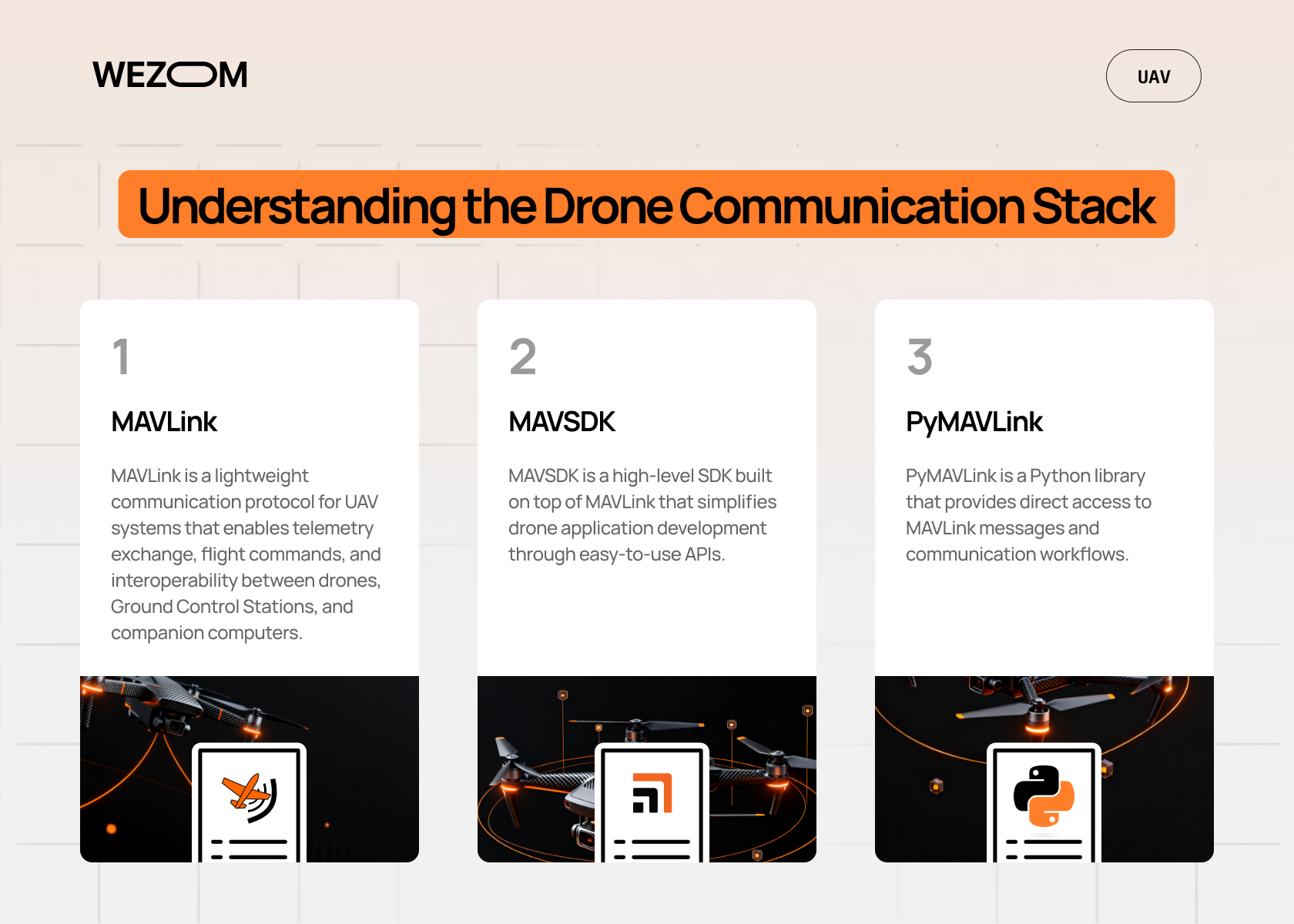
Drone communication architecture includes several interconnected layers that support telemetry exchange, mission execution, navigation, and remote control. While operators typically interact with Ground Control Stations or fleet management platforms, these systems rely on an underlying communication infrastructure connecting the autopilot, sensors, payloads, companion computers, cloud services, and user applications.
The communication layer is responsible for transmitting telemetry, mission updates, commands, diagnostics, and system status information between all components. In modern PX4 and ArduPilot ecosystems, this communication is largely standardized through MAVLink, although developers can work with the protocol at different abstraction levels depending on project requirements.
What MAVLink Is
MAVLink is a lightweight messaging protocol used for communication between drones, Ground Control Stations, companion computers, and other connected systems. It has become the industry standard for PX4 and ArduPilot-based UAV platforms, enabling reliable exchange of telemetry, commands, and mission data.
The protocol serves three primary purposes. First, it supports telemetry transport, allowing systems to exchange information such as GPS position, battery status, altitude, velocity, sensor readings, and vehicle health. Second, it enables command exchange, allowing operators and applications to control flight behavior, upload missions, and manage payload operations. Third, it provides a standardized communication framework that allows different hardware and software components to work together.
One of MAVLink’s key advantages is efficiency. Messages are compact and optimized for low-bandwidth environments, making the protocol suitable for radio links, cellular networks, and other communication channels commonly used in UAV operations.
Because MAVLink is supported by both PX4 and ArduPilot, developers can build interoperable solutions without creating custom communication protocols. This makes MAVLink protocol development a common choice for drone platforms, fleet management systems, telemetry services, and autonomous UAV applications. However, working directly with MAVLink requires handling message serialization, parsing, and communication logic, which can increase implementation complexity compared to higher-level SDKs.
What MAVSDK Is
MAVSDK is a higher-level software development kit built on top of MAVLink. Rather than interacting directly with protocol messages, developers use a simplified API that abstracts many of the complexities associated with MAVLink communication.
This abstraction layer significantly changes the development experience.
Instead of manually processing telemetry packets and constructing command messages, developers interact with intuitive SDK functions. Operations such as takeoff, landing, mission upload, waypoint navigation, telemetry subscription, and health monitoring can be implemented with substantially less code.
The primary goal of the MAVSDK drone app development is to accelerate application delivery while reducing protocol-level complexity. Development teams can focus on business logic, user experience, automation workflows, and mission management rather than low-level communication handling.
MAVSDK architecture typically includes:
- MAVLink communication backend;
- API abstraction layer;
- Telemetry subscriptions;
- Mission management services;
- Action control interfaces;
- Error handling mechanisms.
One major advantage of MAVSDK is multi-language support. Development teams can work with C++, Python, Swift, Java, and other supported languages depending on application requirements.
This flexibility makes MAVSDK integration particularly attractive for organizations building mobile applications, desktop Ground Control Stations, enterprise monitoring systems, and cloud-connected UAV platforms.
Another important benefit is maintainability. High-level APIs reduce code complexity and improve readability, making it easier for teams to onboard new developers and maintain long-term software projects.
However, abstraction also introduces limitations. Developers seeking complete protocol access or highly customized messaging behavior may find MAVSDK restrictive compared to direct MAVLink implementations.
What PyMAVLink Is
PyMAVLink is a Python implementation of the MAVLink protocol that provides direct access to MAVLink messages and communication workflows. Unlike MAVSDK, which abstracts protocol complexity through high-level APIs, PyMAVLink allows developers to work with telemetry data, commands, and protocol messages at a lower level.
This approach is particularly useful for automation, testing, telemetry logging, and custom integrations. Developers can create scripts to monitor vehicle status, automate missions, collect flight data, validate system behavior, or build custom communication services. Because it is based on Python, PyMAVLink is widely used in robotics, research, AI, and UAV development environments.
One of its main advantages is flexibility. Engineers can generate, inspect, modify, and transmit MAVLink messages directly, making it easier to implement specialized workflows that may not be supported by higher-level SDKs. This level of control is especially valuable for rapid prototyping, diagnostics, and experimental projects.
A typical PyMAVLink development service may involve telemetry processing, mission automation, protocol testing, or integration between drones and external software systems. The tradeoff is a steeper learning curve, as developers must understand MAVLink message structures and communication concepts. However, for projects requiring direct protocol access and maximum customization, PyMAVLink remains one of the most powerful tools in the MAVLink ecosystem.
MAVLink vs MAVSDK vs PyMAVLink: Core Differences
Although MAVLink, MAVSDK, and PyMAVLink are frequently mentioned together, they address different layers of the drone communication ecosystem. Understanding these distinctions is essential when designing telemetry architecture, selecting development tools, and planning long-term software scalability.
The simplest way to understand the relationship is to view MAVLink as the communication foundation, MAVSDK as a developer-friendly abstraction layer, and PyMAVLink as a direct Python implementation of the protocol. Each option offers different tradeoffs between development speed, flexibility, complexity, and control.
Organizations focused on rapid application delivery often gravitate toward MAVSDK because it removes much of the complexity associated with protocol handling. Teams building advanced telemetry systems, custom middleware, or research environments may prefer direct MAVLink access or PyMAVLink because these approaches provide significantly more control over message processing and communication behavior.
Another important consideration is team expertise. A software team with strong Python and robotics experience may quickly adopt PyMAVLink, while mobile developers building UAV applications can usually achieve results faster through MAVSDK. Enterprise drone platforms frequently combine multiple approaches within the same architecture, using MAVSDK for application development while relying on MAVLink-based services for telemetry transport and backend communication.
The following comparison illustrates the practical differences.
| Category | MAVLink | MAVSDK | PyMAVLink |
|---|---|---|---|
| Type | Communication Protocol | Software Development Kit | Python MAVLink Library |
| Abstraction Level | Low | High | Low |
| Learning Curve | Steep | Moderate | Moderate to High |
| Telemetry Access | Direct | Abstracted | Direct |
| Language Support | Protocol Specification | Multiple Languages | Python |
| Best For | Custom Integrations | Application Development | Automation and Research |
| Development Speed | Moderate | Fast | Moderate |
| Flexibility | Very High | Medium | Very High |
From a strategic perspective, there is rarely a universal winner. The correct choice depends on business objectives, technical requirements, and operational constraints. A company implementing mavlink api integration for a fleet management platform will often have different priorities than a research lab developing autonomous navigation algorithms or a startup building a commercial drone application.
MAVLink API Integration Explained
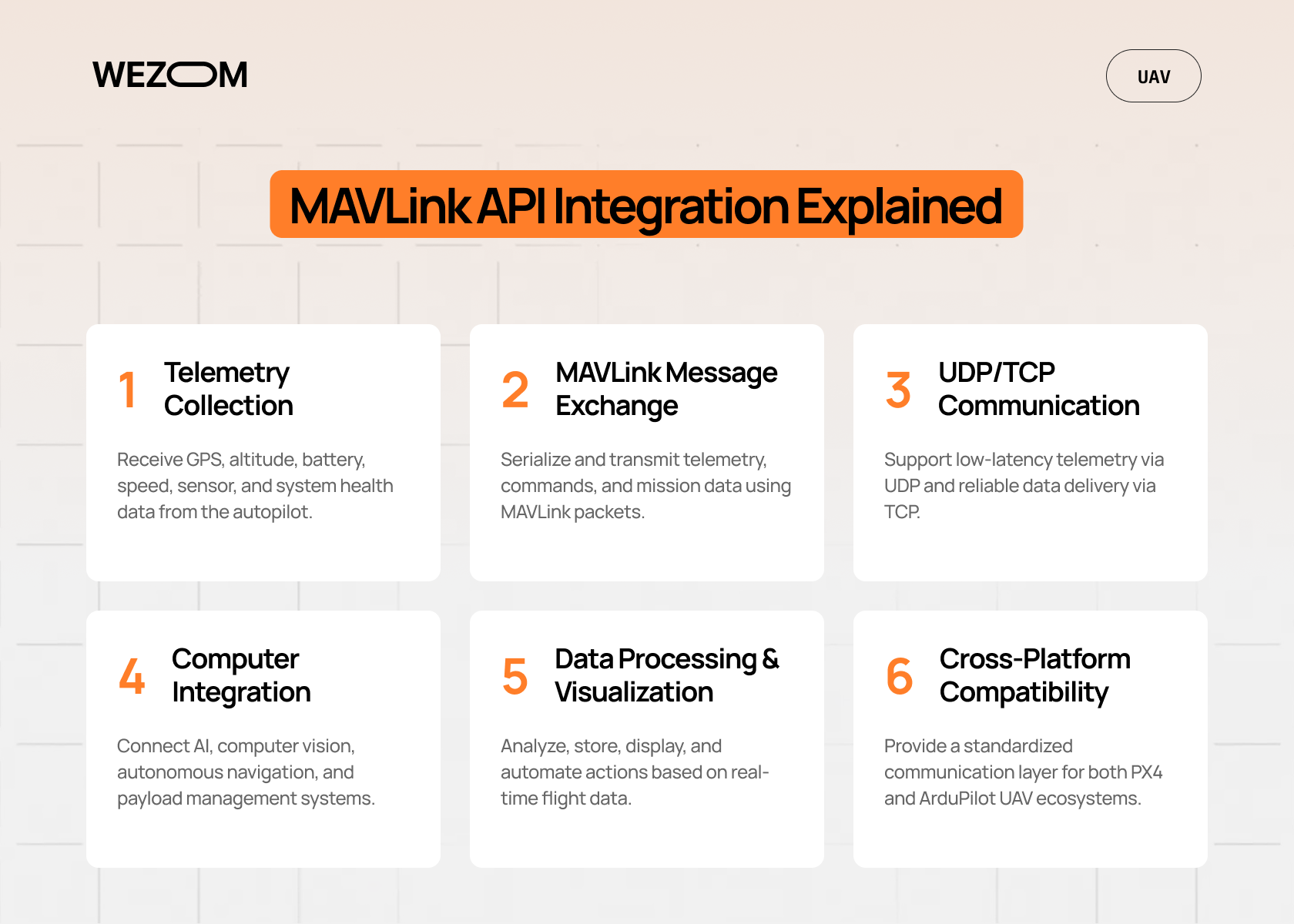
MAVLink API integration enables software applications, companion computers, Ground Control Stations, and cloud platforms to communicate with drones using the MAVLink protocol. In modern UAV systems, it serves as the foundation for telemetry exchange, command delivery, mission management, and vehicle monitoring.
A typical mavlink api integration begins with telemetry collection from the autopilot. Flight data, such as position, altitude, battery status, speed, sensor readings, and system health, is packaged into MAVLink messages and transmitted to connected systems. These messages can then be processed, visualized, stored, or used to trigger automated actions.
Communication is usually handled through UDP or TCP transport. UDP is commonly preferred for real-time telemetry because it offers lower latency, while TCP may be used when reliable message delivery is more important than speed.
MAVLink also plays a key role in communication between the autopilot and companion computers. Onboard applications responsible for computer vision, AI processing, payload management, or autonomous navigation use MAVLink messages to exchange commands and telemetry with the flight controller.
A typical telemetry pipeline includes:
- Telemetry generation by the autopilot.
- Message serialization into MAVLink packets;
- Transmission through UDP, TCP, radio, or cellular networks;
- Processing by applications or middleware services;
- Visualization, storage, or automation workflows.
When designing MAVLink telemetry integration, developers must consider factors such as bandwidth usage, latency, message reliability, synchronization, and scalability. Poorly designed communication pipelines can lead to delayed telemetry, packet loss, and reduced operational visibility.
Because MAVLink is supported by both PX4 and ArduPilot, it provides a standardized communication layer that simplifies integration across different UAV platforms. For organizations building custom drone software, fleet management systems, or enterprise UAV infrastructure, MAVLink API integration offers the flexibility needed to support complex telemetry and control workflows.
MAVSDK Integration for Drone App Development
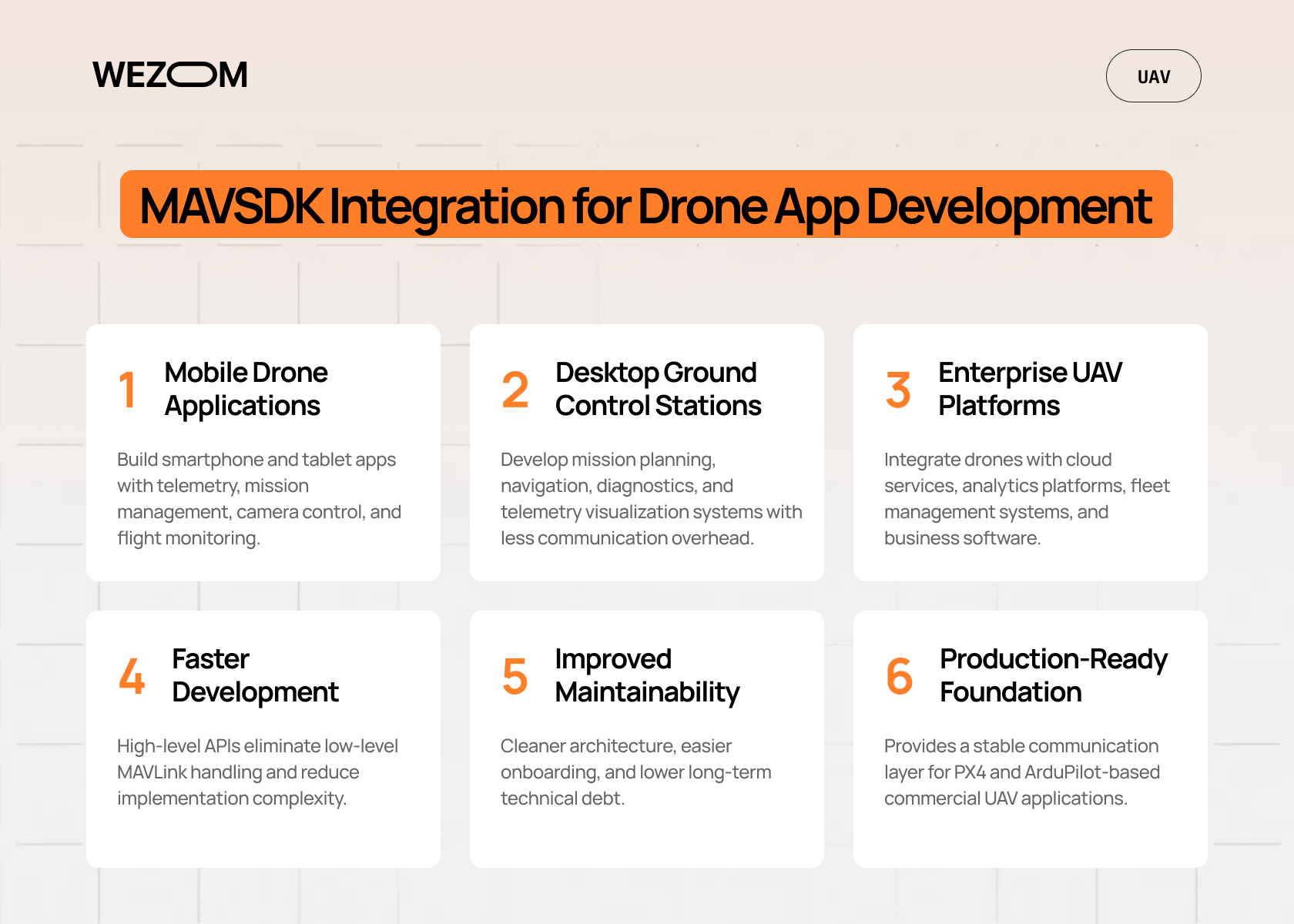
MAVSDK simplifies drone application development by abstracting MAVLink protocol complexity through high-level APIs. Developers can quickly implement telemetry monitoring, mission management, and flight control features without handling low-level communication. This results in faster development, easier maintenance, and a shorter learning curve for engineering teams.
Mobile Drone Applications
Mobile applications have become an increasingly important part of commercial drone operations. Field technicians, inspectors, pilots, and maintenance personnel often rely on smartphones and tablets as primary operational interfaces.
Developing these applications directly against MAVLink can introduce unnecessary complexity. Mobile teams typically prioritize user experience, connectivity management, and operational workflows rather than protocol engineering.
MAVSDK simplifies access to core capabilities such as:
- Vehicle discovery;
- Telemetry streaming;
- Mission upload;
- Flight status monitoring;
- Camera control;
- Payload interaction.
This allows developers to deliver functional applications more quickly while maintaining compatibility with PX4 and ArduPilot platforms.
Desktop Ground Control Systems
Ground Control Stations remain one of the most common drone software categories. These systems support mission planning, flight monitoring, navigation management, diagnostics, and operational oversight.
Modern GCS platforms must process substantial volumes of telemetry while maintaining responsive interfaces and reliable communication channels.
MAVSDK provides a practical foundation for desktop applications because it handles many communication tasks automatically. Instead of manually implementing packet parsing and synchronization logic, developers can focus on mission workflows, mapping interfaces, telemetry visualization, and operator experience.
This approach significantly reduces development effort while maintaining access to critical drone functionality.
Enterprise Drone Platforms
Enterprise UAV deployments typically introduce far greater architectural complexity than standalone applications.
Organizations operating inspection drones, delivery drones, mapping platforms, or fleet management systems often require integrations with cloud infrastructure, business systems, analytics engines, and operational dashboards.
Inspection drones may stream telemetry alongside computer vision results. Delivery drones often require integration with logistics software and routing engines. Mapping platforms process large datasets while coordinating autonomous missions across multiple vehicles. Fleet management systems monitor hundreds or thousands of aircraft simultaneously.
In these environments, MAVSDK drone app development accelerates delivery by providing a stable communication layer that abstracts protocol complexity while preserving access to essential telemetry and control functionality.
Because enterprise environments frequently evolve, maintainability becomes just as important as functionality. High-level SDK architectures generally reduce technical debt and simplify future enhancements compared to low-level protocol implementations.
For many commercial UAV products, MAVSDK therefore represents the most efficient path from concept to production deployment.
When to Use PyMAVLink Development Services
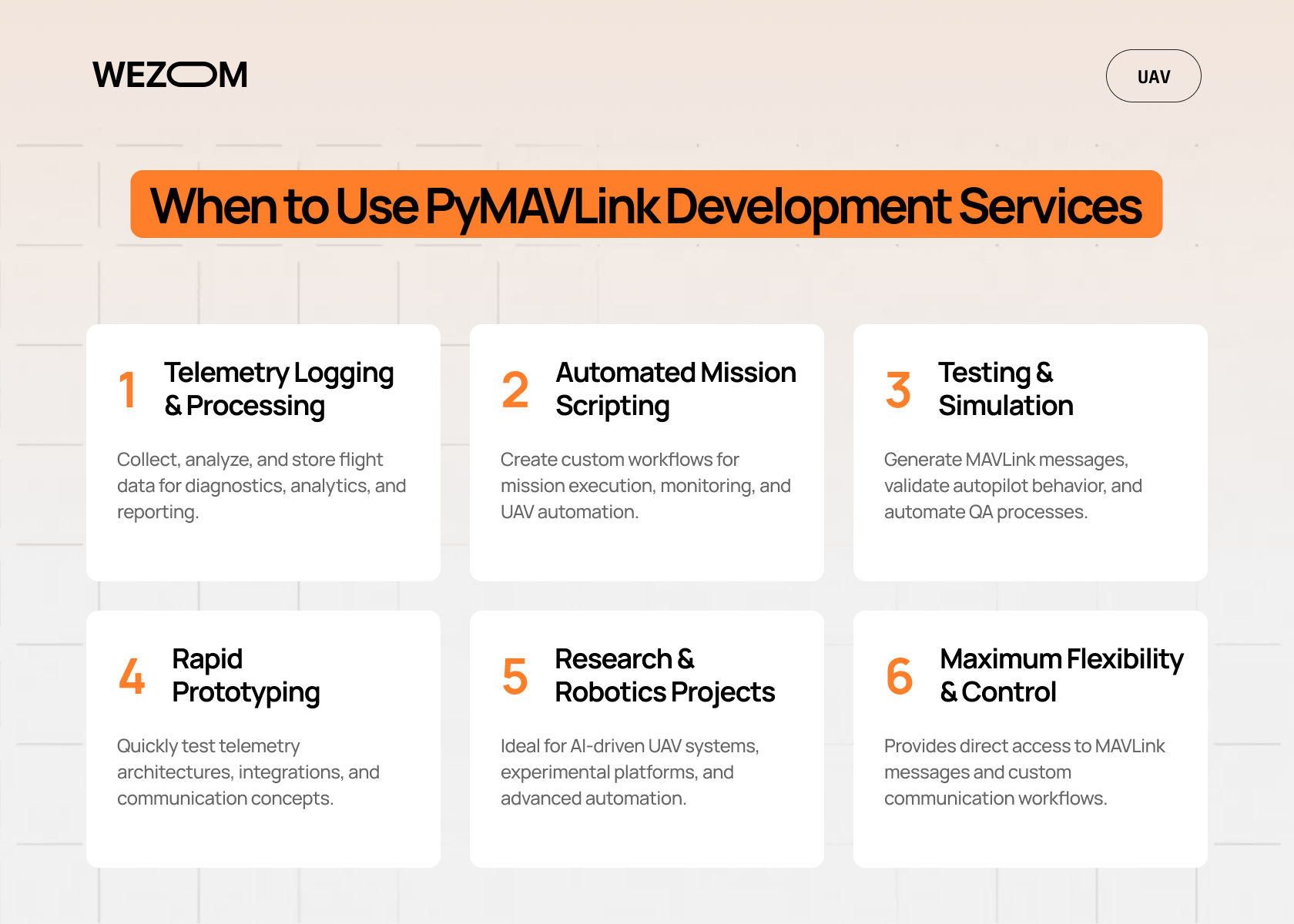
PyMAVLink is best suited for projects that require direct access to MAVLink messages and greater control over communication workflows. Unlike MAVSDK, which provides high-level APIs, PyMAVLink allows developers to work directly with telemetry data, commands, and protocol messages using Python.
One of the most common use cases is telemetry logging. Organizations can collect and process flight data for diagnostics, analytics, maintenance planning, or compliance reporting. PyMAVLink is also widely used for automated mission scripting, enabling developers to create workflows for mission execution, vehicle monitoring, and autonomous testing.
Another important application is building testing frameworks and simulation environments. Engineers can generate custom MAVLink messages, validate autopilot responses, and automate system verification processes. This makes PyMAVLink valuable during software development and quality assurance stages.
Because it is based on Python, the framework is also popular for rapid prototyping. Development teams can quickly test telemetry architectures, communication concepts, and integrations before implementing production-ready solutions. In research and robotics environments, PyMAVLink is frequently used for experimental UAV projects, AI-driven systems, and custom automation workflows.
Typical PyMAVLink development service projects include:
- telemetry logging and processing;
- automated mission scripting;
- testing and simulation frameworks;
- rapid prototyping;
- research and robotics applications.
While PyMAVLink requires a deeper understanding of MAVLink and communication protocols than MAVSDK, it provides significantly greater flexibility. For organizations that need direct protocol access, custom telemetry workflows, or advanced automation capabilities, PyMAVLink remains one of the most powerful tools within the MAVLink ecosystem.
MAVLink GCS Development Considerations
Ground Control Stations (GCS) are a critical component of drone ecosystems, providing operators with real-time access to telemetry, mission management tools, and flight controls. Successful MAVLink GCS development requires a balance between reliable communication, responsive interfaces, and scalable architecture.
One of the primary considerations is telemetry visualization. Operators need accurate information about vehicle position, battery status, flight mode, sensor data, and mission progress to make informed decisions during operations. Reliable telemetry processing and real-time updates are therefore essential.
Mission planning is another core capability. A GCS typically allows users to create and modify waypoint missions, monitor execution, and manage payload-related tasks. These functions depend on stable MAVLink communication between the software and the autopilot.
Developers must also account for data reliability and network conditions. Telemetry can be transmitted through radio, cellular, or internet-based connections, making packet loss, latency, and temporary disconnections unavoidable. Effective systems include buffering, reconnection mechanisms, and error handling to maintain operational stability.
Key areas of focus in MAVLink GCS development include:
- telemetry monitoring and visualization;
- mission planning and execution;
- real-time communication;
- data reliability and synchronization;
- event logging and diagnostics.
As drone fleets grow, scalability becomes increasingly important. Enterprise Ground Control Stations often integrate with cloud platforms, analytics systems, and fleet management tools, requiring an architecture that can support multiple vehicles and large volumes of telemetry data. A well-designed GCS ensures reliable communication, operational visibility, and efficient mission management across the entire UAV ecosystem.
Performance Comparison: MAVLink vs MAVSDK vs PyMAVLink
Performance evaluation should extend beyond raw communication speed. Development efficiency, scalability, maintainability, flexibility, and operational complexity all contribute to the overall success of a drone software project.
| Criteria | MAVLink | MAVSDK | PyMAVLink |
|---|---|---|---|
| Development Speed | Moderate. Requires manual handling of messages, serialization, and communication logic. | High. Ready-made APIs significantly accelerate development. | Moderate. Faster than raw MAVLink but requires protocol knowledge. |
| Latency | Lowest possible latency due to direct protocol access. | Slightly higher because of SDK abstraction layers. | Low latency with direct access to MAVLink messages. |
| Flexibility | Very high. Full control over messages, telemetry, and custom workflows. | Medium. Limited to SDK-supported functionality. | Very high. Direct protocol access with Python-based customization. |
| Scalability | Excellent for custom enterprise telemetry infrastructure and middleware. | High for mobile apps, GCS platforms, and commercial UAV software. | Good, but large-scale deployments may require additional engineering effort. |
| Maintenance Complexity | High. Requires deep MAVLink expertise and ongoing protocol management. | Low. Cleaner codebase and easier long-term maintenance. | Medium. Simpler than raw MAVLink but still requires protocol understanding. |
| Language Support | Protocol specification can be implemented in multiple languages. | Multi-language support (C++, Python, Java, Swift, etc.). | Python only. |
| Best Use Cases | Custom telemetry infrastructure, middleware, and protocol-level integrations. | Mobile apps, Ground Control Stations, fleet management platforms. | Automation, testing, telemetry logging, and research projects. |
| Learning Curve | High. Requires understanding of MAVLink internals. | Low to moderate. Designed for faster onboarding. | Moderate to high. Requires both Python and MAVLink knowledge. |
In practice, MAVSDK is usually the best choice for commercial application development, MAVLink is preferred for highly customized communication architectures, and PyMAVLink is ideal for automation, testing, and research-focused UAV projects.
Decision Framework: Which Option Should You Choose?
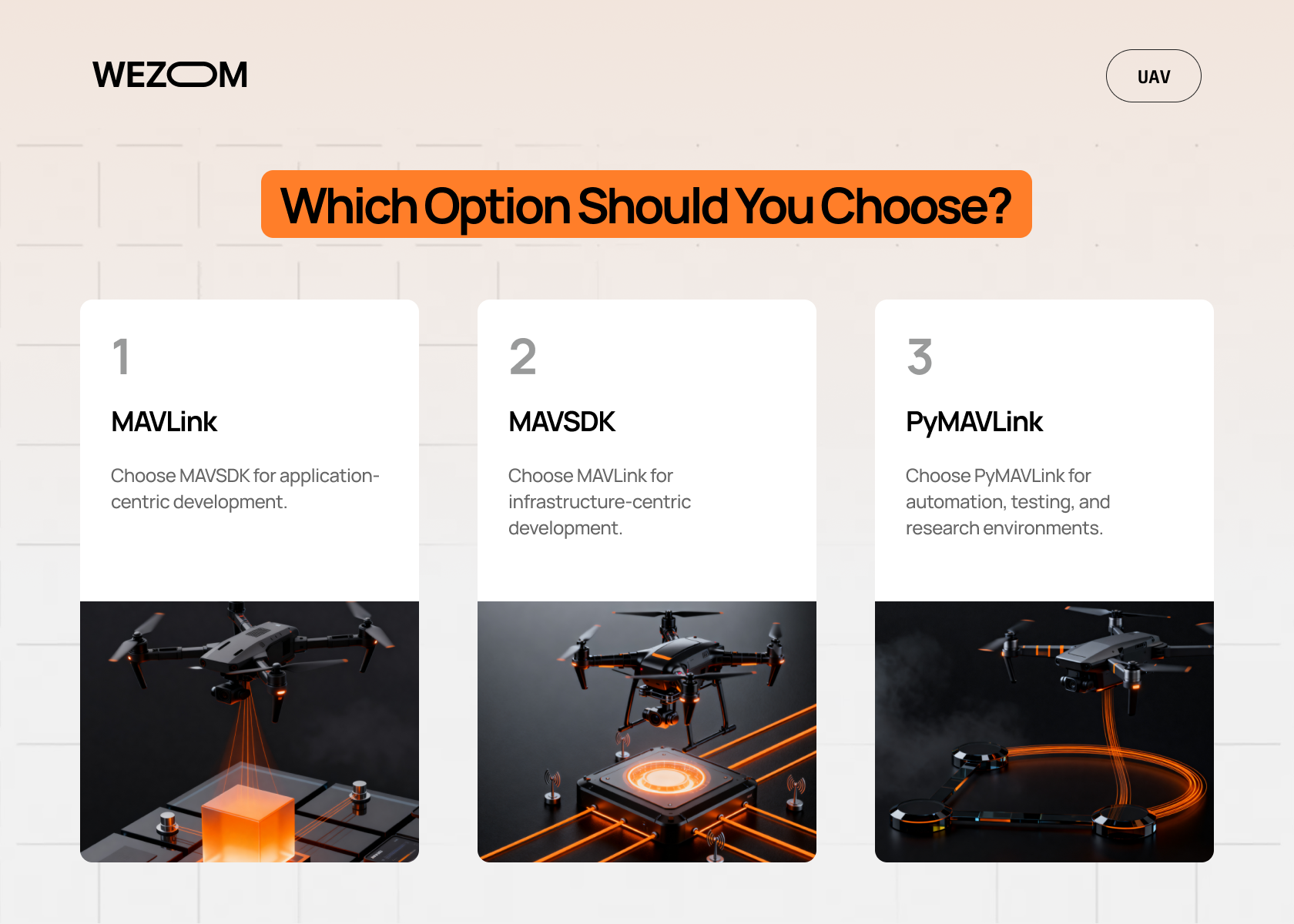
Selecting between MAVLink, MAVSDK, and PyMAVLink should be based on project objectives rather than technical preferences.
If the goal is building mobile applications, desktop interfaces, fleet management tools, or enterprise drone software with rapid delivery timelines, MAVSDK integration is usually the most practical choice. The SDK reduces complexity while providing access to the capabilities required by most commercial products.
If the project involves custom telemetry architectures, advanced middleware, proprietary communication systems, or specialized protocol workflows, direct mavlink api integration often delivers greater flexibility and long-term control.
For organizations focused on automation, testing, telemetry analysis, research, robotics experimentation, or rapid scripting, a PyMAVLink development service typically offers the best balance between flexibility and development speed.
As a general guideline:
- Choose MAVSDK for application-centric development.
- Choose MAVLink for infrastructure-centric development.
- Choose PyMAVLink for automation, testing, and research environments.
Many mature drone platforms ultimately combine all three technologies. MAVLink may serve as the communication backbone, MAVSDK may power user-facing applications, and PyMAVLink may support automation workflows and diagnostic tooling.
The most effective architecture is often not an either-or decision but a layered approach that leverages the strengths of each technology where appropriate.
Common Mistakes in Drone Telemetry Integration
Many drone projects encounter communication issues because telemetry architecture is treated as a secondary concern. One common mistake is choosing the wrong abstraction level. Some teams use direct MAVLink implementations for simple applications, while others rely on high-level SDKs when low-level protocol access is actually required.
Another frequent problem is overengineering telemetry pipelines. Adding unnecessary middleware layers, message transformations, or complex routing logic can increase latency, complicate troubleshooting, and reduce system reliability.
Developers also often overlook MAVLink limitations. While the protocol is highly efficient for telemetry and command exchange, it is not designed for high-bandwidth data such as video streaming or large file transfers. These workloads typically require additional communication technologies.
Bandwidth optimization is equally important. Excessive telemetry rates, unnecessary message subscriptions, and poorly configured communication channels can overload networks and reduce performance, especially in cellular or radio-based deployments.
Finally, many systems lack proper retry and reconnection mechanisms. Temporary packet loss and network interruptions are common in UAV operations, making robust recovery logic essential for maintaining reliable communication.
Avoiding these mistakes helps create telemetry systems that are more scalable, resilient, and easier to maintain over time.

FAQ
What is MAVLink used for in drone systems?
MAVLink is used as a communication protocol that enables telemetry exchange, command transmission, mission management, diagnostics, and system monitoring between drones, Ground Control Stations, companion computers, and cloud infrastructure. It serves as the primary communication layer for many PX4 and ArduPilot-based UAV platforms.
How does MAVSDK simplify drone app development?
MAVSDK provides a higher-level API that abstracts MAVLink message handling and communication complexity. Developers can implement telemetry subscriptions, mission execution, navigation workflows, and flight control features without manually processing protocol messages, significantly accelerating development and reducing maintenance effort.
What is PyMAVLink primarily used for?
PyMAVLink is primarily used for automation, telemetry logging, mission scripting, testing frameworks, research projects, and custom protocol integrations. It provides direct access to MAVLink messages through Python, making it particularly useful for robotics teams, autonomous systems developers, and experimental UAV environments.
When should developers choose MAVSDK instead of MAVLink?
Developers should choose MAVSDK when building mobile applications, desktop software, fleet management platforms, or enterprise UAV solutions that prioritize development speed and maintainability. MAVSDK is especially valuable when direct protocol customization is not required, and rapid delivery is a primary objective.
Is MAVLink suitable for enterprise drone telemetry integration?
Yes. MAVLink is widely used for enterprise-grade telemetry systems because it is lightweight, efficient, and compatible with major autopilot platforms. When combined with scalable infrastructure, monitoring capabilities, and reliable networking architecture, MAVLink can support inspection fleets, delivery operations, mapping platforms, and large-scale autonomous UAV deployments.
