
Embedded Linux Architecture for Scalable Smart Devices
Modern smart devices are expected to process data locally, communicate with cloud platforms, support remote updates, and scale from prototype deployments to large production environments. To meet these requirements, many manufacturers rely on Linux for embedded systems due to its flexibility, stability, and broad hardware support.
A typical Linux embedded system uses a layered architecture that separates hardware-specific functionality from application logic. This approach simplifies maintenance, improves portability, and allows developers to introduce new features without redesigning the entire software stack. As devices evolve, a well-structured architecture becomes essential for managing growing software complexity.
One of the core principles of embedded Linux system design and development is the separation between kernel space and user space. The kernel manages hardware resources, process scheduling, memory allocation, and security controls, while user-space applications handle business logic and device functionality. This separation improves reliability because application failures are less likely to affect the entire system.
Several architectural components form the foundation of modern embedded Linux platforms:
- Kernel – manages hardware resources, memory, processes, and system security.
- Device drivers – provide communication between hardware components and software applications.
- Bootloader – initializes hardware and loads the operating system during startup.
- File system – stores applications, configurations, logs, and persistent data.
- Middleware – enables communication between hardware interfaces and application services.
The startup sequence typically begins with a bootloader that performs hardware initialization and loads the Linux kernel into memory. In many embedded Linux development projects, the bootloader also supports secure boot, recovery procedures, and firmware rollback mechanisms to improve device reliability and security.
Memory management is another critical consideration. Unlike desktop systems, embedded devices often operate with limited RAM and storage resources. Efficient allocation strategies help maintain performance while preventing resource exhaustion. For industrial automation, IoT, and edge computing scenarios, developers may also need deterministic behavior, which can be achieved through real-time kernel enhancements.
By combining hardware abstraction, modular design, efficient resource management, and strong scalability foundations, Linux embedded software development provides a reliable platform for building modern smart devices that can evolve with changing business and technology requirements.
Design Principles for Embedded Linux Systems
Successful embedded Linux development requires more than selecting an operating system. Long-term product stability, scalability, and maintainability depend on architectural decisions made early in the development process.
A modular software architecture is one of the most important design principles. Separating functionality into independent components simplifies updates, testing, and future feature expansion. This approach also supports product families where multiple device versions share a common software foundation.
Scalability should be considered from the start. Many products begin as prototypes but later grow into large deployments with thousands of connected devices. A scalable architecture helps accommodate increased workloads, cloud integrations, and new functionality without major redesigns.
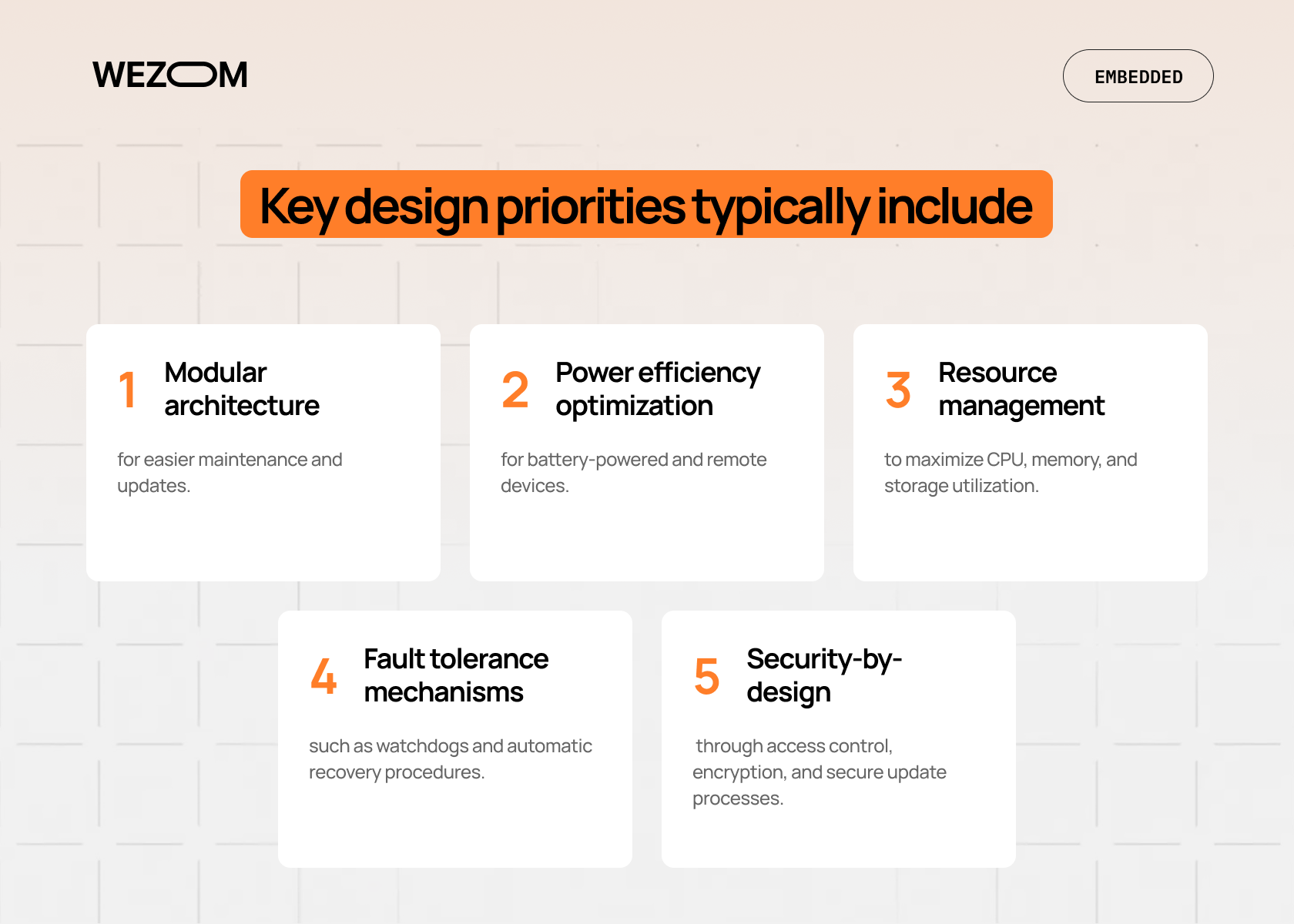
Key design priorities typically include:
- Modular architecture for easier maintenance and updates.
- Power efficiency optimization for battery-powered and remote devices.
- Resource management to maximize CPU, memory, and storage utilization.
- Fault tolerance mechanisms, such as watchdogs and automatic recovery procedures.
- Security-by-design through access control, encryption, and secure update processes.
Reliability is especially important for industrial, healthcare, and IoT environments where devices may operate continuously for years. Engineering teams must ensure systems can recover from failures and continue functioning under changing conditions.
By focusing on scalability, efficiency, reliability, and security from the beginning, organizations can build embedded Linux platforms that remain maintainable and adaptable throughout the entire product lifecycle.
Embedded Linux Software Development Workflow
Effective embedded Linux development follows a structured process that aligns hardware capabilities with software requirements. Since embedded devices combine tightly integrated hardware and software components, development must address both areas simultaneously.
The process begins with defining business, technical, and hardware requirements. Based on these requirements, engineers select the hardware platform and prepare the software environment. A Board Support Package (BSP) is then created or customized to connect the operating system with the target hardware.
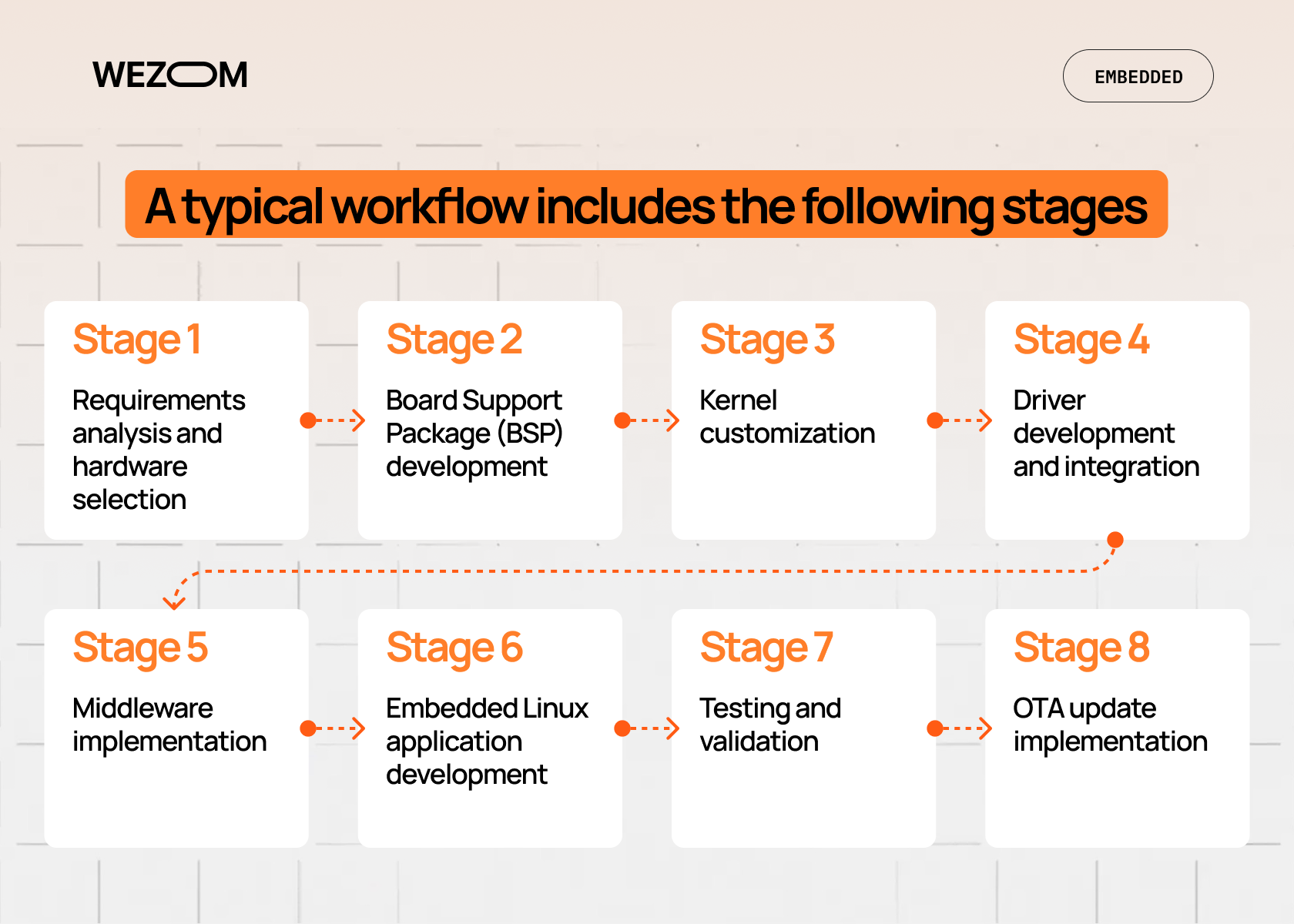
A typical workflow includes the following stages:
- Requirements analysis and hardware selection – defining performance, connectivity, security, and environmental requirements.
- Board Support Package (BSP) development – configuring hardware initialization and low-level system support.
- Kernel customization – enabling required features, removing unnecessary components, and optimizing resource usage.
- Driver development and integration – ensuring communication between the operating system and hardware peripherals.
- Middleware implementation – managing connectivity, data exchange, and protocol integration.
- Embedded Linux application development – building business logic and user-facing functionality.
- Testing and validation – performing functional, integration, performance, and security testing.
- OTA update implementation – enabling remote software updates, rollback mechanisms, and lifecycle maintenance.
Throughout the project, testing and validation remain critical for ensuring stability and reliability. Modern embedded Linux platforms also require a well-designed OTA update strategy, allowing organizations to deploy security patches, bug fixes, and new features without physical access to devices. This structured approach helps reduce development risks while accelerating time-to-market.
Linux Embedded Software Development Tools and Ecosystem
The maturity of the Linux ecosystem is one of its strongest advantages for embedded device manufacturers. A wide range of tools supports every stage of development, from system creation and debugging to deployment and lifecycle management.
Build systems form the foundation of the development environment. Solutions such as Yocto Project and Buildroot allow engineers to create highly customized Linux distributions tailored to specific hardware platforms and application requirements. These frameworks simplify dependency management, package integration, system configuration, and reproducible builds. They also help organizations maintain consistency across development, testing, and production environments.
Debugging tools play a crucial role in identifying performance bottlenecks and stability issues. Engineers frequently rely on tools such as GDB for application debugging, strace for system call tracing, and perf for performance analysis. Together, these tools provide visibility into system behavior and support root-cause investigation when issues arise.
Modern embedded Linux development tools also integrate closely with software engineering best practices. Version control systems such as Git enable collaborative development across distributed teams while maintaining traceability and change management. Continuous Integration and Continuous Deployment pipelines automate build verification, testing procedures, and release preparation, reducing manual effort and improving software quality.
Emulators and hardware simulators further accelerate development by allowing teams to validate software before physical hardware becomes available. This capability shortens development timelines, improves parallelization across teams, and reduces overall project risk.
Performance Optimization Techniques for Embedded Linux Devices
Performance optimization is an essential part of embedded Linux software development, ensuring that devices remain responsive, efficient, and capable of supporting future requirements. As smart devices handle increasing workloads, engineering teams must continuously monitor and improve system performance across hardware and software layers.
Optimization typically begins with system analysis. Developers evaluate CPU utilization, memory consumption, storage operations, and network performance to identify bottlenecks. Profiling and debugging tools help pinpoint areas where resources are being used inefficiently.
Several optimization areas have the greatest impact on device performance:
- System-level optimization – tuning kernel settings, drivers, and background services.
- Application optimization – improving code efficiency and reducing unnecessary resource usage.
- System integration optimization – minimizing latency between devices, cloud platforms, and external systems.
- Firmware and OTA improvements – delivering performance enhancements and fixes through remote updates.
- Long-term monitoring – tracking system health and performance throughout the product lifecycle.
Many organizations use custom embedded Linux development services to optimize performance across the entire software stack rather than focusing solely on applications. This approach helps uncover bottlenecks in drivers, networking components, middleware, and operating system configurations.
Performance optimization should also support future scalability. A device that performs well during pilot deployment may encounter new challenges as workloads increase and additional integrations are introduced. By continuously optimizing resource utilization and system behavior, organizations can extend device lifespan, improve user experience, and maintain reliable operation as products evolve.
Optimization and Scalability Strategies in Embedded Linux Systems
Scalability is one of the key advantages of a Linux embedded system, but achieving it requires deliberate optimization at both the operating system and application levels. As devices process more data, support additional features, and connect to larger infrastructures, efficient resource management becomes increasingly important.
One of the first optimization areas is boot time. Faster startup improves user experience and is often critical for industrial, automotive, and IoT devices. Engineers typically reduce boot times by disabling unnecessary services, optimizing initialization sequences, and streamlining startup processes.
Several strategies help improve scalability and overall system efficiency:
- Boot time optimization – reducing startup delays and unnecessary initialization tasks.
- Memory footprint reduction – removing unused components and optimizing memory allocation.
- CPU utilization optimization – improving task scheduling and minimizing processing overhead.
- Storage optimization – reducing write operations and extending flash memory lifespan.
- Network stack tuning – improving communication efficiency and throughput.
- Latency reduction – optimizing system responsiveness for near real-time applications.
Memory and CPU optimization are particularly important in resource-constrained environments. Efficient resource allocation helps maintain stable performance while leaving room for future software enhancements. Likewise, storage optimization helps preserve flash-based media, which can degrade over time due to excessive write operations.
For connected products, network performance also plays a major role. Proper tuning of communication protocols and connection handling mechanisms can significantly improve data transmission efficiency and device reliability.
By combining these optimization techniques, organizations can build scalable embedded Linux platforms capable of supporting growing workloads, expanding device fleets, and evolving business requirements without major architectural changes. This flexibility is one of the primary reasons businesses continue investing in embedded Linux development for modern smart devices.
Industry Use Cases of Embedded Linux Development
The flexibility, stability, and scalability of Linux have made it a popular choice across industries that rely on connected and intelligent devices. Its ability to support diverse hardware platforms, communication protocols, and deployment environments allows businesses to build solutions tailored to specific operational needs.
One of the most common applications is in smart home devices, including connected cameras, home automation hubs, energy management systems, and voice assistants. These products require secure connectivity, remote updates, and integration with cloud services, making Linux an effective platform for long-term product development.
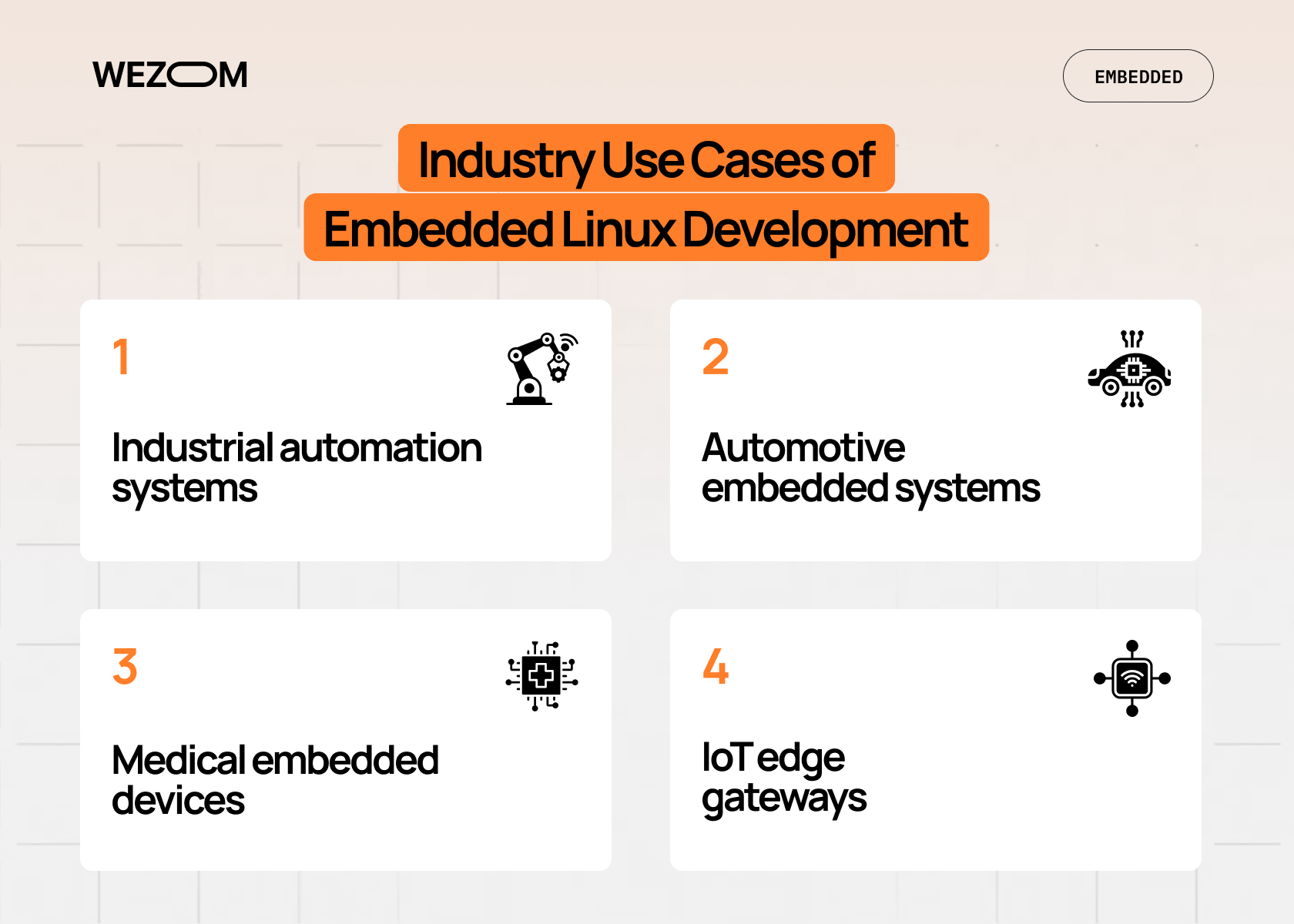
Other major use cases include:
- Industrial automation systems – machine monitoring, predictive maintenance, industrial controllers, and edge analytics platforms.
- Automotive embedded systems – infotainment platforms, telematics solutions, fleet management systems, and connected vehicle services.
- Medical embedded devices – patient monitoring equipment, diagnostic systems, and connected healthcare technologies.
- IoT edge gateways – devices that collect, process, and transmit data between field sensors and cloud infrastructure.
In industrial environments, embedded Linux supports reliable operation, advanced networking, and integration with existing manufacturing systems. Automotive companies use Linux to manage increasingly complex software ecosystems while maintaining flexibility for future feature development.
Healthcare organizations benefit from Linux-based platforms because they offer robust security controls, high reliability, and seamless integration with modern digital health solutions. Meanwhile, IoT edge gateways leverage Linux to perform local data processing, protocol conversion, and device management while reducing cloud dependency and network latency.
Across all these sectors, the primary advantage of embedded Linux software development is scalability. Organizations can start with a prototype or MVP and gradually expand functionality, connectivity, and deployment size without fundamentally changing the underlying platform. This ability to support long product lifecycles and evolving business requirements continues to drive Linux adoption across the embedded systems market.
Security Considerations in Embedded Linux Development
Security is a critical component of embedded Linux development because modern smart devices are continuously connected to networks, cloud platforms, and other systems. Without proper protection, vulnerabilities can expose sensitive data, disrupt operations, or allow unauthorized access to devices.
A strong security strategy starts with secure boot, which verifies the integrity of software components during startup and prevents unauthorized code execution. This helps ensure that only trusted firmware and operating system images are loaded onto the device.
Key security measures typically include:
- Secure boot mechanisms to protect the startup process.
- Kernel hardening to reduce attack surfaces and improve system resilience.
- Data encryption for information stored on devices and transmitted across networks.
- Access control and authentication to restrict unauthorized system access.
- Vulnerability management through regular monitoring and security updates.
Kernel hardening and encryption are especially important for devices operating in industrial, healthcare, automotive, and IoT environments where data security and system reliability are essential.
Security should not be treated as a one-time implementation task. Continuous vulnerability assessment, patch management, and secure OTA update processes help organizations address emerging threats throughout the product lifecycle. By integrating security into every stage of embedded Linux system design and development, businesses can reduce operational risks and improve the long-term reliability of their connected devices.
How Embedded Linux Development Services Accelerate Product Delivery
Developing a smart device requires much more than writing software. Teams must manage hardware integration, operating system customization, security, testing, deployment, and long-term maintenance. This complexity is one reason many organizations rely on embedded Linux development services to accelerate product delivery and reduce project risks.
Experienced engineering teams bring established workflows, proven architectures, and practical knowledge that help avoid common development challenges. Instead of building expertise internally from scratch, businesses can leverage specialists who already understand kernel customization, driver development, hardware integration, and deployment processes.
Several factors contribute to faster delivery:
- Reduced development complexity through proven engineering practices.
- Faster prototyping and MVP creation using reusable frameworks and components.
- Improved maintainability through scalable and modular architectures.
- Regulatory compliance support for industries with strict requirements.
- Access to specialized expertise across hardware, software, networking, and security.
Rapid prototyping is particularly valuable because it allows companies to validate concepts, gather feedback, and identify technical risks early in the development cycle. This helps prevent costly redesigns later.
Long-term maintainability is another important benefit. Products built on a solid architectural foundation are easier to update, scale, and support throughout their lifecycle. Development partners can also help organizations implement OTA update mechanisms, testing automation, and security best practices from the beginning.
By combining technical expertise, efficient development workflows, and industry experience, embedded Linux development services help organizations shorten time-to-market while building reliable, scalable products capable of supporting future business growth.
Choosing an Embedded Linux Development Partner
Selecting the right development partner is critical to the success of an embedded Linux project. Beyond technical skills, organizations should assess a partner’s ability to support long-term product goals, scalability, and ongoing maintenance.
Key areas to evaluate include experience with kernel customization, driver development, BSP implementation, middleware integration, and embedded Linux application development. Strong hardware integration capabilities are also important, as embedded systems require seamless interaction between software and physical components.
Security expertise should cover secure boot, encryption, vulnerability management, secure OTA updates, and security testing. Additionally, experience with large-scale deployments can help ensure long-term system stability and growth.
Post-launch support is equally important. Software updates, security patching, maintenance, and performance optimization help keep devices reliable throughout their lifecycle. A partner with both technical expertise and a solid support model can significantly improve project outcomes.
When evaluating potential partners, organizations should focus on the following areas:
| Evaluation Area | Key Questions |
|---|---|
| Technical Expertise | Can the team handle kernel, driver, BSP, and application development? |
| Hardware Integration | Do they have experience with similar devices and chipsets? |
| Security Engineering | Are secure development practices embedded into their workflow? |
| Scalability Experience | Have they supported large-scale deployments and long-term product evolution? |
| Support Model | Can they provide maintenance, updates, and lifecycle support after launch? |
The most successful partnerships are built on a combination of technical competence, transparent communication, strategic alignment, and long-term commitment. Organizations investing in embedded Linux system design and development should view partner selection as a strategic business decision rather than simply a procurement exercise.

FAQ
What is embedded Linux software development?
Embedded Linux software development involves creating software for dedicated hardware devices using Linux. It typically includes kernel customization, driver development, application creation, testing, deployment, and ongoing maintenance.
Why is Linux widely used in embedded systems?
Linux is popular in embedded systems because it offers flexibility, stability, strong security, and extensive hardware support. Its open-source ecosystem also enables cost-effective customization for different device types.
How does embedded Linux improve smart device scalability?
Linux supports modular architectures, cloud connectivity, and efficient resource management, making it easier to scale devices from prototypes to large deployments. OTA updates and edge computing capabilities further support growth.
What security measures are essential for embedded Linux devices?
Key security measures include secure boot, kernel hardening, data encryption, access control, secure OTA updates, and regular vulnerability management. These protections help reduce cyber risks throughout the device lifecycle.
What is the difference between RTOS and embedded Linux?
An RTOS is designed for deterministic real-time performance, while embedded Linux provides greater flexibility, networking capabilities, and software ecosystem support. With real-time kernel extensions, Linux can also meet many industrial real-time requirements.
