
The popularity of Edge AI is largely driven by the demand for computer vision systems capable of processing video streams directly on the device without transmitting them to the cloud. This fuels the growth of the development of embedded computer vision technologies, which are actively used in autonomous solutions based on drones, robotics, medical equipment, etc., where data transmission latency is critical.
Industries and Products Using Embedded Vision Systems
Embedded vision brings full autonomy to conventional cameras, and this can be extremely useful in the following areas:
- Industrial automation with quality control. Here, embedded vision solutions are installed on conveyors for inspection of microdefects in products in real time (thanks to the speed of tens of frames per second), simultaneously reading markings using optical character recognition and controlling robotic arms.
- Autonomous drones and robotics. In this niche, vision is used to ensure collision avoidance and safe navigation. Specifically, thanks to algorithms for simultaneous localization and mapping, as well as object detection, these devices can navigate even without GPS.
- Automotive. In smart cars, embedded vision-based cameras track the vehicle's trajectory, based on traffic regulations, taking into account road signs and markings. AI can also be used inside the car for driver's facial expressions monitoring and, if necessary, preventing drowsiness at the wheel.
- Security at physical retail locations. Smart cameras in offline stores can perform customer behavior analytics, directing them in queues and preventing theft through silhouette tracking (all without compromising customer privacy).
- Medical equipment. This primarily refers to portable ultrasound scanners and endoscopes that detect tissue abnormalities in real time, thereby assisting surgeons.
- Consumer electronics. This is one of the most extensive areas of application, encompassing both local solutions like smart doorbells and large-scale ones like smart home systems enhanced with gesture recognition algorithms.
Core Components of Embedded Vision Systems
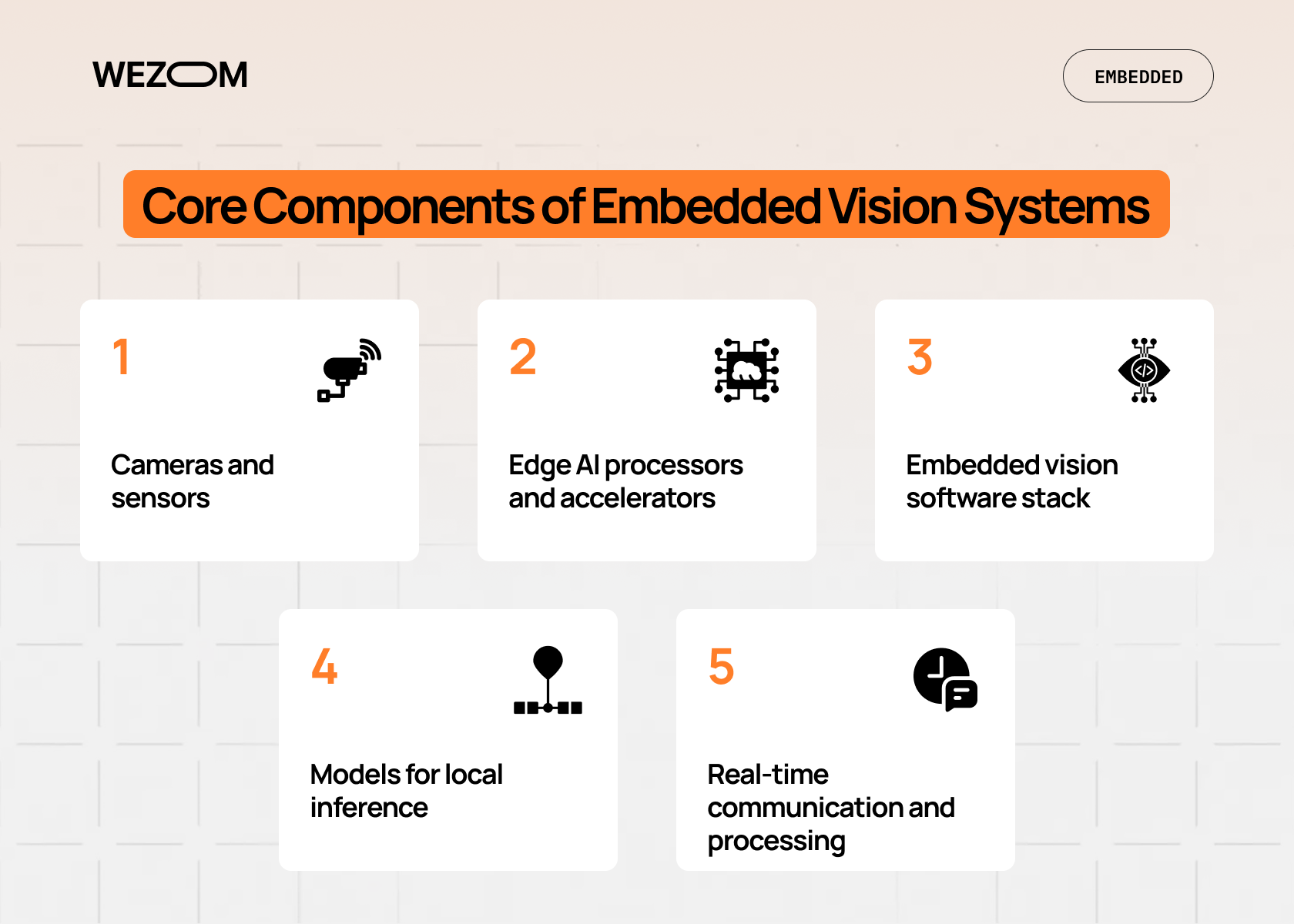
Embedded vision architecture always faces the limitations of the hardware required to efficiently execute resource-intensive AI algorithms. This applies to the following components of customized embedded vision systems:
- Cameras and sensors. Here, developers must deal with global shutter for highly dynamic scenes, as well as MIPI interfaces, which ensure minimal latency when transferring RAW files to the processor.
- Edge AI processors and accelerators. Software is typically developed for heterogeneous platforms such as NVIDIA Jetson, which boast powerful CUDA cores and tensor accelerators ideal for running heavy-duty neural networks; Qualcomm chips equipped with NPUs; Intel's Movidius Vision Processing Unit for energy-efficient systems; as well as energy-efficient ARM cores, TPUs, and configurable FPGAs that minimize latency at the hardware level.
- Embedded vision software stack. Vanilla OpenCV is only suitable for prototyping, so in production, developers must optimize pipelines with CUDA (for Nvidia GPUs), create video capture drivers, as well as integrate the ROS robotics OS for sensor coordination.
- Models for local inference. Because full-size models don't fit in chip memory, developers must compress them using quantization (from FP32 to INT8) and distillation, adapting them to, for example, TensorFlow Lite/TensorRT.
- Real-time communication and processing. Here, it's important to optimize the data bus within the SoC to prevent thermal throttling, which occurs when heavy AI workloads overheat the chip and reduce frame rates.
Embedded Vision Software Development Workflow
Unlike conventional development, development for embedded vision systems is a nonlinear process and is always bound by the performance limitations of the chip being used. Here are the stages involved.
Requirement Analysis
It all begins with an analysis of the project requirements: FPS, acceptable latency, maximum possible power consumption, and the overall budget per unit of the device, which ultimately determines the platform selection. Careful consideration is essential here, as if the chip is too weak, the model won’t be able to deliver the required FPS, while if it’s too powerful, the device will overheat and quickly drain the battery.
Dataset Collection
For edge inference, the dataset must be collected in conditions as close to real-world ones as possible. For example, if the project developers intend for a drone to fly in low-visibility conditions, training on daytime frames will result in failure. It's important to understand that, in addition to the bounding box, the markup should also include semantic segmentation and consideration of distortion/sensor noise of a specific optic.
Model Training
At this stage, you have to consider memory constraints and model compression requirements. While it's easy to train a full-fledged model on a server with powerful GPUs like the A100, you simply won't be able to fit it in a few megabytes of microcontroller flash memory. This is where the following techniques come in:
- Pruning, which removes redundant connections and weights from the neural network;
- Knowledge distillation, with lightweight network training based on the main network's predictions;
- Quantization, which converts model weights from a floating-point format to a compact one like INT8/INT4. This is achieved either through post-training quantization for fast conversion or quantization-aware training to minimize accuracy drop.
Development
Software is written in C/C++ with the hardware vendor's SDK. Developers have also to configure the video capture drivers and the signal processor itself (for primary noise filtering), as well as build the logic for sending frames from the device directly to the accelerator's memory.
Deployment and Profiling
This stage involves compiling the model for TensorRT/OpenVINO, followed by deployment on hardware. Next, profiling comes. It must include checking glass-to-glass latency, RAM/cache resource optimization, as well as testing the FPS speed stability (including peak load conditions).
Integration and Updates
Finally, the system is connected to the actuators via CAN/SPI/ROS buses, with subsequent OTA updates. Also, the project team must perform A/B testing and implement autorollback mechanisms (as a poorly updated model could make the robot/drone blind, resulting in the sudden cessation of its workload).
Benefits of Embedded Computer Vision Systems
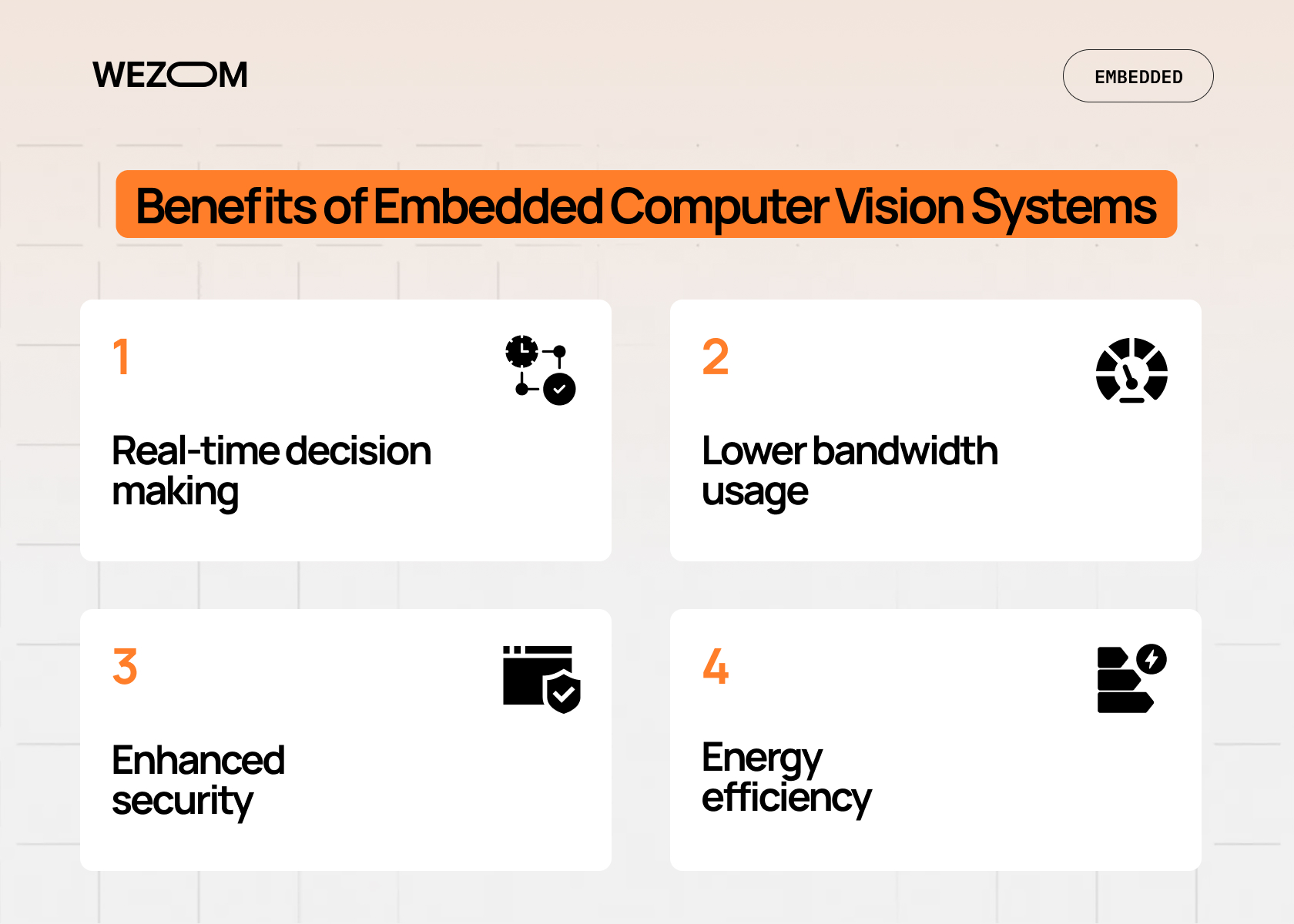
Moving computer vision from cloud data centers to the edge offers a number of advantages, including:
- Real-time decision making (to be precise, in milliseconds, which can be crucial in critical situations, such as when a person suddenly runs into the path of a drone or robot);
- Lower bandwidth usage (since cameras process the video stream onboard, sending only lightweight telemetry to the cloud);
- Enhanced security (due to the ability to anonymize faces, license plates, etc., thanks to processing within an isolated chip), which is critical for industries regulated by GDPR/HIPAA.
- Energy efficiency (as edge solutions consume only 5-15 Watts, they make it possible to deploy large-scale IoT infrastructures from thousands of such devices).
Development Challenges in Embedded Vision Projects
In addition to the advantages, developing custom software for embedded vision system also comes with a number of challenges, including:
- Hardware resource limitations, including memory bottlenecks, due to the processor's inability to load weight matrices from DRAM to SRAM;
- Thermal and power constraints, given that compact device enclosures cannot accommodate a full-fledged cooler, leading to the risk of thermal throttling;
- Synchronization issues, when the system uses multiple cameras, and frames from each arrive with different latencies (which is why developers must implement a hardware trigger at the microsecond level);
- Harsh environmental conditions, including poor visibility, low light levels, and other factors (which require the implementation of heavy-duty HDR processing algorithms, dehazing, and dynamic exposure compensation at the ISP level);
- Cybersecurity risks, including interception of access to video streams, substitution of AI with a poisoned model, and other risks, requiring the implementation of cryptographic chips such as TPM/TEE, firmware encryption, and, of course, compliance with industry security standards.
Technologies Used in Embedded Vision Software
Building software for embedded vision requires a custom stack capable of connecting high-level AI mathematics with the low-level architecture of chips.
- AI and deep learning frameworks. Here, PyTorch is the standard for training models, while for inference on edge devices, these models must be converted to the intermediate ONNX format. In terms of architectures, YOLO models from v8 and above hold the lead due to their ability to instantly detect and segment objects with minimal computational overhead.
- Edge computing platforms and acceleration. Transforming heavyweight models into fast binary code requires compilers like TensorRT (for Nvidia), which optimize weights for tensor cores. For hardware acceleration, a GPU (which handles parallel matrix calculations) and a FPGA (which handles field-programmable integrated circuits) come to the rescue, reducing latency to near zero.
- Embedded Linux and RTOS. If the device is entrusted with complex multimedia tasks, a specialized Embedded Linux (built via the Yocto Project/Buildroot) should be chosen as the OS, while GStreamer is considered the standard choice for building media pipelines. If the device runs on microcontrollers where predictable response times are important, FreeRTOS or Zephyr RTOS are worth considering.
- Sensor fusion technologies. Modern embedded vision must back up cameras with data from lidars and inertial units, and this is where data fusion algorithms (like the extended Kalman filter) are needed to compensate for low light.
- MLOps for Edge AI. This involves automated deployment and logging of inference anomalies, along with data drift monitoring (all of this should be done directly on remote IoT devices using lightweight management agents).
Custom Embedded Vision Systems vs Off-the-Shelf Solutions
So, which option of embedded vision software is better? You’ll be able to make a wise decision after checking the table below.
| Criteria | Off-the-shelf solutions | Custom solutions |
|---|---|---|
| Flexibility | Low, as vendors don’t allow changing the model logic or adding new sensors | High, as the architecture is initially created for specific business tasks and devices and can be modified over time. |
| Performance optimization | Medium, as the software is developed for average hardware | High, with code optimization for a specific SoC |
| Integration complexity | Low initially, but grows disproportionately quickly when trying to implement the solution in legacy infrastructure | Seamless integration with corporate data buses, ERP, Active Directory, and other systems |
| Scalability | Limited by licenses for each new device | The platform can be replicated across millions of IoT devices without additional costs |
| Intellectual property | Business is completely dependent on the third-party vendor's policies | 100% ownership of code and rights |
| Long-term costs | Ongoing costs for subscriptions and customization from the vendor | High initial investment, which is gradually recouped due to the company receiving an intangible asset |
How to Choose an Embedded Vision Development Partner
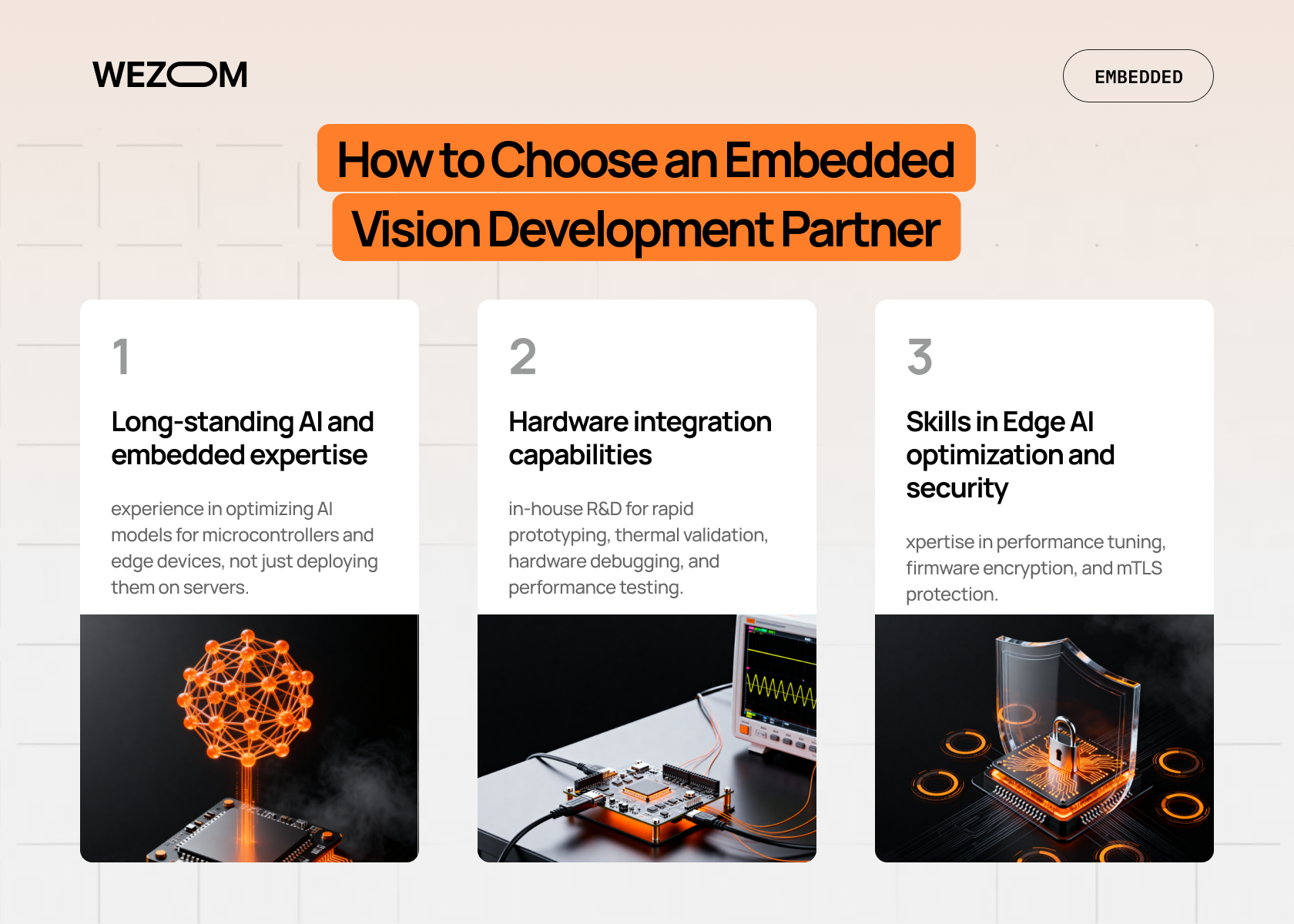
Ultimately, the success of computer vision embedded systems is determined by how effectively the mathematical algorithms interact with the hardware that runs them. That's why it's so crucial to pay attention to the following when choosing a technology partner for such projects:
- Long-standing AI and embedded expertise, meaning your contractor should clearly understand the difference between deploying a model to a server and optimizing it for a specific microcontroller (which is why specialists in C/C++, CUDA, and model compression libraries are needed);
- Hardware integration capabilities, or more precisely, an in-house research and development center for rapid thermal testing and hands-on hardware debugging (using oscilloscopes and logic analyzers) is preferred;
- Skills in Edge AI optimization and security, including the ability to address throttling issues and provide firmware encryption and mTLS for microservices.
FAQ
What industries benefit most from embedded vision systems?
These are primarily industrial automation, robotics, logistics, automotive, medicine, and smart cities.
How do embedded vision systems differ from cloud-based computer vision?
While cloud-based systems send the video stream to servers for analysis, which requires a stable internet connection (and therefore latency is inevitable), the embedded vision alternatives process the data locally, ensuring instant response and privacy.
What hardware is commonly used in embedded vision projects?
Typically, these are single-board computers and SoCs equipped with AI hardware accelerators. First of all, you should consider NVIDIA's Jetson series, Qualcomm's chips, and Intel's Movidius, as well as solutions based on neural processors from ARM or Google.
How secure are embedded vision devices?
Custom embedded machine vision software is significantly more secure than cloud-based alternatives, simply because the video stream never leaves the device. Additionally, developers can isolate containers, implement data encryption, and provide end-to-end authentication of components.
How long does custom embedded vision software development take?
For an MVP, it's typically 3-6 months, but for full-scale embedded vision applications, it all depends on the quality of the ML or AI training dataset, the complexity of the integrations and logic, and certification requirements.
Can embedded vision systems work without an internet connection?
Yes, this is possible thanks to edge inference, which ensures the devices remain operational even in underground mines and other connectivity-constrained zones.
