
What is Firmware?
Firmware is specialized software designed to control hardware-level operations within a device. It acts as the foundational layer in system architecture, enabling direct interaction with electronics such as processors, memory, and communication interfaces. Unlike general software, firmware is tightly coupled with hardware and operates under strict performance, latency, and reliability constraints.
Its primary role is to initialize and configure hardware during startup and ensure the stable execution of core functions. This often includes managing interrupts, handling low-level protocols, and controlling input/output operations. Firmware typically runs in a constrained environment with limited memory and processing power, which makes optimization and efficient compilation critical.
Firmware is stored in non-volatile memory such as ROM or Flash, allowing it to persist across reboots. Many systems rely on a bootloader to manage startup sequences and support controlled updates. However, firmware updates are less frequent compared to application-level software due to deployment risks–any failure at this stage can compromise the entire system.
Examples include BIOS or UEFI in computers, router firmware managing network interfaces, and IoT device firmware controlling sensors. In all cases, firmware ensures system stability and predictable runtime behavior, forming the backbone of reliable embedded execution.
What is Embedded Software?
Embedded software is a higher-level software layer designed to run within embedded systems, typically atop firmware or an operating system. While firmware ensures hardware control, embedded software focuses on delivering functionality, managing system logic, and enabling interaction with users or external systems.
It operates within a defined runtime environment, often using a real-time operating system or middleware. This abstraction allows developers to build scalable and maintainable solutions without directly handling hardware-level details. Embedded software communicates with firmware through defined interfaces and protocols, forming a structured software stack.
The role of embedded software is to implement features such as data processing, automation, and system integration. For example, in medical devices, it processes sensor data and supports diagnostics. In automotive systems, it enables advanced driver-assistance features. Smart appliances it provides automation and user control.
Compared to firmware, embedded software has a more flexible lifecycle. It can be updated more frequently to improve performance, add features, or fix issues. However, this flexibility introduces challenges related to integration, compatibility, and maintaining system stability across updates.
Effective embedded software development requires balancing performance, scalability, and reliability. It must operate within system constraints while ensuring seamless integration with firmware and hardware components.
Firmware vs Embedded Software: Key Differences
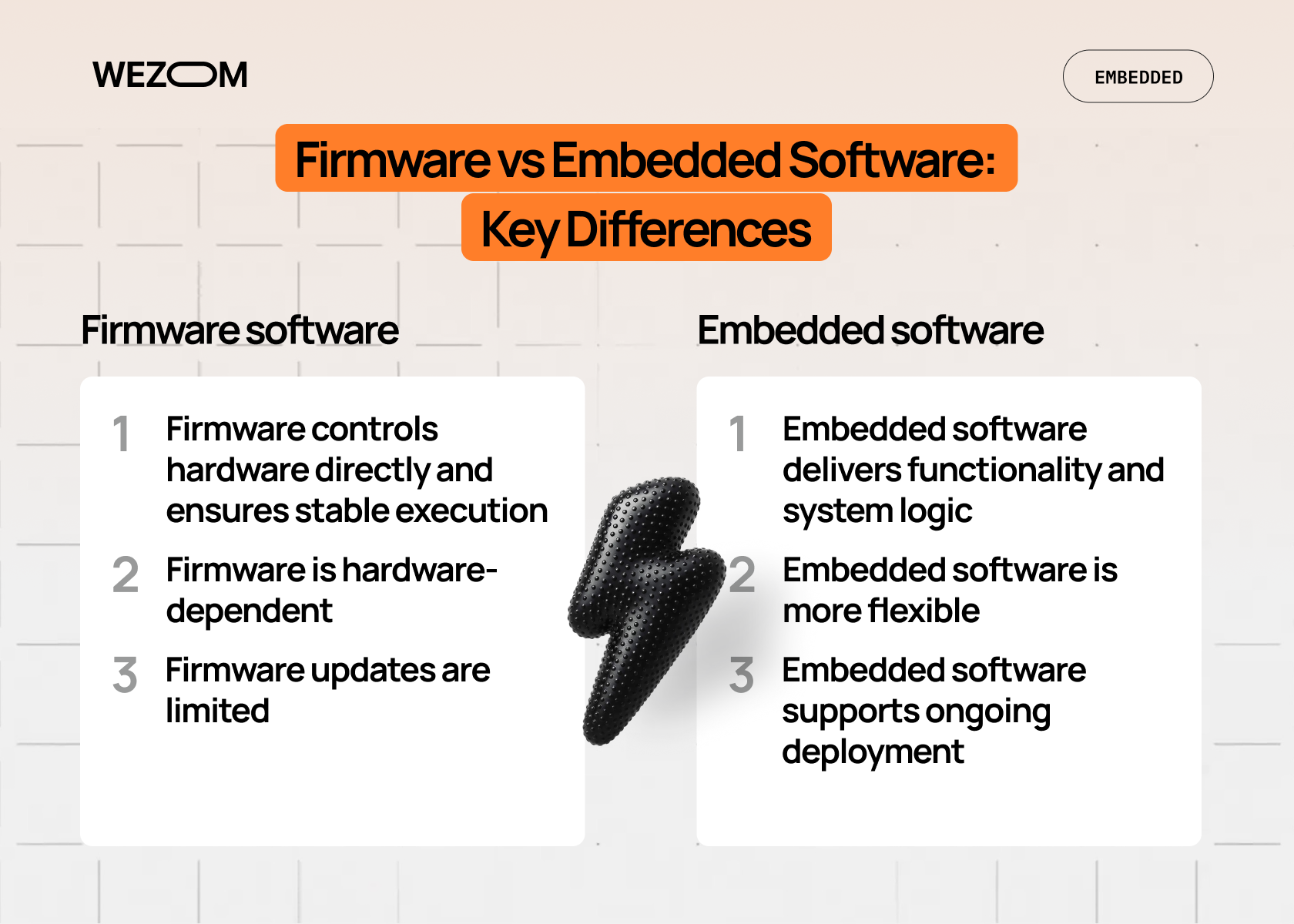
Understanding the difference between firmware and embedded software is essential for system design and development strategy. Although they are closely related, they serve distinct roles within the same environment.
The main difference lies in abstraction. Firmware operates at the hardware level, controlling execution directly and managing low-level operations. Embedded software works at a higher level, focusing on functionality and system behavior. This distinction affects development processes, performance considerations, and system architecture.
Hardware dependency is another key factor. Firmware is tightly bound to specific hardware configurations and requires significant effort to adapt across platforms. Embedded software, while still dependent on hardware, benefits from abstraction layers that improve portability and scalability.
Update frequency also differs. Firmware updates are less frequent due to higher risks during deployment, while embedded software supports iterative updates and continuous improvement. This makes embedded software more adaptable to changing business requirements.
Complexity varies in nature. Firmware development involves deep knowledge of electronics, timing constraints, and optimization. Embedded software development focuses more on architecture, integration, and managing the software stack.
In summary, firmware vs embedded software can be distinguished by:
- Firmware controls hardware directly and ensures stable execution.
- Embedded software delivers functionality and system logic.
- Firmware is hardware-dependent; embedded software is more flexible.
- Firmware updates are limited; embedded software supports ongoing deployment.
Recognizing these differences helps align development efforts and reduce risks in complex embedded systems.
Embedded Software vs Firmware: Architecture Comparison
From an architectural perspective, embedded software vs firmware is organized in a layered model that defines how systems operate and scale. Firmware forms the base layer, directly interacting with hardware, while embedded software resides above it, leveraging abstraction to deliver advanced functionality.
The hardware layer includes processors, memory, and communication interfaces. Firmware sits on top of this layer, handling initialization, configuration, and real-time control. It ensures that all components operate correctly within system constraints and provides a stable execution environment.
Above the firmware, the system may include middleware or an operating system that manages resources and runtime behavior. Embedded software operates within this layer, focusing on application logic, integration, and user-facing features. It interacts with firmware through defined interfaces, enabling separation of concerns and improved maintainability.
This layered architecture supports scalability and flexibility but also introduces dependencies. Poor integration between firmware and embedded software can lead to latency issues, reduced performance, or system instability. Therefore, clear interface design and optimization are critical.
Understanding embedded firmware vs embedded software in architecture helps organizations design systems that balance reliability with functionality, ensuring both layers contribute effectively to overall system performance.
Below is a comparison table that highlights how firmware vs embedded software differ within system architecture, focusing on execution, hardware interaction, and overall role in the software stack.
| Aspect | Firmware | Embedded Software |
|---|---|---|
| Architecture Layer | Lowest layer above hardware | Higher layer within the software stack |
| Level of Abstraction | Low-level (hardware-level control) | Higher-level (application logic and functionality) |
| Hardware Interaction | Direct interaction with electronics, registers, and interfaces | Indirect interaction via firmware or OS APIs |
| Execution Environment | Bare-metal or minimal runtime | Runs on RTOS, middleware, or embedded OS |
| System Role | Initializes hardware, manages bootloader, and ensures stability | Implements features, workflows, and system behavior |
| Dependency on Hardware | Highly hardware-dependent | Partially abstracted, more portable |
| Performance Requirements | Strict latency, deterministic execution | Balanced performance with scalability and flexibility |
| Update Frequency | Rare, high-risk deployment | Frequent updates, iterative improvements |
| Integration Complexity | Focused on hardware integration and protocol handling | Focused on system integration and user-facing functionality |
| Development Focus | Optimization, reliability, low-level control | Scalability, maintainability, and functionality |
Firmware vs Software Development Approach
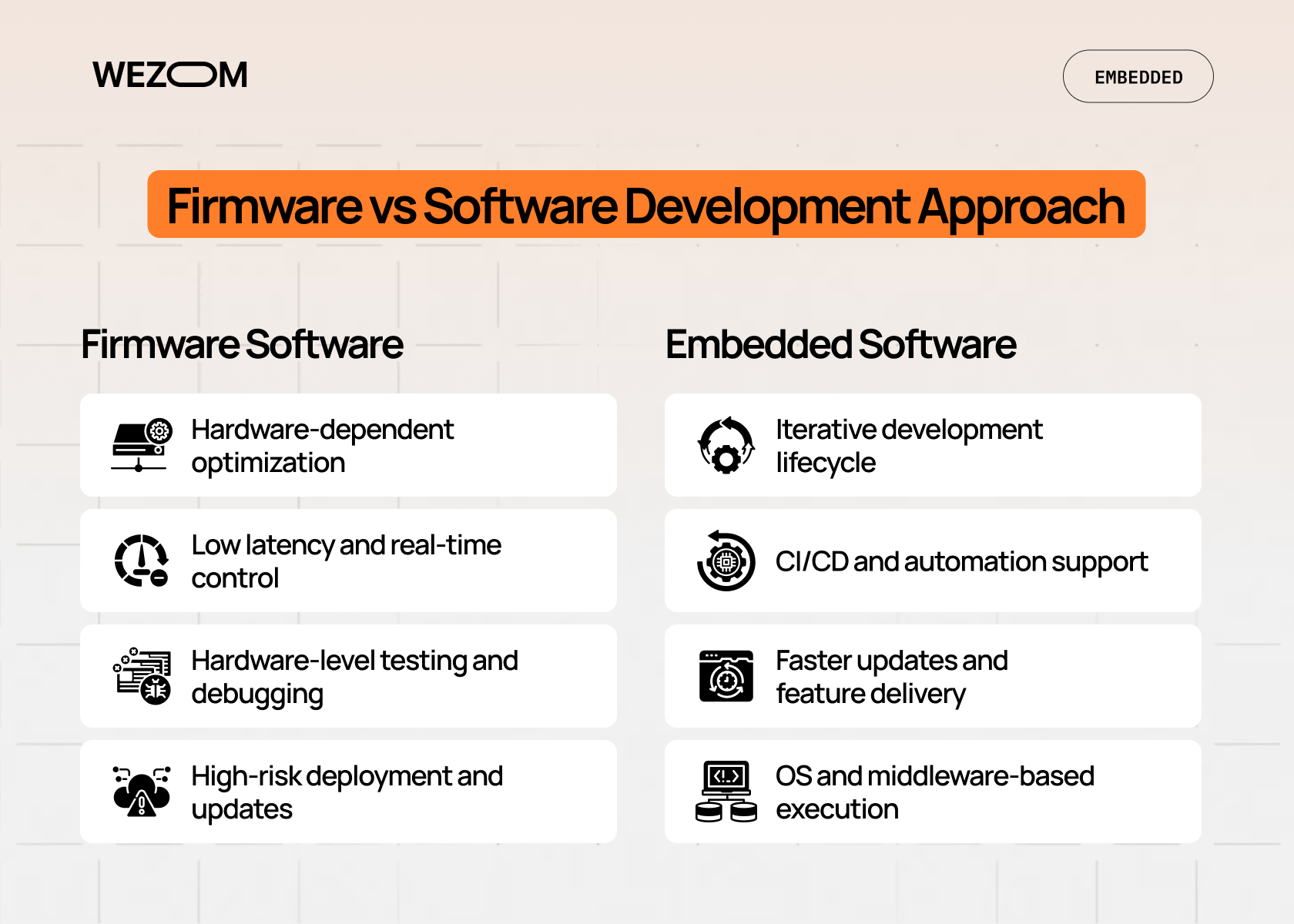
The firmware vs software development approach differs significantly in lifecycle, testing, and deployment due to the environments each operates in. Firmware development is constrained by hardware limitations, requiring precise optimization, efficient execution, and strict control over latency and performance.
Testing firmware often involves hardware-in-the-loop environments and detailed validation processes. Debugging is complex, as issues may originate from interactions between hardware and software. Deployment is also risky, requiring careful management to avoid system failures.
Embedded software development, in contrast, follows a more iterative lifecycle. It benefits from modern development tools, automation, and continuous integration practices. Updates can be deployed more frequently, enabling faster improvements and feature delivery.
Real-time requirements also differ. Firmware handles critical operations where timing is essential, while embedded software may rely on operating systems or middleware to manage execution. However, both must meet performance and reliability expectations within constrained environments.
These differences highlight the need for tailored processes and expertise when working with embedded vs firmware systems, ensuring each layer is developed and maintained effectively.
Embedded vs Firmware in Real-World Use Cases
In real-world scenarios, embedded vs firmware roles become clearer across industries. In automotive systems, firmware controls hardware components such as sensors and braking systems, ensuring real-time reliability. Embedded software enables advanced features like navigation and driver assistance, enhancing functionality.
In healthcare devices, firmware manages data collection from sensors, while embedded software processes this data for diagnostics and user interaction. Reliability and low latency are critical, as system failures can have serious consequences.
Consumer electronics rely on firmware for hardware control and embedded software for automation and user experience. Smart appliances, for example, use firmware to manage operations and embedded software to enable connectivity and advanced features.
In industrial IoT, firmware ensures stable operation in harsh environments, handling communication protocols and hardware-level execution. Embedded software supports analytics, integration, and scalability across systems.
These examples demonstrate that firmware vs embedded software are complementary. Both are required to deliver reliable, high-performance systems across different environments.
Embedded Firmware vs Embedded Software: Common Misconceptions
There are several misconceptions around embedded firmware vs embedded software that can lead to confusion in development and decision-making. One common issue is treating these terms as interchangeable, despite their distinct roles within system architecture.
In smaller systems, firmware may handle both low-level control and some application logic, which blurs the distinction. However, as systems grow in complexity, separating responsibilities becomes essential for scalability and maintainability.
Another misconception is that firmware is simpler than embedded software. In reality, firmware development involves strict constraints, hardware-level optimization, and complex troubleshooting. Ensuring reliability and stability at this level is often more challenging than higher-level development.
Industry terminology differences also contribute to confusion. Different sectors may use the same terms differently, depending on their technical context. This can create misunderstandings when teams collaborate across domains.
Clarifying these differences helps organizations avoid integration issues, align development strategies, and improve overall system performance.
Which One is More Important?
The debate around embedded software vs firmware importance is misleading, as both are essential components of a unified system. Firmware provides the foundation for hardware control, ensuring stability, reliability, and proper execution. Without it, embedded systems cannot function.
Embedded software, however, delivers the functionality and user-facing features that define product value. It enables integration, scalability, and continuous improvement through updates and new capabilities.
The importance of each depends on the system lifecycle. Early stages prioritize firmware stability, while later stages focus on embedded software enhancements. Both must be aligned to ensure optimal performance and avoid bottlenecks.
From a system-level perspective, firmware and embedded software are complementary. Effective collaboration between these layers ensures reliable, scalable, and high-performing embedded systems.
Conclusion
The difference between firmware and embedded software lies in their roles, abstraction levels, and development approaches. Firmware operates at the hardware level, providing control and stability, while embedded software focuses on functionality and system behavior within the software stack.
Understanding firmware vs embedded software is critical for designing efficient architectures and managing development processes. Both layers must be carefully integrated to ensure performance, reliability, and scalability.
For organizations building embedded systems, success depends on balancing these components, defining clear interfaces, and aligning development strategies across the system lifecycle.
FAQ
What is the difference between firmware and embedded software?
The difference between firmware and embedded software is mainly in abstraction and functionality. Firmware controls hardware directly and ensures system initialization and execution. Embedded software operates above it, implementing features and system logic. In practice, firmware ensures the device works, while embedded software defines how it works.
Is firmware a type of software or hardware?
Firmware is a type of software that operates at the hardware level. It is stored in non-volatile memory and controls physical components. Although closely tied to hardware, it is still classified as software with specific constraints related to performance, deployment, and reliability.
Can embedded software exist without firmware?
In most systems, embedded software depends on firmware for hardware initialization and control. While some environments abstract firmware through operating systems, low-level control still exists, making firmware a critical underlying component.
What is an example of firmware in everyday devices?
Examples of firmware include BIOS in computers, router firmware managing network protocols, and firmware in IoT devices controlling sensors and communication. These systems operate behind the scenes to ensure stable and reliable execution.
What devices use embedded software?
Embedded software is used in automotive systems, healthcare devices, smart appliances, and industrial IoT solutions. It enables functionality, integration, and scalability, supporting modern system requirements across various industries.
