
Every year, companies increasingly use AI to manage corporate knowledge bases. However, public APIs cannot be used for these purposes, as they pose a risk of leaking confidential information. This is where retrieval-augmented generation technology comes in, isolating everything that should be hidden from outsiders. As a company specializing in deploying fault-tolerant RAG architectures that guarantee the protection of commercial secrets, we'll explain all the nuances of their implementation.
What Is Retrieval-Augmented Generation (RAG)?
RAG is based on isolating knowledge storage from text generation. This means that instead of using new knowledge (company-owned documents) for training, a dynamic context is applied. When a user asks a question, the search engine first finds relevant information in verified sources (such as Wikipedia, public databases, GitLab, etc.) and then feeds it into an LLM as authoritative data.
This is how maximum AI accuracy is achieved, with almost 100% elimination of hallucinations, as the model no longer invents answers based on the weights acquired during training.
Why Security Matters in Enterprise RAG Systems
When you integrate AI into the workflows of a large enterprise, ensuring its secure use will be a high priority. In particular, an out-of-the-box RAG without the appropriate add-ons is a potential attack vector, as it carries the risk of data leakage when this data is transferred to third-party servers. Sending context to public cloud models can also be used for retraining, and therefore potentially deanonymizing corporate private information.
Furthermore, an employee could accidentally grant access to sensitive financial data or corporate secrets through a prompt to an AI assistant. If a RAG lacks GDPR/ISO/IEC 27001 compliance and internal security policies (if any), it will naturally not be suitable for use in a corporate environment.
Architecture of Secure RAG Systems
.png "Architecture of secure RAG pipelines with data ingestion, vector storage, retrieval, LLM inference and security layers")
The secure RAG systems we specialize in require deploying a multi-layered privacy framework consisting of:
- Data ingestion layer. This stage involves parsing internal documents through the implementation of ETL pipelines that automatically strip text of personal data and trade secrets, while breaking documents into chunks;
- Embedding and vector storage. At this stage, chunks are vectorized using local open-source embedding models, after which these vector databases are hosted either on-premises or in a private cloud, with additional encryption at rest;
- Retrieval layer. When a request is received, the system searches for similar vectors, synchronously performing a hybrid search, matching the vector index with user access rights;
- LLM inference layer. To prevent data leakage, quantized open-source models are deployed within closed Kubernetes clusters to block external traffic;
- Security layer. At this level, authentication, role-based access, TLS encryption, and audit trail are implemented for each user prompt.
How Secure RAG Works Step by Step
You must understand the operating principles of secure RAG pipelines to properly separate processes between the search engine and the model itself. The nuance is that in enterprise solutions, this is very different from public sandboxes, and here’s what we mean:
- Query processing. It all starts with the end user entering a prompt – since the system should not send it in its original form. The request must first go through normalization and tokenization, where linguistic filters clear it of potentially malicious code. And only then the cleaned request is passed to the local embedding model, which converts it into a vector.
- Authentication/authorization checks. Along with the vector creation, the system makes a request to the access control module to make sure that the user is authorized in the system and to determine their specific work group.
- Context retrieval. Now, the search engine makes a request to the isolated vector database. The search for relevant documents by cosine similarity occurs using a pre-filtering mechanism, when the vector database matches the query vector only with those chunks whose metadata corresponds to the access rights of a specific user. That is, if, say, an intern is looking for information on the architecture of a project, the system at the database level won’t see chunks with the top-secret-finance tag.
- Sensitive data filtering. Once relevant text blocks are found, they go to a context validation layer based on the data loss prevention system, which scans them for sensitive information such as PII or password hashes. If found, the system automatically masks these elements before sending them to the model.
- Response generation. This is the final stage at which the prompt assembly is formed, consisting of a system instruction, a cleared user request, and a filtered context. All this is transmitted to the local inference server, where the model compiles a response, which is encrypted and, finally, sent to the user.
Key Security Mechanisms in RAG Systems
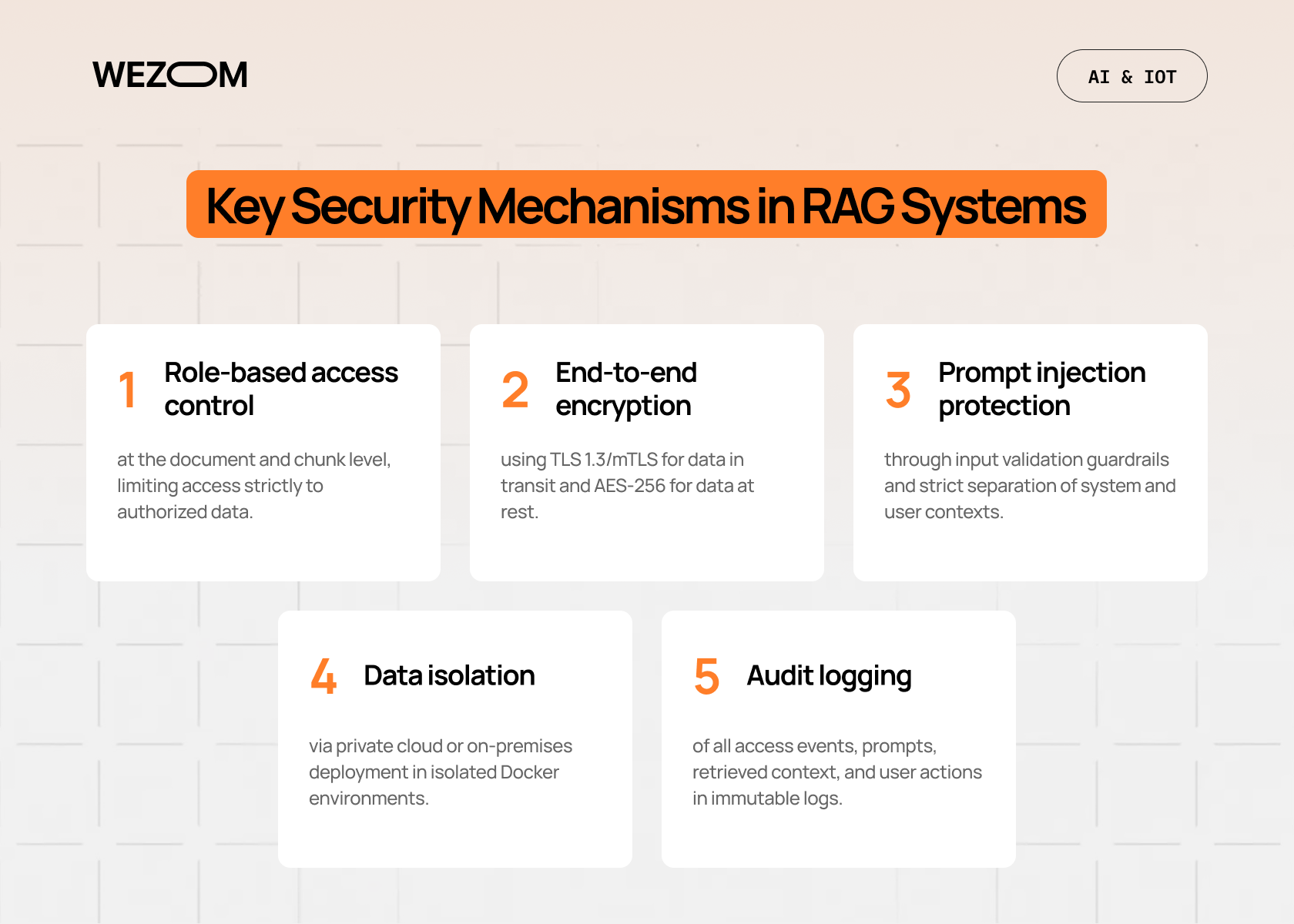
To guarantee absolute fault tolerance and invulnerability of the system, we employ a comprehensive set of RAG security mechanisms:
- Role-based access control at the granular metadata level of each text fragment to prevent lateral movement of an attacker within the network (i.e., even if an account is compromised, the attacker will only gain access to the tiny portion of the knowledge base authorized by that account's role);
- Data encryption both in transit (via TLS 1.3/mTLS protocols between all microservices in the architecture) and at rest (in the disk subsystems of vector databases and chunk storage using AES-256);
- Prompt injection protection, using two-stage verification – first, through request validation at the input level using specialized guardrails and then, through separation of the system context from user input at the API call level;
- Data isolation, with the elimination of public cloud solutions (using isolated Docker containers, either in private cloud or on-premise, instead);
- Audit logging, recording every knowledge base access, vectors, user ID, prompt text, received context metadata, etc. in immutable logs in real time.
Common Risks in Enterprise RAG
Neglect of security measures in the context of RAG implementation leads to the emergence of a number of specific vulnerabilities. In particular, here, we mean the following ones:
- Data leakage through prompts, when inattentive employees load confidential code or corporate secrets into non-isolated dialog boxes – in this case, without end-to-end DLP control, this information ends up in the logs of model providers or, even worse, in the next iteration of neural network training;
- Unfiltered retrieval results, when the RAG system performs a semantic search blindly, without checking the Active Directory, which ultimately leads to a violation of confidentiality (that is, when any user with a low access level can ask a sophisticated question and receive in the answer a summary of documents to which they initially don’t have access);
- Poisoned embeddings, when a hacker introduces malicious documents into a corporate knowledge base, which, when indexed, distort the vector database, thereby forcing the search engine to produce malicious or misleading chunks;
- Unauthorized access to the knowledge base, when end-to-end mTLS authentication between RAG components is not provided, and if a hacker gains access to the vector database port, he or she gets the opportunity to download all vector representations of documents (and then, through reverse engineering, it is already possible to restore the original text array of the trade secret).
Best Practices for Secure RAG Implementation
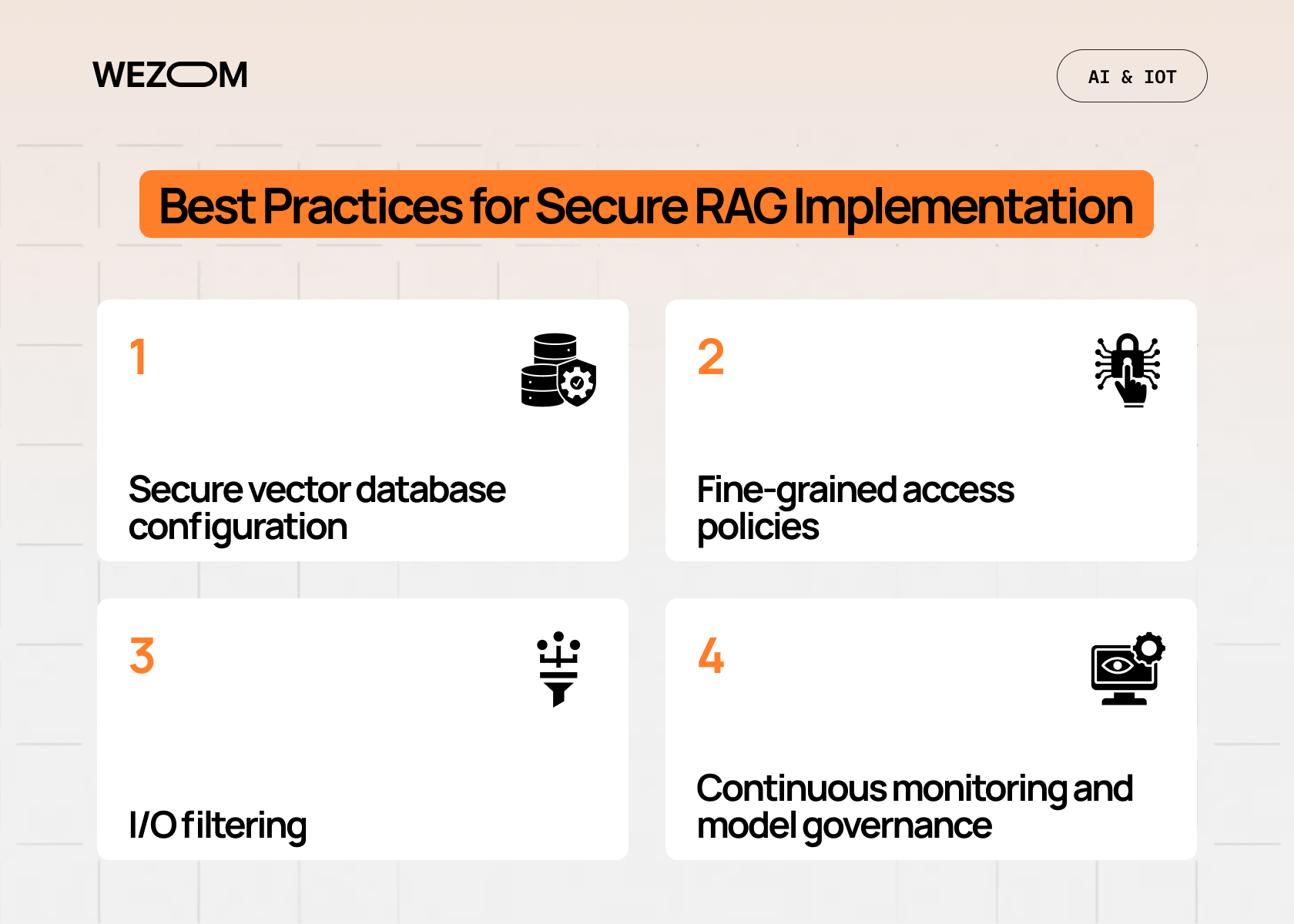
Effective deployment of an enterprise RAG system requires adherence to a number of infrastructure configuration standards. In particular, through trial and error, we have determined a set of best practices that guarantee maximum data protection with minimal latency when generating responses.
- Secure vector database configuration. Since vector storage is the basis of the RAG system, we completely isolate database instances at the network level – for example, using Kubernetes Network Policies. Thanks to this, we are able to exclude any external connections, and access to the database itself is determined only by a fixed search engine pod. We also implement mandatory authentication (using mTLS) for all internal requests.
- Fine-grained access policies. A secure RAG must duplicate access rights from conventional corporate repositories, for which it makes sense to implement attribute-based access control logic, when each text chunk is assigned a hash list of allowed group IDs during indexing. This allows the search engine to perform filtering on the vector database side, preventing invalid context from entering before it is retrieved.
- I/O filtering. Model’s protection on the perimeter should be based on the principle of a double gateway, when user requests are validated through lightweight classifiers to block SQL and prompt injections. Next, the model’s response has to be checked by a local DLP system, which detects accidental data leakage within the generated tokens if, for example, the model tries to generate a confidential ID or a closed system path.
- Continuous monitoring and model governance. Operating AI requires monitoring security metrics – for this, it makes sense to log all sessions in SIEM systems that allow you to identify any anomalous activity (for example, if a specific user begins to actively generate queries on various closed topics). To do this, the governance model must include prompt versioning and regular updating of local model weights, and of course, auditing vector indexes.
Ultimately, a specific set of secure RAG practices is best discussed on a project-by-project basis, taking into account departmental architecture, model used, compliance standards, and a number of other factors.
Use Cases of Secure RAG in Enterprises
Ultimately, reliable RAG protection always pays off – at the very least by accelerating information searches in vast amounts of unstructured data without the risk of compromising intellectual property. Let's take a closer look at the use cases where this is most justified:
- Internal knowledge assistants. When you obtain a single entry point for searching information across all departments of the company, with a properly configured RAG, you can consolidate all knowledge bases and thus provide employees with instant answers according to their job responsibilities.
- HR policy chatbots. This refers to the automation of onboarding and responses to employee questions about vacations, payroll, sick leave, etc., where RAG ensures that the bot provides answers precisely in accordance with the employee's grade.
- Engineering documentation search. RAG can become an indispensable tool for IT departments, as it gives their employees instant access to specifications and code repositories without the risk of leaving the company's closed system.
- Compliance systems. Highly intelligent analysis of thousands of contracts and case law becomes possible in seconds, allowing lawyers to quickly identify contractual risks while preserving clients' secrets.
- Customer support automation. Deploying prompters for customer support operators through RAG solutions allows them to instantly receive instructions on complex technical products from corporate manuals. This reduces operator response times to just a few seconds and eliminates the risk of internal regulations being leaked into the public domain.
Challenges in Scaling Secure RAG Systems
Implementing a full-fledged RAG at enterprise scale with tens of thousands of users comes with its own set of challenges.
Here, we're primarily concerned with latency issues, as implementing a multi-level security system inevitably entails additional computation. The more users, the higher the latency, so it's crucial to optimize the architecture through caching and asynchronous security checks.
Another challenge is large-scale indexing and synchronization, when the volume of corporate knowledge is measured in terabytes, so generating embeddings becomes too resource-intensive. It's important to ensure that if a document is updated in the ERP system, RAG must immediately reindex this chunk in the vector database; otherwise, the model will operate on outdated data.
Finally, it's worth mentioning the forced tradeoffs between security and performance, as data isolation requires deploying local models. At the same time, open-source models require enormous GPU power, forcing businesses to find a balance: either use expensive clusters for heavy (but accurate) models or optimize the architecture through quantization and guardrails agents.
FAQ
What is Secure RAG in simple terms?
In a nutshell, this is a secure technology that allows artificial intelligence to answer user questions based on proprietary company documentation within an isolated environment, preventing information leakage to the global internet.
How does RAG differ from a traditional LLM?
While conventional models only use the knowledge they were trained on (which leads to hallucinations and data outdatedness), RAG implementation helps to retrieve relevant facts from the company's knowledge base before generating each new response.
Why is security important in enterprise RAG systems?
In the enterprise sector, a data breach can result in the loss of intellectual property, as well as fines for violating user data privacy standards and subsequent lawsuits.
How is internal company data protected in RAG?
RAG data security is achieved through the complete deployment of the system within the company's private cloud, the implementation of end-to-end encryption (e.g., AES-256+TLS 1.3), and, of course, the implementation of a role-based access model, whereby the AI is only able to access documents authorized for a specific user.
Can RAG systems leak sensitive data?
Yes, this can happen due to improper configuration of RAG systems. They are susceptible to leaks through prompt injections or incorrect indexing, which is why enterprise RAG security solutions require the implementation of custom DLP filters and rigorous access rights verification at the vector database level.
