


Power budget as a hard constraint
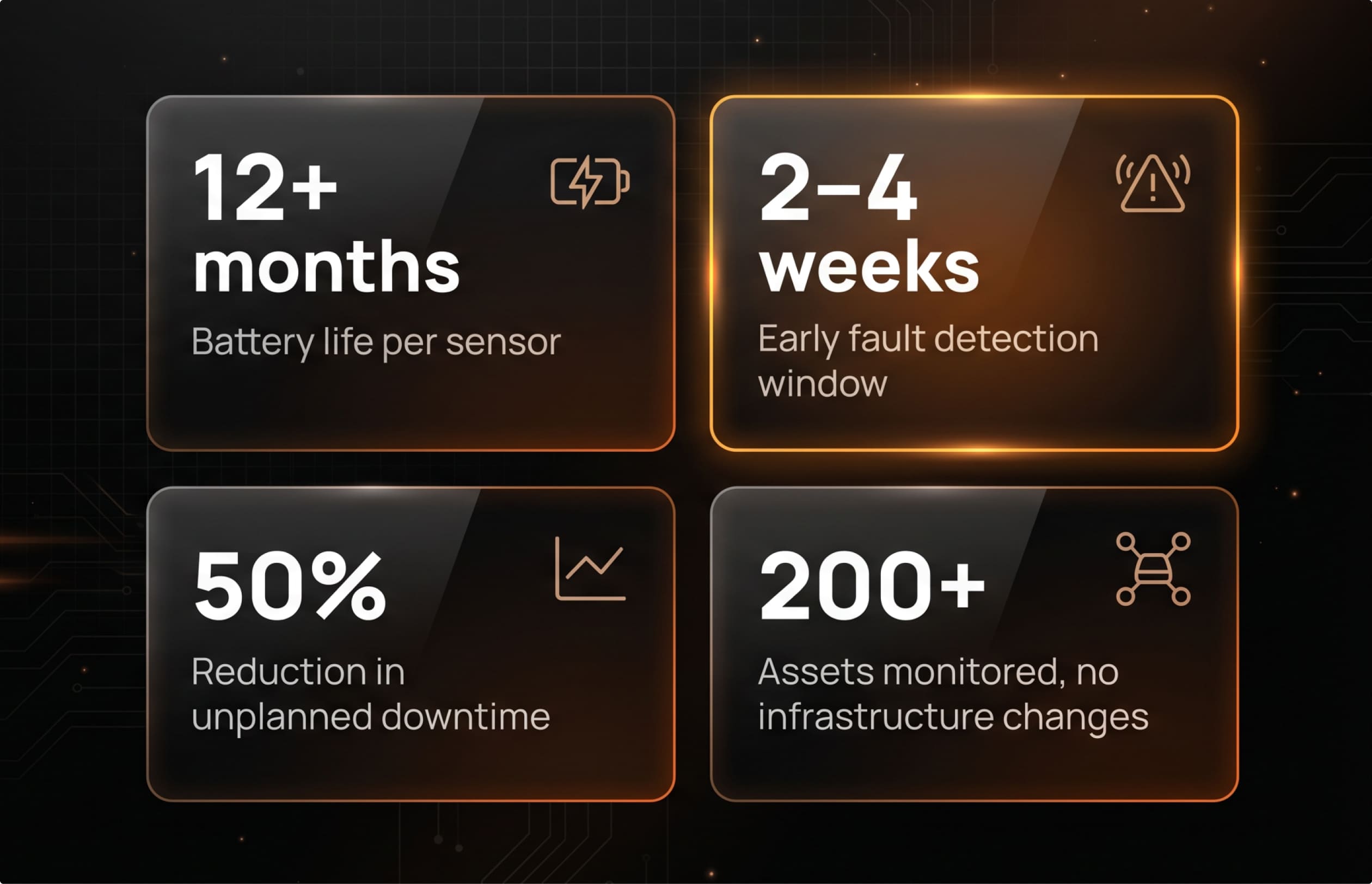
12 months of battery life was a non-negotiable requirement, not a stretch goal. Every firmware decision — sampling rate, radio duty cycle, sleep state transitions — was evaluated against a power budget model built before the first line of code was written.
Edge signal processing — not raw data streaming
The sensor runs FFT and RMS calculations on-device. What gets transmitted is not raw accelerometer data — it's compact frequency-domain features and derived health indicators. Radio-on time is cut by over 90%, which is where most of the battery savings come from.
Adaptive reporting
Under normal operating conditions, the sensor reports infrequently. When vibration signatures shift outside baseline — early bearing wear, misalignment developing, imbalance growing — the sensor automatically increases its reporting rate and triggers an alert. High-fidelity data when it matters, minimal transmission when it doesn't.
Zero-friction deployment
Magnetic mount. QR code scan to register. Asset assigned in the mobile app. Sensor reporting in under three minutes. Designed to be deployed by a maintenance technician, not an IoT engineer.
Embedded & Firmware Layer
- MCU: Nordic Semiconductor nRF52840 (ARM Cortex-M4F, integrated BLE 5.0)
- MEMS sensor: 3-axis accelerometer, configurable sampling up to 3.2kHz
- Edge processing: FFT, RMS, peak-frequency detection running on-device
- Battery: 360mAh Li-SOCl2, 12+ months at standard reporting interval
- Sleep current: <5uA between measurement cycles
Wireless Communication
- Primary: Bluetooth Low Energy 5.0 to local gateway
- Extended range option: LoRaWAN (firmware-configurable, same hardware)
- Gateway: BLE-to-cloud gateway with Ethernet / 4G LTE backhaul
Cloud Backend
- Time-series storage: InfluxDB for raw metrics and derived health indicators
- Anomaly detection: FFT baseline deviation + RMS trend alerting
- CMMS integration: REST API for SAP PM, IBM Maximo, Infor EAM
- Data retention: configurable per asset criticality tier
Mobile & Web Application
- Mobile (iOS / Android): sensor onboarding, live readings, alert management, asset history
- Web dashboard: plant-wide fleet overview, per-asset vibration trending, maintenance schedule recommendations
- Alert delivery: push notification, email, SMS, webhook
Operational Impact
The maintenance team's workflow shifted from reactive firefighting to planned interventions. With 2-4 weeks of advance warning on developing faults, parts are ordered, downtime is scheduled during planned maintenance windows, and production is protected.
Diagnostics Capability
Bearing wear, shaft misalignment, and rotor imbalance now show up in frequency data weeks before they're audible or visible. The maintenance team has access to a category of diagnostic information that simply didn't exist before — continuous, quantitative, per-asset condition data.
Plant-Wide Scale
The system went from pilot (12 sensors, one production line) to full deployment (200+ sensors, entire facility) in under 90 days. No infrastructure changes, no additional gateways, no re-architecting. The platform absorbed the scale increase transparently.
