


Electrically accurate emulation
The HIL stand doesn't approximate battery behavior — it models it. Cell-level SoC curves, internal resistance profiles, temperature-dependent impedance, and pack-level voltage dynamics are all parameterizable, so the BMS under test cannot distinguish the emulator from real cells.
Fault injection by design
Over-voltage, under-voltage, cell imbalance, sudden load transients, communication loss, and sensor failures are all first-class test scenarios — not afterthoughts. Engineers define fault sequences in YAML and the system executes them reproducibly.
Real-time closed-loop control
The emulator responds to BMS commands within 500us, maintaining physical accuracy under dynamic load conditions — the kind that expose firmware bugs that static bench tests never catch.
Pipeline-integrated validation
Every firmware commit triggers an automated test run. Results are logged, compared against baseline, and flagged before the build reaches hardware — turning validation from a bottleneck into a continuous process.
Power Emulation Hardware
- Programmable bidirectional DC supply with <1ms transient response
- Cell-level emulation: configurable SoC, SoH, and internal resistance per cell group
- Voltage range: 0-800V (compatible with 400V and 800V EV architectures)
- Current range: up to 500A peak emulation capability
Real-Time Control Layer
- Real-time controller: FPGA-based with <500us closed-loop latency
- Hardware I/O: CAN FD, LIN, SPI, analog I/O for BMS interfacing
- Isolation: 1500V galvanic isolation between emulator and control system
Test Management
- Scenario language: YAML-based test scripts with parameterized fault injection
- Automated pass/fail evaluation against defined acceptance criteria
- Full data logging: voltage, current, temperature, CAN traffic, per millisecond
- Auto-generated test reports (PDF / HTML) per firmware build
Integrations
- CAN FD for BMS communication (SAE J1939, AUTOSAR ComStack, custom protocols)
- Git-triggered CI/CD pipeline for automated firmware validation
- InfluxDB + Grafana for test trend analysis across firmware versions
Validation Speed
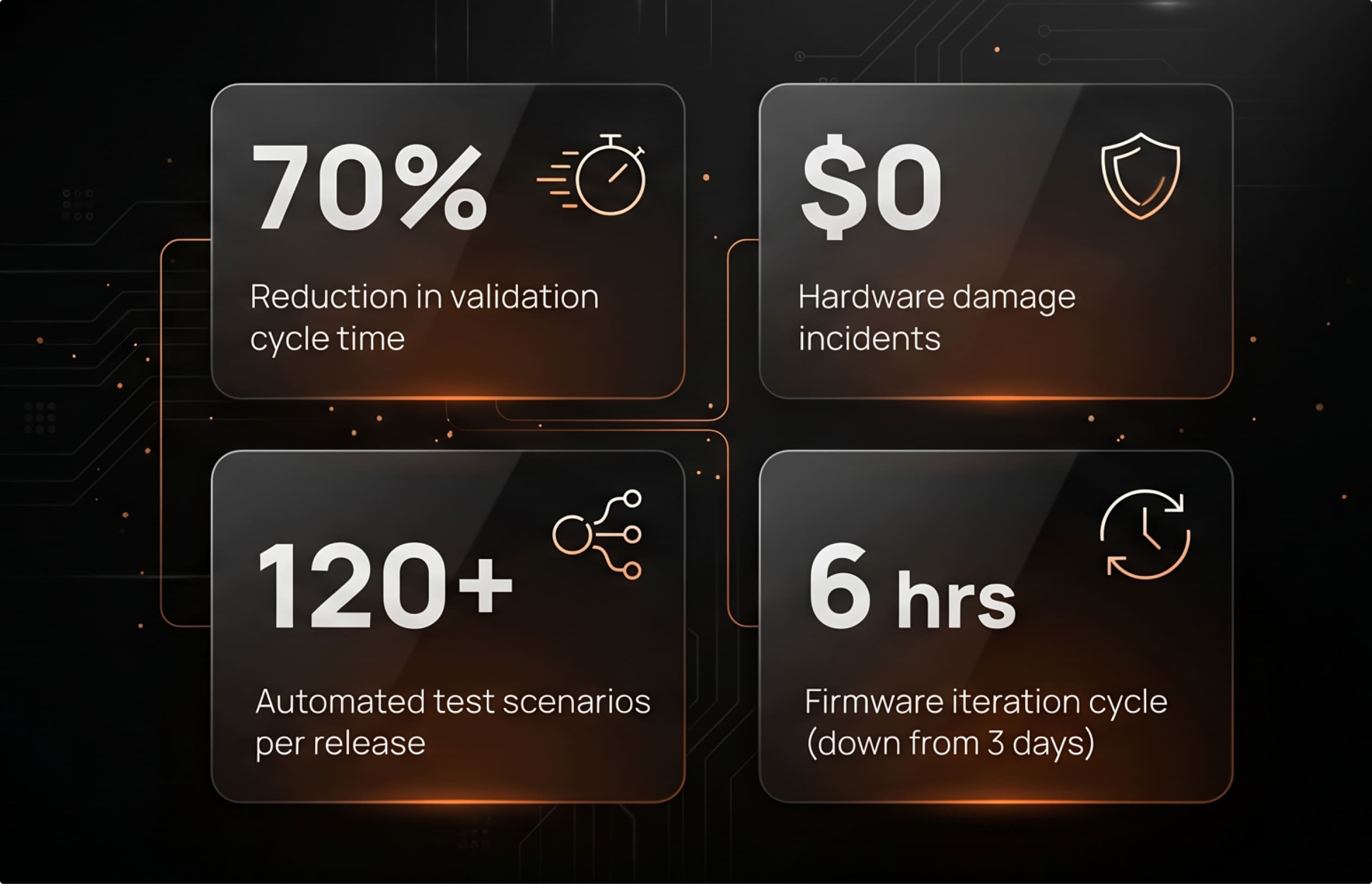
Multi-day hardware setup cycles are gone. Overnight automated runs now cover the full regression suite — 120+ scenarios — and deliver a complete test report before the engineering team starts the next day.
Safety Record
Zero thermal events, zero cell damage, zero equipment failures during the entire test program. Removing real batteries from early-stage validation eliminated the category of risk entirely.
Firmware Quality
Bugs that previously reached prototype hardware — and cost days to diagnose — are now caught in automated runs within hours of the commit that introduced them. Defect escape rate to hardware dropped significantly.
