
What Is AI Defect Detection?
AI defect detection refers to the use of artificial intelligence technologies to automatically identify defects, anomalies, or irregularities in products, materials, or processes. Instead of relying solely on manual quality control or rule-based inspection software, modern AI systems analyze visual or sensor data using advanced algorithms to determine whether an item meets quality standards.
In industrial environments, defect detection using AI is typically applied on production lines where cameras, sensors, or other monitoring devices capture data from products as they move through manufacturing stages. The AI system processes this information in real time and identifies deviations such as scratches, structural defects, contamination, incorrect assembly, or shape inconsistencies.
Organizations increasingly adopt AI-powered defect detection to maintain high production quality while reducing operational costs. As manufacturing becomes more automated and high-volume, human inspectors alone cannot maintain consistent inspection accuracy across millions of units. AI enables scalable and continuous inspection without fatigue or human bias.
Modern AI-powered defect detection systems operate by learning patterns from large datasets. By analyzing thousands or millions of examples, the system learns what constitutes a normal product and what signals a defect. Once trained, these models can evaluate new production items within milliseconds.
Businesses adopt AI in defect detection not only to reduce errors but also to improve production visibility. Continuous monitoring helps manufacturers identify process problems early, preventing large batches of defective products from being produced.
Role of Computer Vision
Computer vision is the core technology behind most AI visual inspection for defect detection solutions. It allows machines to interpret visual data such as images or video streams captured by cameras installed on production lines.
Computer vision models analyze:
- surface textures;
- structural geometry;
- color variations;
- material consistency;
- assembly alignment.
By using deep learning techniques, particularly convolutional neural networks (CNNs), systems can recognize extremely subtle visual differences that would be difficult for humans to detect consistently.
In AI-enabled visual inspection for defect detection, high-resolution industrial cameras capture images of products at multiple stages of production. These images are processed by trained neural networks that detect patterns and classify objects into categories such as:
- acceptable product;
- minor defect;
- critical defect;
- unknown anomaly.
Because these models learn directly from visual data rather than predefined rules, they can adapt to complex environments where defects vary in appearance.
Many defect detection systems using AI now combine computer vision with advanced algorithms that enable segmentation, classification, and anomaly detection. This combination allows systems to precisely locate defects within images, improving root-cause analysis and quality monitoring.
Difference vs Traditional Inspection
Traditional inspection methods rely heavily on human operators or rule-based software systems. While these methods have been widely used for decades, they present several limitations.
Human inspectors often experience fatigue, inconsistency, and limited scalability. As production speed increases, maintaining inspection accuracy becomes increasingly difficult.
Rule-based systems attempt to automate inspection by defining thresholds or pattern rules. However, such systems struggle with variability in lighting conditions, materials, or product designs.
AI-based defect detection addresses these limitations by learning patterns directly from data. Instead of relying on manually defined thresholds, machine learning models continuously refine their understanding of acceptable product conditions.
Key differences between traditional inspection and AI-driven defect detection include:
| Aspect | Traditional Inspection | AI Defect Detection |
|---|---|---|
| Decision logic | Rule-based | Data-driven learning |
| Scalability | Limited | High |
| Adaptability | Low | High |
| Accuracy in complex environments | Moderate | High |
| Continuous improvement | Limited | Built-in through retraining |
As a result, organizations implementing AI outsourcing company solutions or developing internal AI capabilities increasingly prioritize AI-driven quality control systems.
How AI Defect Detection Works
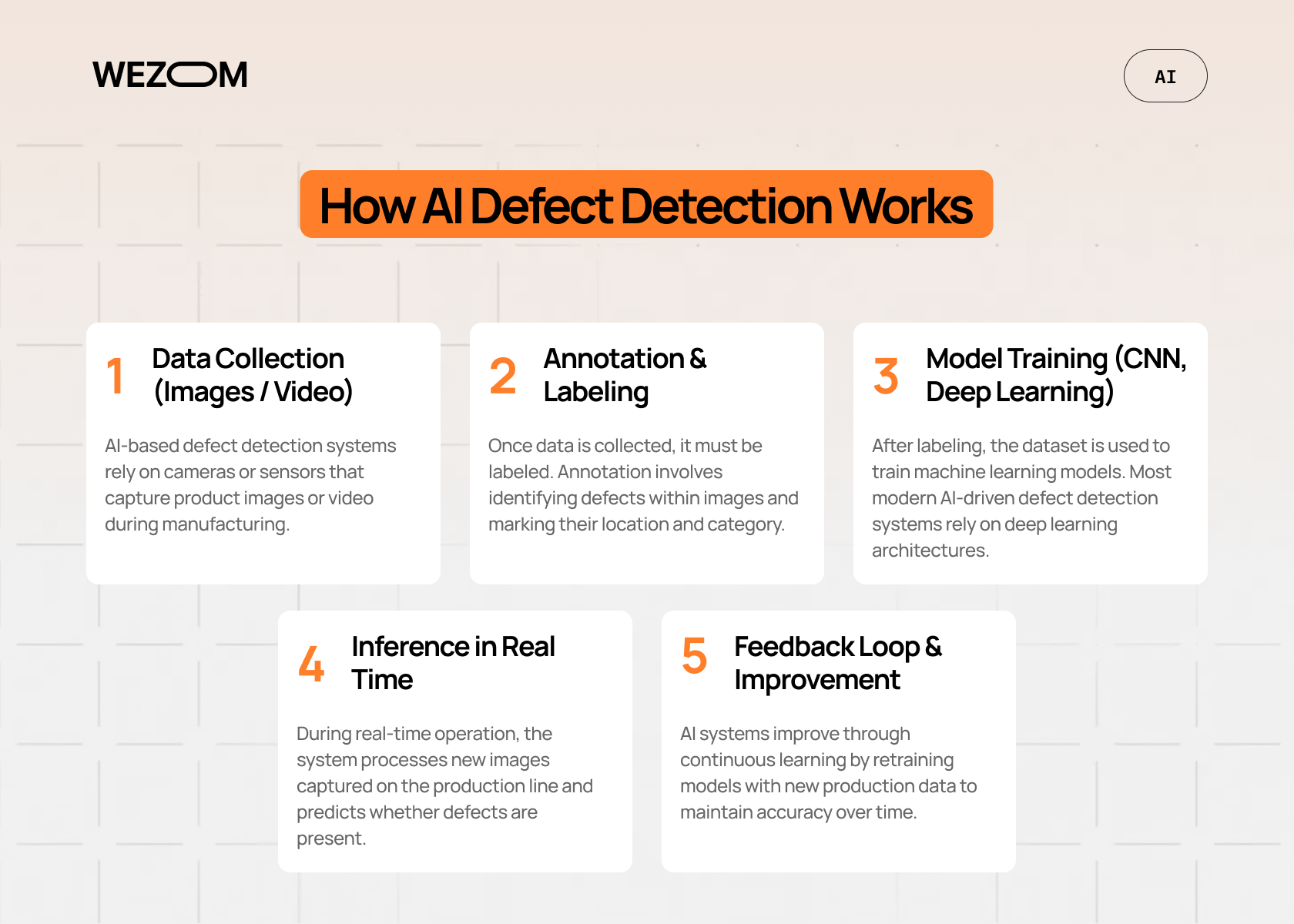
AI defect detection involves several stages that transform raw data into reliable inspection decisions. The process combines data engineering, machine learning development, and real-time system deployment.
Data Collection (Images / Video)
The foundation of any AI-based defect detection system is data. Cameras or sensors installed on production lines capture images or video streams of products during manufacturing.
Typical data sources include:
- industrial cameras;
- thermal sensors;
- X-ray imaging systems;
- ultrasonic sensors;
- infrared scanners.
Visual inspection systems usually rely on high-resolution cameras capable of capturing detailed images of products moving at high speeds.
For defect detection with vision AI, the data pipeline collects thousands or millions of images representing both normal products and defective items. This dataset becomes the basis for training machine learning models.
Annotation & Labeling
Once data is collected, it must be labeled. Annotation involves identifying defects within images and marking their location and category.
Common annotation tasks include:
- bounding box labeling;
- pixel segmentation;
- defect classification tags;
- anomaly flags.
Labeling is essential for supervised learning models used in AI-powered defect detection systems. Accurate labels allow neural networks to learn the visual characteristics of defects.
However, annotation can be time-consuming. Large industrial datasets often require specialized labeling tools and domain expertise from quality control specialists.
Model Training (CNN, Deep Learning)
After labeling, the dataset is used to train machine learning models. Most modern AI-driven defect detection systems rely on deep learning architectures.
Common model types include:
- Convolutional neural networks (CNNs);
- Vision transformers;
- Autoencoders for anomaly detection;
- Object detection networks such as YOLO or Faster R-CNN.
These models learn patterns that distinguish normal products from defective ones.
Training involves iterative optimization where the model processes thousands of labeled images and gradually improves its prediction accuracy.
Key performance metrics during training include:
- Accuracy;
- Precision;
- Recall;
- F1 score.
These metrics ensure that the model detects defects reliably while minimizing false alarms.
Inference in Real Time
Once trained, the model is deployed in production environments. During real-time operation, the system processes new images captured on the production line and predicts whether defects are present.
The inference pipeline typically includes:
- Image capture.
- Preprocessing.
- Model prediction.
- Defect classification.
- Output decision.
This process often takes milliseconds, allowing inspection to occur without slowing production.
Many AI-powered defect detection systems integrate with industrial automation platforms. If a defect is detected, the system may trigger actions such as:
- rejecting the defective product;
- stopping the production line;
- sending alerts to operators.
Feedback Loop & Improvement
AI systems improve over time through continuous learning. Production environments change due to material variations, machine wear, or new product designs.
To maintain accuracy, organizations implement feedback loops where new production data is periodically collected and used to retrain models.
This continuous improvement process ensures long-term reliability and helps address issues such as model drift or evolving defect patterns.
Types of AI-Based Defect Detection Systems
Organizations implement different types of AI-based defect detection systems depending on the nature of their production processes, the types of defects they need to identify, and the available data sources. Modern inspection architectures combine multiple technologies — including computer vision, sensor analytics, and machine learning pipelines — to achieve reliable quality control.
Below are the most common categories of systems used in industrial environments.
Visual Inspection (Camera-Based Systems)
Visual inspection systems are the most widely deployed approach in AI visual inspection for defect detection. These solutions rely on industrial cameras and computer vision algorithms to analyze the visual characteristics of products as they move along the production line.
In a typical setup, high-resolution cameras capture images or video streams of each product. These images are then processed by neural networks trained to identify defects such as:
- scratches or cracks;
- surface contamination;
- incorrect assembly;
- shape deformation;
- color inconsistencies;
- missing components.
Computer vision models used in defect detection with vision AI can perform several tasks simultaneously:
- classification (defective vs normal);
- object detection (finding defect locations);
- segmentation (identifying exact defect areas).
Because the inspection occurs automatically and continuously, AI-powered defect detection systems can analyze thousands of items per minute without slowing production. These systems are particularly effective for industries where product appearance directly reflects quality, such as electronics, automotive components, and packaging.
Lighting control, camera positioning, and image quality are critical factors for the performance of camera-based inspection systems. Many production lines implement controlled lighting environments to ensure consistent image capture for reliable AI inference.
Sensor-Based Detection
Not all defects are visible to cameras. Some quality issues occur internally or involve physical properties that require specialized sensors to detect. In these cases, sensor-based AI defect detection systems analyze signals collected from industrial monitoring devices.
Examples of sensor data used in defect detection systems using AI include:
- vibration signals from machinery;
- acoustic emissions from mechanical parts;
- temperature measurements from thermal sensors;
- pressure readings in pipelines;
- ultrasonic signals for structural inspection.
Machine learning models analyze these signals to detect anomalies that may indicate defects or early equipment failures. For example, unusual vibration patterns may signal mechanical wear or alignment issues in rotating equipment.
Sensor-based detection is often used for predictive maintenance and structural integrity monitoring. In many industrial environments, it works alongside visual inspection systems to provide a more comprehensive view of product and equipment health.
Hybrid Systems
Hybrid systems combine multiple data sources to improve defect detection reliability. Instead of relying on a single inspection method, hybrid architectures integrate computer vision with sensor data and other operational signals.
For example, a hybrid AI-powered defect detection system might include:
- camera-based surface inspection;
- thermal monitoring of components;
- vibration analysis of machinery;
- production process data from manufacturing equipment.
Combining these signals allows AI models to identify complex defects that may not be visible through a single data source. For instance, a component might appear visually correct but exhibit abnormal thermal behavior that indicates internal damage.
Hybrid systems are becoming increasingly common in advanced manufacturing environments where production processes are complex, and defect detection requires multiple perspectives.
Edge vs Cloud-Based Systems
Another important distinction between defect detection systems using AI is their deployment architecture. AI models can run either on edge devices near the production line or in cloud-based infrastructure.
Edge AI systems perform real-time inference directly on local devices installed in factories. These systems use specialized hardware such as GPU-enabled industrial computers or dedicated AI accelerators.
Advantages of edge-based inspection include:
- extremely low latency;
- independence from network connectivity;
- real-time decision making;
- Reduced data transfer costs.
Edge deployment is particularly important when inspection must occur instantly to remove defective products from the production line.
Cloud-based systems, on the other hand, process data in centralized computing environments. Cloud infrastructure provides large computational resources for training models, storing datasets, and performing advanced analytics.
Cloud platforms are often used for:
- large-scale model training;
- centralized monitoring across multiple factories;
- long-term quality analytics;
- dataset management and labeling.
In practice, many organizations adopt hybrid architectures where AI-driven defect detection runs inference on edge devices while training, monitoring, and data analysis occur in the cloud. This approach balances real-time performance with scalable machine learning infrastructure.
Key Benefits of AI in Defect Detection
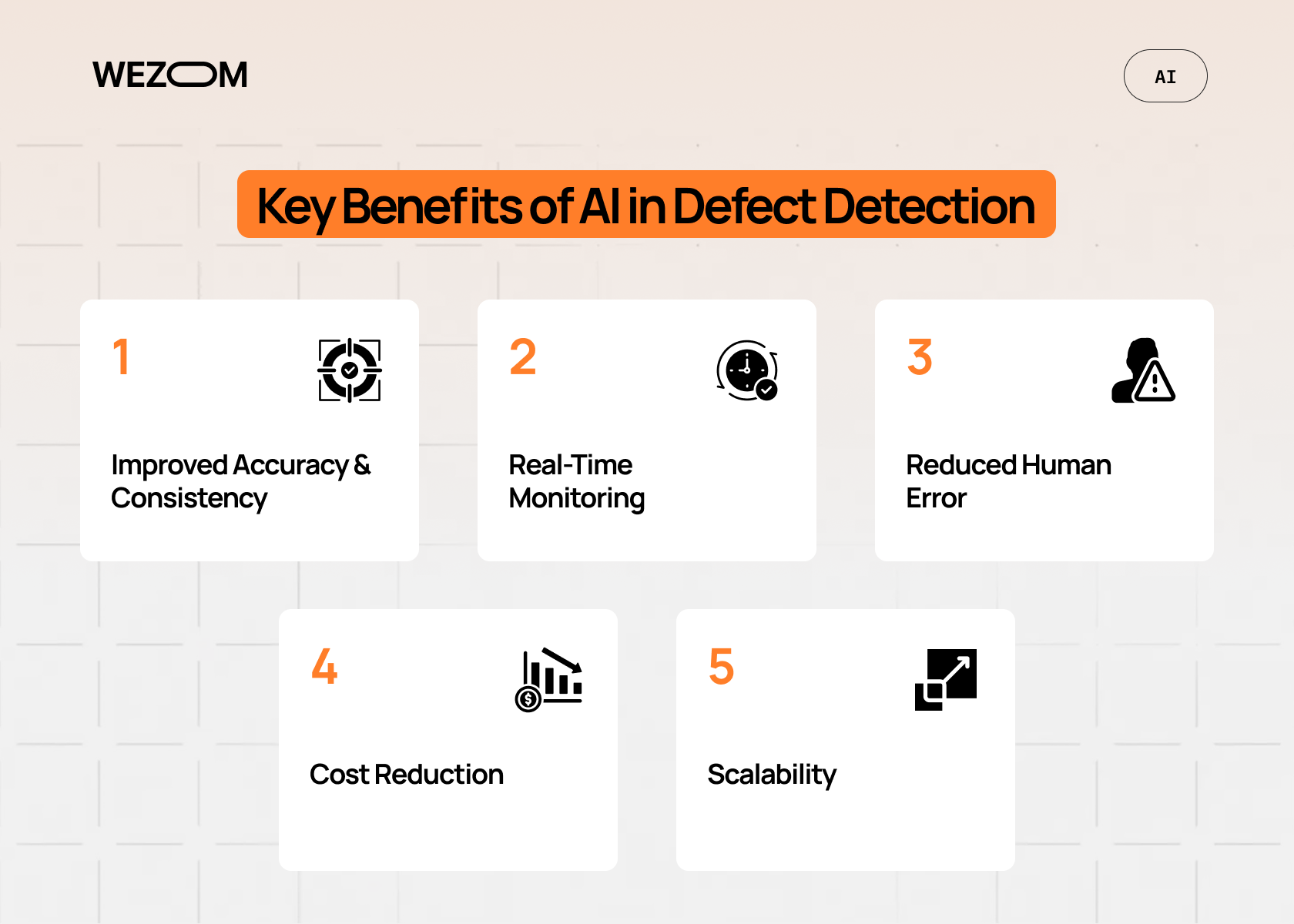
AI technologies provide several advantages for industrial quality control systems.
Improved Accuracy & Consistency
Human inspectors may experience fatigue or inconsistency over long shifts. AI systems maintain stable performance and detect defects with consistent accuracy.
Machine learning models analyze fine-grained visual patterns that might be missed during manual inspection.
Real-Time Monitoring
Real-time monitoring allows organizations to detect problems immediately rather than after production batches are completed.
Continuous inspection reduces waste and improves overall production efficiency.
Reduced Human Error
Manual inspection is prone to subjective judgment and oversight. AI systems provide objective, data-driven decisions that reduce variability in quality control.
Cost Reduction
Although implementing AI-powered defect detection systems requires initial investment, organizations often achieve long-term cost savings through:
- Reduced product recalls
- Lower labor costs
- Less production waste
- Faster defect identification
Scalability
As production volumes increase, AI systems can scale without requiring proportional increases in inspection staff.
This scalability makes AI particularly valuable for high-volume manufacturing environments.
Challenges and Limitations
Despite its advantages, AI-based defect detection also presents challenges.
Data Scarcity
High-quality labeled datasets are essential for training reliable models. However, many defects occur rarely, making it difficult to collect sufficient examples.
Organizations often use techniques such as synthetic data generation or anomaly detection models to address this issue.
False Positives and False Negatives
AI models may occasionally misclassify products.
False positives occur when a system incorrectly identifies a defect. False negatives occur when a defect goes undetected.
Balancing precision and recall is critical to ensure reliable inspection.
Model Drift
Production conditions may change over time, causing model performance to degrade.
Regular retraining and monitoring are necessary to maintain detection accuracy.
Hardware Limitations
Industrial environments may impose constraints on camera placement, lighting conditions, or computing resources.
These factors must be carefully considered during system design.
Change Management
Introducing AI into production environments often requires organizational adjustments.
Operators must learn to trust AI decisions, and workflows may need to be redesigned to integrate automated inspection systems.
Industries Using AI Defect Detection
AI defect detection technologies are widely adopted across many industries.
Manufacturing
Manufacturing plants use AI-powered defect detection to inspect mechanical components, detect assembly errors, and monitor product quality.
Automotive
Automotive manufacturers use computer vision to detect welding defects, paint inconsistencies, and assembly misalignments.
Electronics
Electronics production requires extremely precise inspection. AI systems detect microscopic defects in circuit boards and semiconductor components.
Food Production
Food processing companies use AI-enabled visual inspection for defect detection to identify contamination, packaging errors, or damaged products.
Pharmaceuticals
Pharmaceutical manufacturers apply AI defect detection to inspect tablets, vials, and packaging to ensure compliance with strict regulatory standards.
From Pilot to Production: Scaling AI Defect Detection
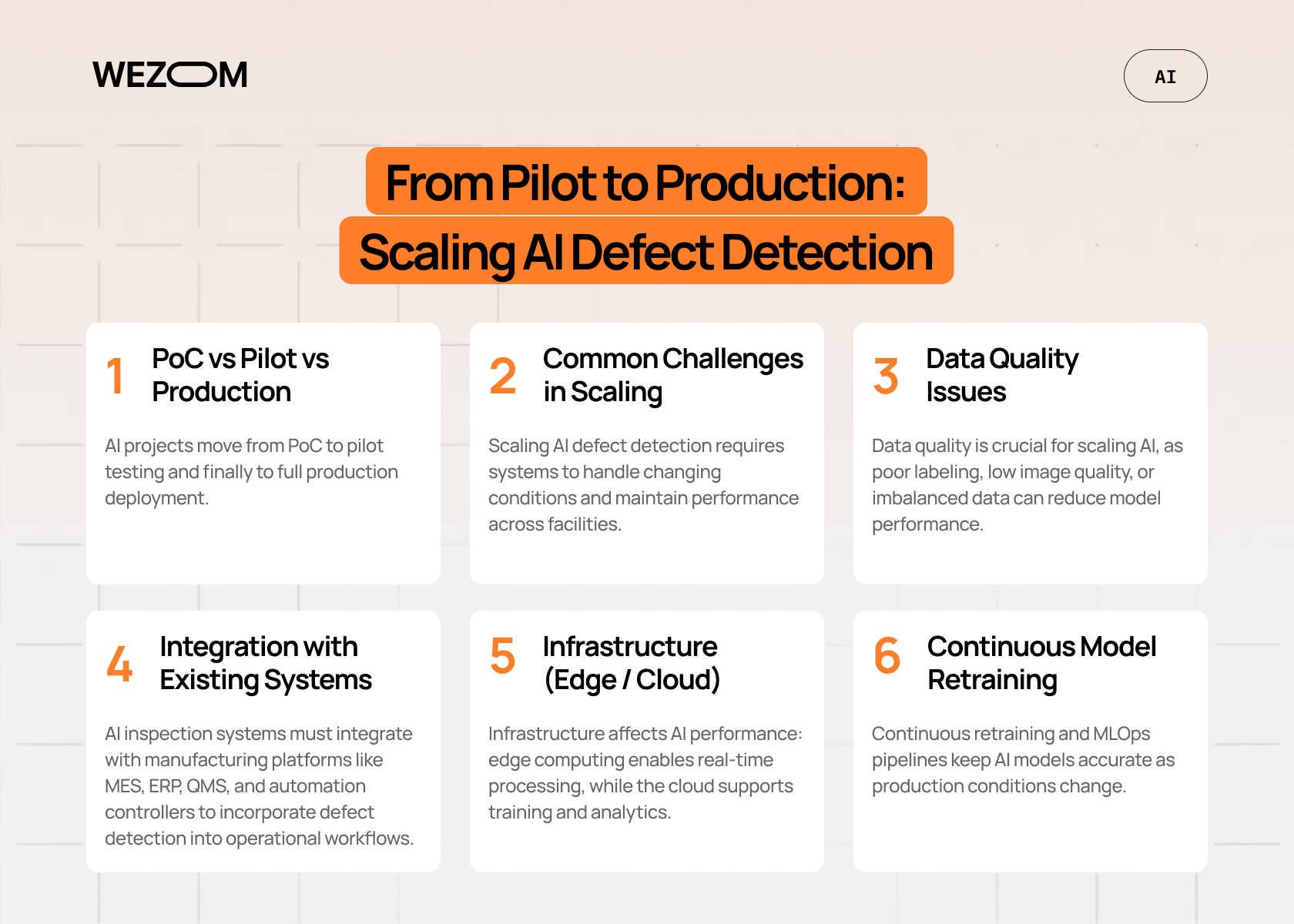
Deploying AI in industrial environments typically begins with experimental projects and gradually expands into full production systems.
PoC vs Pilot vs Production
AI initiatives often start with a proof of concept (PoC). This stage focuses on validating whether AI defect detection is technically feasible for a specific use case.
A pilot project follows the PoC stage. During the pilot phase, the AI system operates in a limited production environment. The goal is to evaluate system performance under real operating conditions.
Production deployment occurs when the AI solution becomes part of the standard quality control workflow. At this stage, the system must meet strict requirements for reliability, scalability, and integration.
Organizations frequently underestimate the complexity of moving from pilot projects to full deployment. While PoC experiments may demonstrate promising results, scaling these solutions across multiple production lines introduces additional challenges.
Common Challenges in Scaling
Scaling AI-driven defect detection requires addressing several operational challenges.
Production environments involve variable lighting conditions, changing product designs, and fluctuating manufacturing speeds. AI systems must remain robust under these dynamic conditions.
Additionally, deploying AI across multiple facilities often requires adapting models to new environments while maintaining consistent performance.
Data Quality Issues
Data quality becomes a critical factor when scaling AI solutions. Inconsistent labeling, poor image quality, or imbalanced datasets can significantly reduce model performance.
Organizations must establish standardized data pipelines to ensure that training datasets remain reliable and representative of real production conditions.
Integration with Existing Systems
AI inspection systems rarely operate in isolation. They must integrate with existing manufacturing systems, such as:
- Manufacturing execution systems (MES).
- Enterprise resource planning (ERP) platforms.
- Quality management systems (QMS).
- Industrial automation controllers.
Successful integration ensures that defect detection insights are incorporated into broader operational workflows.
Infrastructure (Edge / Cloud)
Infrastructure decisions influence system performance and scalability.
Edge computing enables real-time inference directly on the production floor. This approach minimizes latency and reduces reliance on network connectivity.
Cloud infrastructure supports centralized model training, monitoring, and analytics. Combining edge and cloud environments allows organizations to maintain both real-time responsiveness and scalable computing resources.
Continuous Model Retraining
Production conditions evolve due to material variations, equipment wear, or product design changes.
Continuous retraining ensures that AI models remain accurate as these conditions change. Organizations often implement automated MLOps pipelines to manage model updates and monitor performance metrics.
Best Practices for Successful Deployment
Organizations implementing AI-powered defect detection systems can improve their success rates by following several best practices.
Start with High-Impact Use Case
Selecting the right initial use case is critical. High-impact applications typically involve defects that are:
- difficult for humans to detect;
- frequent enough to collect training data;
- costly when missed.
Focusing on these scenarios increases the likelihood of achieving measurable ROI.
Ensure Dataset Quality
Data quality directly influences model performance. Organizations should prioritize collecting diverse datasets that represent real production variability.
Standardized labeling guidelines also help maintain dataset consistency.
Use MLOps Pipelines
MLOps frameworks enable efficient management of machine learning workflows.
Automated pipelines support tasks such as:
- dataset management;
- model training;
- version control;
- deployment automation;
- performance monitoring.
These capabilities are essential for maintaining scalable AI defect detection systems.
Monitor Model Performance
Continuous monitoring ensures that models maintain high accuracy in production.
Key performance indicators may include:
- detection accuracy;
- false positive rate;
- false negative rate;
- inference latency.
Monitoring systems can trigger alerts when performance metrics fall below predefined thresholds.
Iterate Continuously
AI systems improve through iterative development. Feedback from production environments helps refine models and improve detection capabilities.
Organizations should treat AI deployment as an ongoing process rather than a one-time implementation.
Cost of AI Defect Detection Systems
The cost of implementing defect detection systems using AI varies depending on several factors.
Key Cost Factors
Major cost drivers include:
- hardware infrastructure;
- data collection equipment;
- dataset labeling;
- model development;
- integration with existing systems.
High-resolution industrial cameras and specialized sensors may represent significant upfront investments.
Development vs Off-the-Shelf Solutions
Organizations may choose between custom development and commercial solutions.
Off-the-shelf AI-powered defect detection systems provide faster implementation but may offer limited customization.
Custom solutions allow organizations to tailor models to specific production requirements but require greater development effort.
ROI Considerations
Despite initial investment costs, many organizations achieve strong returns on AI inspection systems.
ROI benefits often arise from:
- reduced product recalls;
- lower labor costs;
- increased production efficiency;
- improved product quality.
When deployed successfully, AI-driven defect detection can significantly improve operational performance.
Future Trends in AI-Powered Defect Detection
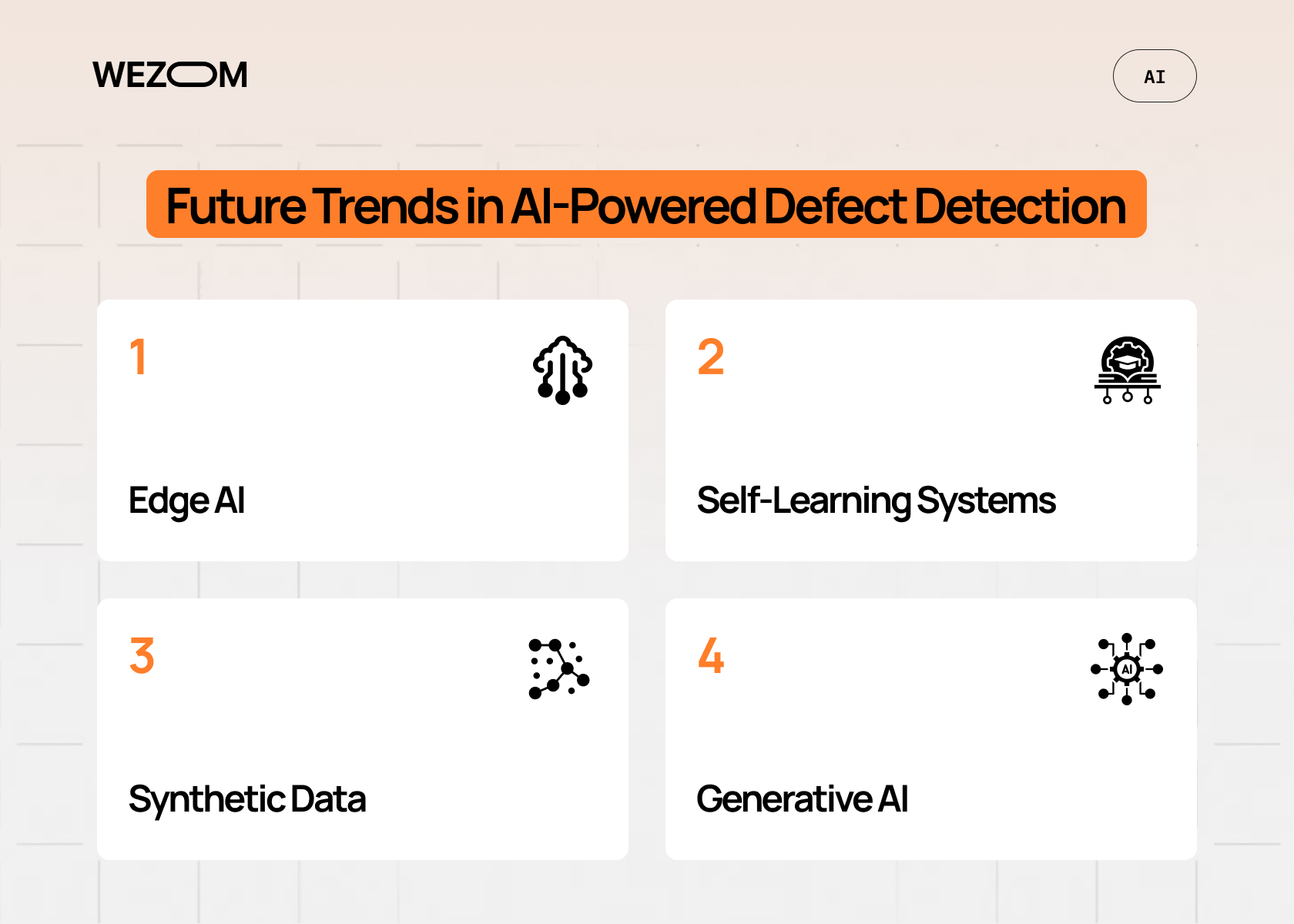
The field of AI inspection technologies continues to evolve rapidly.
Edge AI
Edge computing enables faster inspection by processing images directly on production equipment.
Advances in specialized AI hardware are making edge inference more efficient and cost-effective.
Self-Learning Systems
Next-generation AI systems aim to automatically adapt to new defect patterns without requiring extensive retraining.
Self-learning models may identify anomalies that were not previously labeled in training datasets.
Synthetic Data
Synthetic datasets generated through simulation or generative models help address data scarcity challenges.
These datasets can augment real training data and improve model robustness.
Generative AI
Generative AI technologies may assist in defect simulation, training dataset generation, and advanced anomaly detection.
These tools could significantly accelerate the development of reliable AI defect detection solutions.
FAQ
What is AI defect detection?
AI defect detection refers to the use of artificial intelligence algorithms to identify defects in products, materials, or production processes. These systems analyze visual or sensor data using machine learning models trained on large datasets.
Unlike traditional inspection systems that rely on predefined rules, AI-based defect detection systems learn patterns from data. This allows them to recognize subtle defects and anomalies that may not be captured by rule-based logic.
How accurate is AI defect detection?
The accuracy of AI-powered defect detection systems depends on factors such as dataset quality, model architecture, and deployment conditions.
In well-designed systems, detection accuracy can exceed human inspection performance, especially in high-volume manufacturing environments. However, achieving high accuracy requires continuous monitoring, model retraining, and robust data pipelines.
What industries use AI for defect detection?
AI defect detection is widely used in industries that require strict quality control standards.
Common applications include manufacturing, automotive production, electronics assembly, food processing, and pharmaceutical manufacturing. These industries rely on AI inspection systems to detect defects early and maintain consistent product quality.
What is the role of computer vision in defect detection?
Computer vision enables machines to analyze visual information captured by cameras or imaging systems.
In AI visual inspection for defect detection, computer vision algorithms identify patterns, textures, and structural variations that indicate defects. Deep learning models process this visual data to classify products and detect anomalies in real time.
Can AI detect defects in real time?
Yes, modern AI-powered defect detection systems are designed for real-time operation.
Using optimized neural networks and edge computing hardware, these systems can process images within milliseconds. Real-time detection allows manufacturers to remove defective products immediately and prevent production issues from escalating.
