
The use of AI in UAV software has transformed these devices from mere flying cameras for mapping into autonomous agents that can make decisions on their own, thereby minimizing human error and providing unprecedented data accuracy that would otherwise be unattainable with manual control.
How AI Works in Drone Technology
To get a full picture of what you'll be paying for as a software owner, it's important to understand what's “under the hood”. The main thing is that artificial intelligence here works as a symbiosis of four components, which must meet weight and power consumption constraints. Let's take a closer look.
Core Components
Let’s check them briefly:
- Computer vision. Using convolutional neural networks, the drone with AI gains the ability to recognize objects such as cracks in wind turbine blades, weeds, or defective insulators in power lines. Today, developers typically implement real-time segmentation models running at 60+ FPS.
- Machine learning. This technology allows the drone with artificial intelligence to learn from previous experience. In particular, we're talking about reinforcement learning algorithms – they allow the drone to adapt to turbulence or failing motors.
- Neural networks. This technology enriches the drone with the ability to classify conditions and perform predictive analytics – for example, to detect wear on parts long before it becomes visually noticeable.
- Sensor fusion. AI is capable of combining data from lidars, optical cameras, thermal imagers, and sensors, making the drone versatile. For example, if the camera is blinded by the sun, the drone will continue its flight based on lidar data.
Autonomous Flight Decision Making
This refers to the system's ability to process the Perception -> Planning -> Action cycle in milliseconds. Specifically, the first stage involves constructing a 3D point cloud of the space; next, it activates pathfinding algorithms so the drone can optimize its route when an obstacle appears. Finally, commands are transmitted to the flight controller via MAVLink or other protocols.
Edge vs Cloud AI
It's crucial to determine what software will be based on: Edge AI or Cloud AI. The former implies that computations will be performed directly on the AI powered drones (on chips or specialized NPUs), ensuring instant response, offline operation, and top data security. Meanwhile, Cloud AI will stream telemetry data to a server via 5G/Starlink. This provides unlimited computing power for complex AI models, but on the other hand, it’s tied to the quality of the connection.
Use Cases of AI in Drone Operations
Generally speaking, the scope of AI applications, as we've already seen from public experience, is extremely broad. However, in the context of drones and the restrictions associated with their use, things aren't so simple. That's why, in recent years, AI in drone technology has been extremely effective in solving problems in the following sectors.
Agriculture
AI drones are finding application in the following agricultural areas:
- Plant health analysis using multispectral cameras paired with deep learning neural networks (they can detect nitrogen deficiency or pests at an early stage);
- Yield forecasting using computer vision (useful for calculating the number of seedlings or fruits with a forecast accuracy of up to 95-98%);
- Spot spraying, using Edge AI, which identifies weeds and precisely targets them with herbicides (resulting in cost savings of up to 70%).
Critical Infrastructure
Here, AI and drones minimize risks and downtime by taking on tasks such as:
- Predictive maintenance based on neural networks capable of analyzing thousands of images to detect microcracks and predict the time until critical failure;
- Autonomous power line patrols in conditions of strong magnetic interference, with autofocus and zoom.
Security and Video Surveillance
In the surveillance sector, AI for drones can be used for:
- Anomaly detection, with preliminary training on normal object behavior and subsequent instant alerts if something goes wrong;
- Perimeter and crowd monitoring with facial recognition and motion vector analysis to identify dangerous crowds or panic.
Delivery and Logistics
In the logistics sector, AI in drones can:
- Plan routes in a dynamic environment (using algorithms like SVO/VIO to maneuver between trees, wires, and even other UAVs);
- Perform drone swarm optimization, distributing orders to minimize mileage and take battery life into account.
Environmental Monitoring
Finally, in this area, drones and artificial intelligence can take on:
- Wildlife tracking, using thermal imagers and object classifiers (usually needed to count populations in dense forests);
- Assessing the consequences of disasters after floods or earthquakes, including constructing damage maps, identifying survivors, and determining safe routes for rescuers.
Benefits of AI in Drone Operations
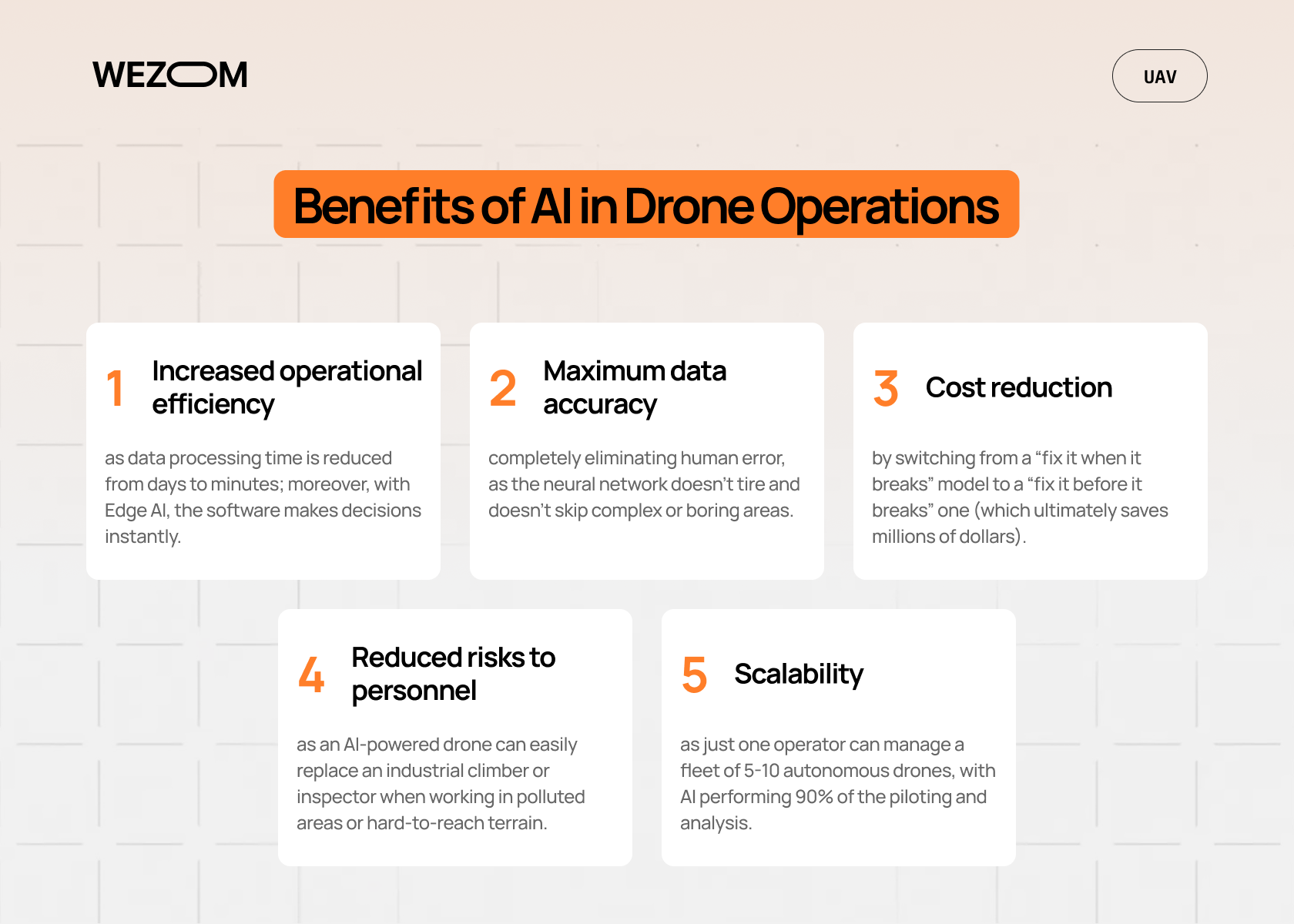
For drone software owners, what's ultimately important isn't how sophisticated the neural network magic is, but what specific KPIs it delivers. Typically, this means:
- Increased operational efficiency, as data processing time is reduced from days to minutes; moreover, with Edge AI, the software makes decisions instantly.
- Maximum data accuracy, completely eliminating human error, as the neural network doesn't tire and doesn't skip complex or boring areas.
- Cost reduction by switching from a “fix it when it breaks” model to a “fix it before it breaks” one (which ultimately saves millions of dollars).
- Reduced risks to personnel, as an AI-powered drone can easily replace an industrial climber or inspector when working in polluted areas or hard-to-reach terrain.
- Scalability, as just one operator can manage a fleet of 5-10 autonomous drones, with AI performing 90% of the piloting and analysis.
Challenges in the Drone Industry and How AI Solves Them
Despite the maturity of today's UAV software market, scaling such software solutions still faces challenges due to limited human resources and the complexity of the environment. Specifically, this concerns:
- A lack of qualified personnel. Manually inspecting a kilometer of pipeline or a hectare of forest requires hundreds of man-hours, so fatigue-related errors are inevitable. Meanwhile, AI is shifting drones into a “set and forget” mode, where mission autonomy allows a single operator to control a swarm of 10+ aircraft.
- Data overload. Just one flight with an 8K camera or LiDAR scanner generates terabytes of raw data, so manually sorting it makes the project economically unfeasible. In contrast, computer vision algorithms pre-process data in real time, highlighting only critical anomalies and generating a report immediately after landing.
- Safety in complex environments. Indoor or forested flights often result in aircraft being lost due to dynamic obstacles. However, with deep learning-based AI obstacle avoidance systems, drones gain the ability to assess spatial parameters and then select the optimal evasive maneuver (without interrupting the mission).
- Operational inefficiency. While suboptimal routes drain battery life, AI can optimize flight paths based on wind and terrain, thereby maximizing flight time (typically by 15-20%).
- Regulatory compliance. Complex legislation requires strict adherence to flight zones and a range of safety protocols. To achieve this, developers resort to using AI that automatically checks the route against ATM databases and adjusts course when entering restricted areas.
Future Trends in AI-Powered Drone Technology
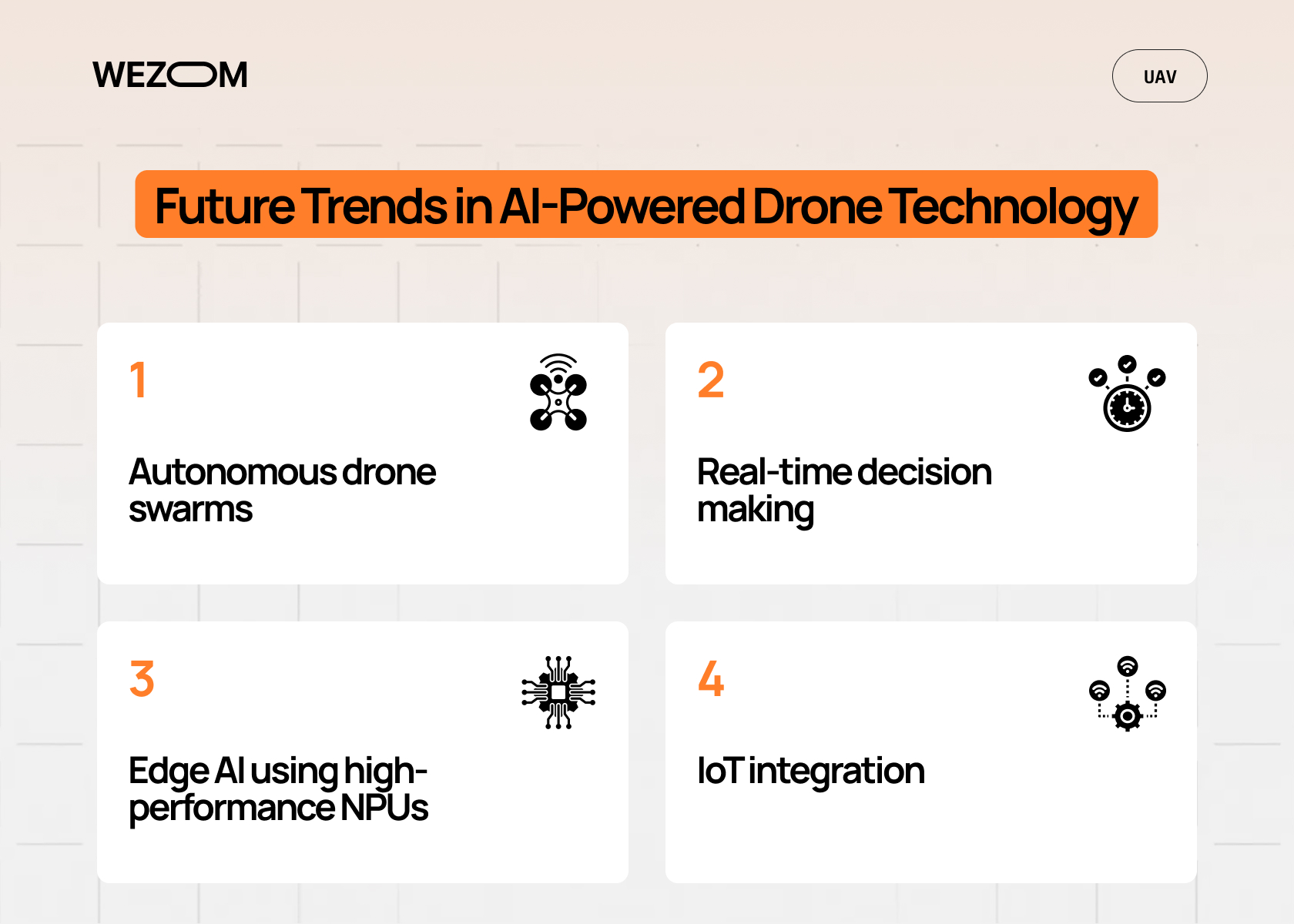
According to our internal insights, AI-based software for UAVs will see the most active development in the coming years in the following areas:
- Autonomous drone swarms, which implies a shift from single missions to collective intelligence, where a swarm of drones with AI will distribute tasks among themselves during flight (for example, one drone scans, a second details, while a third relays a signal).
- Real-time decision making, with flexible behavior in uncertain situations (for example, drones will soon be able to independently change mission priorities upon detecting a victim while searching for forest fires).
- Edge AI using high-performance NPUs (they will soon be comparable to full-fledged servers, making the drone completely independent of communication with a base station or satellite).
- IoT integration, meaning drones will become fully functional smart city sensors and will be able to exchange data with traffic cameras and city navigation robotics systems in real time.
Conclusion
In summary, the use of AI in UAV software development will enable businesses to implement a number of complex processes autonomously and cost-effectively. This is all thanks to drones, which will finally be able to understand their surroundings in real time and make instant decisions based on this information without human intervention.
FAQ
How does AI improve drone operations?
Artificial intelligence ensures the automation of the most complex steps, such as plotting the optimal route based on current weather conditions, conducting inspections with instant identification of defects in images, and more. Ultimately, this reduces mission time by tens of times.
What industries use AI-powered drones?
These are primarily used in agriculture, energy, logistics, and the security sector. These technologies are also gradually being implemented in environmental monitoring (particularly for forest protection and tracking animal populations in hard-to-reach areas).
How accurate is AI in drone data analysis?
Modern neural networks are capable of achieving 98-99% accuracy in classifying objects. In practice, this significantly exceeds the capabilities of the human eye (especially when working with large arrays of monotonous images) and eliminates the possibility of missing critical faults or pest infestations (which are usually inevitable due to human analyst fatigue).
How do AI drones handle obstacles?
Typically, such systems rely on sensor fusion algorithms to combine data collected by lidar and cameras and then create dynamic 3D maps of the environment. This allows the drone to instantly stop before an obstacle and immediately plan a safe flight path around it (which is quite feasible even in rapidly changing environments or, for example, indoors).
Can AI drones replace human inspectors?
For now, a complete replacement is impossible, as the final decision and legal responsibility still remain with humans. However, it's important to emphasize that AI takes over 90% of the routine and dangerous work, meaning human experts can focus on interpreting results and managing complex processes, rather than exposing themselves to danger or wasting time on routine, labor-intensive tasks.
