
Just ask yourself: how much of your working capital is currently frozen in warehouses as excess inventory? And how often does your forecasting system result in shortages of fast-moving items, directly worsening customer loyalty? Finally, are your traditional planning methods, based on manual adjustments, prepared for market volatility? We believe the answer to all these questions lies at the intersection of finance and intelligent technologies, which we'll discuss below. By leveraging AI in operational processes, retailers can achieve significant working capital optimization, reducing excess stock and increasing cash flow efficiency.
What Drives High Working Capital in Retail?
Excessive working capital is usually a direct consequence of operational inefficiencies and is caused by five so-called "retail anchors":
- Excess inventory. It is the most obvious anchor, often caused by outdated algorithms that fail to account for seasonality or competitor promotions, which further entails excess storage.
- Stockouts and safety stock buffers. Often, fear of product shortages forces companies to resort to unnecessary stock replenishment, which doesn't take into account the probability model. As a result, businesses waste capital on unnecessary SKUs that will never be needed.
- Inefficient forecasting. Most systems are based on one-dimensional predictive time-series models and don’t take into account other critical aspects, such as weather conditions, local events, media coverage, etc. – all of which can potentially lead to incorrect purchasing decisions over six months to a year.
- Unoptimized promotions. Promotions also often lead to increased working capital, as related purchases are often made based on overly optimistic forecasts, while demand may be lower than expected.
- Poor supplier alignment. Inconsistency with suppliers also impacts safety stock: if one supplier misses a deadline, the retailer is forced to increase the safety buffer.
Fortunately, all of these problems can be addressed, specifically with narrow-focused AI systems.
How AI Helps Retailers Reduce Working Capital
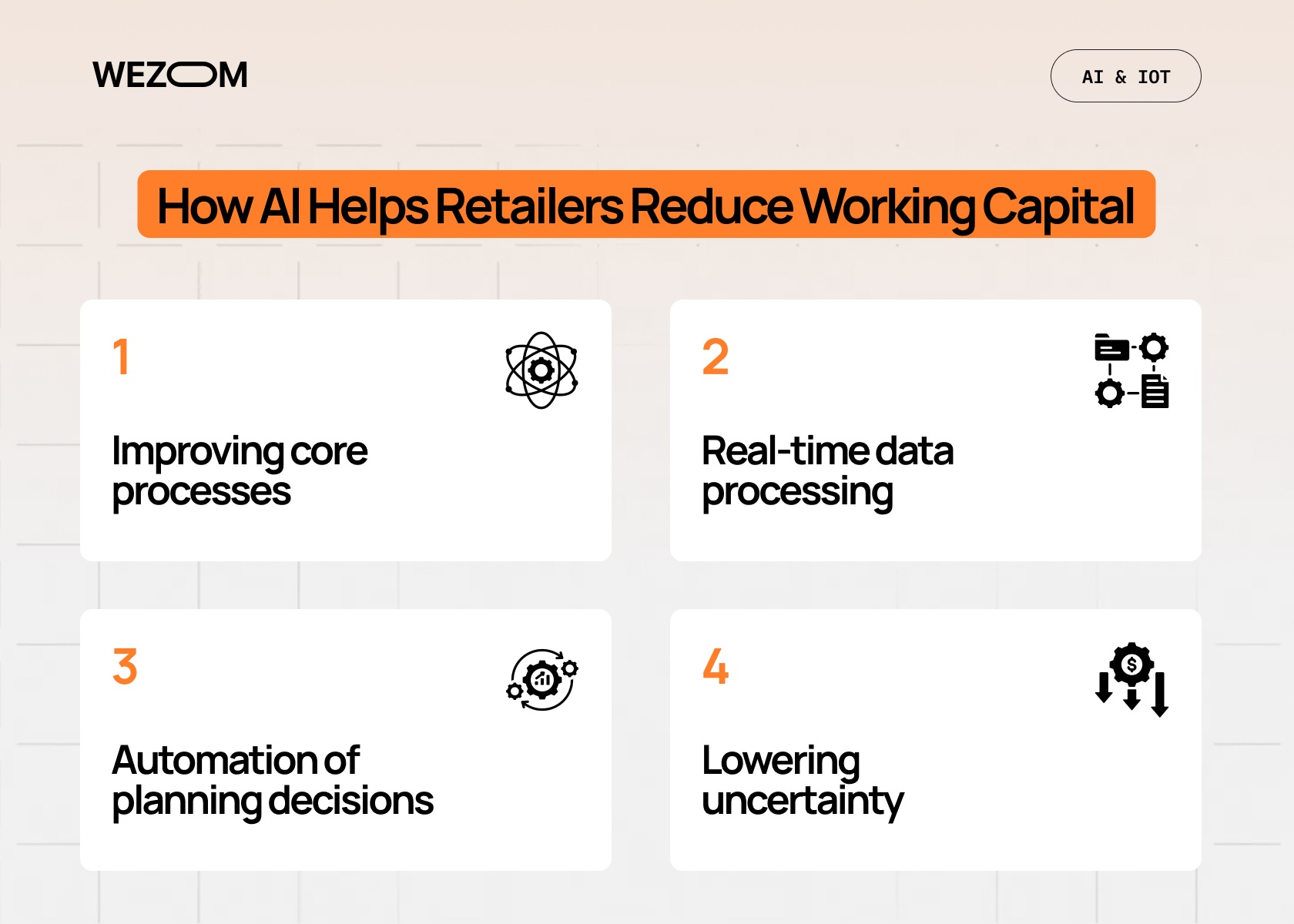
Now, it's time to figure out exactly what benefits AI can bring to retailers.
Improving core processes
AI makes working capital management prescriptive rather than retrospective – in particular, by moving from average rules to dynamic planning at the level of each SKU at each specific point of sale, as well as by automating decision-making (i.e., without manual adjustments).
Real-time data processing
Instead of processing data once a week, AI enables real-time analysis of sales and the factors that influence them, which is important given that demand has fluctuated within hours in recent decades. This approach makes it possible to implement automated micro-adjustments to orders, preventing overstock or shortages.
Automation of planning decisions
Since a colossal portion of operational managers' time is spent on manually approving orders and analyzing reports, AI applications in retail can provide benefits through AI in retail operations, up to 80% of routine planning tasks can be automated, improving decision speed and accuracy. This significantly increases the order cycle speed while simultaneously reducing operating costs.
Lowering uncertainty
Finally, AI reduces uncertainty by providing a probabilistic demand distribution and accurate risk assessment. Implementing AI working capital optimization techniques such as dynamic safety stock, predictive replenishment, and probabilistic demand modeling can unlock significant cash flow improvements. This also reduces the need to lock up significant capital in safety stock.
AI for Inventory Optimization
In this section, we would like to discuss AI inventory optimization opportunities in more detail.
For example, AI predictive replenishment systems can automatically order products based on forecasts of when a specific product will reach critical levels in a specific store. To do this, they use a demand model that calculates the optimal order timing and quantity, taking into account current transportation constraints and delivery costs. Also, instead of a single safety stock buffer, AI implements dynamic, SKU-specific management, calculating the safety stock for each product based on its demand variation coefficient, marginality, and the probability of on-time delivery. Moreover, some AI systems can dynamically model lead time based on historical and external data, such as transport hub loads, weather forecasts, holidays, and the capacity of a specific supplier. Modern AI inventory optimization tools dynamically adjust stock levels per SKU and store, preventing both overstock and shortages.
A direct consequence of all these capabilities is that, through AI, managers receive a practical action plan for reducing both excess inventory (with promotional strategies and redistribution to more active sales points) and shortages (with the scheduling of accelerated deliveries or cross-stock).
Hackett Group, Inc.’s insights
Hackett Group, Inc., a leading consulting firm in the field of generative AI for retail and enterprise digital transformation, recently announced the intriguing results of its European Working Capital Study for 2025 (covering 1,000 non-financial companies), which showed that working capital efficiency in the region continued to decline in 2024, and the cash conversion cycle worsened by 3%.
More detailed analyses revealed that the deterioration was driven by an increase in days outstanding for sales and days outstanding for inventory, which outpaced the increase in days outstanding for accounts payable. This resulted in the freezing of over €1.4 trillion in excess working capital, representing 14% of total revenue and 37% of gross working capital.
In light of this global failure, Hackett Group concluded that unfreezing working capital will require the implementation of a number of disciplines and technologies – in particular, AI, which, when integrated into enterprise resource planning and accounts receivable management platforms, will help businesses automate debt collection, predict late payments, recommend dynamic credit limits, and expedite dispute resolution. AI-driven forecasting, which can guarantee real-time visibility of demand and inventory movements, will also be useful. Finally, within procure-to-pay processes, AI will help businesses automate routine tasks, improve decision-making, and introduce AI supply chain optimization solutions, thereby reducing overhead costs.
AI for Demand Forecasting
Traditional forecasting methods are linear and often based on the stationarity of time series, meaning they rely primarily on historical sales data. Meanwhile, ML-based forecasting uses nonlinear models (such as gradient boosting or LSTM networks) capable of analyzing hundreds of diverse features simultaneously. These solutions don't simply extrapolate the past; they model the drivers of demand, allowing them to adapt to sudden changes several times faster than the aforementioned traditional systems. Specifically, AI evaluates three factors (with prioritizing them) that are inaccessible to such systems:
- Seasonal and calendar factors;
- Macroeconomic factors;
- Behavioral factors.
It's also important to highlight that forecasting demand for new products has always been a blind spot, leading to oversupply or shortages. Advanced retail demand forecasting powered by AI allows retailers to anticipate shifts in customer demand and reduce both overstock and stockouts. AI can easily address this through analog modeling, finding products with similar characteristics in the database and using their sales curves as a baseline forecast (it’s subsequently adjusted based on media noise and pre-orders).
This means that every percentage point reduction in forecast error leads to a greater or lesser degree of the release of capital, a reduction in safety stock, and, consequently, the release of funds previously tied up in a product that no one will buy soon. Implementing AI demand forecasting ensures accurate predictions, directly contributing to improved working capital optimization and inventory reduction.
AI for Promotion Optimization
The first advantage of artificial intelligence in the retail market, in the context of promotional optimization, is highly accurate promotional lift forecasting for each SKU. This is achieved because, along with historical sales analytics, the model can also analyze competitors' reactions, current inventory, and other factors, ultimately allowing retailers to timely assess whether a promotion will achieve its target ROI.
Next cannibalization prevention comes: here, AI can determine what percentage of sales of a promotional item will be gained at the expense of lost sales of another, higher-margin product in the same category. This leads to a simpler decision-making cycle of whether a promotion is worth the loss of margin or whether it should be abandoned.
Some AI solutions can also generate promotional calendars that maximize overall margins, not just sales of a single SKU – all this is made possible by highly targeted algorithms that prevent excessive promotions and ensure the correct sequencing of advertising campaigns.
Another common problem that AI can effectively combat is the overpurchase of goods that remain in stock for long periods. Specifically, AI-generated forecasts are automatically integrated into the purchasing system, ensuring that only the necessary and sufficient quantities are ordered, thereby helping in building effective inventory reduction strategies for promotional items. This integration supports effective inventory reduction strategies, ensuring only necessary quantities are ordered for each promotion.
Finally, AI improves the Gross Margin Return on Investment metric, ensuring that funds invested in promotional items are returned with the maximum margin in the shortest possible time. This also indirectly has a positive impact on the cash conversion cycle.
Financial Outcomes and ROI
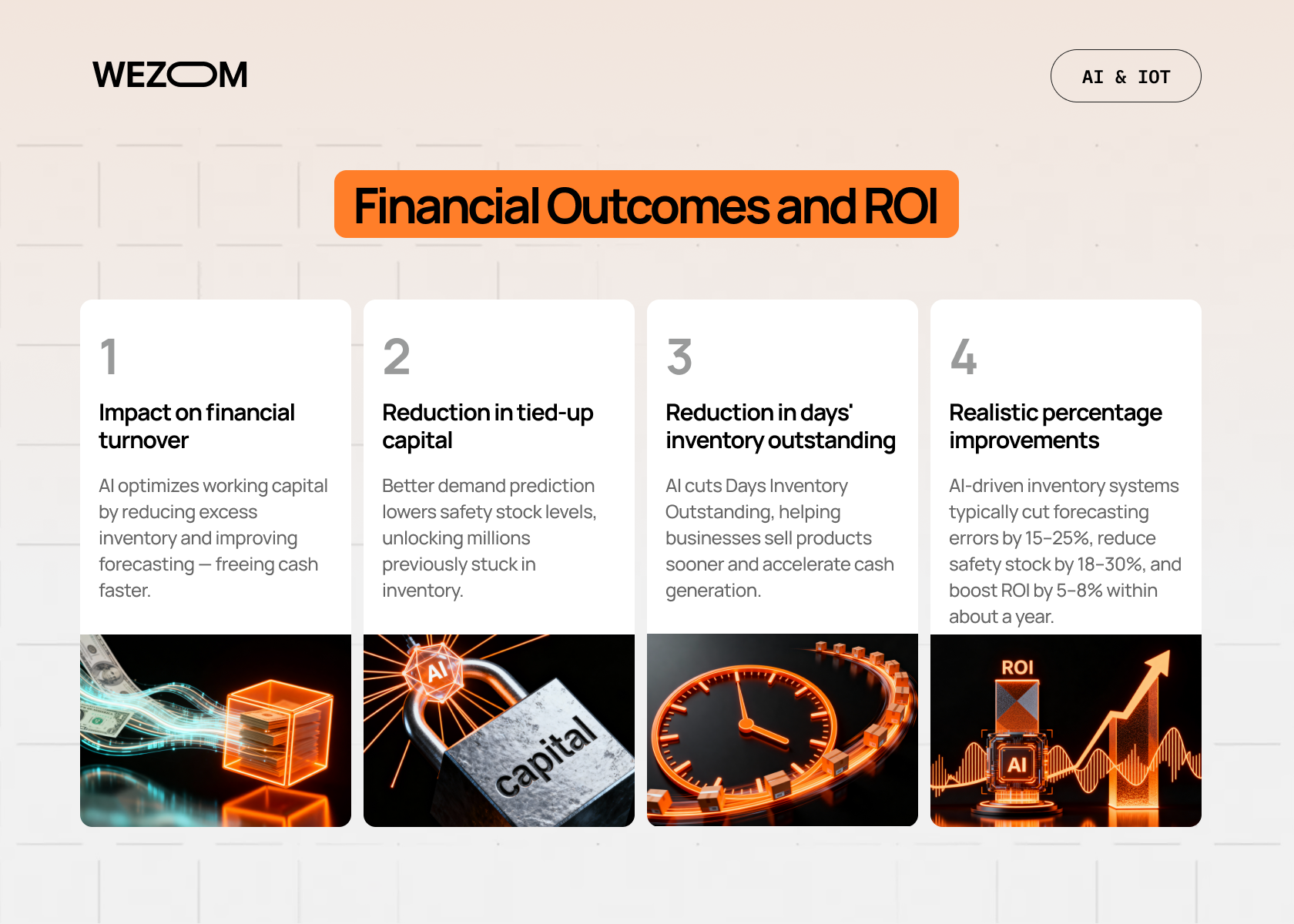
In this section, we'd like to answer the question, “How is AI changing the retail industry?” in the context of the specific financial benefits.
- Impact on financial turnover. Working capital optimization with AI has an immediate positive impact on cashflow by reducing inventory, which, in turn, allows you to convert it into cash. It also makes accounts payable and receivable forecasts more accurate.
- Reduction in tied-up capital. Using dynamic safety stock and accurate forecasting frees up tied-up capital, which for large retailers can amount to tens of millions of dollars. These measures directly help to reduce working capital tied up in slow-moving inventory and idle stock.
- Reduction in days' inventory outstanding. AI can reduce days' inventory outstanding, i.e., the number of days an item remains in the warehouse, helping businesses sell inventory faster and, consequently, generate cash more quickly.
- Realistic percentage improvements. With the correct implementation of a comprehensive AI solution for retail inventory management and forecasting, companies achieve remarkable results within a year and a half, reducing MAPE (by 15-25%) and safety stock (by 18-30%), as well as increasing ROI (by 5-8% of annual purchasing volume).
It's also worth noting that, unlike rule-based planning systems, retail planning AI has better elasticity (as the model can retrain on new data), is nonlinear (meaning it can identify non-obvious insights and dependencies between variables), and is based on a probabilistic approach, allowing retailers to make decisions based on informed risk assessment. With the correct implementation of a comprehensive AI solution for retail inventory management, companies can achieve more precise stock control and free up working capital.
Challenges and Risks to Consider
Using AI solutions for retail processes, such as working capital management, comes with a number of sometimes subtle risks:
- Poor data quality. This refers to the "Garbage In, Garbage Out" problem, where predictive models are highly sensitive to data quality, for example, if they have gaps in historical sales records, errors in marking promotional periods, inaccuracies in lead-time data, a lack of data standardization across different branches, etc. All of this can be addressed through preliminary data cleaning and standardization.
- Integration with legacy retail systems. Large retailers often use legacy ERP systems, making integrating modern AI pipelines unnecessarily complex. To overcome this challenge, you'll need to implement API gateways that ensure seamless data transfer back and forth with minimal latency.
- Model drift. Machine learning models are subject to data drift (related to changing consumer and market behavior patterns), which causes their accuracy to decline over time. Addressing this issue requires the implementation of MLOps pipelines with automatic drift monitoring and a model retraining mechanism.
- Organizational readiness. In addition to having the necessary technological foundation, you’ll also need to ensure your employees are prepared to use it. Therefore, you must provide training focused not on delving into the model codebase, but on changing their decision-making principles.
- Change management. AI implementation radically transforms work processes, and AI recommendations often conflict with employees' years of experience. To avoid them, you’ll have to ensure transparent communication of project goals and engage users in the model testing process.
If you would like to seamlessly introduce AI-driven retail demand forecasting into your regular processes, write or call us, and we’ll take care of everything.
How Retailers Can Implement AI

The use of AI in retail requires a well-thought-out implementation workflow based on achieving the fastest possible profitability:
- Discovery and data audit, with assessing pain points (essentially, the SKUs with the largest surplus/shortage) and identifying critical financial metrics such as DIO and GMROI.
- Building an MVP/pilot project based on a basic AI demand forecasting model for a single product category/region.
- Validation and operation in Shadow Mode (this involves testing the AI for the accuracy of its decisions by comparing them with manual decisions).
- Go-live and integration through the gradual introduction of automation with the mandatory use of Human-in-the-Loop practices. This approach allows the introduction of AI supply chain optimization solutions that reduce bottlenecks and improve overall operational efficiency.
- Expansion and implementation of MLOps for scaling across the entire product assortment, as well as continuous monitoring and retraining of models.
Given the complexity of these steps, you’ll need a specific technology stack including cloud platforms (like AWS SageMaker/Azure ML/Google Vertex AI), specialized FinOps tools, data lake/lakehouse tools (they're needed for consolidating structured and unstructured data), and API management solutions (for building gateways between the ML model and legacy software you're already using).
And yes, a few words about the team – you won't just need an IT department, but a cross-functional team with data scientists, ML engineers, FinOps specialists, business analysts, cloud architects, and supply chain managers – it all depends on how deeply you're involved in the model building process (i.e., whether it's based on an existing platform or developed from scratch by your internal team).

FAQ
How does AI help reduce working capital in retail?
You can reduce working capital with AI by minimizing its freezing in excess inventory — in particular, through accurate demand forecasting, the introduction of dynamic safety stock management for each SKU, and excluding over-purchasing of promotional goods.
What AI techniques improve retail demand forecasting?
They involve the use of ensemble ML models such as Gradient Boosting and Random Forest, as well as deep neural networks capable of analyzing time series, allowing consideration of the nonlinear influence of hundreds of external factors simultaneously.
Can AI help retailers avoid overstock during promotions?
Yes, it can — for example, through the accurate forecasting of promo lifts for each specific case. Instead of ordering goods according to the most pessimistic scenario, AI assesses the required procurement volume and then sends this data to the appropriate system.
What are the risks of using AI for demand forecasting?
They include, first of all, the low quality of the initial data and the model drift, which occurs when a model trained on outdated data loses its accuracy in a changing market.
What challenges do retailers face when integrating AI?
Challenges of AI in retail include resistance from personnel accustomed to manual operations, the difficulty of integrating with legacy systems, as well as the need to build expensive MLOps infrastructure required for continuous model monitoring and retraining.
