
The future surrounds us everywhere, particularly when we consult a doctor, attempt to solve health problems ourselves, or follow a healthy lifestyle on our own. For instance, this year, Forbes stated quite an interesting fact: about 22% (which is almost a quarter of all) of healthcare organizations have already implemented AI tools, driven by the growing need for end-to-end automation, immediate processing of large datasets from disparate sources, and highly skilled assistance to human specialists. This growing adoption is closely tied to AI in healthcare regulations and the need to ensure healthcare AI compliance from the early stages of product development.
Meanwhile, AI for this sector is not ChatGPT or Google Gemini that we use for everyday needs. Below, as an experienced Healthtech company, we’ll provide you with some unobvious insights connected with its usage in this field.
Why Healthcare Organizations Use Artificial Intelligence
So, how is AI used in healthcare? Let's consider the main tasks that it can solve more effectively than other technologies in this field.
- Clinical decision support. Leading medical centers are already implementing multimodal LLM systems, which address the issue of alert fatigue rather than accuracy. These systems employ context-sensitive algorithms that filter out 90% of false positives, including those caused by doctors' own misinterpretations.
- Diagnostics and triage. The use of AI in healthcare enables the processing of images and data from wearable devices either locally or on the clinic's servers, minimizing latency and reducing the load on the cloud. Regarding triage, voice biomarkers will increasingly be used, taking into account both text and the patient's intonation/breathing/coughing.
- Patient engagement. AI-powered applications will soon rely on reinforcement learning to determine the ideal moment to communicate with a specific patient, thereby creating a fundamentally new level of personalization.
- Operational automation. Since modern AI can completely take over medical coding, automatically converting physician notes into ICD codes with accuracy superior to that of humans, it significantly reduces the number of claim denials. We can also expect the tight integration of RPA with cognitive agents, requesting missing documents from patients or laboratories without the involvement of medical center personnel.
- Data analytics. Very soon, developers will use synthetic data to train models for AI applications in healthcare, thereby solving the problem of a lack of rare clinical cases and helping to circumvent strict privacy restrictions. Analytical platforms will also increasingly adopt a data mesh format, ensuring that exchange of insights between different clinical departments is conducted in safety, without the need to utilize hard-to-implement data lakes.
If you’re interested in using AI in the healthcare industry to solve the above and other problems, feel free to contact us, and we'll implement an intelligent app tailored to your needs.
New Regulations for the Healthcare Sector
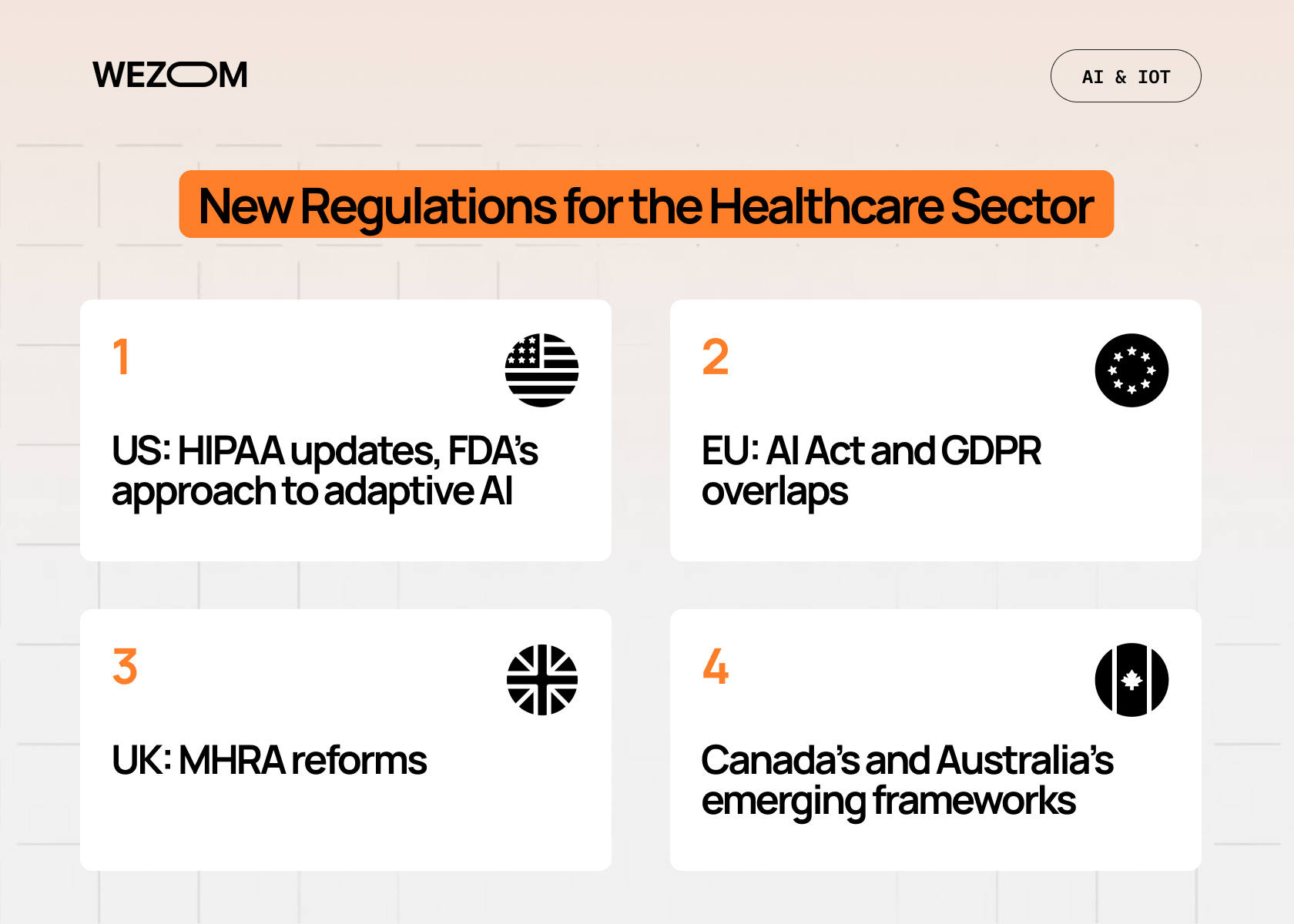
Having outlined the role of AI in healthcare, we can now move on to the key governance standards shaping the industry. These updates reflect the global shift toward stricter AI healthcare regulations and unified approaches to AI in healthcare compliance.
US: HIPAA updates, FDA’s approach to adaptive AI
The FDA has recently shifted to Total Product Life Cycle regulation, that is, issuing certificates for solutions based on adaptive AI, based on algorithms that undergo post-release training. It now requires the implementation of automated data drift monitoring systems and a Performance Change Protocol. This approach also reinforces HIPAA compliance for AI in healthcare, particularly in systems that continuously learn from patient data.
EU: AI Act and GDPR overlaps
The European AI Act aims to address the issue of explainability and regulate the right to freedom from automated decisions under the GDPR. For medical centers, this means mandatory implementation of interpretability layers on top of neural network black boxes. As a result, developers must rethink architectures to meet evolving AI in healthcare regulations across multiple jurisdictions.
UK: MHRA reforms
The MHRA is based on the concept of Software as a Medical Device Airlock that enables the temporary release of innovative AI products to a limited market under strict oversight to collect real-world data, allowing startups to quickly test hypotheses without standard EU restrictions.
Canada’s and Australia’s emerging frameworks
These countries rely on Good Machine Learning Practice, which requires proof that training samples are representative of the local population. Its principles also strictly regulate local data bias to guarantee apps’ ethics and transparency.
What does the “high-risk AI systems” classification mean?
Any AI that influences diagnosis or treatment falls into the high-risk category, meaning healthcare organizations are required to have internal quality management systems based on the ISO 13485 standard, implement logging and traceability practices for postmortem auditing, and have human-in-the-loop functionality that allows a physician to take over control of the AI at any time. Such classification directly impacts healthcare AI compliance and increases the complexity of AI healthcare workflows regulatory requirements.
Patient Data Protection
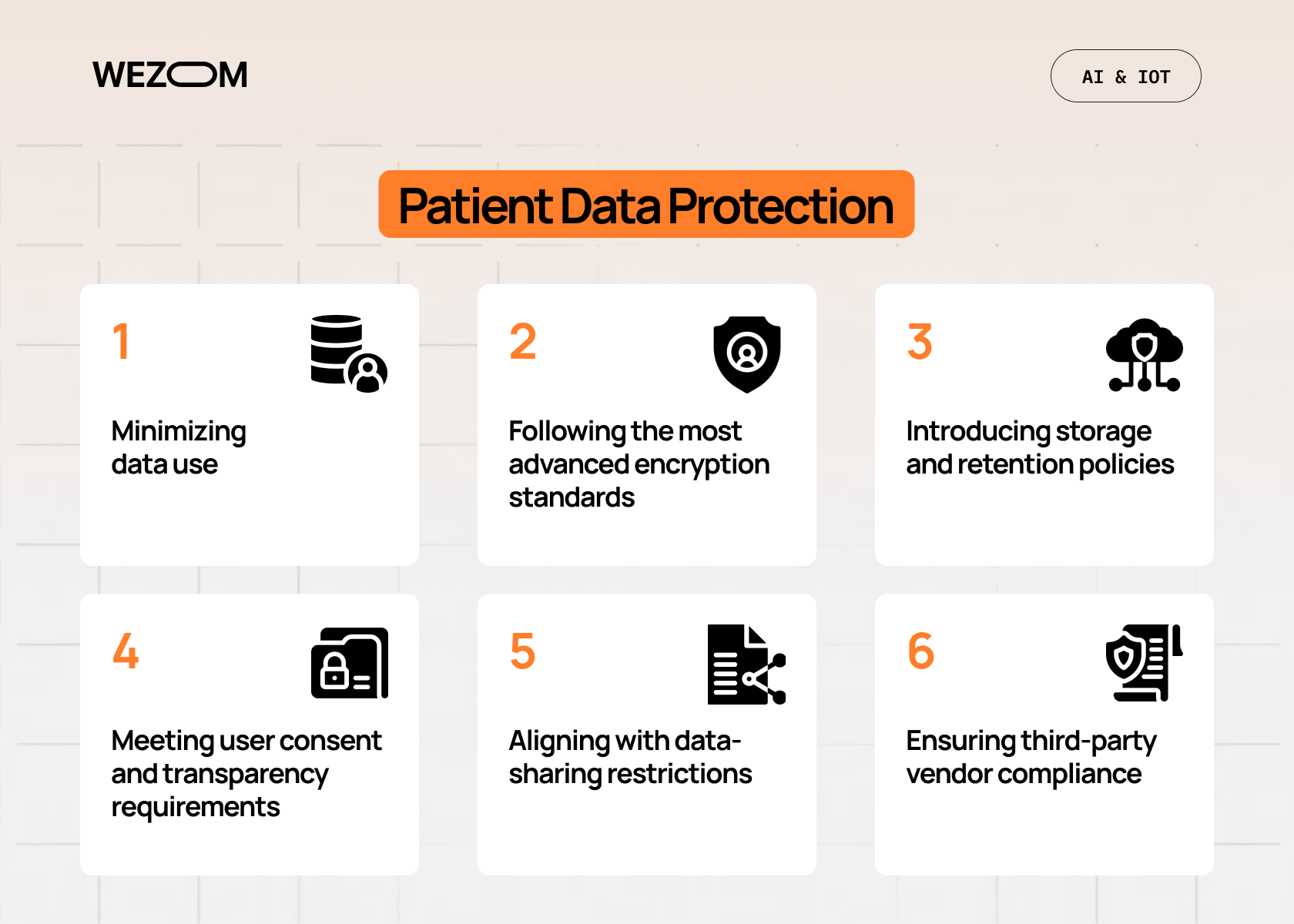
Proper data handling is a core part of AI in healthcare compliance, especially under strict medical software regulations. Since patient data privacy is critical, it's important to adhere to the following generally accepted guidelines:
- Minimizing data use. More and more developers are relying on federated learning architectures, where a model is uploaded to a patient's device or a clinic's server, trained there, and returns updated parameters instead of raw data.
- Following the most advanced encryption standards. The AES-256 standard is obsolete; the leading generative AI in healthcare examples are implementing Homomorphic Encryption, which allows computations to be performed on encrypted data without decryption.
- Introducing storage and retention policies. In this context, you need to ensure the immutability of audit logs and clinically important records (e.g., via WORM storage or immutable ledgers), and implement geofencing at the cloud service level.
- Meeting user consent and transparency requirements. Instead of a simple checkbox under the privacy policy, you should implement a Granular Dynamic Consent architecture solution, which allows the user to control access in real time. Moreover, consent to use specific patient data must be revocable at any time, requiring the backend to immediately mark data as inaccessible and exclude it from active learning pipelines.
- Aligning with data-sharing restrictions. Data transfer between clinics and applications must be based on the HL7 FHIR R5 standard, but with a new security layer.
- Ensuring third-party vendor compliance. Since third-party APIs and libraries are potentially vulnerable, it makes sense to implement a Software Bill of Materials, a detailed inventory of all AI system components. Also, if your software is based on a pre-trained model or a third-party OCR library, you are required to document their origin, versions, and dataset cards. This is also essential for maintaining AI for regulatory healthcare compliance when integrating external AI components.
Would you like to ensure all these rules are met in your software? Welcome to us, a reliable technology partner in the Healthtech sector.
Regulatory Requirements
Despite the emerging nature of AI technology, companies must already align with healthcare AI compliance requirements, especially when processing sensitive patient data.
Generally speaking, regulatory requirements for AI-driven apps are still vague due to the technology’s innovative character. However, there are a number of mandatory measures to avoid potential fines and license revocation.
The first is the inclusion of model cards in the technical documentation with the architecture’s description, intended use, successful cases, and failure modes – scenarios where the model is guaranteed to fail. The FDA also requires proof that the model's F1 score correlates with real improvements in patient outcomes. Another important aspect is bias avoidance, which is performed through counterfactual testing (it's important to ensure that the system doesn't change the diagnosis based solely on gender).
As for more transparent restrictions, the "black box" principle is prohibited by law for diagnostics, meaning the system is required to provide local explanations for each prediction based on methods such as Shapley Additive Explanations or Integrated Gradients. Moreover, it's important to prohibit your app from making decisions in high-risk systems. Therefore, they must be designed using the Intervention Friction principle, literally forcing physicians to perform a conscious action to confirm them. It's also worth noting that ISO 14971-based risk management is now replaced by the NIST AI Risk Management Framework, which controls risks associated with data drift, data poisoning, and hallucinations (you must include them in the risk matrix, defining clear mitigation measures and providing a circuit breaker).
Finally, you must implement immutable logs, which record every model inference: the hash, the model version, the returned result, the confidence score, and the human action following the recommendation. This way, if you discover a bug in the algorithms later, you'll be able to instantly find all the patients affected by it.
UX Requirements
The first thing to consider is accessibility. This involves not only ensuring adequate color contrast, legible fonts, and localization, but also developing a voice-first interface that recognizes both medical terminology and plain language. More detailed information on accessibility can be found in the WCAG 2.2 guidelines (level AAA). Another note: your app shouldn't freeze or return a "404" error. This is why it makes sense to use graceful degradation, where the interface switches to "reference" mode or an offline checklist if the required functionality is unavailable for some reason.
Also, you should remember that only a doctor can make a final diagnosis. Therefore, AI should be limited to so-called confidence bars (for example, based on the "Traffic Light" pattern, where green indicates high confidence, yellow indicates that additional physician’s oversight/clarification of symptoms is required, and red signalizes a need for a complete review by a physician).
If you're developing software for doctors, its interface shouldn't overwhelm them with alerts. The concept of "silent AI" comes to the rescue here. According to this concept, the system will operate in the background if all indicators are normal and only draw attention to deviations in a hierarchical manner. Moreover, if you're working on a comprehensive clinical system, onboarding can't involve a tutorial with only a few slides – you'll need to implement a full-fledged simulation mode with interactive cases using synthetic data to gradually build trust in the system.
How to Build a Compliant AI-Driven Healthcare App
This process should be fully aligned with AI in healthcare compliance and regulations, covering both technical and legal aspects. In this section, we’ll present a short step-by-step guide covering the key aspects to consider when developing an AI-driven healthcare app.
Define risk level and regulatory classification
First, you have to determine the device class, that is, whether your app will be categorized as Software as a Medical Device. Also, you should refer to the EU MDR or FDA classification to determine the risk class (I, IIa, IIb, III) – this will determine the scope of documentation and the need for clinical trials.
Map data flows and conduct privacy impact assessments
Now, you can move on to building a data flow map to determine where data is created, encrypted, and decrypted for processing. Also, don't forget about a data protection impact assessment (at the prototyping stage) to prove to the regulator that you’ve minimized data collection.
Implement secure architecture and encryption
At this stage, you can begin building a zero-trust architecture, where no system component relies on another by default. Also, you must consider implementing data encryption at rest, in transit, and, where possible, in use (via secure enclaves in the cloud). Finally, you need separate the storage of medical data and personal identifiers.
Validate models and document performance
Now, you're ready to conduct the model validation using holdout sets that have never taken part in training (they should belong to different demographic groups and use different devices). After that, you can create a technical file for certification, proving the robustness of the algorithm.
Design a transparent, accessible UX
It makes sense to develop the interface in collaboration with physicians, conducting usability testing in conditions simulating a real clinic – this will provide confidence that the UX prevents errors rather than causing them.
Conduct security testing and audits
At this step, you can move on to red teaming the AI, using ethical hackers to trick the model into misdiagnosing it or revealing sensitive data.
Maintain post-deployment monitoring
After the deployment, you should introduce MLOps pipelines into your workflows for production monitoring, with a set up of data shift alerts. Regular retraining and model revalidation procedures should also be scheduled in time for all updates, to maximize your software’s lifespan. Continuous monitoring is also required to meet AI healthcare workflows regulatory requirements in dynamic production environments.
Common Compliance Mistakes and How to Avoid Them
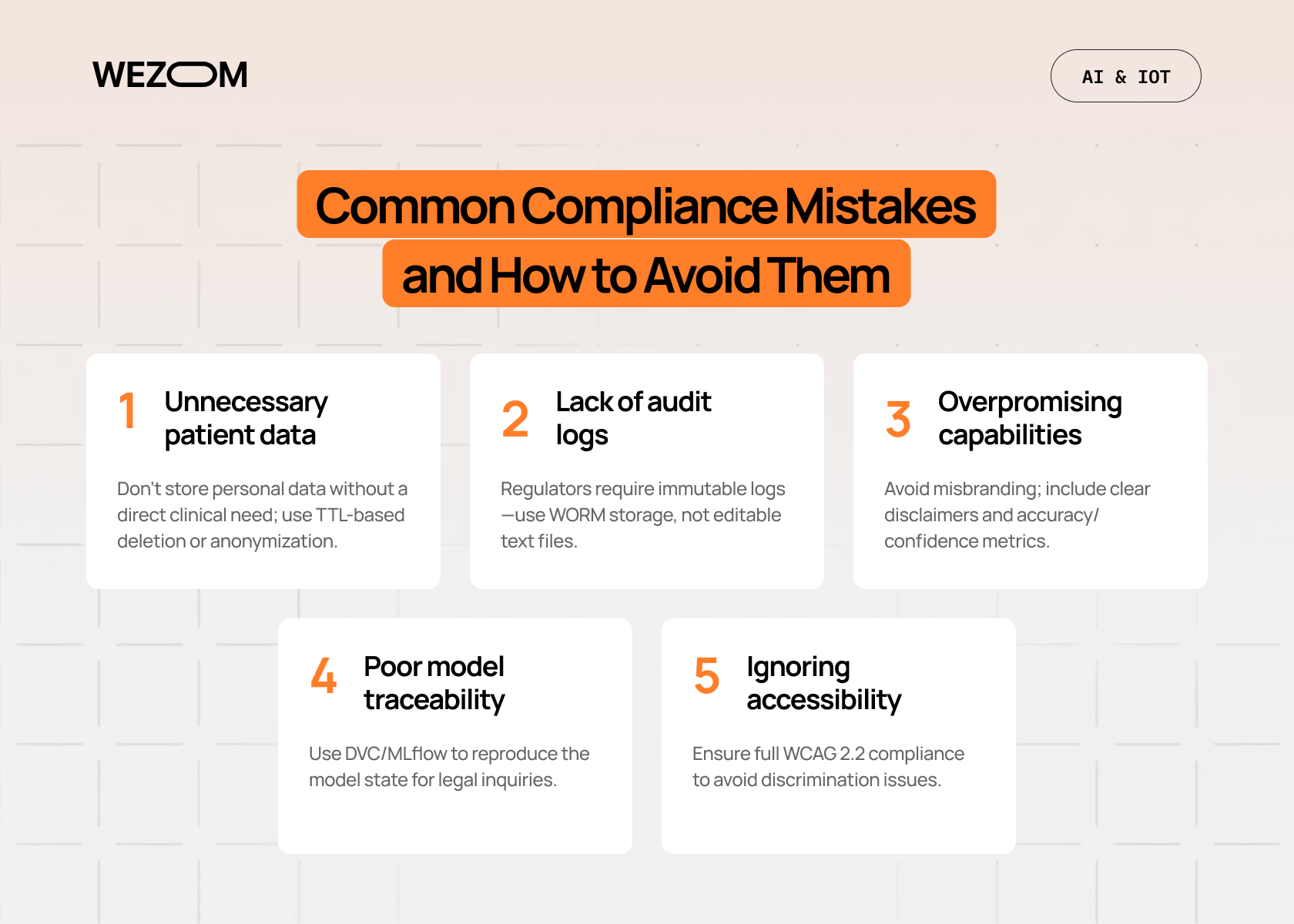
In this section, we'd like to highlight common challenges associated with using AI in healthcare apps and share insights on how to overcome them. Most of these issues arise from ignoring AI in healthcare compliance at early development stages.
- Storing unnecessary patient data. Storing patient personal data without a direct clinical need can result in fines under GDPR and HIPAA. To prevent this, you must implement automatic, time-to-live policies at the database level, deleting or anonymizing data once it no longer has operational value.
- Lack of audit logs. Since access logs are the first thing regulators request during an audit, they shouldn't be stored in plain text files that can be edited. Instead, you must use WORM storage, with every action recorded in an immutable ledger.
- Overpromising capabilities. Marketing that exceeds actual capabilities in the healthcare sector is unacceptable and is called misbranding (which can lead to losing permissions to operate). That's why you must implement strict labeling with disclaimers like "Not a definitive diagnosis" and accuracy metrics with specified confidence intervals.
- Poorly documented model behavior. If a patient files a lawsuit due to an AI error, you are obligated to restore the exact state of the neural network at the time of the incident. To make this possible, it makes sense to use tools like DVC and MLflow, so you have everything you need at hand for each release.
- Ignoring accessibility guidelines. The lack of accessibility today is tantamount to discrimination, so you must ensure your app’s compliance with WCAG 2.2.
If you want to avoid all these mistakes and other, less common ones in your project, write or call us to delegate it from start to finish!

Future Trends in Healthcare AI Regulation
The most important trend for developers working under AI healthcare regulations
is shifting from recertification for each neural network update through predetermined change control plans – that is, through prior approval with the regulator of the protocol by which the AI will be further trained. We are also moving toward a model where patients should have access to their data through decentralized protocols and be able to disclose it only during the session, without the right to copy it to the medical institution's server.
Now, a few words about regulations related to the application of AI in healthcare: today, the US, Canada, and the UK are actively promoting the aforementioned Good Machine Learning Practice, unified rules for developing medical AI, which predisposes AI solutions in healthcare to scaling into global markets. Standardization of probability representation is also becoming a trend – instead of arbitrary graphs, generally accepted risk visualization methods will be used, reducing the likelihood of misinterpretation by physicians. Finally, from August 2026, the EU will require mandatory registration of high-risk AI systems in a publicly accessible EU database. This means your app’s purpose must be public, including its accuracy level and limitations. Overall, the industry is moving toward standardized healthcare AI compliance frameworks that simplify global scaling.
FAQ
Are AI-driven healthcare apps classified as high-risk?
In the EU, this is true because of the AI Act (if the app provides medical advice, conducts triage, or interprets tests). In the US, classification depends on the level of autonomy: if the system guides the doctor, it’s Class II/III (high risk), while if it serves as a reference, the risk is lower.
What privacy rules must healthcare apps follow?
The basic minimum to get a consent for your app is to ensure compliance with GDPR (EU) and HIPAA (US) standards, but it's also important to consider local medical software regulations, such as those in Texas (requiring that medical data be stored strictly on physical servers within the state), California (CCPA), Japan (APPI), and others.
What are the biggest risks when using AI in digital health?
For AI tools in healthcare, these include algorithmic bias, hallucinations using false facts, and adversarial attacks that deliberately deceive diagnostic algorithms.
Can AI apps store medical data in the cloud?
Yes, but only if the data is encrypted with keys the cloud provider doesn’t have access to, and data residency requirements are fully met.
What security measures must healthcare apps implement?
To ensure reliability and minimize security risks, recommended measures include end-to-end encryption, multi-factor authentication for all users, regular penetration testing, and a zero-trust architecture. It's also important to develop a disaster recovery plan and ensure strong ransomware protection.
