
Most logistics operations have messy data. Fragmented across multiple systems. Inconsistent formats. Missing values. Unstructured inputs.
Waiting for this to improve before implementing AI is a mistake.
The organizations succeeding with AI in logistics aren't the ones with perfect data. They're the ones who learned to design AI pilots that work despite data imperfections — through appropriate algorithm selection, strategic data preparation, and iterative validation.
This article outlines a practical approach:
- Realistic assessment of logistics data challenges.
- Design principles for effective AI pilots.
- Data preparation strategies that deliver ROI.
- AI methods that handle incomplete datasets.
- Integration approaches for existing systems.
- Framework for measuring and scaling success.
The goal is to help you build AI pilots that succeed with the data you have, not the data you wish you had.
Understanding Your Data Challenges
Data silos are killing your visibility. Your Transportation Management System doesn't talk to your Warehouse Management System. Your fleet management software lives in its own universe. ERP? That's another island entirely. Each system has its own format, its own timestamp conventions, sometimes even its own version of 'customer ID.'
Then there's the format chaos. One system gives you dates as MM/DD/YYYY, another prefers DD-MM-YYYY, and — weirdly enough — one still uses Unix timestamps. Weights might be in pounds, kilograms, or just blank fields where someone forgot to enter anything.
Missing values? You'll find those everywhere.
Unstructured data adds another layer: sensor readings from IoT devices that arrive whenever they feel like it, GPS coordinates with inconsistent precision, spreadsheets that drivers fill out with creative interpretations.
Common mistakes? People either spend six months trying to achieve perfect data (spoiler: you never will), or they jump straight into AI without any cleaning whatsoever. Both approaches fail. The sweet spot is somewhere in between.
Key Principles for AI Pilot Design

Start small. Seriously, smaller than you're thinking right now. Don't try to optimize your entire logistics network on day one. Pick one corridor — maybe that route between your Chicago warehouse and Detroit distribution center. Or one warehouse where you want to improve dock scheduling.
Pilot AI success depends on learning fast, and you can't learn fast when you're drowning in complexity.
Define clear KPIs before you write a single line of code. What does success look like? Maybe it's reducing empty miles by 15%. Maybe it's improving container utilization from 70% to 85%. Whatever it is, write it down. Make it measurable.
Research from Gartner shows that organizations defining clear performance metrics before starting AI pilots significantly increase their chances of successful scaling. Yet many companies still launch pilots without concrete success criteria — and wonder why they struggle to scale.
Focus on high-impact processes. Your AI pilot for logistics should target something that actually moves the needle. Route optimization? High impact. Predictive maintenance on your most expensive fleet assets? Very high impact.
Embrace iteration. Your first model won't be perfect. That's fine. The goal of a pilot isn't perfection — it's rapid learning. Set up feedback loops. Test assumptions weekly, not quarterly. Use an agile workflow where you're constantly refining based on what you're seeing.
Data Preparation Strategies
Data cleaning and normalization don't have to be perfect, but they do need to be consistent. Pick a standard format for dates, times, weights, distances — whatever dimensions matter for your pilot. Then systematically convert everything to that standard.
Feature engineering with incomplete datasets is where things get interesting. You don't always need complete data to create useful features. Missing a precise delivery time? You might still know the day. Missing exact weight? You might know the weight category.
Handling missing values: you've got options. Mean imputation works for some things (average delivery time, for instance). For categorical data, create a separate 'unknown' category. For time-series data from sensors, forward-fill or interpolation can work.
But here's the key: don't just blindly fill in missing values. Understand why they're missing. If 30% of your weight measurements are blank, there's probably a systematic issue with how that data gets captured.
Synthetic data generation can be a lifesaver for testing your AI pilot before you have perfect real-world data. Generate realistic shipment records based on distributions you observe. Create simulated routes with varying traffic patterns. Build test datasets that let you validate your algorithm without waiting for months of clean production data.
Data augmentation helps when you don't have enough training examples. Got 500 delivery scenarios but need 5,000? Augment by slightly varying times, distances, weights. Add realistic noise.
AI Approaches That Work with Messy Data
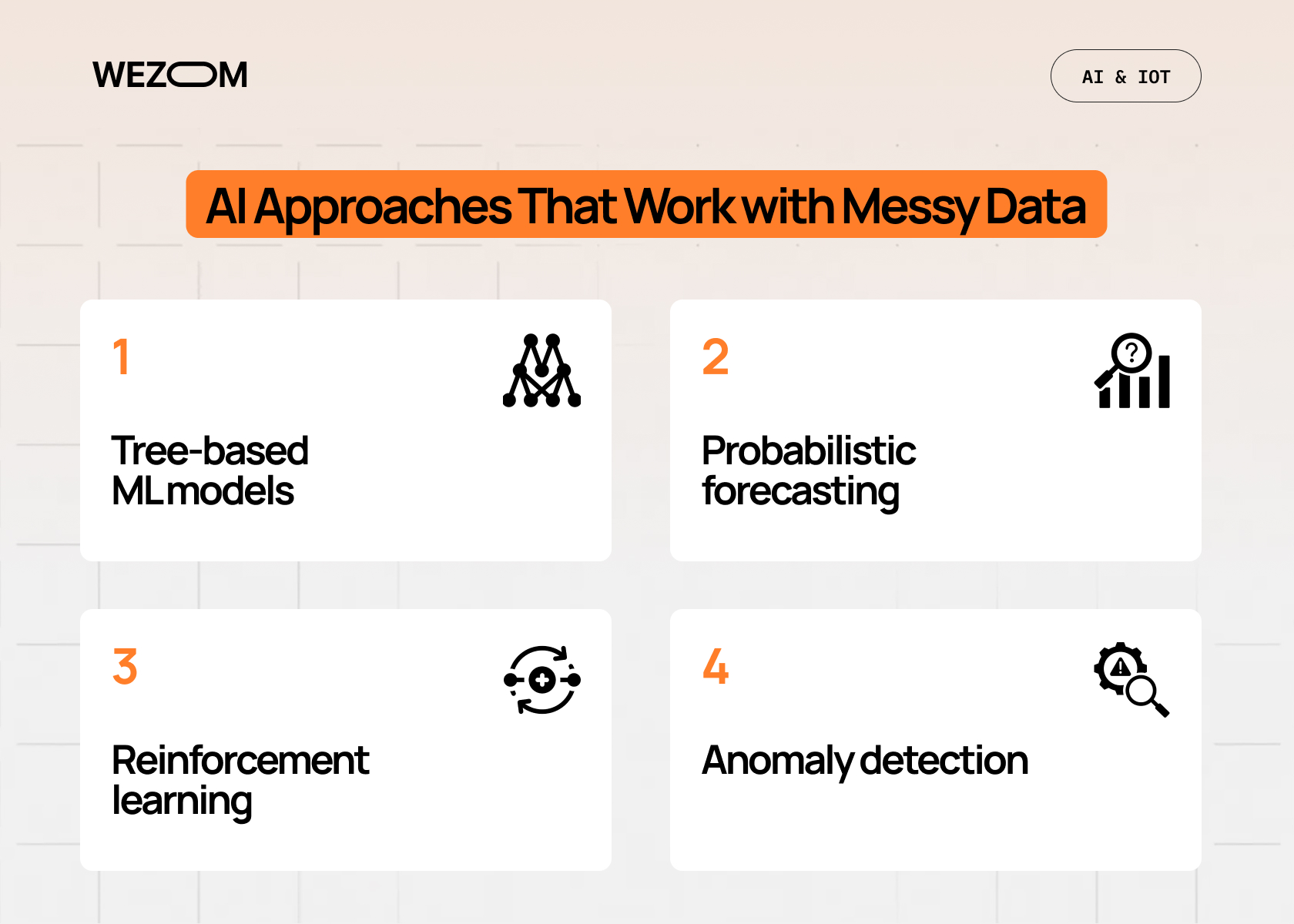
Machine learning models that handle incomplete data include tree-based algorithms like Random Forests and Gradient Boosting. These can naturally handle missing values and don't freak out when your dataset has gaps. They're also interpretable, which matters when you need to explain to operations why the AI suggested a particular route.
Probabilistic forecasting gives you ranges instead of precise predictions. Instead of saying 'delivery will take exactly 47 minutes,' you get 'delivery will take 40-55 minutes with 80% confidence.' When your input data is uncertain, probabilistic outputs make way more sense.
Reinforcement learning for route optimization is particularly interesting because it learns from experience. The AI agent tries different routes, observes what works, adjusts its strategy. You don't need perfect historical data — the model creates its own training data through trial and error.
AI-powered anomaly detection doesn't even need labeled training data. Unsupervised algorithms can find unusual patterns — trucks that deviate from normal routes, shipments that take way longer than expected, fuel consumption that spikes unexpectedly.
Integration With Existing Logistics Systems
TMS, WMS, and ERP integration is non-negotiable. Your AI needs data from these systems, and ideally it should be able to feed recommendations back into them. This usually means APIs, webhooks, or scheduled data syncs.
Real-time IoT and sensor data streams add another layer of complexity. Temperature sensors in refrigerated trucks, GPS trackers, fuel monitors — all of this can feed into your AI, but you need infrastructure to handle streaming data. Message queues, time-series databases, real-time processing pipelines — the whole stack.
For a pilot, you might not need real-time initially. Batch processing every hour could be fine. Get it working first, then optimize for latency.
Cloud vs on-premise? Most AI pilots today lean toward cloud because it's faster to set up and easier to scale. You can spin up compute resources when you need them, pay for what you use, and avoid lengthy procurement cycles for hardware.
But if you have strict data residency requirements or massive data volumes that would cost a fortune to transfer, on-premise or hybrid might make sense. Some organizations keep raw data on-premise and only send aggregated features to the cloud for model training.
Don't overthink this for your pilot. Pick what's fastest to implement. You can always migrate later.
Choosing the right integration method depends on your specific constraints — system age, data volume, latency requirements, and available resources. Here's what works best in different scenarios.
| Approach | Best For | Setup Time | Scalability |
|---|---|---|---|
| REST API | Modern systems, real-time needs | 1-2 weeks | High |
| Database Export | Legacy systems, batch processing | 2-3 days | Medium |
| File Transfer (FTP/SFTP) | Simple data exchange, scheduled updates | 1 week | Low-Medium |
| Message Queue | High-volume, asynchronous processing | 2-3 weeks | Very High |
Start with the simplest approach that meets your pilot's needs. You can always upgrade to a more sophisticated integration method once you've proven the concept.
With API-first approach, even if your pilot is small, design it with an API from the start. This makes it way easier to scale later. Your prototype might serve predictions to just one dashboard today, but if it's API-based, connecting five more systems tomorrow is trivial.
Measuring Success and Scaling
KPI evaluation should happen continuously during the pilot, not just at the end. Set up a dashboard that tracks your key metrics daily or weekly. Are empty miles actually decreasing? Is route efficiency improving?
ROI estimation needs to account for both hard and soft benefits. Hard: reduced fuel costs, fewer drivers needed, decreased empty miles. Soft: better customer satisfaction, more reliable delivery windows.
When do you scale? Not when the pilot is perfect. You'll never get there. Scale when you've demonstrated clear ROI on a small scope, when you understand what data you need and how to get it, and when you've worked out the major operational kinks.
A McKinsey study found that only 10% of AI pilots successfully scale to production. The main reason? Companies either scale too early (before they've validated the approach) or wait too long (until the business context has changed).
Lessons learned: document everything. What worked? What didn't? Which data sources were actually valuable vs which ones turned out to be noise? These lessons become your playbook for deployment.
Common Pitfalls and How to Avoid Them
Overcomplicating the pilot is the number one killer. Someone gets excited and wants to optimize routes AND predict demand AND automate warehouse scheduling all in one go. Don't.
Pick one problem. Solve it well. Then move to the next one.
Ignoring business context happens when tech teams build AI in isolation. Your model might be technically brilliant, but if it recommends routes that violate driver union agreements or customer delivery windows, it's worthless. Involve operations people from day one.
Poor change management sinks more AI project pilots than bad algorithms. If your dispatchers don't trust the AI recommendations, they won't use them. Frame AI as augmentation, not automation. Position it as a tool that makes their jobs easier.
Insufficient training is related. You can't just deploy an AI tool and expect people to figure it out. They need to understand what it does, why it suggests what it suggests, and when to override it.

Conclusion
Messy data doesn't have to stop your AI pilot. Logistics companies that start now — with imperfect data — will be miles ahead of those still waiting for perfect conditions. What matters is starting small, being smart about data preparation, choosing the right algorithms, and keeping your eyes on business outcomes.
The companies that succeed with AI in logistics aren't the ones with perfect data. They're the ones that know how to work with imperfect data intelligently. They prototype, they test, they validate, and they iterate until they find something that works.
Need help navigating the pilot-to-production journey? Our team specializes in designing AI solutions for logistics operations with real-world data constraints. We've helped companies move from messy spreadsheets and disconnected systems to scalable AI deployments — without waiting for perfect data. Get in touch to discuss how we can help you design and launch your AI pilot.

FAQ
What is an AI pilot in logistics?
An AI pilot in logistics is a small-scale, controlled implementation of artificial intelligence technology designed to solve a specific logistics challenge — such as route optimization, demand forecasting, or warehouse automation. It serves as a testing phase to validate whether an AI approach works in a specific environment before committing to full-scale deployment.
Why is messy data a challenge for AI in logistics?
Messy data is challenging because most AI algorithms require clean, consistent, and complete datasets. In logistics, data often comes from multiple systems such as TMS, WMS, and ERP that may not integrate well, leading to inconsistent formats, missing values, and unstructured information. With proper data preparation strategies and suitable algorithm choices, effective AI solutions are still achievable.
Can AI work with incomplete or inconsistent data?
Yes. Certain machine learning approaches, such as tree-based algorithms like Random Forests and Gradient Boosting, handle incomplete data effectively. Probabilistic forecasting methods can also manage uncertainty inherent in messy datasets. The key is selecting the right approach for the available data quality and applying smart data cleaning and normalization techniques.
How to measure AI pilot success in logistics?
AI pilot success should be measured using clear, predefined KPIs aligned with business objectives. Common metrics include cost savings (fuel, labor, overhead), operational efficiency (reduced empty miles, improved vehicle utilization, faster delivery times), and performance improvements such as on-time delivery rates. Baseline measurements should be set before the pilot, with continuous tracking during testing.
How to clean and normalize logistics data?
Begin by defining standard formats for key data dimensions such as dates, times, weights, distances, and locations. Use automated scripts to convert data from different sources into these standards. Address missing values with appropriate methods, including mean imputation for numerical data, categorical assignment for classifications, and forward-filling for time-series sensor data. Prioritize cleaning efforts on the data most critical to your specific AI pilot.
