
We all know that none of the static reports we're accustomed to can answer the question, “What's next?” – instead, they simply reflect the current state of affairs. However, thanks to the advent of AI, this problem can be addressed – specifically through AI dashboards, which allow businesses to act proactively, guided by evidence-based predictive analytics instead of intuition. Below, we'll discuss the components that such dashboards should include, as well as explain how to build them and what mistakes to avoid during their development and implementation.
What Are AI-Powered Dashboards?
AI-powered dashboards are NexGen business analytics solutions with a machine learning layer integrated between raw data and visualization. Talking about what’s under the hood, machine learning here searches for subtle patterns, while automation algorithms handle the entire ETL process, extracting data from external systems and interpreting it to make it valuable for a specific business.
While traditional dashboards only summarize the results of a company's previous activities (requiring manual investigation of the causes of a particular outcome), AI dashboards are equipped with predictive capabilities and, in particular, can perform modeling of future events. Therefore, they can even generate text explanations for the causes of negative outcomes, suggesting possible solutions and alerting managers to hidden threats.
Main Features of AI Executive Dashboards
Formally, we can identify five fundamental features that a typical executive reporting dashboard should have:
- Predictive analytics, so the solution can build mathematical models based on historical data, for example, forecasting revenue by the end of a quarter, taking into account seasonality and market fluctuations, with up to 95% accuracy;
- Real-time data processing, so the system can track margin changes or supply chain disruptions as they occur;
- Natural language insights, enabled by generative AI integration, will allow the solution to supplement graphs with text-based explanations/instructions;
- Automated reporting, so the solution automatically generates regular reports tailored to the specific role of the specialist handling them;
- Smart alerts, so the system continuously monitors baselines and signals responsible parties if any of them deviate from the statistical norm.
Mandatory Components of AI-Powered Executive Dashboards
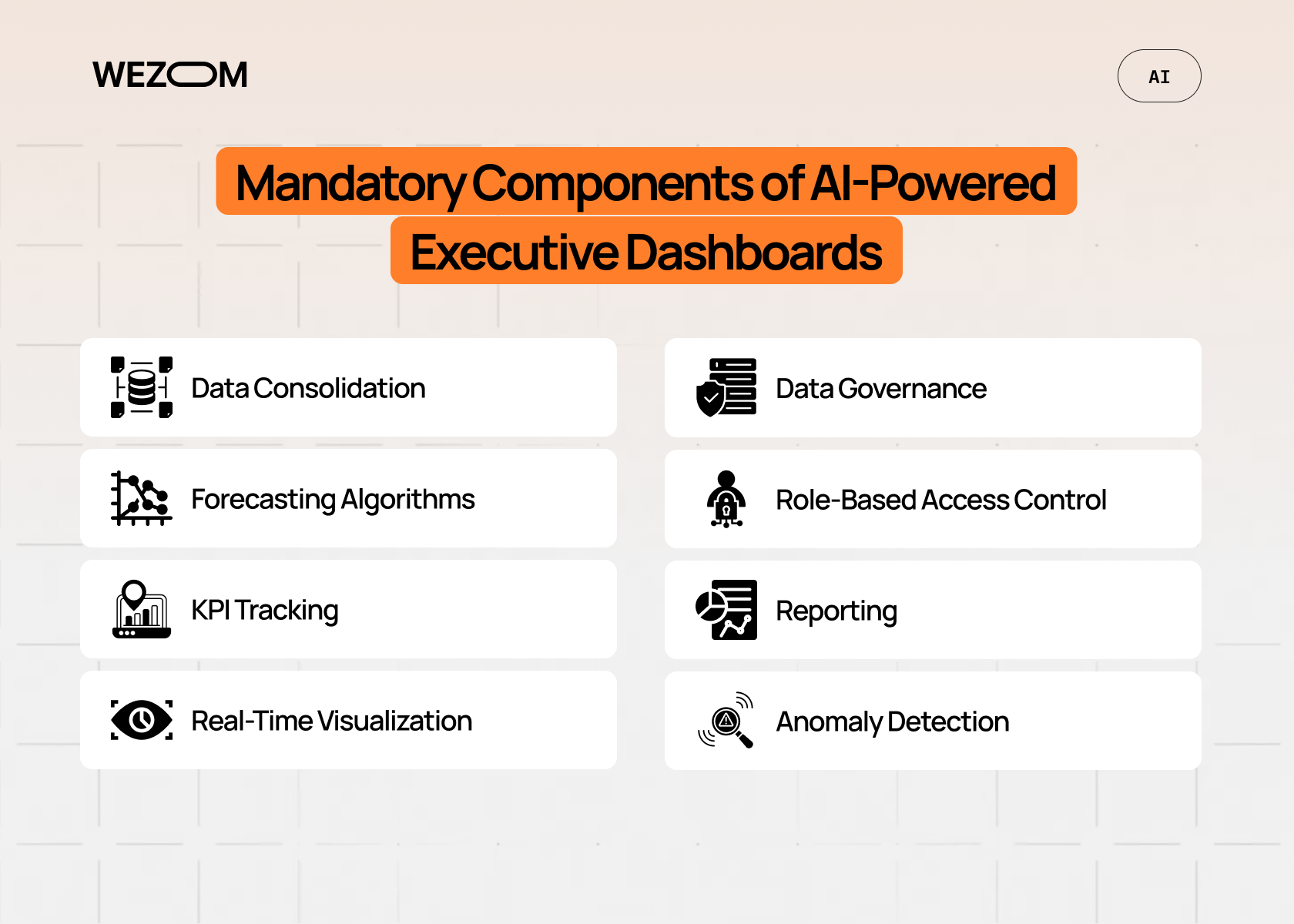
To make an AI analytics dashboard to deliver real value to a specific business, you have to include eight fundamental modules that must be mutually integrated. Let's consider them in turn.
Data Consolidation
Artificial intelligence will be only as effective as the completeness of the data it uses for analysis. This means the development team must correctly integrate disparate data streams from ERP, CRM, HRM, marketing platforms, and other systems. Another crucial task of this module (besides collecting information) is to perform the ETL process, that is, extract data from files, clean it of junk, and finally normalize it to create a single dataset ready for analysis.
Forecasting Algorithms
This is where insights are generated. Essentially, it's the system's analytical core, where, unlike standard Excel formulas, regression analysis occurs, as well as neural networks and clustering algorithms. This enables the system to analyze thousands of factors simultaneously in minutes and identify hidden patterns in the available data.
KPI Tracking
The executive dashboard shouldn't duplicate operational reports – actually, that's why this module is needed: it calculates high-level strategic metrics like LTV, EBITDA, Cash Burn Rate, and departmental margins. This module also enables the drill-down approach, where you start with the holding's overall profit and, with a couple of clicks, drill down to a specific receipt or expense item in a specific branch to understand the true cause of losses.
Real-Time Visualization
Visualization involves both chart creation and contextual presentation of information. This is essentially what this module is responsible for – ensuring that data is updated without delay. AI in this context helps adapt the interface; if an indicator is critical at a given moment, it’s highlighted more brightly. AI-generated text descriptions, which briefly describe the essence of what's happening in the charts, are also included here.
Data Governance
This module monitors data quality, preventing decisions made on incorrectly entered information. Data encryption (preferably AES-256 or equivalent) is also implemented here to ensure businesses are reliably protected from external threats.
Role-Based Access Control
The dashboard is essentially a single window, but all its content must be personalized. This is achieved thanks to this module, which enables the system to automatically filter data. This means the CEO will be able to see the overall picture across all departments, the CFO will have in-depth financial analytics, while the COO will receive production efficiency metrics. This, in turn, will prevent critical information from wide-spreading across departments.
Reporting
This module replaces the routine tasks of an entire analytics department. Specifically, it can automatically generate reports for fixed time intervals in a user-friendly format, based on templates that take into account both context and changes detected by the AI during the reporting period.
Anomaly Detection
This is an intelligent notification system that learns from normal business performance. This means that within a couple of months of implementation, the module will be able to accurately identify deviations. For example, if order volume drops by 3% during an unusual period, the system won't wait until the end of the month but will immediately send an alert to the relevant specialist. Ultimately, this approach allows the problem to be fixed when its impact is minimal.
Benefits of AI Executive Reporting Dashboards
Let’s check the benefits that the implementation of an AI dashboard for executives brings to businesses:
- Speeded-up decision making, meaning that instead of days spent on data analysis, receiving a response will take a maximum of minutes, which will give the business another vital asset;
- Better data accuracy, as AI completely eliminates the human factor (and therefore manual input errors);
- Reduced costs for manual operations, achievable through end-to-end automation, which, in turn, frees up hundreds of hours of work for analysts and CFOs;
- Enhanced understanding of the future business strategy, achievable because AI highlights correlations that aren’t obvious even to seasoned specialists;
- Advanced forecasting capabilities, provided by predictive models that enable what-if scenarios, meaning you can predict the outcome of a price change or entering a new market.
Use Cases of Business Executive Dashboards
The ultimate value of business executive dashboards lies in their ability to connect disparate metrics into a single, logically coherent system, making them particularly useful in the following domains:
- Financial performance. Along with calculating cash flows and income and loss, AI can also assess cash flow risks and analyze the impact of inflation or exchange rate fluctuations on costs. This allows you to instantly identify expense items where expenses are growing faster than revenue.
- Revenue monitoring. AI provides comprehensive scoring, determining the likelihood of closing deals, and identifying signs of customer churn. Thus, you’ll be able to immediately detect segments that offer the greatest potential for upselling.
- Marketing analysis. The AI dashboard shifts from click-based evaluation to revenue contribution evaluation, thanks to attribution algorithms that distribute value across all channels and predict the ROI of new advertising campaigns.
- Operational efficiency assessments. Custom dashboards for manufacturing and logistics can monitor capacity utilization and predict equipment wear and tear, enabling predictive maintenance and thereby eliminating long-term downtime.
- KPI management for executives. AI dashboards perform an aggregation of the strategic goals of the enterprise by analyzing how the implementation of interim tasks in one department impacts the achievement of the overall company-wide goals.
How to Build an Effective AI Executive Dashboard
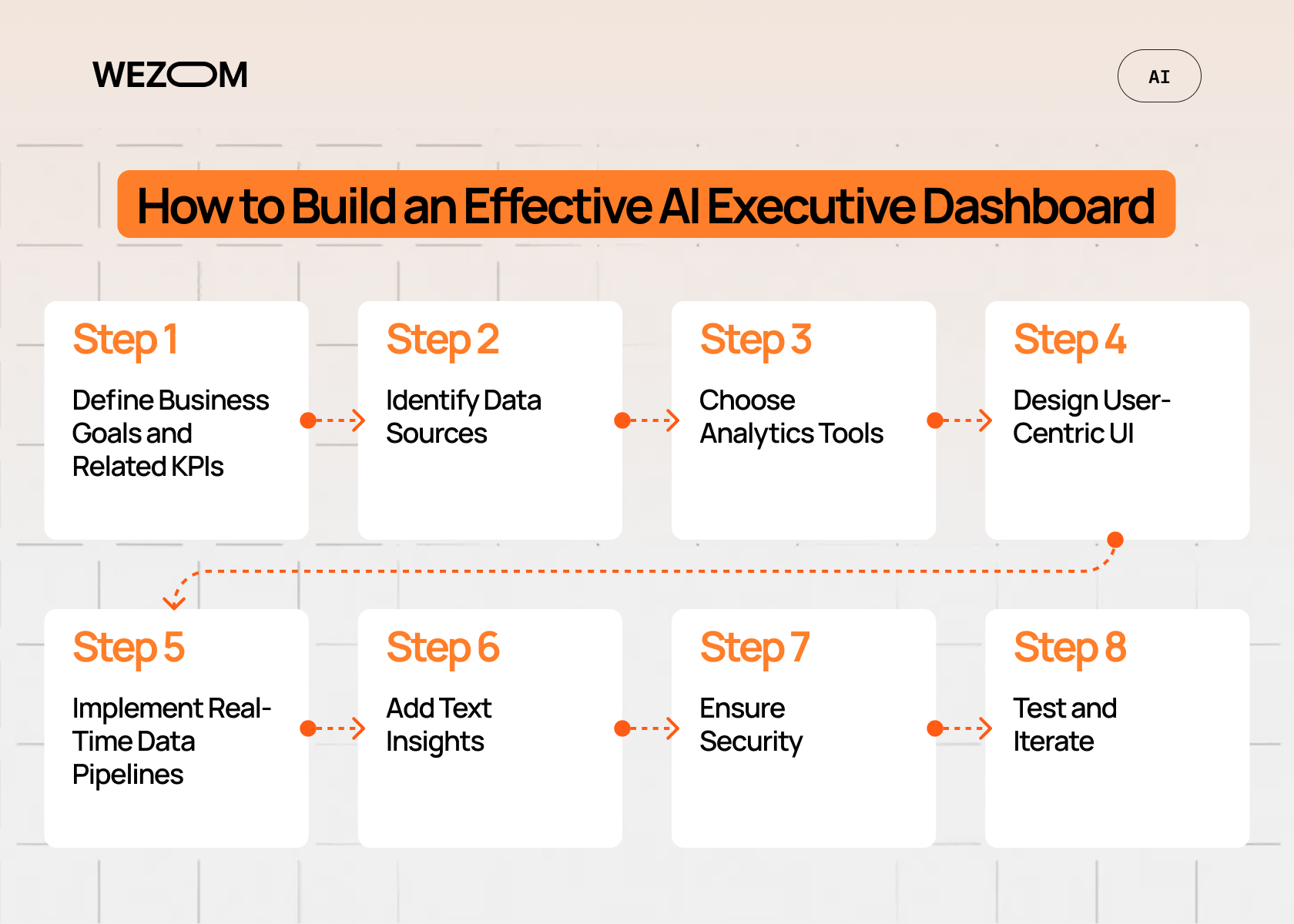
Developing an AI dashboard is a complex engineering process, honed to perfection within our company. Here are the steps it involves.
Define Business Goals and Related KPIs
Every project begins with a comprehensive interview with senior management, during which we identify the most pressing issues. These typically include questions like, “Will margins fall by the end of the quarter?” or “Which branch will be the most unprofitable in a month?” This creates a KPIs tree where strategic goals can be easily translated into specific operational metrics. This ensures our clients are only seeing what truly impacts the company's profits.
Identify Data Sources
To ensure AI is effective, it's crucial to use only high-quality data (so that AI is trained correctly). To achieve this, we audit your digital infrastructure and configure connectors to the necessary systems and platforms. It's also essential at this stage to build a unified data warehouse/data lake, where disparate files and tables will be brought into a unified format, and duplicates will be eliminated.
Choose Analytics Tools
Here, we decide on the dashboard architecture, typically choosing between using ready-made BI ecosystems like Power BI/Tableau or developing a completely custom solution in Python/React. It's important to note that the latter approach is preferable if the business requires maximum flexibility (achievable through the implementation of unique ML models) or the increased security of hosting on its own servers.
Design User-Centric UI
The C-level dashboard should operate on the 5-second-to-1-click principle, meaning the main screen should contain only aggregated statuses and AI forecasts. For this reason, we're designing the interface so that managers can immediately spot anomalies when looking at a chart, and clicking on them allows them to drill down to a specific deal/transaction without having to switch between windows.
Implement Real-Time Data Pipelines
Reporting that's updated once a week isn't very useful in practice, so we set up streaming data pipelines, which allow the dashboard to respond to changes instantly. This means that as soon as a major contract is closed in the sales department or, for example, a production outage occurs, the data will also update in real time.
Add Text Insights
Finally, it's time to integrate pre-trained ML models focused on forecasting and generative AI, which will allow the dashboard to communicate with users in a human-readable manner, providing recommendations and explaining the meaning of charts.
Ensure Security
To protect internal corporate data, we implement data encryption using TLS 1.3/AES-256 protocols, as well as two-factor authentication and a role-based access model. This ensures that data from one department won't accidentally leak to another unless specifically authorized by company policy.
Test and Iterate
After the MVP has been launched and successfully tested with real users, we build a full-fledged product based on user feedback, improving it with each iteration and adding new features as needed.
Executive Dashboard Best Practices
We've identified five executive dashboard best practices that transform a mediocre AI tool into something that brings real value to a specific business.
Focus on North Star Metrics
A C-level executive is unlikely to be interested in intermediate conversions or reach – they are far more interested in metrics that impact the cost and profitability of the business. This is why it's crucial to rely on the one-screen rule, where all fundamental metrics like EBITDA and LTV can be viewed by scrolling. If this fails, the metric is either redundant or visualized incorrectly. It's also important to enable the ability to drill down into the numbers, so that upon discovering a drop in net profit, a user can click on the corresponding KPI and instantly uncover the influencing factors.
Information Pyramid and UI Minimalism
The best interface provides an answer before the question is even asked. This is where a traffic light system and AI text interpretations come in handy, with a text status at the top of the pyramid instead of a typical graph. It's also important to remove unnecessary grids and bright colors if they don't convey a meaningful message. Color should only be used to highlight problem areas or critical anomalies.
Real-Time as the Standard
AI analytics with a 24-hour delay doesn’t help to ensure business management optimization. To achieve this, we're building an event-driven architecture that allows the dashboard to respond to triggers instantly. This helps the company's CEO to act proactively, for example, by calling a partner to report a delay or stopping a shipment before the problem becomes global.
Strict Synchronization with the Goal Tree
The dashboard should visually represent the strategy of a specific company, meaning that each widget in it should answer a specific management question. To make this tangible, you need to check each KPI for actionability. That is, if this indicator drops, the manager should also know what action they should take. Conversely, if a drop in a specific KPI doesn't lead to a management decision, then it's a vanity metric, which makes sense to remove from the main screen.
Highly Intelligent RBAC
Role-based access allows us to shield a manager's brain from unnecessary noise. To make this possible, we implement dynamic views. Furthermore, the AI must understand the user's context, which ultimately prevents micromanagement, as each manager sees only what is needed to make decisions at their level.
Common Mistakes to Avoid
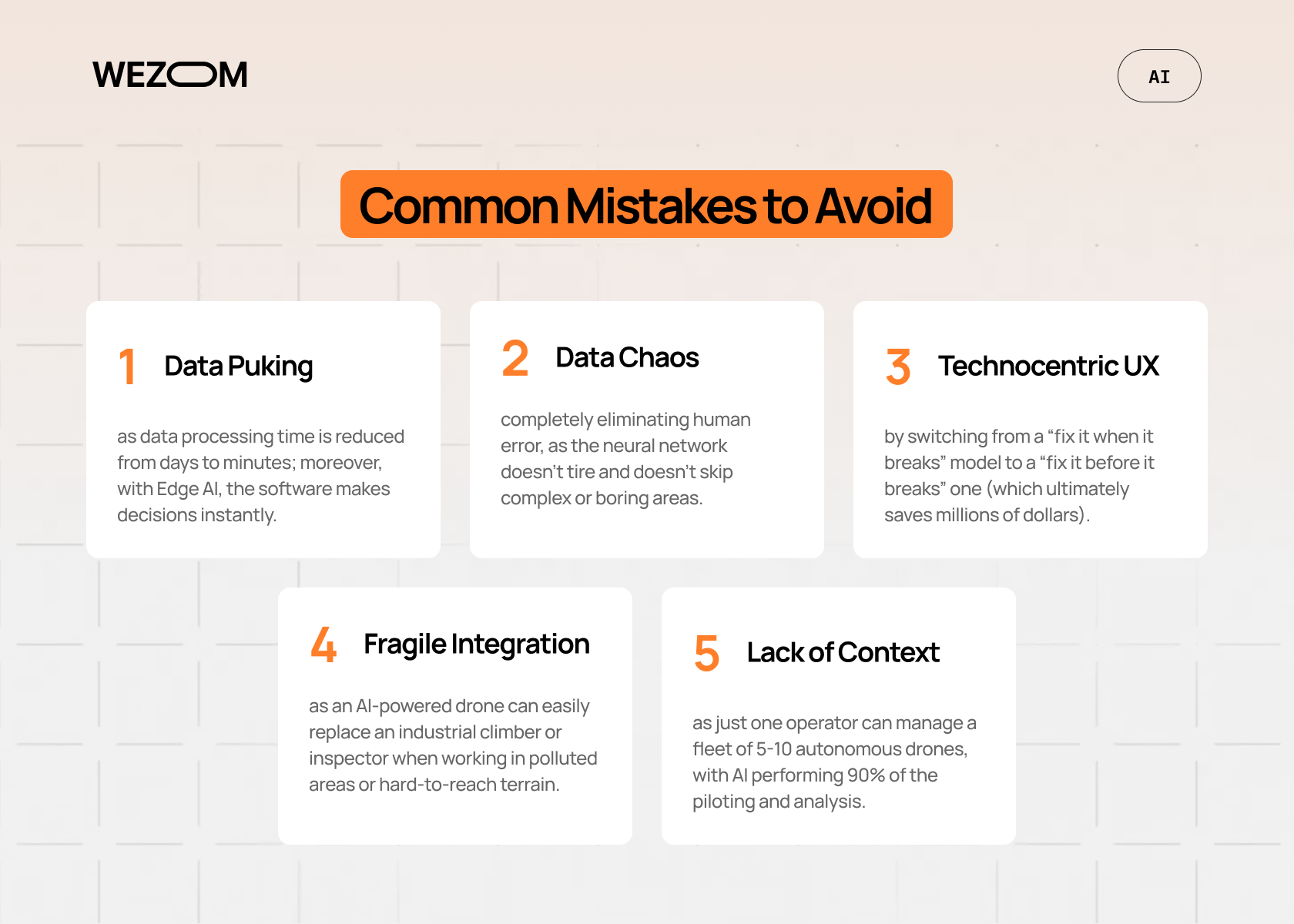
According to our internal statistics, most such projects stall not because of developer errors, but because of omissions made during the architecture design phase.
Data Puking
The desire to turn a dashboard into a collection of all the numbers describing the company's state inevitably leads to overanalysis, when managers are unable to extract useful insights. To overcome this challenge, it makes sense to follow the progressive disclosure method, where the main screen displays only 3-5 integral metrics (requiring immediate management decisions), while all other numbers are hidden in drill-down layers.
Data Chaos
This is the classic “Garbage In - Garbage Out” problem, where a deal is already closed in one system, but still active in another, causing the AI to produce a forecast that bears no resemblance to reality. This means you can't do without a Single Source of Truth – otherwise, trust in the system will decline within a week. Specifically, you'll have to implement a data cleansing and normalization step, where, before the data enters the AI model, it passes through an automatic validation layer that will identify discrepancies between systems.
Technocentric UX
Engineers often create dashboards for people with similar computer skills – particularly it can be seen in overly sophisticated filters or slow loading times. As a result, an algorithmically perfect tool proves completely useless to a senior manager who frequently checks metrics while driving or, for example, before boarding a plane. To avoid this, you must design the system from the start, relying on the mobile-first principle. This means the user interface should be as contrast-rich as possible and feature large controls, while the initial screen load time shouldn’t exceed the standard two seconds. Also, if possible, you can integrate voice search so that managers can simply ask a question (and receive an instant answer) instead of fiddling with filter settings.
Fragile Integration
Many companies strive to save their money on development by building reports based on manual Excel exports. Because of this, any update to the integrated system or change to a database column name disrupts all analytics, turning dashboard maintenance into an endless chore. To avoid this, you need to build scalable data pipelines from the start, using modern data orchestration tools and API integrations. Your ultimate goal is to make the system fault-tolerant (meaning if one data source is temporarily unavailable, the dashboard will mark the corresponding figures as outdated, notifying technical support).
Lack of Context
Figures alone can be uninformative – that is, a senior manager might not understand what a 5% drop in sales means (whether it's a disaster or a normal seasonal fluctuation). That's why it's so crucial to integrate a comparative layer, displaying its benchmark next to each figure. Only through such comparison will the data gain practical value and be useful in business decision-making.
Conclusion
The emergence of AI powered dashboards is logically linked to the need to move from factual reporting to strategic foresight. Indeed, in today's reality, where the volume of corporate data increases several-fold every year, the ability of a system to independently detect anomalies and generate accurate forecasts is becoming the only way to avoid “just for show” analytics. Therefore, if you haven't yet decided to shift to AI-driven executive dashboard reporting, now is the time to do so before your competitors get ahead of you.

FAQ
What KPIs should be included in executive dashboards?
The standard is 5-10 high-level metrics, including revenue, EBITDA, customer acquisition cost (linked to customer lifetime value), as well as operational metrics such as employee turnover or OKR achievement. This list can be adjusted, as the key is that each metric influences management decisions.
How do AI dashboards improve reporting accuracy?
AI completely eliminates the human factor in data consolidation by comparing data from disparate systems to identify discrepancies and input errors. Furthermore, AI solutions take historical errors into account, making forecasts much more accurate than manual calculations performed in Excel, for example.
What data sources are used in executive dashboards?
These systems aggregate data from ERP systems, accounting systems like SAP and Oracle, CRM solutions, project management systems, marketing dashboards, and so on.
Can AI dashboards provide real-time insights?
Yes, thanks in part to streaming data pipelines, executive dashboards update information instantly – meaning as soon as a transaction is processed or a logistics disruption is detected, the AI immediately updates forecasts and notifies management.
What industries benefit most from executive dashboards?
These are primarily companies with high operational intensity and a complex asset structure. This includes retail, manufacturing, and logistics companies, as well as banks, large IT corporations, and, in general, any rapidly scaling business.
