
Your digital infrastructure is gradually expanding, and your client base is growing. However, when it comes to consolidating disparate services and apps into a single system, your IT department claims it's impossible for one reason or another. This usually happens when a core system, like ERP or CRM, has become legacy – you have to spend your budget on supporting it, but it's actually hindering your scalability. So, should you continue patching holes or build everything from scratch?
Why Is Legacy Transformation Essential?

Today, the term "legacy" doesn't just mean software with an outdated interface – usually, its codebase, due to a lack of modernization, is no longer suitable for third-party integrations. Here's why you shouldn't leave things as is:
- Growing technical debt. Many companies spend up to 70-80% of their IT budgets not just on maintaining such systems, but on keeping them running – so what kind of innovation can we even talk about?
- Slow time-to-market. While your competitors can launch new features in a few days, you'll have to spend months implementing changes. This leads to a loss of agility and, with it, your market position.
- Scaling issues. Legacy solutions are almost never adapted to cloud workloads and user traffic spikes, which often causes them to freeze at the most inopportune moments.
- Security and compliance risks. Legacy software is more susceptible to cyberattacks than software based on a modern tech stack, meaning businesses using it won’t achieve compliance in strictly regulated niches.
- Cost inefficiency. Regular reliance on rare specialists in old programming languages and unnecessarily intensive use of server capacity are other common problems with legacy software.
If you want to avoid all these problems, you should definitely consider transforming your IT infrastructure.
What Is API Wrapping?
API wrapping implies a "light" approach to modernizing legacy systems. Instead of completely replacing their core, developers build a layer around it based on a modern tech stack, i.e., an API wrapper. This allows any third-party services (mobile software, payment gateways, and even neural networks) to interact with the system via standard protocols, regardless of the age of its code.
What Is Full Legacy System Replacement?
Unlike the previous approach, legacy system replacement involves radical modernization. That is, developers eliminate legacy solutions from your IT infrastructure and transfer them to a new architecture. This approach can be implemented in three ways:
- Rebuild, when the system is completely rebuilt from scratch on a modern stack;
- Replatform, when the system is migrated to a new platform – for example, the cloud – with code refactoring;
- Rehost, when the system itself and its associated databases are migrated to new servers.
Not sure which of these approaches is optimal for your case? Feel free to contact us personally – we’ll analyze your IT infrastructure, select the best solution, and implement it with minimal or no downtime.
Benefits of Wrapping Legacy Systems with APIs
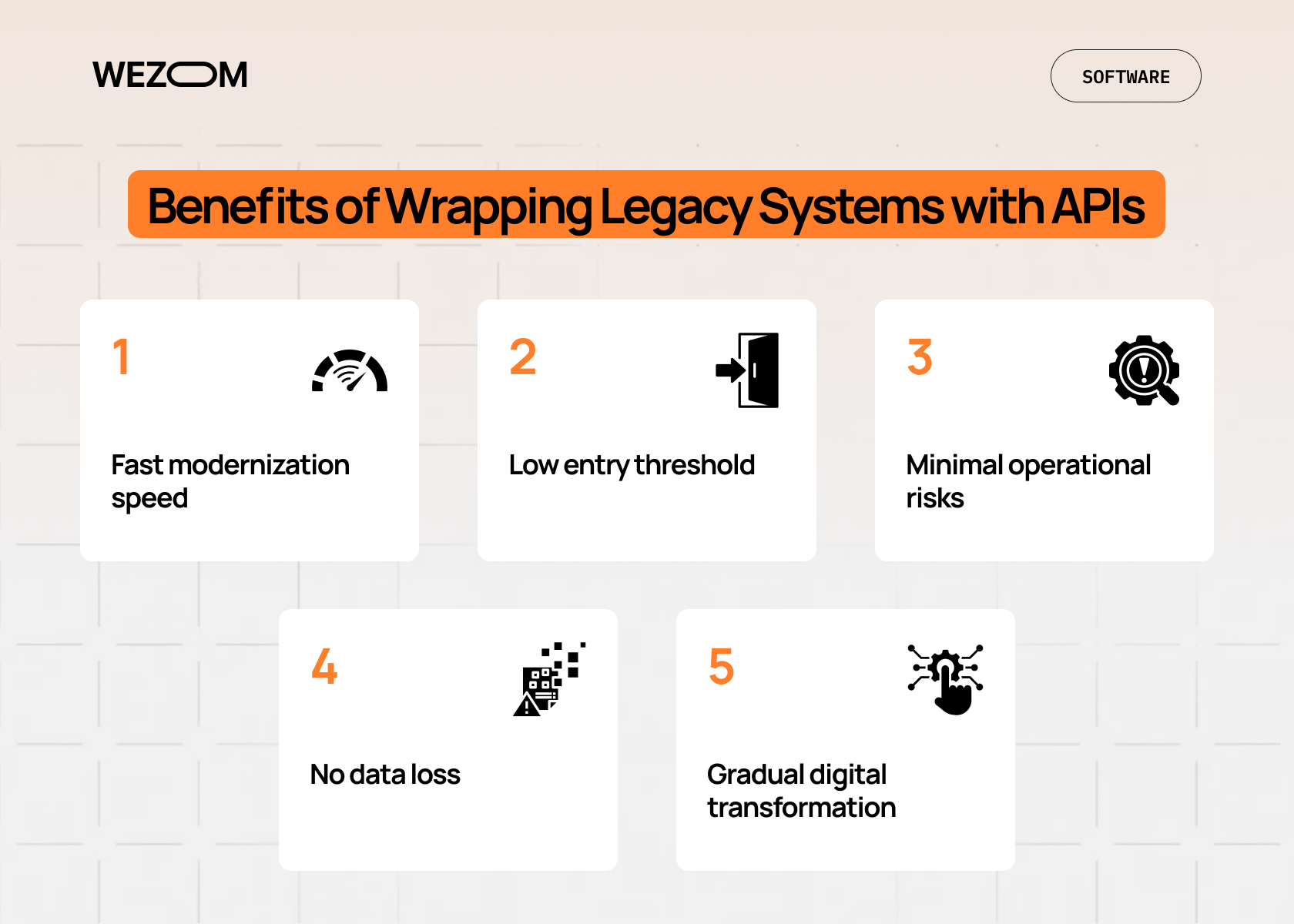
While a full legacy system replacement requires colossal resources and could lead to downtime (not to mention challenges associated with risks of data loss or employee resistance), API wrapping offers several advantages in this context:
- Fast modernization speed. You'll see the first results (for example, integration with several new services) in a few weeks, not months of development.
- Low entry threshold. You don't need to invest millions of dollars upfront – instead, you pay only for creating so-called bridges between legacy and modern solutions.
- Minimal operational risks. Your business continues to operate as usual, and employees won't even notice the changes while your IT partner implements new features on top of the old interfaces.
- No data loss. The risk of losing critical data is zero since the underlying database remains the same.
- Gradual digital transformation. API wrapping allows you to modernize your system in stages, each of which can be planned as your resources become available. This means this approach can be implemented gradually, without the risk of disrupting seamless interoperability between existing services and, thus, continuity of your regular workflows.
Of course, API wrapping is not a one-size-fits-all solution and has its bottlenecks, which we'll discuss below.
Limitations of API Wrapping
Despite a number of advantages, API wrapping has its limitations:
- Technical debt doesn't disappear. Internal errors, core maintainability issues, and sophisticated logic can still persist, no matter how modern the interface.
- Performance is limited. If your legacy system processes a request in 4-5 seconds, no optimization through an API wrapper will make it work in milliseconds, since the speed of the entire chain is always limited by the speed of the weakest (usually legacy) link.
- Security risks are inherited. If the system core doesn't support modern encryption or authentication methods, an API wrapper can only partially mitigate these threats, but not completely eliminate them.
- Scalability bottlenecks. An API allows you to connect new services, but if your database architecture isn't initially designed for millions of concurrent connections, the system may collapse under such a load.
This is why, in some cases, it makes sense to resort to legacy software modernization from scratch.
Benefits of Replacing Legacy Systems

When you decide to follow the full system migration strategy, you're essentially investing in the foundation of your IT infrastructure for the next 10-15 years, as you achieve:
- Long-term operational efficiency. The new system will run several times (if not hundreds of times) faster, requiring fewer support resources and providing end-to-end automation.
- Modern architecture. If your IT partner makes a well-informed decision, for example, to migrate to microservices and move the platform to the cloud, you’ll get your IT infrastructure’s instant extensibility, both up and down, depending on user load.
- Security by default. Modern systems are built with current governance in mind, can boast reliability, and have full alignment with regulatory requirements such as GDPR/HIPAA/ISO 27001.
- Reduced long-term total cost of ownership. Maintaining a modern stack is always cheaper in the long run than simply paying to keep working on something that was relevant 10 years ago, if not more.
Ultimately, the benefits of which approach – API wrapping or full legacy system modernization – are best delegated to professionals like WEZOM. Write or call us, and we'll determine which legacy modernization strategy will be best for you in terms of ROI.
Risks and Downsides of Full Replacement
Complete replacing legacy systems completely is always high-risky:
- High upfront costs. You'll need significant investment from the start, and this is necessary before the system can bring you any profit.
- Long implementation timelines. Legacy system replacement strategy often takes years to complete, especially for large corporations in highly regulated industries, which can be critical in a changing market environment.
- Complex data migration. Transferring ten-year archives from the old DBMSs to new ones without loss or distortion will require highly qualified engineers specializing in legacy modernization software.
- Employee resistance. Employees accustomed to working with the same interface for years may sabotage the new system implementation, so you'll also need to invest in their training.
A hybrid approach is also possible, where legacy modules are rewritten after API wrapping. This can be done step-by-step and with a gradual budget allocation. In this case, once all modules are upgraded, you’ll be able to completely abandon the use of the legacy solution.
When API Wrapping Makes Sense
Choosing an API wrapping strategy makes sense when you have a service or application that needs to be launched "yesterday," or, for example, when you're confident in the stability of your IT infrastructure core, and it doesn't require radical refactoring. It's also the only viable option if your budget is limited.
When Full Replacement Makes Sense
Radical legacy modernization solutions make sense when your system has reached its scalability limit and no longer supports adding new services. It's also the best option if you regularly encounter costly downtime or, for example, if the vendor whose stack your legacy system is based on no longer supports it. Finally, you should consider this approach if you critically need new features based on cutting-edge technologies like AI, but they're physically impossible to implement on the old architecture.
Costs, Timelines, and ROI: Wrapping vs Replacement
To make this choice easier, we have summarized the main characteristics of these two approaches in a comparison table.
| Characteristics | API wrapping | Full replacement |
|---|---|---|
| Time-to-market | 1-4 months | 12-36 months, due to long development, testing, and DBMS migration cycles |
| Initial costs | Low to medium | High |
| Technical debt | Remains | Is fixed |
| Downtime risks | Low | High, as failures are possible when switching from the old system to the new one |
| Scalability | Limited by the throughput of the legacy core | High, usually due to the migration to the cloud |
| ROI | Results are immediately visible after connecting new services | Savings and profit growth become apparent within 2-3 years |
How to Choose the Right Decision for Your Business
Before assessing the modernization budget, you should conduct an internal audit based on the following criteria:
- The complexity and state of the legacy system. If its code is so sophisticated that a single change breaks several other modules, API wrapping will only help temporarily.
- The nuances of a long-term business strategy. If you're planning global expansion or implementing real-time AI analytics, the legacy core will drag your business down, as it will make this impossible (or only partially possible).
- Evaluate the total cost of ownership. You have to compare the costs of maintaining the API layer and the legacy system against the costs of developing a new system. Often, the former option is more expensive in the long run than even a loan for full replacement.
- Integration requirements. You have to estimate how many external services you need – if there are dozens, a modern microservices architecture will handle this better than layering an API on top of a monolithic legacy solution.
- Team readiness. Finally, you should consider whether your employees have the skills to work with the new system– usually, a complete replacement requires retraining.
If you're close to making a final decision and are now looking for a reliable IT partner to implement the upgrade, feel free to contact us – we know how to modernize legacy applications.

FAQ
What is the difference between API wrapping and full legacy system replacement?
API wrapping involves building a modern integration layer on top of an existing legacy system so it can interact with new services. Full legacy system replacement, on the other hand, means creating an entirely new IT foundation and retiring the old system.
Is API wrapping a long-term solution or just a temporary fix?
In most cases, API wrapping is an intermediate solution. It typically gives organizations 2–3 years to secure budget and plan for full system modernization or migration to the cloud.
What risks come with wrapping legacy systems with APIs?
The main risk is that while the system gains a modern interface, underlying issues in the legacy code remain. These hidden problems can still cause data loss, performance degradation, or sudden failures during peak loads.
How long does it take to replace a legacy system?
For small and mid-sized businesses, legacy system replacement usually takes a year or more. Enterprise-level IT modernization projects can last up to five years, depending on complexity and scale.
Can organizations use a hybrid approach instead of full replacement?
Yes, and this is often the most effective approach. A common strategy is the strangler pattern, where an API wrapper is built first and legacy functions are gradually rewritten and migrated module by module to a new architecture. Over time, the legacy system is fully phased out.
