
Does your business lose money due to automated coding that requires editing, which eats up time? Or perhaps you're afraid to entrust intelligent tools with very responsible tasks? And, finally, how much time do your staff spend verifying the facts these tools provide?
In recent years (especially, in 2026), when artificial intelligence isn’t longer an experiment, choosing the right tool directly impacts your business profits and data privacy. Below, as a seasoned software development company, WEZOM (which, by the way, specializes in developing custom AI solutions), we’ll compare the three AI models that created hype around the world.
Why Businesses Need to Choose the Right Option When Introducing AI
We identified the factors that determine the optimal solution for corporate needs.
First of all, it’s reliability – businesses are looking for top accuracy, and this is axiomatic, as a tool prone to generating false information and requiring regular fact-checking negates potential time savings. Then, cost reduction comes – different AI options have different token and API pricing. Obviously, it’s a critical factor for businesses that generate millions of output tokens monthly.
Let's move on: having a ready-made integration ecosystem isn't longer a sufficient condition to satisfy the specific business’ needs; seamless data transfer to the systems this business is already using is essential as well. Finally, a few words about productivity, i.e., how quickly AI generates answers, as it's important that employees don't have to make a lot of manual edits or clarify their prompts.
Ultimately, all the tool’s capabilities must be assessed based on their efficiency; otherwise, the tool’s implementation into workflows won’t provide any additional competitive advantage. So, before we take a more detailed look at the three leading players to define which AI is better, we invite you to check some important metrics.
Which Metrics Are Considered Optimal and Which Are Not?
We’ve identified nine factors that determine how effective a specific tool will be in real-world corporate conditions:
- Speed. This is the time for response generation. For example, a good 1st token latency has to be <500 milliseconds, while the complete generation of an average-length response should be <2 seconds.
- Accuracy. This means the accuracy level of the generated information and the response stability when repeated requests were made. An indicator of <2% is suitable for implementation in highly regulated sectors.
- Multimodality. This factor means that the tool must process insights from diverse sources – for example, being able to both analyze images and link them to other types of data, such as text.
- Security. While basic is the GDPR/ISO 27001 compliance, some industries also need built-in Constitutional AI mechanisms and legislative-level guarantees that corporate data won’t be used for further model training.
- Integrations. You should check the presence of ready-made APIs for integrating the tool into the enterprise apps you already utilize.
- Ecosystem compatibility. The solution you choose should integrate easily with cloud platforms; that is, it has to be predisposed to fast deployment in the vendor's environment.
- Context window length. This is the maximum number of tokens entered by the end user that the solution processes at one time. For example, today's standard for enterprise analysis is 128,000 tokens, which is equivalent to approximately 100 pages of text.
- Pricing. The optimal price for mass adoption is considered to be less than $0.0005 per 1,000 input tokens; otherwise, it will be too expensive to ensure end-to-end automation across departments.
We'd also like to highlight familiarity. Many people (including your employees) are accustomed to working with specific tools and trust them more than others. Therefore, when implementing a solution, you should first get their opinions to avoid so-called employee resistance, when, for some personal reason, an employee refuses to use your proposed model. However, let's return to the topic of our article – are you curious to learn which tools comply with these points and which don't?
ChatGPT
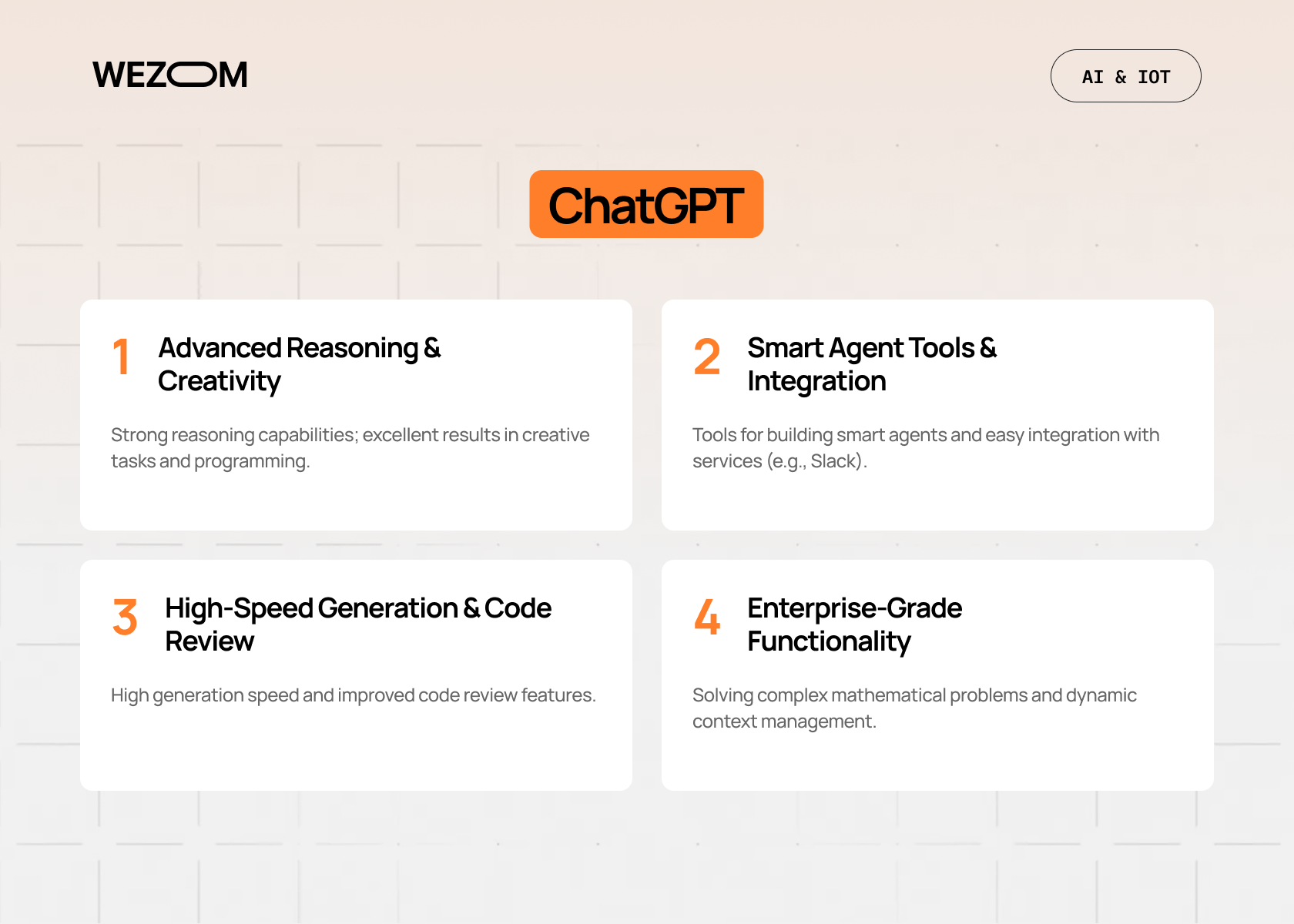
In a nutshell, the solution is great at performing complex reasoning. The fact is that, according to our internal testing, it demonstrates top results in creative tasks and program coding. It also offers a comprehensive toolset for creating smart agents, as well as can be integrated seamlessly with a lot of external tools you may already be familiar with firsthand, like Slack. Finally, this AI has excellent generation speed, which, as practice shows, is crucial for implementing custom chatbots.
However, the tool also has serious drawbacks: its cost increases disproportionately with the number of tokens. There are also some privacy issues: despite the OpenAI team's ongoing work on internal security mechanisms, this solution has repeatedly compromised its user data privacy. Therefore, there’s a serious obstacle to its use in strictly regulated sectors. Finally, it often overlooks details in long prompts (especially if you add some files to them). And yes, its multimodality is just an add-on, not a native feature.
In general, if you need a versatile model for writing/refactoring code, generating various content, and/or integrating into research systems, you should definitely consider this option.
By the way, a little insider information: among our clients representing international tech companies, there is a belief that OpenAI is an Abstract Intelligence leader and has a non-public absolute logic mode, accessible through specific Enterprise APIs. Therefore, using this tool is justified for solving complex mathematical problems. If we add the significant improvements to the code review feature (which enables bug fixing in large codebases) and the introduction of dynamic context (allowing the model to independently decide which part of the conversation history to use to save your tokens), it becomes clear that it’s an outstanding tool for enterprises of all sizes.
Claude
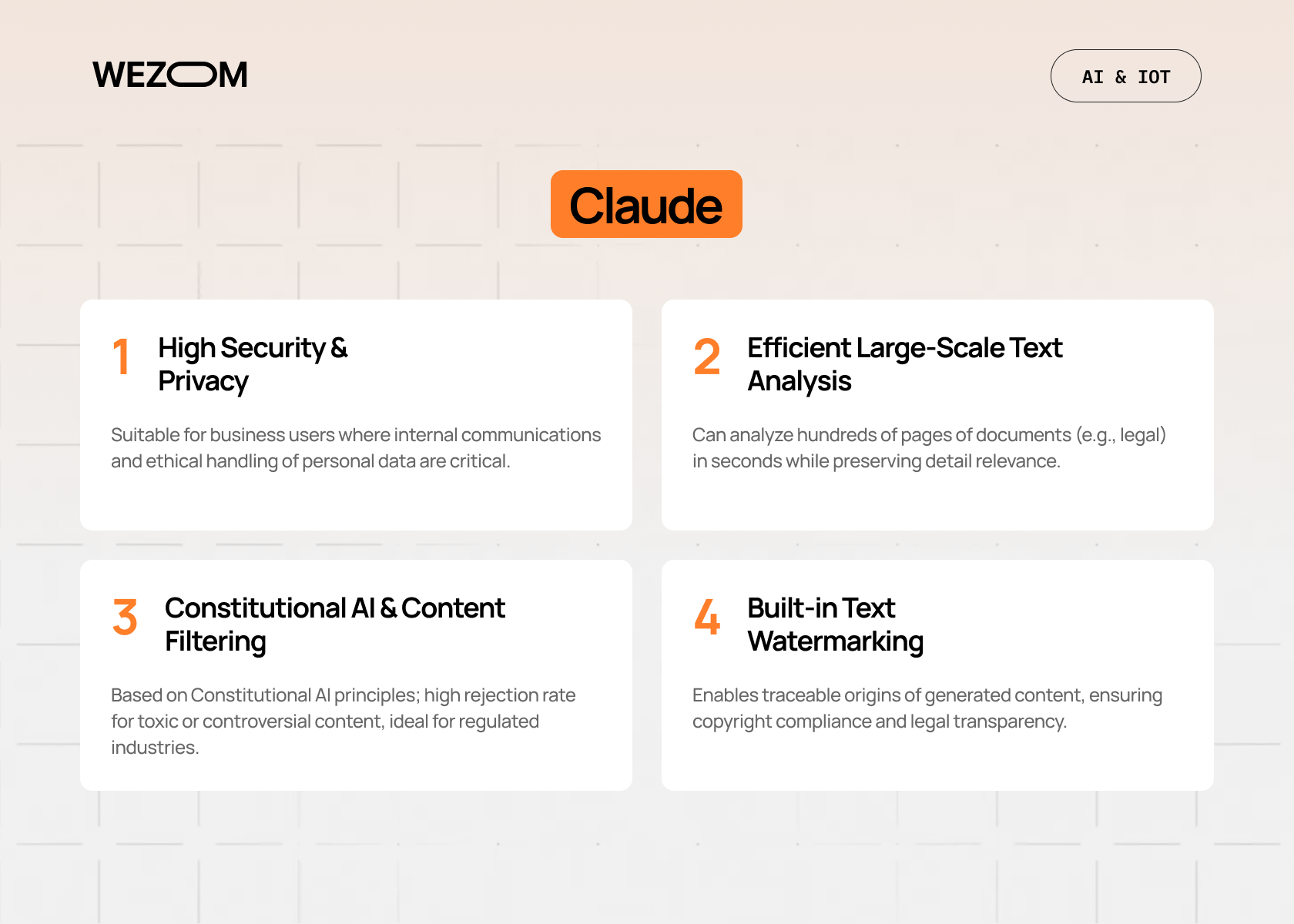
This tool has rightfully earned the loyalty of business representatives for whom security is a priority (for example, in internal communications). Also, it’s suitable for the ethical handling of personal data and can analyze colossal volumes of text (particularly legal documents).
As we mentioned above, the tool is based on Constitutional AI, which trains a model based on a set of principles. This makes it an extremely valuable solution for highly regulated industries – some of their representatives admit that Claude's rejection rate for generating toxic or controversial content is among the highest. We've also heard from our clients that Anthropic has developed its own watermarking system for output text, which is invisible to the user but enables legally traceable origins of generated content (it’s critical for copyright compliance). Furthermore, it allows you to enter massive datasets as prompts, so you’ll be able to analyze documents hundreds of pages long in a matter of seconds, while preserving the relevance of details.
As for disadvantages, the generation speed is slightly slower than that of the competitors. In coding tasks, Claude is still behind the others.
Gemini
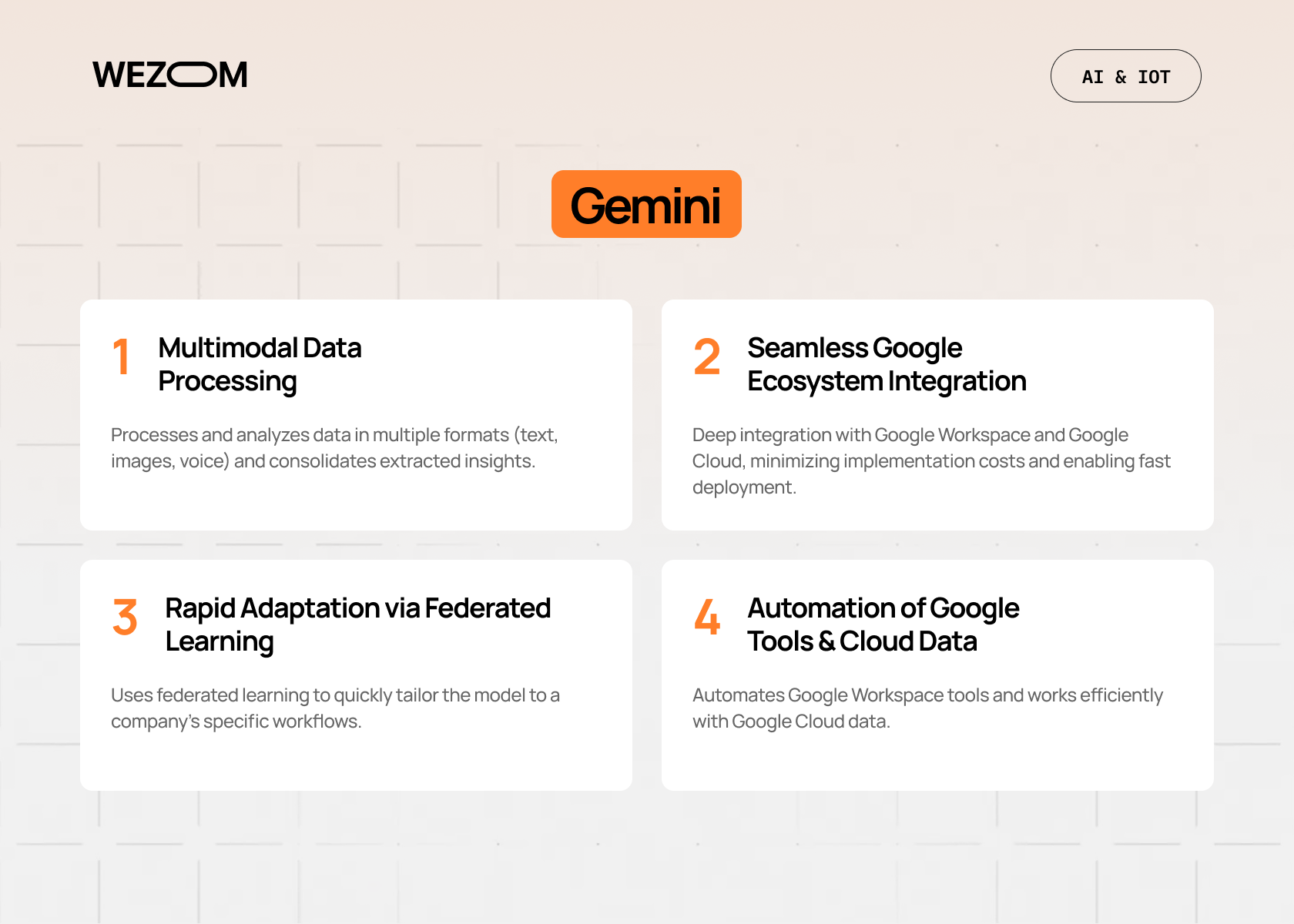
Generally speaking, it’s the perfect choice for companies whose workflows involve processing multi-format data. Moreover, Gemini doesn't simply work with text and images; it consolidates and analyzes all extracted insights. For example, our tests demonstrated its superiority in analyzing a production line diagram through images with an accompanying text-based failure description and a voice report.
The next pleasing thing is that it has a deep connection with the Google ecosystem, meaning that for millions of companies whose infrastructures are based on it, this AI’s integration will take less than an hour, thereby reducing implementation costs and eliminating staff resistance.
Another advantage, which hasn’t yet been fully explored, is the adaptation speed. Our secret sources confirm that Google uses federated learning on Google Cloud data, which allows Gemini to tailor a model to specific company’s workflows faster than competitors. It’s also good at automating Google Workspace tools and working with Google Cloud data.
However, it’s worth noting that, while Gemini's inference capabilities are undoubtedly strong, they don't always outperform our first contestant for regular text queries. Also, the cost of using multimodal APIs may be too high for small companies.
Comparison Table
So, is Claude better than ChatGPT or is Gemini better than ChatGPT? Or, in the Claude vs Gemini couple, who will win? Check our AI models comparison below to find out the answer to the question: “What's better than ChatGPT?” with our ChatGPT vs Claude vs Gemini comparison table!
| Model | Chat GPT | Claude | Gemini |
|---|---|---|---|
| Strengths |
|
|
|
| Weaknesses |
|
|
|
| Best for |
|
|
|
| Context window | Approximately 128,000 tokens | Approximately 200,000 tokens (to 1,000,000 tokens for the Opus version) | Approximately 1,000,000 tokens (in the Gemini Pro version) |
| Multimodality | Strong (text/code/images) | High (text/images), with a focus on security | Excellent, as this ChatGPT alternative was natively developed for all data input formats |
| Pricing | Medium/High (approximately $20 per month for the Pro version) | Medium (as its pro versions cost less than those from competitors – actually, this is the main difference between Claude and ChatGPT) | Medium/Low (the best pricing/capabilities ratio is typical of the Flash tier) |
Which Option Should You Choose?
As you see, there's no one-size-fits-all answer on which AI to use, and what AI is better than ChatGPT. So, it's much better to focus on the specific tasks your ideal AI tool should solve:
- Best for coding. Chat GPT is definitely a favorite here – although many developers still rely on Claude, our experience suggests that the first one outperforms it in understanding sophisticated logics.
- Best for enterprises. It’s undoubtedly Gemini – all thanks to its seamless integration into Google's existing infrastructure. Gemini also provides top-notch scalability, even for the most complex corporate workflows spanning multiple departments.
- Best for research. Claude wins here due to its minimal number of hallucinations and ability to process huge volumes of tokens.
- Best for creativity. It’s ChatGPT, as it generates human-like texts with a specific tone of voice and intention.
- Best budget option. It's best to choose Gemini’s Flash subscription plan, which provides sufficient performance at the lowest price, meaning you can implement dozens or even hundreds of highly intelligent automation tools with it.
If you realize that none of these models (at least in their original form) is suitable for your business needs, write or call us, and we’ll build a custom solution – either based on them or completely from scratch.
FAQ
What is the main ChatGPT vs Claude difference?
In the ChatGPT vs Claude comparison, ChatGPT primarily focuses on logical reasoning, computer programming, and idea generation, while Claude emphasizes ethics and in-depth analysis of lengthy texts. As a result, ChatGPT performs better at creating new content, whereas Claude excels at analyzing existing content.
Is Gemini better than ChatGPT for multimodal tasks?
Yes. In the Gemini vs ChatGPT comparison, Gemini performs better because it was originally designed as a multimodal model. This allows it to natively extract insights from images, videos, and text, while ChatGPT added multimodality later and, in comparison, performs somewhat weaker.
Which AI is the most accurate in long-form content generation?
Claude (Opus/Pro) is specifically designed for extra-long context windows and emphasizes security through the Constitutional AI approach. Independent testing shows it produces fewer hallucinations and maintains higher attention to detail when processing documents exceeding 50,000 tokens.
What AI model is most reliable for coding?
The latest versions of Claude Opus have demonstrated excellent performance in advanced coding and refactoring tasks. Developers value it for its strong understanding of large project architectures and its ability to deliver structured, logical solutions.
Which AI offers the best value for its price?
For most corporate tasks, Gemini offers the best value, especially with its budget-friendly pricing and deep integration with Google Cloud. However, if ethics and transparency are critical—such as in the legal sector—Claude is the better choice due to reduced operational risk.
