
How Drone Delivery and Logistics Are Transforming Modern Supply Chains
When Zipline reported completing over 600,000 commercial drone deliveries across multiple continents, the logistics industry stopped dismissing aerial delivery as speculative. When major retailers like Walmart expanded drone delivery partnerships across dozens of locations, the conversation shifted from "if" to "how" and "when."
Drone logistics has crossed the threshold from pilot programs to scalable operations. Organizations evaluating drone delivery management systems now have real performance data, regulatory frameworks that actually exist (not just proposals), and proven integration pathways with existing warehouse drone integration infrastructure.
This article breaks down what's actually working in drone delivery software, examines the operational realities behind successful implementations, and maps out the critical factors that determine whether aerial logistics make sense for your specific use cases. We'll look at the technology stack powering autonomous delivery systems, the regulatory landscape you'll need to navigate, and the real-world performance metrics that separate marketing hype from genuine competitive advantage.
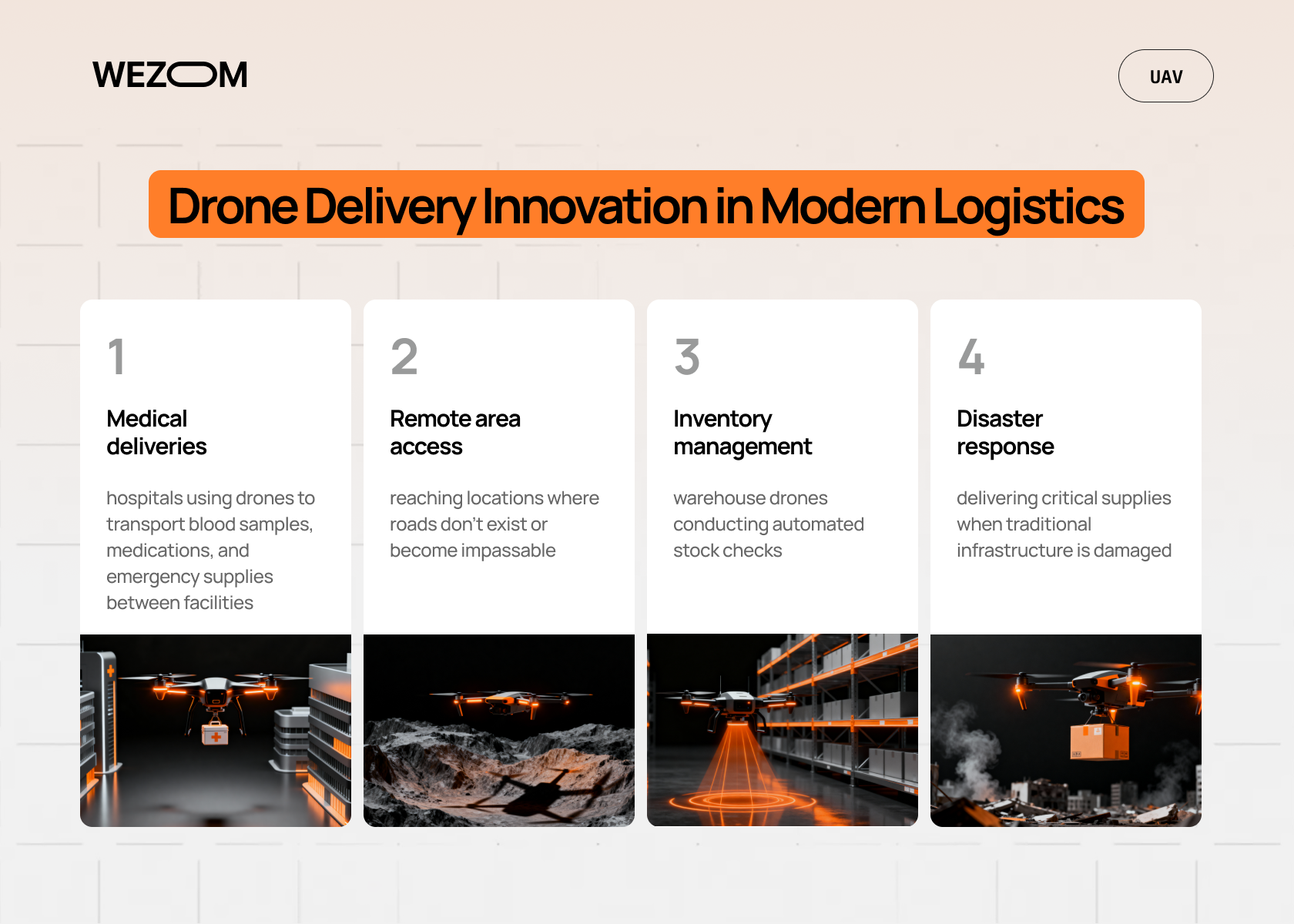
Drone Delivery Innovation in Modern Logistics
Think about your last online order. You probably expected it within two days, maybe even the same day. That expectation is reshaping entire supply chains.
Drones entered the logistics conversation because they solve a specific pain point: last-mile delivery. That final leg of the journey from the distribution center to your door accounts for nearly 53% of total shipping costs. It's inefficient, slow, and expensive.
But drones can fly over obstacles. No traffic lights. No road construction. No need to circle the block looking for parking.
The transformation isn't just about speed, it's about accessing delivery scenarios that were previously impossible or economically unfeasible with ground transportation:
- Medical deliveries: hospitals using drones to transport blood samples, medications, and emergency supplies between facilities.
- Remote area access: reaching locations where roads don't exist or become impassable.
- Inventory management: warehouse drones conducting automated stock checks.
- Disaster response: delivering critical supplies when traditional infrastructure is damaged.
Look, I'm not saying drones will replace trucks tomorrow. But they're carving out specific niches where they absolutely excel.
The commercial drone market is projected to reach $58.4 billion by 2030, according to MarketsandMarkets research. That's a serious investment.
Different regions are approaching this differently. The United States sees companies like Zipline and Wing expanding operations. Europe focuses on urban drone corridors and sustainability metrics. Asia-Pacific leads in volume, with China and Japan aggressively deploying drone logistics systems.
One thing we've noticed? The most successful implementations start small. They test specific routes, gather data, refine the system, then scale.
Core Components of Drone Delivery Systems
A drone delivery system is an entire ecosystem of software, hardware, and infrastructure working together.
Drone Delivery Software: The Brain of Autonomous Logistics
The software is honestly the most critical piece. Drone delivery software handles:
- Flight path calculation considering weather, no-fly zones, and obstacles.
- Battery management and automatic return-to-base protocols.
- Package verification and delivery confirmation.
- Communication with ground control and other drones.
- Real-time adjustments based on changing conditions.
Modern systems use AI-powered drone delivery algorithms that learn from each flight. Over time, they optimize routes, predict maintenance needs, and improve delivery accuracy.
Some platforms integrate with existing warehouse drone integration systems. Your package gets picked, the system assigns it to a drone, calculates the optimal route, and coordinates the entire delivery — all automatically.
Navigation, Tracking, and Real-Time Communication Technologies
GPS alone won't cut it for precise deliveries. These systems combine multiple technologies.
Computer vision helps drones identify landing zones and avoid unexpected obstacles. LiDAR sensors create 3D maps of the environment, crucial for urban deliveries. 5G connectivity enables real-time drone tracking with continuous data transmission.
But here's something that surprised me: many systems still require human oversight. Fully autonomous operation is the goal, but we're not quite there yet.
Integration with Warehouse and Fleet Management Systems
Leading drone fleet management platforms connect directly with warehouse management systems, inventory databases, and order fulfillment software. The moment a package is ready, the system evaluates whether drone delivery is optimal based on weight, destination, weather, and fleet availability.
This integration automates package assignment, synchronizes inventory updates, coordinates departure scheduling to prevent airspace conflicts, and pushes real-time status updates across all logistics platforms. The goal? Zero manual intervention between order confirmation and successful delivery.
Regulatory and Safety Challenges in Drone Delivery
Technology moves fast. Regulations? Not so much.
Every country has different drone delivery regulations. In the U.S., the FAA requires Part 107 certification for commercial drone operations. Europe has its own framework through EASA.
The biggest bottleneck? BVLOS operations — flying drones beyond the operator's line of sight. Most regulations still require visual contact, which severely limits delivery range.
Then there's airspace management for drones. How do you coordinate hundreds of drones flying simultaneously? UTM (Unmanned Traffic Management) systems are being developed, essentially creating digital highways in the sky.
Modern drone fleet management systems include redundant safety features: multiple backup propellers, geofencing to prevent entering restricted areas, automatic emergency landing protocols, and regular maintenance schedules enforced by software.
Rural deliveries are generally easier from a safety perspective. Urban environments require more sophisticated collision avoidance. People are nervous about drones flying over their heads. Privacy concerns. Noise complaints. General unease about autonomous systems.
Smart drone delivery companies address this through community outreach, quieter propeller designs, and strict data privacy policies. Trust builds slowly. Each successful delivery helps.
Drone Delivery Software: Key Features and Innovations
Let's get specific about what makes good drone delivery management software actually work.
| Feature | Function | Business Impact |
|---|---|---|
| AI Route Optimization | Analyzes weather, traffic, no-fly zones to calculate the fastest path. | Reduces delivery time by 30-40%, cuts energy costs. |
| Real-Time Fleet Monitoring | Tracks all drones simultaneously with live telemetry. | Improves operational efficiency, quick problem response. |
| Predictive Maintenance | Uses flight data to forecast component failures. | Minimizes downtime, extends drone lifespan. |
| Package Tracking Integration | Connects with customer apps for delivery updates. | Enhances customer experience. |
| Airspace Compliance | Automatically checks regulatory restrictions. | Ensures legal compliance, prevents violations. |
| Payload Management | Monitors package weight and special handling needs. | Prevents overloading, ensures safe delivery. |
The innovation happening in smart logistics technology is impressive. Some systems now incorporate weather prediction models, dynamic drone route optimization that adjusts mid-flight, and swarm coordination.
One client told us their system reduced failed delivery attempts by 67% after implementing AI-powered scheduling. That's the kind of improvement that shows up directly on the balance sheet.
Modern e-commerce drone solutions plug directly into Shopify, WooCommerce, SAP, Oracle, and existing warehouse management software. The order comes in, the system checks if drone delivery is optimal, assigns it automatically, and updates the customer — all without human intervention. That's the promise of automated delivery networks.
How Drone Delivery Impacts Business Operations
Traditional delivery vehicle costs include fuel, driver salaries, vehicle maintenance, and insurance. Drones need charging, maintenance, and operator oversight, but the cost per delivery drops significantly once you reach scale.
Zipline, operating medical deliveries in Rwanda and Ghana, reports delivering to remote health facilities in 15-30 minutes versus 4+ hours by road. That's transformative.
For commercial deliveries, drones excel at orders within a 5-10 mile radius of distribution centers.
Last-mile drone delivery solves specific problems. Peak hour flexibility — while trucks sit in traffic, drones fly over it. Rural accessibility improves dramatically. One distribution center can serve a much larger area effectively.
But drones currently have payload limitations. Most commercial drones carry 5-10 pounds. Bulky items still need traditional delivery.
Zipline: over 600,000 commercial deliveries completed.
Wing Aviation: operating in Australia, Finland, and parts of the U.S.
Amazon Prime Air: demonstrated successful deliveries in limited markets.
Walmart: testing drone delivery with multiple partners across several states.
What do these success stories have in common? They started with well-defined use cases and worked closely with regulators.
Future of Drone Logistics and Autonomous Systems
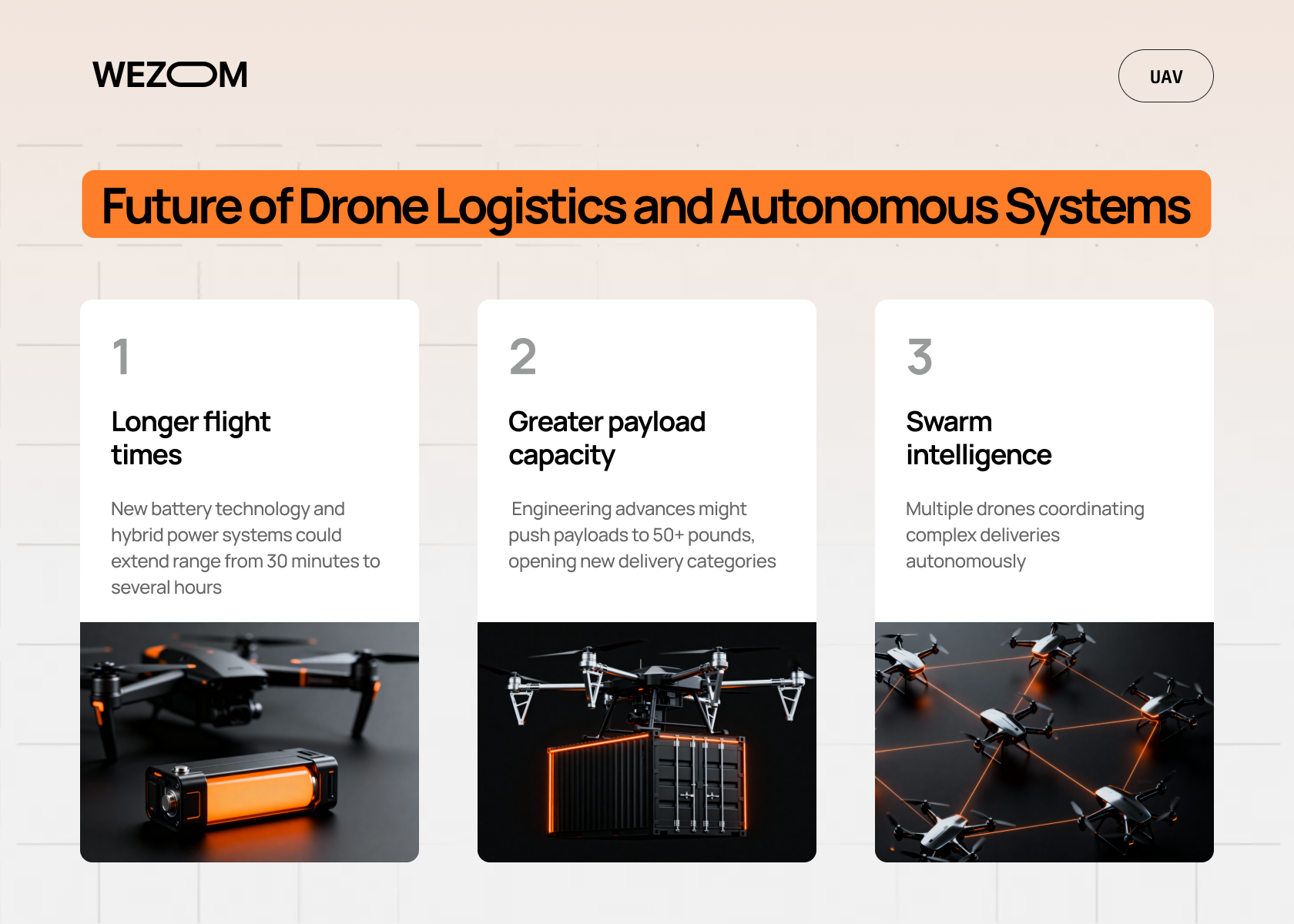
The drones flying today are first-generation. What's coming is significantly more capable:
- Longer flight times: New battery technology and hybrid power systems could extend range from 30 minutes to several hours.
- Greater payload capacity: Engineering advances might push payloads to 50+ pounds, opening new delivery categories.
- Swarm intelligence: Multiple drones coordinating complex deliveries autonomously.
We think we'll see specialization. Medical drones optimized for speed. Cargo drones built for capacity. Last-mile drones designed for dense urban environments.
By 2030, drone deliveries won't be newsworthy, they'll be normal. Urban centers will have established drone corridors. Regulatory frameworks will mature and standardize.
Autonomous delivery systems will handle routine deliveries with minimal human oversight. Operators will manage fleets of hundreds of drones from centralized control centers.
The biggest changes might be in infrastructure. Purpose-built landing pads. Automated charging stations. Drone-friendly architecture in new buildings.
Let’s also mention the role of sustainability and green logistics.
Electric drones produce zero direct emissions. A delivery vehicle driving 10 miles burns significant fuel. A drone flying the same distance uses a few cents of electricity.
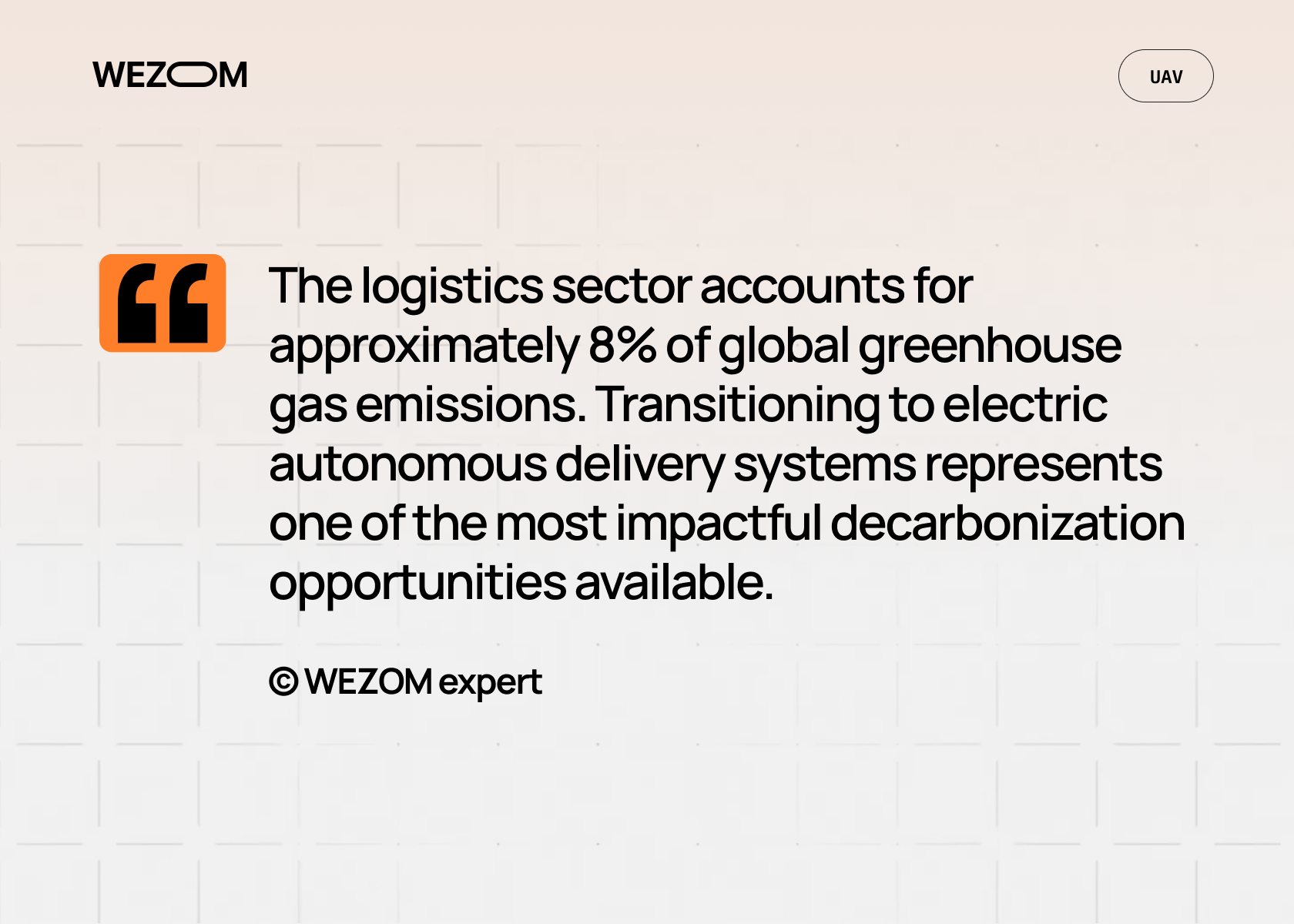
Sustainable drone logistics isn't just good PR, it's increasingly required. European regulations now mandate carbon reporting for logistics operations.
The math generally favors drones for small package deliveries over traditional vehicles, especially in high-density delivery areas.
Conclusion
Drone logistics won't replace your entire delivery network. The technology has clear constraints: weather sensitivity, limited payload capacity, regulatory complexity that varies by jurisdiction.
What it does is fill gaps that traditional logistics can't address efficiently. Companies investing in drone delivery software now aren't chasing futuristic visions, they're capturing measurable advantages in specific operational scenarios. Faster time-to-delivery in target markets. Reduced per-unit costs at scale. Demonstrable sustainability improvements that matter for corporate reporting and customer perception.
If you're considering drone fleet management for your operations, start small. Identify specific routes where drones excel. Test the technology. Gather data. Then scale what works.
The future of drone logistics is already here. It's just unevenly distributed.
FAQ
What industries benefit most from drone delivery systems?
Healthcare leads the way — delivering blood samples, medications, and emergency supplies. E-commerce, especially for small, time-sensitive items, is seeing rapid adoption. Agriculture and food delivery in suburban areas show promise too.
How does drone delivery software ensure route efficiency?
AI algorithms analyze real-time weather, air traffic, no-fly zones, delivery windows, and battery levels. The software calculates optimal routes considering all constraints and adjusts dynamically if conditions change mid-flight.
What are the biggest obstacles to large-scale drone logistics?
Regulatory approval for beyond-visual-line-of-sight operations remains the primary bottleneck. Payload limitations restrict deliveries. Weather sensitivity affects reliability. Initial infrastructure investment is substantial.
Can drones deliver in adverse weather conditions?
Modern drones handle light rain and moderate winds, but heavy precipitation, strong gusts, or lightning ground operations for safety. Advanced systems predict weather patterns and schedule deliveries around problematic conditions.
How does AI influence the accuracy of drone navigation?
AI enhances navigation through computer vision for obstacle detection, predictive path planning, real-time adjustments, and precision landing. Systems continuously improve accuracy through machine learning.
Are drone deliveries environmentally friendly compared to traditional logistics?
Generally, yes. Electric drones produce no direct emissions and use minimal energy per delivery. For small packages over short to medium distances, drones typically show 80–90% lower emissions than traditional delivery vehicles.
What is the estimated ROI for companies adopting drone delivery technology?
Early adopters in medical logistics report ROI within 18–24 months. Commercial applications typically see 3–5 year payback periods. Key factors include reduced labor costs, fuel savings, increased delivery capacity, and enhanced customer satisfaction.
