
Artificial intelligence has now fully transitioned from a technology that is effective only in theory to a fundamental business asset. That’s why “How much does it cost to build an AI system?” today has become a pressing concern that torments startup executives and top management at multinational corporations. Actually, according to a recent Gartner report, global investment in AI will reach $2.52 trillion this year, confirming unprecedented demand for the smart automation of human labor.
However, these overall figures conceal a complex cost structure. So, the answer to the question of “How much does it cost to build artificial intelligence?” requires analyzing server capacity, talent costs, along with data preparation and long-term support, as, ultimately, the cost of an AI system for business directly depends on the depth of integration of algorithms into the company's operations.
Budget Factors Influencing AI System Cost
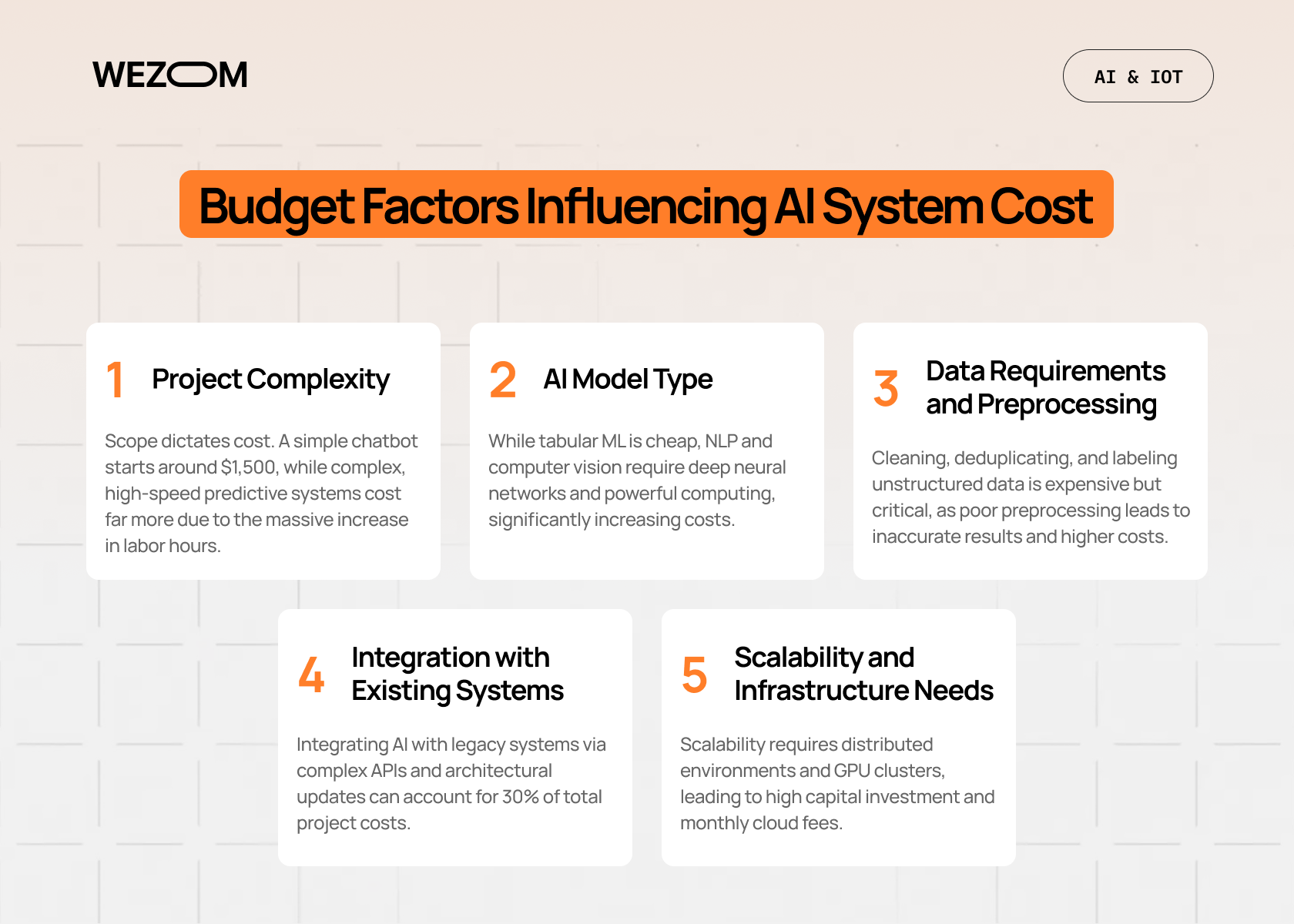
In short, there are many factors that determine the final custom AI system cost, such as the choice of mathematical framework or infrastructure resiliency requirements.
Project Complexity
It is the primary factor determining the cost of AI system development. For example, if your task is limited to creating a chatbot to answer basic questions, the price will be minimal (let's say from one and a half thousand dollars – the solution will have an API and will be based on one of the ready-made models). However, if you need to build a multi-tiered prediction analytics system capable of processing millions of transactions per the one second, the cost will increase too rapidly, as it directly impacts the number of man-hours.
AI Model Type
Classic machine learning for analyzing data from tables is the least expensive. However, natural language processing systems (needed for, for example, analyzing legal documents) or computer vision (for quality control in manufacturing) require the use of deep neural networks. Training such models needs specialized libraries and powerful computing nodes, which significantly increases the cost of the solution.
Data Requirements and Preprocessing
If a company doesn't have well-structured storage with relevant data only, a significant portion of the budget will be spent on dataset creation. This process includes data collection, denoising, deduplication, and, most expensively, data labeling. Without high-quality preprocessing, even the most sophisticated algorithm will produce erroneous results, making the data preparation stage critical to the final cost.
Integration with Existing Systems
To properly integrate your AI solution with current ERP/CRM/manufacturing systems will require developing complicated APIs. Additionally, changing the existing IT infrastructure to ensure that the legacy and the new application can communicate effectively is another major aspect. As a result, as much as 30% of the entire project cost can be attributed to changes needed to the project’s architecture.
Scalability and Infrastructure Needs
Infrastructure costs depend on the planned workload. If the system has to support high scalability, engineers must design a distributed environment capable of dynamically allocating resources. Usually, this implies using GPU clusters to process real-time queries, which turns out to be an additional significant capital investment and high monthly payments to cloud providers.
Development Stages and Their Costs
The AI product development lifecycle consists of several sequential stages. Understanding this sequence provides a clear answer to the question of “how much does AI cost?” at each stage of implementation.
| Stage | Activity | Duration | Cost Range |
|---|---|---|---|
| Research | Business analysis/PoC/roadmap | 2-5 weeks | $15,000-$35,000 |
| Data engineering | Collection/cleaning/labeling | 6-12 weeks | $30,000-$80,000 |
| Development | Model architecture/training/ tuning | 10-20 weeks | $70,000-$200,000 |
| Deployment | Backend dev/API/cloud setup | 5-10 weeks | $40,000-$100,000 |
| Testing | Accuracy validation/stress testing | 4-7 weeks | $20,000-$50,000 |
Custom vs Off-the-Shelf AI Solutions: Cost Comparison
Choosing between developing a custom system and licensing a ready-made product is one of the most significant strategic dilemmas for businesses. How much does AI cost to develop versus monthly subscriptions? This will allow you to effectively allocate capital and operating expenses. While ready-made tools offer a quick start, a customized solution provides a unique competitive advantage and ownership of intellectual capital.
Pros and Cons of Custom AI
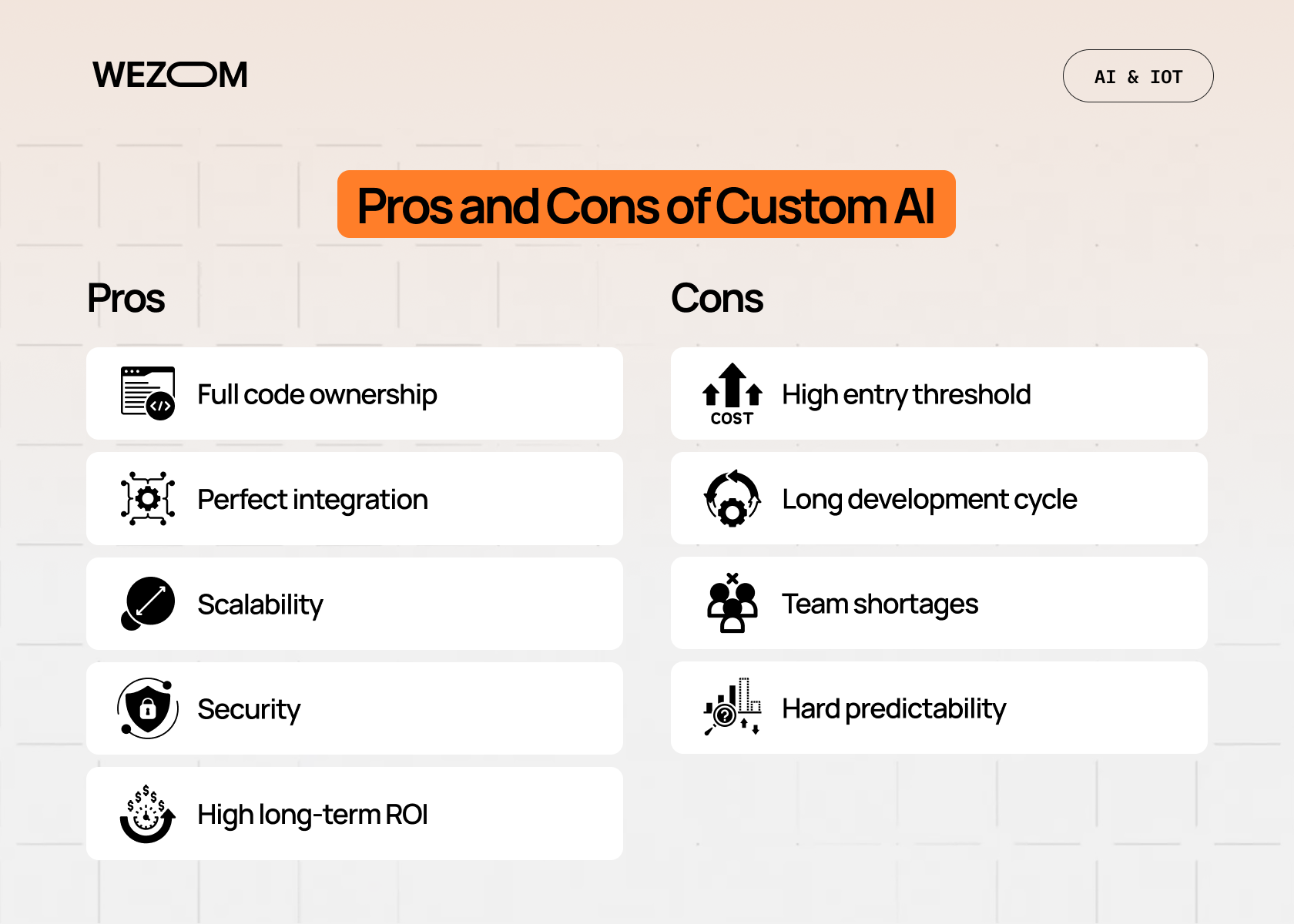
Developing a custom system is an investment in an architecture that 100% matches your unique business processes (there is actually a very wide price range here – while for an MVP, architecture level might cost around $10,000, for an enterprise-grade solution the lower limit might be ten times higher). Overall, this approach requires significant assets at the engineering stage, but offers maximum flexibility and control over data.
Pros:
- Full code ownership. You pay no license fees and are the sole owner of your intellectual property.
- Perfect integration. The product will be designed to fit your current infrastructure and databases.
- Scalability. A custom architecture allows you to add new features without the limitations imposed by third-party providers.
- Security. You have complete control over security protocols and the storage location of sensitive information.
- High long-term ROI. Once a critical mass of simultaneous users is reached, the cost per user becomes lower than with SaaS.
Cons:
- High entry threshold. The initial cost of a custom AI system will require a lot of investment even before the first commercial results are achieved.
- Long development cycle. Design and preparation of a high-quality dataset will extend the product's time to market by six to twelve months.
- Team shortages. A persistent shortage of pros will force the company to invest heavily in finding and retaining engineers for maintenance.
- Hard predictability. The final project estimate may increase due to unforeseen expenses during the model training phase or the need for emergency infrastructure expansion.
Cost Savings with SaaS/Ready-Made Solutions
Using SaaS AI tools is the most cost-effective option for businesses during the startup phase. You will only pay for what you use, thus avoiding huge costs associated with building your own AI solution from scratch (i.e., paying for the time and effort spent in training your first AI model and testing before being able to build a subsequent one using that same data).
So, by using off-the-shelf AI solutions, even small businesses can quickly implement their machines to find efficiencies without needing to hire a data scientist. However, you should also consider so-called “hidden inflation”, as you process more data, the cost of using the service (paid per hour) will increase, so what appears to be a low-cost solution may become a very big expense as the complete data processing ecosystem grows in size.
Long-Term Maintenance Cost Considerations
Currently, maintenance costs include mandatory retraining of models on fresh datasets to prevent accuracy loss due to data drift. Companies face regular bills for scalable cloud hosting and data storage, the size of which directly depends on the quality of architectural optimization. Additional expenses are required to adapt the security framework to changing legislation and API monitoring for seamless integration with the main business systems.
Hidden or Ongoing Costs to Consider
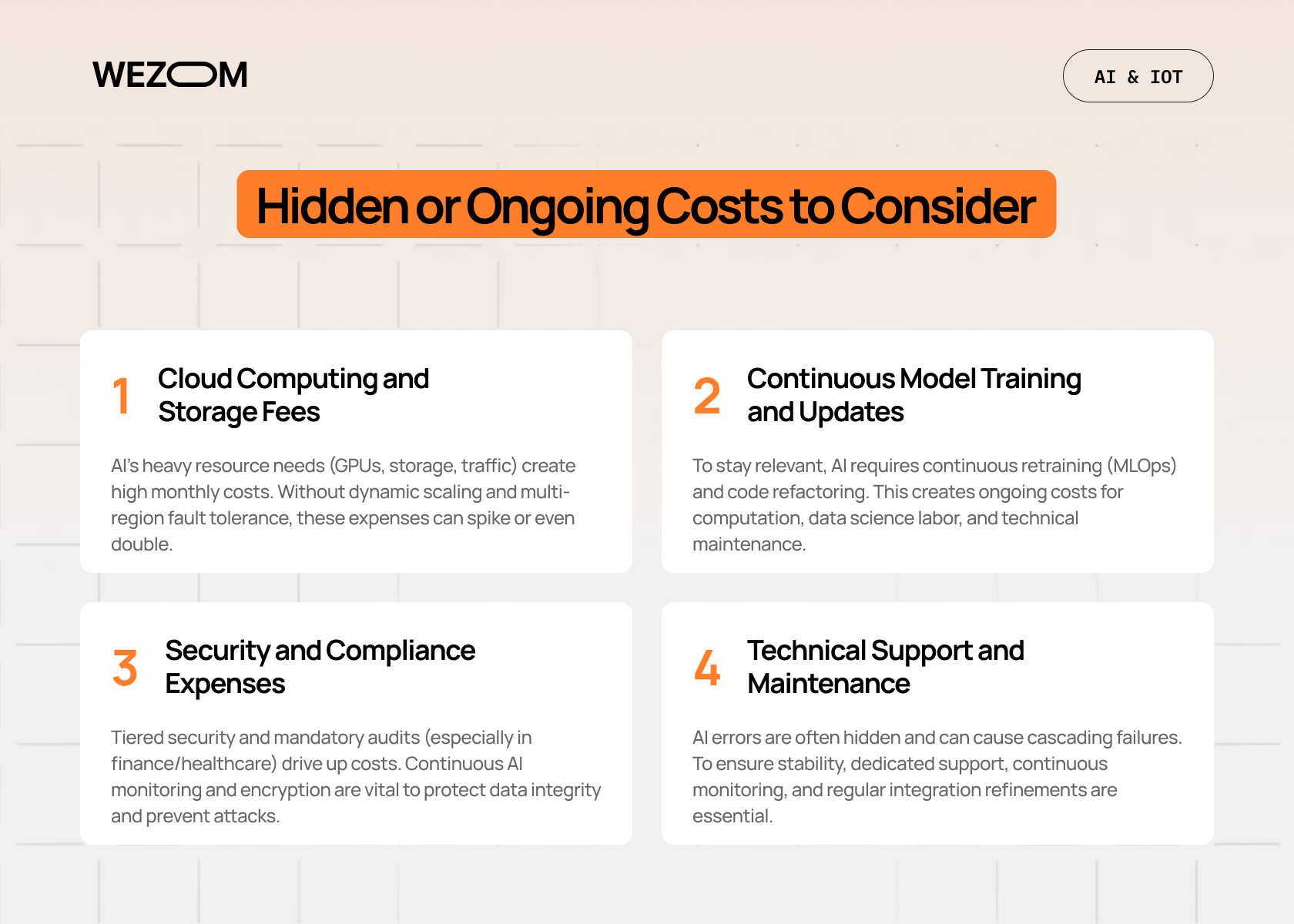
Launching a model into production is only the beginning part of active resource allocation. The main financial challenges typically emerge during actual use, when the final cost of an AI system for business begins to accumulate operational costs, which are difficult to predict at the design stage. That’s why understanding the structure of these expenses is essential for maintaining high project efficiency and preventing budget anomalies when scaling.
Cloud Computing and Storage Fees
Artificial Intelligence models require a lot of resources for real-time operation. They run continuously, creating cloud-based accelerated-GPU instances to respond to requests, generating growing monthly costs due to increasing demand for AI products. It’s also crucial to consider the cost of storing large data sets, including training data, logs, and mandatory backups, as well as CPU time.
Without properly configured dynamic scaling, hosting costs may experience excessive spikes during peak periods, negating the potential economic advantages of introducing such innovations. In addition, due to modern development and cloud architectures, there is a cost item associated with outgoing traffic, which can negatively impact your business when integrating third-party services. Also, it’s worth noting that building out a fault-tolerant solution in multiple geographical areas means that this potentially doubles the server costs and makes fault-tolerant architectures an expensive standard for all businesses at the enterprise level.
Continuous Model Training and Updates
Information your algorithm uses from one day to the next could become irrelevant/replaced/changed through time, which, in turn, negatively affects all predicted outcomes. For your system to stay relevant and useful, you must have an ongoing MLOps process aimed at regularly re-training your neural network on new data sets. Each iteration has associated costs from the computation and labor of data scientists during the validation process. And, since the AI Industry is constantly developing new technologies, it’s also important to refactor code regularly, so your new technology will remain compatible with your infrastructure. All of these payments combine and create an ongoing cost for maintaining your MLOps for your production systems.
Security and Compliance Expenses
Multi-tiered security measures must be implemented to protect data and adhere to global regulatory standards. The processing of confidential data necessitates sophisticated encryption and anonymization, creating a heavier demand on system processes and higher operating expenses. When operating as a legitimate company in the finance or healthcare industries, companies are required to have expensive annual audits and certifications, which involve additional pricey consulting services. It is also critical to protect the architecture itself from attacks. Specialized AI monitoring technology must run continuously to protect the integrity and reliability of the entire solution by monitoring the architecture in real time and ensuring that it cannot be manipulated.
Technical Support and Maintenance
Any error in an intelligent system can lead to unpredictable cascading failures in the company's global business logic, so having a dedicated technical support team is essential for a stable deployment. Unlike traditional software, errors in AI are often hidden: the model may function formally, but gradually begin to produce incorrect or biased results. This explains why you need to implement a sophisticated system of deep analytics and continuous monitoring by engineers. Moreover, as your IT ecosystem develops, interfaces for seamless integration with other programs will require regular refinement to ensure the smooth operation of all business processes in real time.
Tips to Optimize AI Development Budget
The implementation of intelligent systems is a resource-intensive process, but there are proven methods that can significantly optimize the cost of AI system development. Instead of trying to create a comprehensive solution from day one, successful companies use an iterative approach and modern tools, which reduces financial risks and accelerates the achievement of a positive ROI.
Below, there’s a list of methods for optimizing your budget:
- Start with developing an MVP. Instead of implementing all business processes at once, you can focus on one feature with the greatest automation potential. This will allow you to test the viability of the chosen algorithm on real data with minimal investment. A successful MVP launch provides an opportunity to demonstrate the system's value to stakeholders and get funding for further scaling based on efficiency metrics.
- Use pre-trained models and transfer learning. Developing and training a neural network from scratch is the most expensive part of the cost of building artificial intelligence. Modern platforms offer access to basic models through APIs or open-source frameworks. Transfer learning allows you to take an existing model and fine-tune it for your specific tasks using much less data and computing power, dramatically reducing the cost of a custom AI system.
- Prioritize features based on expected ROI. Not all AI capabilities are equally beneficial for business. Therefore, you have to conduct a thorough analysis and identify those tasks where automation will yield the greatest savings in man-hours or direct revenue growth. Eliminating non-essential functions early on will allow you to focus your budget on critical architecture, ensuring rapid ROI and stable deployment of core functionality.
- Consider outsourcing instead of in-house development. Hiring highly specialized data science and MLOps specialists is extremely expensive due to a talent shortage in the market. A great option to prevent budget harming is engaging an external team with expertise and proven framework solutions. This way, you’ll be able to avoid the costs of recruiting, training, and retaining staff. Also, outsourcing ensures flexibility: you pay for a specific result and can scale the development team depending on the current project phase.
- Use optimization and improvements. If you don’t monitor how your features are using resources, your infrastructure can get out of control. So, you should use cloud monitoring tools to check the consumption of your GPUs and memory. This way, you will be able to do specific optimizations of your code and the design of your database structure to lower your cloud hosting costs.
ROI and Business Value of AI Systems
The return from any investment is ultimately the basis of evaluation. A successful project launch will rely on an understanding of how the costs associated with developing AI systems correlate to profitability.
Measuring Efficiency Gains
The main contribution to the project's ROI comes from the radical automation of routine and cognitively demanding operations. Modern algorithms can process and interpret vast amounts of unstructured information in fractions of a second, which would take a skilled employee hours or even days of intense effort. This frees up human capital for creative, high-level strategic tasks, leading to a leap in overall productivity. Directly reducing dependence on manual data entry and minimizing the human factor in the document processing chain leads to a steady increase in the operating margins of the entire organization.
Revenue Impact
Intelligent models create additional ways to earn revenue and discover hidden patterns in consumer behavior that would be missed by traditional analytical systems, in addition to internal process improvement. Advanced customer analytics allow businesses to ensure a higher level of personalization, enabling them to present the ideal product or service to each user at precisely the right time. By providing improved accuracy in recommendations, intelligent models can directly drive increases in conversion rates and substantial increases in the average order value, enabling the custom AI system to offset its cost as quickly as possible through both net sales increase and improved customer retention.
Cost Reduction Potential
The cost-saving opportunities offered by predictive resource management techniques also play an essential role. AI can take on many tasks, including providing a seamless way to forecast inventory levels accurately, optimize complicated logistics routes, and forecast possible failures of industrial equipment. Preventing one significant mistake in a worldwide supply chain could result in savings equal to the entire original budget for deploying that system.
Decision-Making Improvements
The use of data-driven insight into market trends means that management can make decisions based on sound information instead of pure intuition. By utilizing optimized processes for operations, businesses will minimize potential risks associated with costly errors and get the ability to adjust and adapt to unexpected circumstances. The capability to instantly conduct analysis for numerous hypothetical situations will afford companies the ability to respond to changes in the marketplace rapidly. This aspect is critical to survive and maintain a competitive advantage within any industry.
Last Thoughts
Nowadays, we see the development of artificial intelligence as a conscious investment. Although the cost of an AI system for business is typically about hundreds of thousands of dollars, this represents only a small portion of what is required to complete your project. The success project depends heavily on how well you plan cloud servers maintenance and data updates once your product has been released.
For effective budgeting, we recommend a step-wise approach: start by testing the feasibility of your concept with simple prototypes or existing products, and only after that allocate money for complex custom development. All in all, with the proper setup, AI can help you make more accurate and faster decisions, providing your business with a great competitive advantage.
FAQ
How much does it cost to develop a simple AI system?
So, how much does it cost to make an AI? The creation of a basic solution, such as a simple chatbot or a data classification tool, is typically valued between $40,000 and $80,000. These numbers cover the expenses for data preparation and algorithm tuning. Still, even for a minimum viable product, thorough hypothesis testing and security measures are required, which directly affect the total budget.
Are custom AI solutions more expensive than ready-made ones?
Custom development is more expensive than ready-made services at the start, with investments from $60,000 being required. However, during long-term use, the absence of monthly licensing fees per user makes this option more cost-effective. A tailored approach allows the solution to be precisely adjusted for specific tasks, whereas the capabilities of off-the-shelf ones are often too limited.
How much does AI system maintenance cost annually?
Approximately 15-25% of the initial development cost is allocated to annual system support, which includes cloud server payments, data storage, and model retraining to maintain its accuracy. Expenses for technical monitoring and interface updates are also considered here, as they prevent algorithm failures caused by outdated information.
How much does AI integration with existing systems cost?
The process of integrating AI into a company's current IT environment is estimated at the $15,000-$60,000 range. The complexity is tied to the need to create data bridges between legacy software and new neural networks. Secure data transfer protocols and server optimization are required, too, as they are aimed at speeding up the main business processes.
How long does it take to develop a business AI system?
Usually, 4 to 9 months are allotted for the creation of a full-scale solution. This timeframe includes data collection/preparation, model training, and its final testing. Simple prototypes for testing ideas are prepared within 1.5-2 months, while the development of complex platforms requires a longer period (from 8 months) to ensure their stable, predictable operation.
