
The question of how much it cost to create an app in 2026 is no longer limited to basic development expenses. Modern mobile products operate within complex digital ecosystems that combine cloud software, automation, AI, security, scalability, and long-term maintenance strategies. For startups, enterprises, and growing digital platforms, understanding mobile app development cost has become a strategic exercise rather than a simple pricing calculation.
In today’s market, organizations evaluate not only the mobile app development price itself, but also the return on investment, delivery timeline, operational risks, scalability potential, and long-term total cost of ownership. Whether you are planning a new startup product, modernizing enterprise software, or launching a new digital service, having a realistic understanding of cost of mobile app development helps avoid budget overruns, technical debt, and missed business opportunities.
This article explores how much does mobile app development cost in 2026, what factors influence pricing, how different platforms affect budgets, and how businesses can accurately the cost of development in mobile application projects. The perspective reflects real-world agency practices, outsourcing models, enterprise delivery standards, and modern software engineering workflows.
Mobile App Development Pricing Overview 2026
The mobile market in 2026 continues to expand across industries such as eCommerce, healthcare, fintech, logistics, media, and enterprise automation. As digital products grow in complexity, mobile application development cost is increasingly influenced by infrastructure maturity, integration depth, and regulatory requirements rather than interface complexity alone.
Overview of Typical Cost Ranges
When companies ask how much does it cost to develop an app, the answer depends on scope, quality expectations, platform strategy, and business goals. In practical terms, cost of mobile application development typically falls into the following ranges:
- Basic MVP or utility applications – $15,000 to $50,000
Suitable for validating ideas, internal tools, simple prototypes, or early-stage startups that prioritize speed over advanced features. - Medium-complexity business applications – $50,000 to $150,000
Includes authentication, integrations, moderate UX customization, analytics, and scalable backend architecture. - Advanced platforms with automation and integrations – $150,000 to $350,000
Covers real-time features, complex workflows, third-party services, advanced security, and performance optimization. - Enterprise-grade or AI-powered ecosystems – $350,000 to $1,000,000+
Includes AI automation, compliance requirements, multi-region scalability, enterprise integrations, and long-term roadmap planning.
These ranges represent end-to-end delivery, including design, frontend, backend, API integration, QA, deployment, and early maintenance. They reflect average agency and outsourcing market pricing across North America, Europe, and distributed delivery models.
Organizations frequently underestimate mobile app development cost by focusing solely on interface screens while ignoring architecture, security, testing, and operational readiness. This leads to unrealistic budgeting and delayed launches.
Why Costs Vary Widely
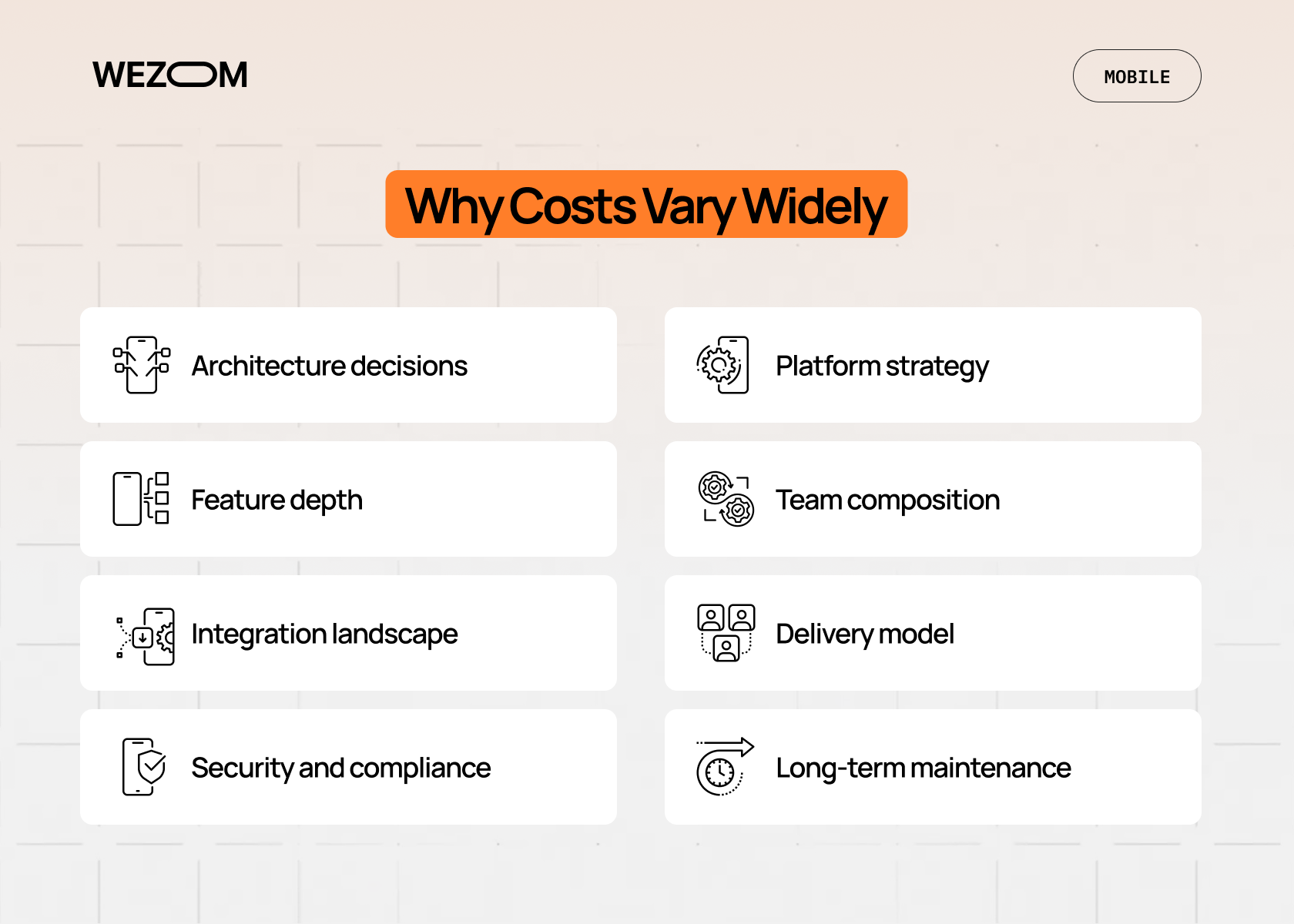
There is no single fixed answer to the cost of mobile app development because every product operates within a unique business and technical context. Pricing variability emerges from multiple dimensions:
- Architecture decisions – monolithic versus microservices, cloud-native design, scalability requirements.
- Feature depth – automation logic, real-time processing, personalization, AI capabilities.
- Integration landscape – number of external APIs, payment gateways, mapping services, analytics platforms.
- Security and compliance – data encryption, identity management, audit readiness.
- Platform strategy – native iOS, native Android, cross-platform, or progressive web architecture.
- Team composition – seniority of engineers, QA maturity, DevOps automation level.
- Delivery model – outsourcing, dedicated team, agency-based engagement, or in-house development.
- Long-term maintenance – upgrade cycles, infrastructure scaling, ongoing optimization.
Two applications with visually similar interfaces can differ significantly in cost of development in mobile application projects if one of them requires real-time processing, compliance audits, or enterprise-grade scalability.
Comparison Table of Typical Cost Ranges
| App Category | Estimated Budget Range | Typical Timeline | Primary Cost Drivers |
|---|---|---|---|
| Simple MVP | $15K – $50K | 2–4 months | Limited features, minimal integrations |
| Business App | $50K – $150K | 4–7 months | Authentication, APIs, UX |
| Advanced Platform | $150K – $350K | 7–12 months | Automation, scalability, QA |
| Enterprise / AI | $350K+ | 12–24 months | Compliance, AI, security |
This comparison illustrates how mobile app development price scales with complexity and operational maturity.
What Determines App Development Cost?
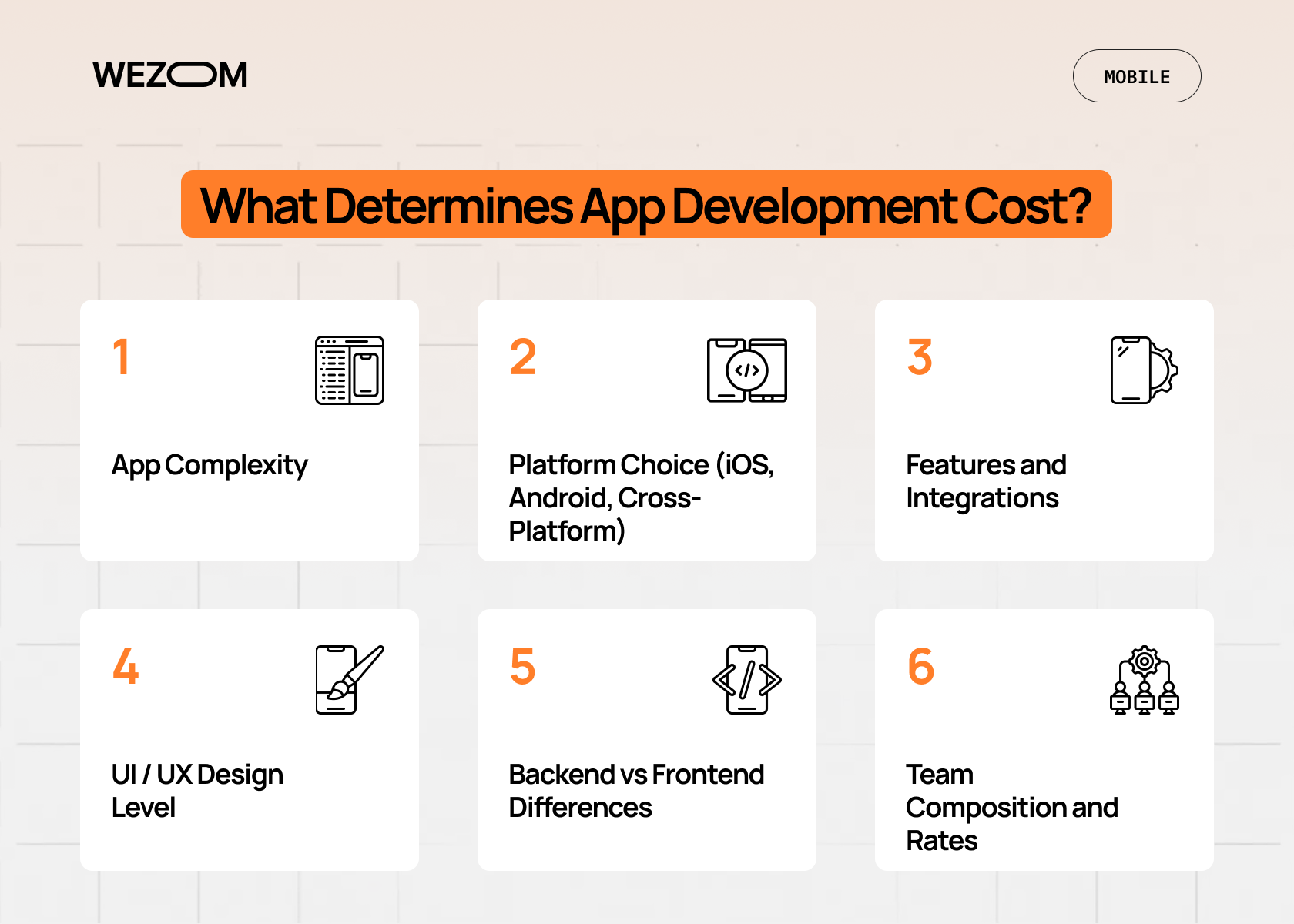
Understanding mobile app development cost factors allows organizations to build realistic budgets and align product scope with business priorities. While every project is unique, several core dimensions consistently influence pricing.
App Complexity
Complexity defines the volume of engineering effort, architectural planning, testing, and long-term support. It increases when additional layers are introduced:
- Multiple user roles and permission layers
- Workflow automation and business logic orchestration
- Offline synchronization
- Real-time messaging or streaming
- Advanced analytics and reporting
- High security and access control requirements
- Cross-device compatibility
A simple CRUD-based application requires limited backend logic, whereas a real-time platform with automation and analytics demands significantly higher engineering investment. Complexity directly impacts total development cost across the entire lifecycle.
Platform Choice (iOS, Android, Cross-Platform)
Platform strategy strongly affects cost of mobile app development. Organizations evaluating how much does it cost to develop an iOS app or how much does it cost to develop an Android app must consider:
- Separate frontend codebases for native development
- Device fragmentation and OS compatibility testing
- Performance optimization requirements
- Platform-specific UI guidelines and review processes
- Long-term maintenance across OS updates
Cross-platform frameworks reduce duplicated frontend development but introduce additional testing complexity and potential performance trade-offs. Progressive web solutions reduce upfront budget but limit access to native device capabilities.

Features and Integrations
Feature scope is a major driver of mobile application development cost. Each feature adds design, development, testing, security validation, and maintenance overhead. Typical integrations include:
- Payment systems and subscription billing
- GPS and geolocation services
- Messaging and notifications
- Analytics and attribution platforms
- Identity and authentication providers
- External enterprise APIs
Advanced features such as AI automation, personalization engines, or predictive analytics significantly increase mobile app development price due to infrastructure and data processing requirements.
UI / UX Design Level
Design quality impacts both user adoption and production cost. High-quality UX involves:
- User research and usability testing
- Prototyping and interaction design
- Accessibility compliance
- Multi-device responsive layouts
- Animation and micro-interactions
Investing in strong UI and UX increases upfront cost of mobile application development but often reduces churn, support costs, and redesign expenses later.
Backend vs Frontend Differences
While frontend receives more visual attention, backend development often represents the largest engineering workload. Backend responsibilities include:
- Data modeling and storage architecture
- API orchestration and integration
- Security enforcement and access control
- Scalability planning and load management
- Monitoring, logging, and optimization
Backend complexity plays a critical role in answering the question: how much does it cost to develop an app beyond surface-level design?
Team Composition and Rates
Team structure determines productivity, quality, and pricing. Typical roles include:
- Product manager or business analyst
- UI / UX designers
- Frontend developers
- Backend engineers
- QA specialists
- DevOps engineers
Rates vary by geographic location, seniority, and engagement model. Outsourcing and agency delivery can optimize budget but require strong communication and governance practices.
How App Complexity Impacts Cost
Complexity directly correlates with timeline, staffing, testing intensity, and infrastructure investment. Understanding complexity tiers helps organizations estimate how much mobile app development cost realistically aligns with business goals.
Simple Apps
Simple applications usually include:
- Limited screens and workflows
- Basic CRUD operations
- Minimal integrations
- Standard UI components
- Lightweight backend
Typical use cases include internal tools, MVP validation, proof-of-concept platforms, and early-stage startup prototypes.
Estimated budget: $15,000 – $50,000
Timeline: 2–4 months
Risk level: Low
Simple apps allow rapid market testing but often require future re-architecture as business grows.
Medium-Complexity Apps
Medium-complexity solutions introduce:
- User authentication and role management
- Multiple external API integrations
- Customized UI and UX
- Analytics and monitoring
- Scalable backend foundation
These applications are common for SaaS startups, service platforms, and growing digital products.
Estimated budget: $50,000 – $150,000
Timeline: 4–7 months
Risk level: Medium
Medium complexity reflects the most common category when evaluating cost of mobile app development.
Advanced / AI / Real-Time Apps
Advanced platforms incorporate:
- Machine learning models and automation workflows
- Real-time data synchronization
- High-performance APIs
- Complex business logic orchestration
- Advanced security and compliance
Organizations asking how much does it cost to develop an AI app should expect significantly higher engineering investment due to data processing pipelines, infrastructure scaling, and model lifecycle management.
Estimated budget: $150,000 – $350,000
Timeline: 7–12 months
Risk level: Medium–High
Enterprise-Grade Apps
Enterprise platforms require:
- High availability and disaster recovery
- Compliance with regulatory standards
- Deep integration with legacy systems
- Multi-region scalability
- Advanced security architecture
Enterprise-grade systems represent the upper bound of how much does it cost to develop an app in production environments.
Estimated budget: $350,000 – $1,000,000+
Timeline: 12–24 months
Risk level: High
How Platform Choice Affects App Pricing
Platform selection influences development velocity, maintenance burden, and long-term scalability. Businesses evaluating how much does it cost to develop an iPhone app or how much does it cost to develop an Android app must consider both short-term and long-term financial implications.
Native iOS Cost
Native iOS development delivers high performance and deep integration with the Apple ecosystem. Cost drivers include:
- Swift development expertise
- App Store compliance and review cycles
- Device compatibility optimization
- Security standards and privacy policies
Typical range: $40,000 – $200,000+ depending on complexity and features.
Native Android Cost
Android development faces device fragmentation and OS diversity. Cost drivers include:
- Hardware compatibility testing
- Performance optimization
- Google Play compliance
- Localization requirements
Typical range: $40,000 – $220,000+.
Cross-Platform (React Native / Flutter)
Cross-platform frameworks reduce duplicated code but require additional testing and optimization. Cost drivers include:
- Framework limitations
- Native module integration
- Performance tuning
- Tooling maturity
Typical range: $50,000 – $180,000.
Progressive Web Apps (PWA)
PWA solutions reduce upfront mobile app development cost but offer limited device access and offline capabilities.
Typical range: $20,000 – $90,000.
| Platform | Typical Cost Range | Key Advantages | Limitations |
|---|---|---|---|
| Native iOS | $40K – $200K+ | Performance, ecosystem quality | Higher cost |
| Native Android | $40K – $220K+ | Market reach | Fragmentation |
| Cross-Platform | $50K – $180K | Faster delivery | Framework constraints |
| PWA | $20K – $90K | Budget efficiency | Limited native features |
Technology and Feature Cost Breakdown
Modern mobile products operate as distributed software systems rather than isolated applications. Infrastructure, automation, integrations, and security layers significantly influence mobile app development cost and long-term operational resilience. Understanding how individual technologies affect budget helps organizations prioritize features and optimize investment.
AI / ML Integration Impact
When evaluating how much does it cost to develop an AI app, organizations must consider the full lifecycle of artificial intelligence rather than only model training. AI-related cost drivers include:
- Data collection pipelines, labeling processes, and dataset governance
- Model experimentation, validation, and continuous improvement
- Cloud compute resources for training and inference
- MLOps pipelines for deployment and monitoring
- Data security, privacy, and regulatory compliance
AI capabilities such as recommendation engines, image recognition, natural language processing, fraud detection, and predictive analytics often increase cost of mobile app development by 30–120% compared to traditional feature sets. Performance optimization and scalability become critical, especially when AI workloads grow with user adoption.
Third-Party Services and Integrations
Third-party services accelerate product delivery but introduce recurring costs and technical dependencies. Common integrations include:
- Payment gateways and subscription management platforms
- Mapping and geolocation services
- Analytics and attribution platforms
- Customer communication and notification services
- Identity providers and authentication APIs
Each integration requires API configuration, security validation, testing, version management, and long-term maintenance. As the number of integrations grows, mobile application development cost increases due to added QA cycles and operational complexity.
Real-Time Features and Geolocation
Applications that rely on real-time communication or live data synchronization require specialized architecture:
- Event-driven APIs and streaming pipelines
- Low-latency infrastructure
- Data consistency mechanisms
- Load balancing and autoscaling
- Monitoring and alerting
Geolocation-based services introduce additional complexity related to accuracy, privacy, and battery optimization. These requirements directly impact mobile app development price and ongoing infrastructure budget.
Security and Compliance Services
Security is no longer optional for production-grade applications. Typical investments include:
- Encryption of data at rest and in transit
- Identity and access management
- Secure API gateways
- Automated vulnerability scanning
- Compliance audits depending on industry
Strong security increases initial cost of development in mobile application projects but protects against financial losses, reputational damage, and regulatory penalties.
Step-by-Step Cost Breakdown by Development Phase
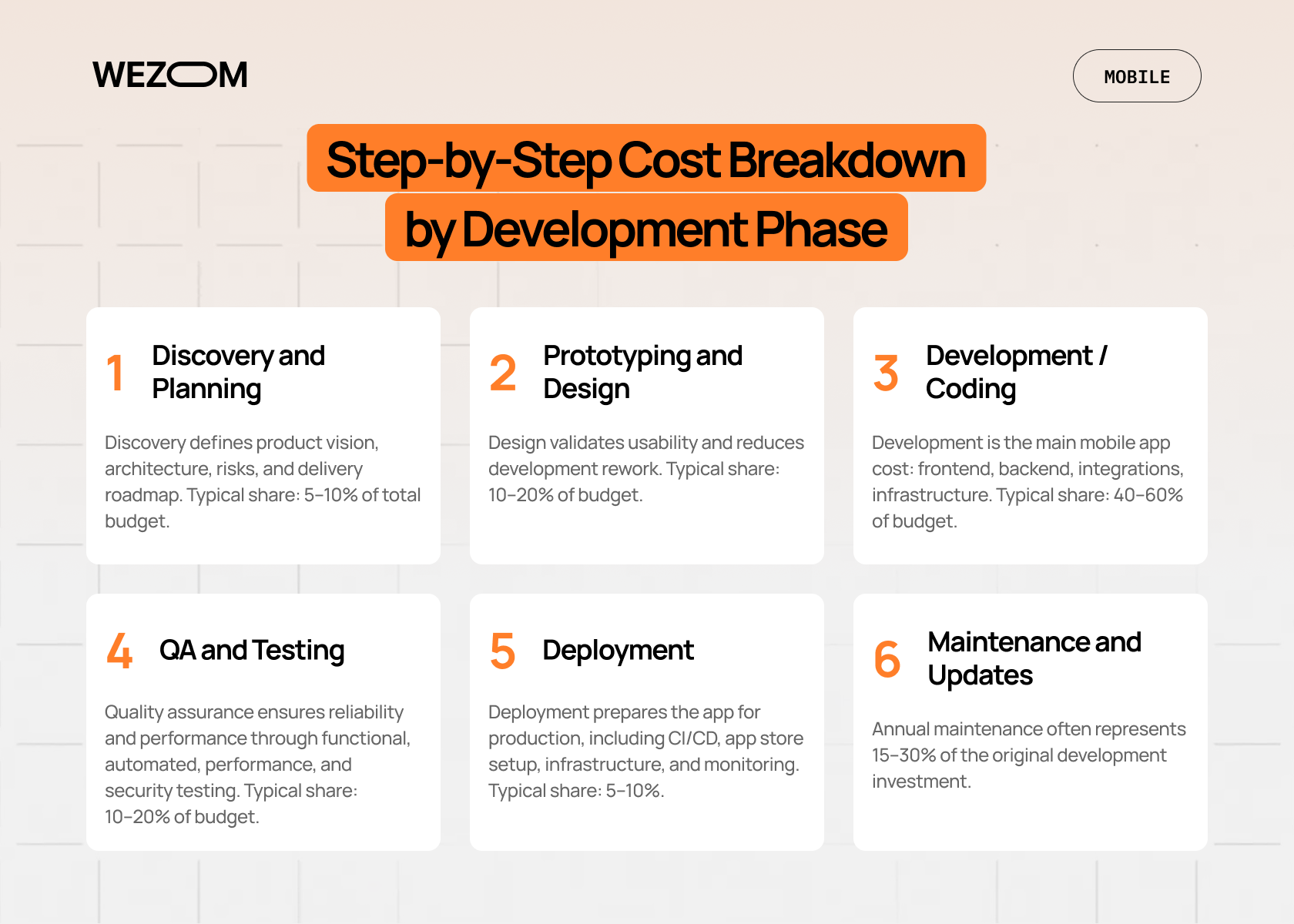
Understanding how budget is distributed across development phases improves transparency and planning accuracy.
Discovery and Planning
Discovery defines product vision, architecture, risks, and delivery roadmap. Activities include:
- Business requirements analysis
- Stakeholder alignment
- Technical feasibility assessment
- Architecture modeling
- Budget and timeline estimation
Typical share: 5–10% of total budget.
Prototyping and Design
Design validates usability and reduces development rework. Deliverables include:
- Wireframes and interactive prototypes
- UI component libraries
- UX testing and iteration
- Accessibility validation
Typical share: 10–20% of budget.
Development / Coding
Development consumes the largest portion of mobile app development cost:
- Frontend implementation
- Backend services and APIs
- Database modeling
- Integration with external systems
- Automation and infrastructure setup
Typical share: 40–60% of budget.
QA and Testing
Quality assurance ensures reliability and performance:
- Manual functional testing
- Automated regression testing
- Performance validation
- Security verification
Typical share: 10–20% of budget.
Deployment
Deployment prepares the application for production:
- CI/CD pipeline configuration
- App store preparation
- Infrastructure provisioning
- Monitoring setup
Typical share: 5–10%.
Maintenance and Updates
Ongoing support includes:
- Bug fixes
- OS compatibility updates
- Performance optimization
- Feature expansion
Annual maintenance often represents 15–30% of the original development investment.
App Development Costs by Industry and Type
Industry-specific requirements influence architecture, compliance, and operational complexity, shaping mobile app development cost.
Social Media Apps
Key drivers include:
- Real-time messaging
- Media storage and streaming
- Moderation workflows
- High scalability
Estimated budget: $120,000 – $400,000+.
eCommerce Apps
Cost drivers include:
- Payment processing
- Inventory synchronization
- Personalization engines
- Analytics integration
Estimated budget: $80,000 – $300,000+.
FinTech and HealthTech
Primary drivers include:
- Regulatory compliance
- Data protection
- Security audits
- Integration with financial or medical systems
Estimated budget: $150,000 – $600,000+.
Marketplace Platforms
Cost drivers include:
- Multi-role user logic
- Matching algorithms
- Payment flows
- Trust and safety mechanisms
Estimated budget: $120,000 – $450,000+.
IoT and Gaming
Cost drivers include:
- Hardware integration
- Real-time telemetry
- Performance optimization
- Custom APIs
Estimated budget: $150,000 – $700,000+.
| Industry | Typical Cost Range | Primary Complexity Drivers |
|---|---|---|
| Social Media | $120K – $400K+ | Real-time scalability |
| eCommerce | $80K – $300K+ | Payments and analytics |
| FinTech / HealthTech | $150K – $600K+ | Compliance and security |
| Marketplace | $120K – $450K+ | Multi-role workflows |
| IoT / Gaming | $150K – $700K+ | Hardware integration |
Hidden Charges That Affect Your Budget
Hidden costs often surprise organizations during scaling and long-term operation.
Backend Infrastructure and Hosting
Cloud infrastructure scales with traffic, storage, and performance demands.
App Store Fees
Developer accounts and transaction fees impact revenue margins.
App Marketing and ASO
User acquisition campaigns, analytics tools, and optimization require ongoing budget.
Legal and Compliance
Contracts, privacy policies, and regulatory audits generate additional expenses.
Maintenance and Upgrades
Continuous updates and security patches require dedicated resources.
How to Estimate Your App Budget?
Practical Cost Estimation Framework
A structured estimation approach includes:
- Define business objectives and success metrics
- Prioritize features and MVP scope
- Select platform strategy
- Estimate team composition and timeline
- Add contingency buffer
- Validate assumptions with technical experts
Tips on Avoiding Under- or Over-Budgeting
- Avoid unrealistic timelines
- Invest in early discovery
- Validate architecture assumptions
- Plan maintenance from the start
- Track metrics continuously
FAQ
What is the average cost to create a mobile app?
The average cost to create a mobile app ranges from $50,000 to $200,000 depending on complexity, platform, and integrations.
What factors affect mobile app development cost the most?
Primary factors include app complexity, platform strategy, integrations, security requirements, and team expertise.
How long does it take to develop a mobile app?
Development timelines typically range from 3 to 12 months depending on scope and platform.
How to reduce mobile app development costs?
Reducing scope, using cross-platform frameworks, prioritizing MVP features, and leveraging automation help optimize budget.
Does UI/UX design impact cost a lot?
Yes. High-quality UI and UX increase upfront investment but improve product success and retention.
