
IoT devices generate data. Machine learning makes sense of it. Simple, right?
Not quite. The real story is how these two technologies have created a feedback loop that's making systems smarter by the day — learning from every interaction, predicting failures before they happen, and automating decisions that used to require human oversight.
Here's what's actually happening: your smart home, your fitness tracker, industrial sensors in factories, they're all generating massive amounts of data every second. Too much for humans to process. But machine learning thrives on exactly this kind of data overload. It finds patterns we'd never spot, predicts outcomes before they happen, and automates responses in real-time.
That's the machine learning — internet of things partnership in action.
In this article we'll see how exactly this works, show you real applications across industries, and cover both the massive benefits and the challenges you need to know about.
What Is IoT and Machine Learning?
IoT is basically a network of physical devices that connect to the internet and exchange data with each other. Your fitness tracker, smart speaker, connected car — they're all part of the internet of things. These devices have sensors that collect information about their environment: temperature, movement, sound.
Here's the thing though. On their own, IoT devices are pretty dumb. They can collect data all day long, but they don't really know what to do with it. That's where their tech partner comes in.
Machine learning is a subset of artificial intelligence that lets computers learn from data without being explicitly programmed for every single scenario. Instead of following rigid rules, ML algorithms find patterns in data and make predictions based on what they've learned.
Think about how Netflix recommends shows. It's not because someone manually decided you'd like that crime documentary, the algorithm learned from your viewing patterns.
So what happens when you combine IoT with machine learning?
You get devices that don't just collect data, they understand it. A smart thermostat doesn't just know the temperature; it learns your schedule, predicts when you'll be home, and adjusts accordingly. That's machine learning in IoT doing its thing.
The devices become adaptive. They improve over time. They start anticipating needs instead of just responding to commands.
How IoT and Machine Learning Work Together
Let's get into the mechanics of this partnership. It's actually pretty straightforward once you see the flow.
IoT machine learning systems start with data generation. IoT devices are incredible data generators. They pump out massive amounts of information constantly. A single connected factory might generate terabytes of data daily from thousands of sensors monitoring everything from machine vibrations to temperature fluctuations.
According to Statista, the number of connected IoT devices worldwide is expected to reach 39.1 billion by 2029, up from 16.6 billion in 2023. That's an insane amount of data being created every second.
But here's the problem: humans can't process all that data. We're not built for it. You could have a team of analysts working 24/7 and they still wouldn't scratch the surface.
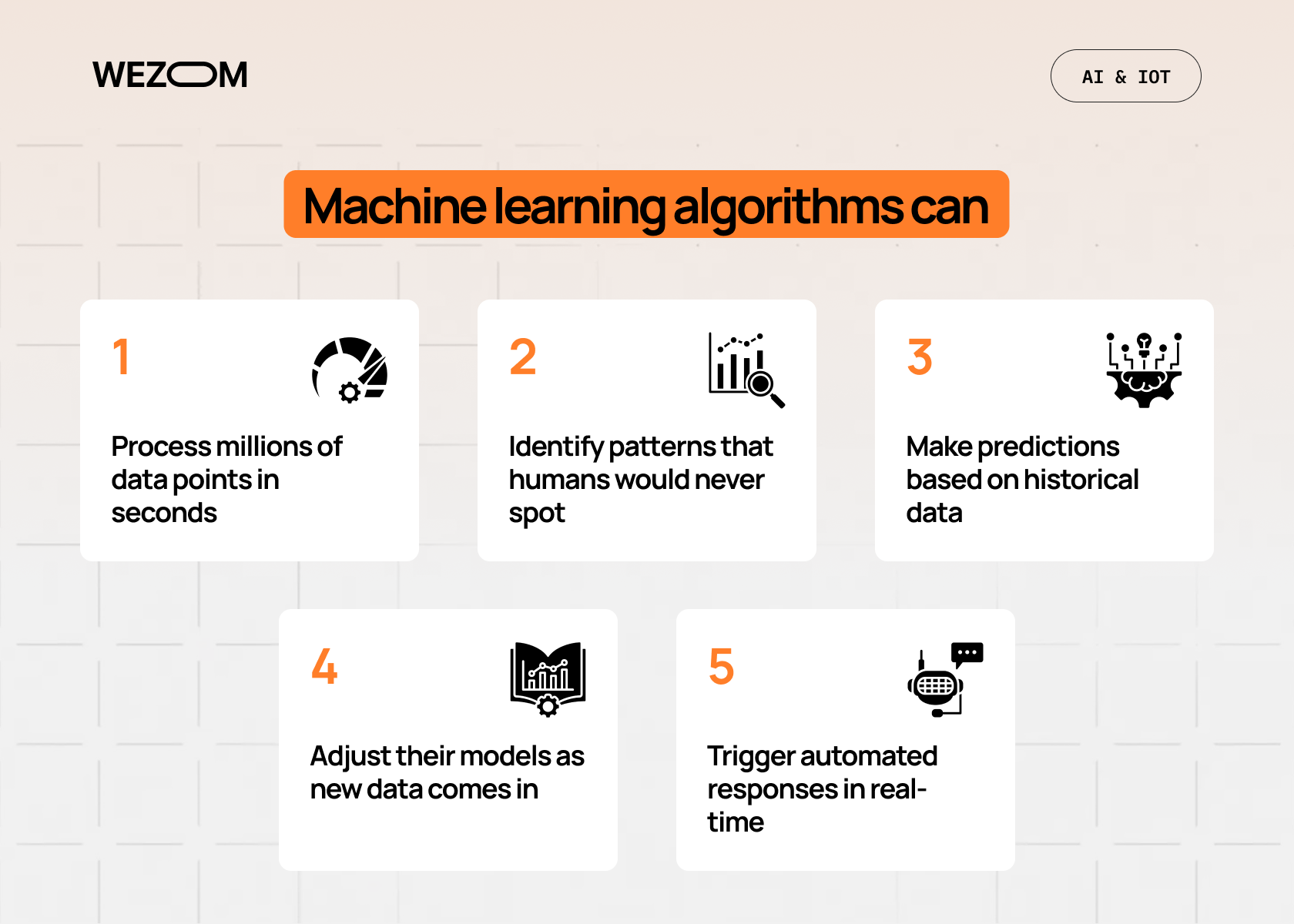
Machine learning algorithms can:
- Process millions of data points in seconds.
- Identify patterns that humans would never spot.
- Make predictions based on historical data.
- Adjust their models as new data comes in.
- Trigger automated responses in real-time.
Look, here's a simple example. Your smart watch collects heart rate data throughout the day. A traditional system would just show you the numbers. But with machine learning, it analyzes patterns, notices when something's off, and might alert you to see a doctor before you even feel sick.
The IoT and ML combo turns raw data into actionable insights.
What makes this partnership really powerful is the continuous feedback loop. IoT devices collect data, ML models analyze it and make predictions, those predictions lead to actions, and then the devices collect more data about the results. Round and round it goes, getting smarter with each cycle.
One client told us their smart building system reduced energy costs by 40% in the first year. Not through any major infrastructure changes, just through this learning loop optimizing HVAC systems based on occupancy patterns and weather predictions.
Real-World Applications of IoT and ML
Let's talk about where this tech partnership is actually making waves. Because theory is nice, but real-world impact is what matters.
Smart Homes That Actually Think
Your home is probably smarter than you realize. Smart thermostats like Nest use ML algorithms to learn your preferences and schedule. They track when you're home, what temperature you like at different times, and even factor in weather forecasts to optimize heating and cooling.
Security systems have gotten ridiculously good too. They can now distinguish between your cat walking past a window and an actual intruder. That's ML analyzing video feeds in real-time, learning what "normal" looks like for your home.
And it's not just about convenience (though honestly, who doesn't love saying "lights off" and having it actually happen). It's about efficiency — cutting energy waste and reducing costs.
Healthcare Gets Personal
Patient monitoring through IoT devices combined with ML is changing how healthcare works.
Wearable devices track vital signs continuously. ML algorithms analyze that data stream looking for warning signs: irregular heartbeats, changes in breathing patterns, early indicators of disease exacerbation.
Weirdly enough, some hospitals are using this technology to predict which patients are likely to deteriorate before traditional monitoring would catch it. That's the kind of proactive care that saves lives.
Diabetics can now use continuous glucose monitors that don't just track blood sugar, they predict future levels and automatically adjust insulin pumps. That's machine learning in IoT at its finest.
Manufacturing's Predictive Revolution
Predictive maintenance might sound boring, but it's saving manufacturers millions. Here's how it works: sensors on machinery collect data about vibrations, temperature, energy consumption, and performance. ML models learn what "healthy" operation looks like and can predict when a machine is likely to fail, often weeks in advance.
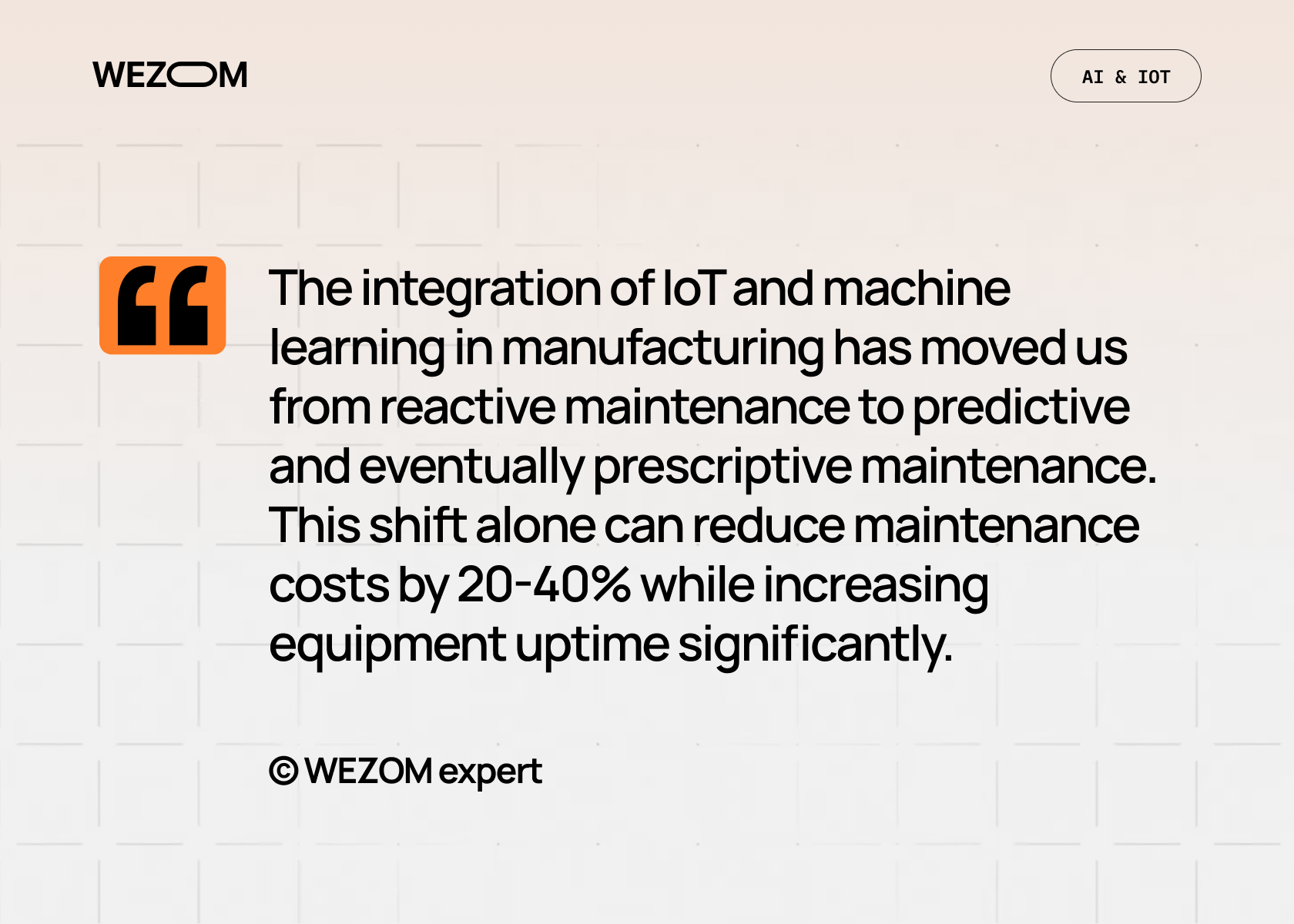
Instead of fixing things after they break (expensive, disruptive) or maintaining them on a fixed schedule whether they need it or not (wasteful), you maintain them exactly when needed. Brilliant.
Transportation: More Than Self-Driving Cars
Sure, autonomous vehicles are the flashy example everyone talks about. They use dozens of IoT sensors (cameras, radar, lidar) feeding data to ML models that make split-second driving decisions. But that's just one piece of the puzzle.
Logistics companies use IoT and machine learning to optimize delivery routes in real-time, adjusting for traffic, weather, and new orders. Fleet management systems predict which vehicles need maintenance, reducing breakdowns and downtime.
Even public transportation is getting smarter. Buses and trains equipped with IoT sensors help ML systems predict crowding, optimize schedules, and improve service reliability.
Agriculture Goes High-Tech
Precision farming might be one of the most impactful applications you've never thought about. Farmers use IoT sensors to monitor soil moisture, nutrient levels, weather conditions, and crop health. ML algorithms process this data to provide specific recommendations: water this section more, apply fertilizer here, harvest that field next Tuesday.
Drones equipped with cameras and sensors fly over fields collecting data. ML models analyze the images to detect diseases, pest infestations, or irrigation problems before they become visible to the human eye.
The result? Higher yields, less water waste, fewer chemicals, and more sustainable farming. Not bad.
Benefits of Combining IoT and Machine Learning
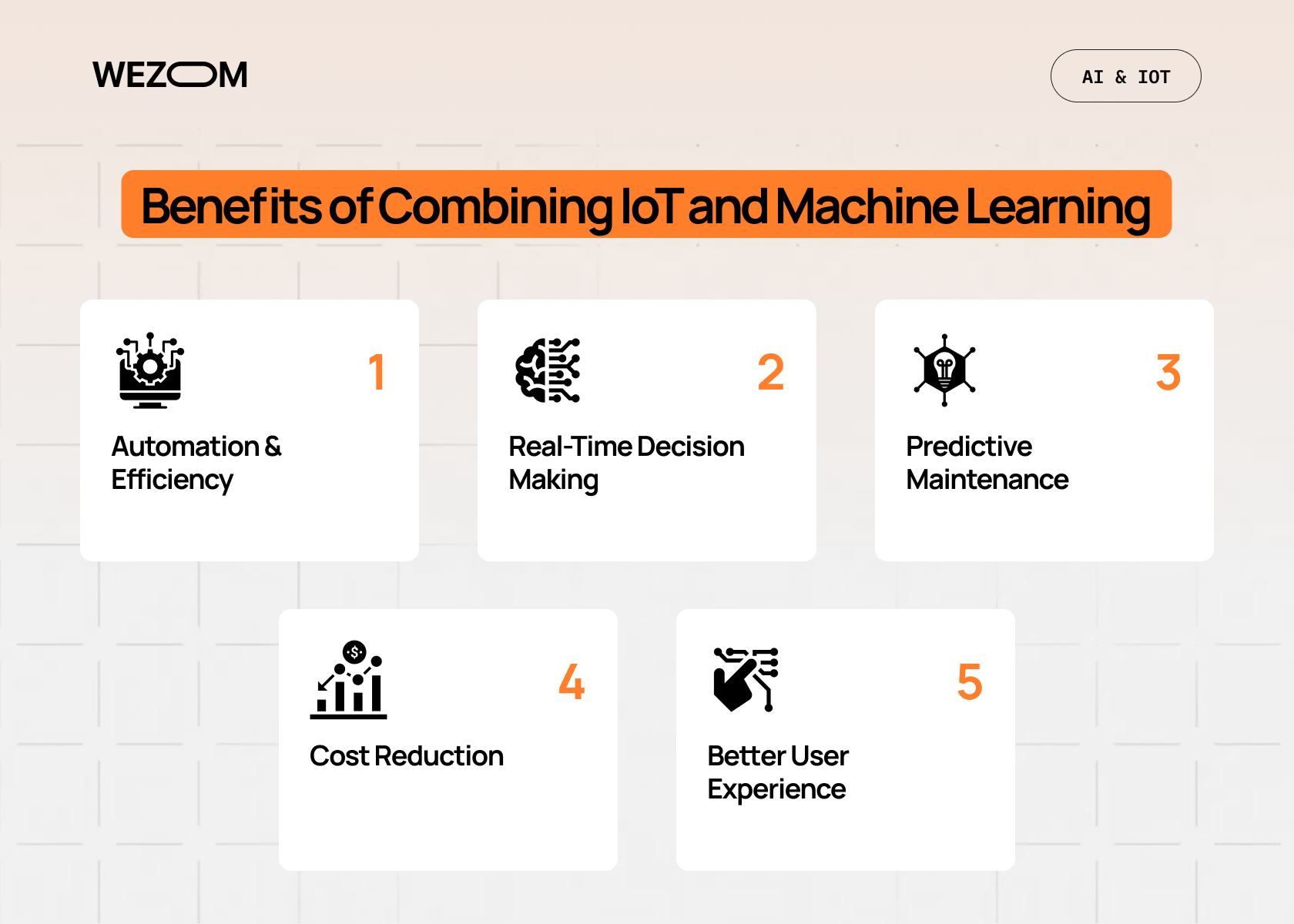
Now that you've seen it in action, let's break down why this partnership is so powerful. What are the actual benefits organizations get when they implement IoT with machine learning?
| Benefit | What It Means | Real Impact |
|---|---|---|
| Automation & Efficiency | Systems handle routine tasks and optimize processes without human intervention. | 30-50% reduction in manual monitoring tasks; operations run 24/7. |
| Real-Time Decision Making | Instant analysis and response to changing conditions. | Prevent failures before they happen; respond to opportunities immediately. |
| Predictive Maintenance | Know when equipment will fail before it does. | 20-40% lower maintenance costs; up to 50% reduction in downtime. |
| Cost Reduction | Less waste, better resource allocation, fewer failures. | Energy savings of 20-30%; reduced operational expenses across the board. |
| Better User Experience | Personalized, adaptive interactions. | Higher satisfaction rates; increased engagement and loyalty. |
Automation isn't just about cutting jobs. Here's something we think gets misunderstood. When we talk about automation through IoT and ML, people immediately worry about jobs. But that's not really what's happening in most cases.
What we're automating is the boring, repetitive stuff that humans hate doing anyway. Monitoring thousands of data points? Checking if machine #47 needs maintenance? Adjusting building temperatures every hour? Let the algorithms handle it.
This frees people up to do what they're actually good at — creative problem-solving, strategy, innovation. You know, the interesting stuff.
Real-Time Decision-Making
Humans are great at making decisions, but we can only process so much information at once. ML models can analyze thousands of variables simultaneously and make decisions in milliseconds.
That's crucial in scenarios where timing matters. A smart grid balancing energy loads. A traffic management system redirecting vehicles. A financial trading platform spotting opportunities. These need speed that humans simply can't match.
The Predictive Maintenance Game-Changer
We keep coming back to this because it's such a clear win. Traditional maintenance is either reactive (fix it when it breaks) or preventive (fix it on a schedule). Both are inefficient.
Predictive maintenance using IoT and ML is prescriptive. The system tells you exactly what needs attention, when, and sometimes even why. No more surprise failures. No more unnecessary maintenance. Just efficiency.
One manufacturing client showed me their numbers: predictive maintenance reduced unexpected downtime by 75%. That's enormous in an industry where every hour of downtime can cost tens of thousands of dollars.
Cost Reduction That Actually Shows Up
Look, everyone promises cost savings. But with IoT and machine learning, you can actually measure it. Energy bills drop. Maintenance costs decrease. Waste reduces. Efficiency improves.
Quick question: how much time does your team spend on tasks that could be automated? That's your cost reduction opportunity right there.
User Experience That Adapts
This is probably the benefit consumers notice most. Things just work better. Your apps know what you want. Your devices adjust to your preferences. Your services feel personalized.
That's because machine learning in IoT creates systems that learn from every interaction. The more you use them, the better they get at serving you. It's not one-size-fits-all anymore, it's one-size-fits-you.
Challenges
Now, we know what you're thinking. This all sounds great, but what's the catch? Because there's always a catch:
- Data privacy and security concerns
Here's the uncomfortable truth: IoT devices are collecting massive amounts of data about us. Where we are, what we're doing, our health metrics, our habits, our homes. And all that data is being processed by ML algorithms and often stored in the cloud.
That's... a lot of personal information floating around. And honestly, security hasn't always kept pace with innovation. We've seen IoT botnets, smart home hacks, and healthcare data breaches.
The internet of things and machine learning partnership amplifies both the benefits and the risks. More data means better insights, but it also means more vulnerability if that data isn't properly protected.
Encryption, secure authentication, privacy-by-design — these aren't optional extras. They're requirements. And yet, too many IoT deployments still treat security as an afterthought.
- Integration complexity
Connecting everything sounds simple in theory. In practice? It's complicated. You've got devices from different manufacturers using different protocols. Legacy systems that weren't designed to be connected. Data in different formats. Networks with varying reliability.
Getting IoT and machine learning working together seamlessly requires significant integration work. It's not plug-and-play. It requires planning, expertise, and often custom development.
And when something breaks (because something always breaks), troubleshooting becomes exponentially harder when you're dealing with interconnected systems.
- Edge computing becomes necessary
Here's a technical challenge that matters more than people realize. Sending all your IoT data to the cloud for ML processing creates problems like latency (too slow for real-time decisions), bandwidth costs (expensive at scale), privacy concerns (sensitive data leaving premises), reliability issues (what happens when connectivity drops?).
The solution is edge computing — processing data locally on or near the devices. But that means you need more powerful (and expensive) edge devices, and managing distributed ML models is complex.
Some decisions need to happen locally. Others can go to the cloud. Figuring out which is which and implementing that architecture? Not trivial.
- Data Quality and storage
Machine learning models are only as good as the data they learn from. If your IoT sensors are poorly calibrated, installed incorrectly, or generating noisy data, your ML models will learn the wrong patterns.
I've seen projects fail because nobody validated the sensor data before feeding it to the algorithms. The models learned perfectly, they just learned to predict nonsense.
Data cleaning, validation, and quality assurance need to be part of your IoT strategy from day one. And you need enough storage capacity to keep the data you'll need for training and retraining models over time.
What strikes us about successful IoT and ML implementations is how they start small. Companies that try to transform everything at once usually struggle. The ones that succeed pick one specific problem (reducing energy costs in one building, predicting maintenance for one machine line, optimizing one logistics route) and prove the concept there first.
Then they scale.
And these systems are already operating around you. The building you're in probably has smart HVAC. Your phone is processing ML models locally. Connected cars are on the roads.
The question isn't whether to adopt these technologies. It's how quickly you can do it effectively.
Conclusion
Look, we've covered a lot here. From smart homes to factories, from healthcare to agriculture, IoT and machine learning are reshaping how systems work. They're making things more efficient, more responsive, and frankly more interesting.
But here's what matters most: this isn't about technology for technology's sake. It's about solving real problems: reducing costs, improving experiences, preventing failures, saving time. The tech is just the tool.
If you're considering how IoT with machine learning might fit into your organization or your life, start by identifying the problem you want to solve. Then explore whether connected devices generating data and algorithms learning from that data could help. Chances are, they can.
The partnership between the internet of things and machine learning is just getting started. What we're seeing now is early days. As algorithms get smarter, devices get cheaper, and networks get faster, the possibilities multiply.
Want to explore how IoT and machine learning could transform your operations? Let's talk about what's possible for your specific situation.
FAQ
What is machine learning in IoT and what’s its role?
Machine learning enables IoT devices to go beyond simple data collection. It analyzes the massive amounts of data generated by sensors, identifies patterns, makes predictions, and automates decision-making. Basically, ML turns "dumb" connected devices into intelligent systems that learn and improve over time.
How does IoT benefit from machine learning?
IoT benefits from machine learning in several ways: predictive capabilities (knowing what will happen before it does), automation (systems that run themselves), personalization (adapting to individual users), and efficiency (optimizing resource use). Without ML, IoT devices would just collect data without really understanding or acting on it meaningfully.
How secure are IoT systems that use machine learning?
Security in IoT and ML systems varies widely depending on implementation. The technology itself can actually enhance security — ML can detect anomalous behavior and potential threats. But it also introduces risks since you're collecting and processing sensitive data. Strong encryption, secure authentication, regular updates, and privacy-by-design principles are essential. Honestly, many IoT deployments still have security gaps that need addressing.
How does machine learning improve IoT performance?
Machine learning improves IoT performance by enabling real-time optimization, predicting failures before they occur, reducing latency through edge processing, filtering out noise and irrelevant data, and continuously adapting to changing conditions. ML models can process information faster and more accurately than rule-based systems, leading to better outcomes across the board.
Here's the key advantage: adaptability. Rule-based systems are static — someone programs them once, and they follow those rules forever. Machine learning systems evolve. They learn what "normal" looks like for your specific setup, adjust to seasonal changes, and refine their predictions based on actual outcomes. Your IoT system literally gets better at its job every day.
