
In recent years, AI app development faced the so-called context paradox, where even the most advanced model's potential is compromised by fragmented infrastructure, forcing developers to spend more than half of the project time on glue code. Indeed, when your database is in PostgreSQL, your logs in Datadog, and your codebase in an IDE, models often lose context when switching between sources. The Model Context Protocol, discussed below, effectively addresses this problem.
Why AI Development Workflows Break Without Standardized Context
So, what does MCP stand for? Actually, the lack of such a protocol makes AI systems fragile, and here's why:
- Tools are isolated, so an agent working with code may not see data in other tools because their communication protocols are incompatible;
- As each agent has its own memory logic, this risks desynchronization when one agent is aware of the user's session, and another is not;
- Teams often have to rewrite the same functionality for each new model, which leads to an unjustified technical debt;
- Transferring a task from one agent to another often results in the loss of important information, and the model must reanalyze the project structure each time;
- Due to the lack of standards, each API requires unique schema processing, making automatic integration of new tools too expensive;
- When you need to integrate dozens of new tools, the complexity of managing them grows too fast;
- Orchestration requires a lot of custom callback functions, where debugging even one of them quickly leads to the collapse of the entire chain.
How MCP Changes the Architecture of AI Applications
An MCP server architecture brings the concept of a universal connector with standardized components to life. Specifically, it separates:
- Clients, including IDEs and AI agents, request resources and tools, while managing sessions;
- Servers, which provide data (for example, a server for accessing the file system);
- Tools, which perform specific functions (basically, everything the server allows a specific agent to do);
- Resources, including logs and files that the agent is allowed to access;
- Standardized prompts, which optimize user interaction with a specific tool;
- Standardized transport layers (stdio/HTTP/SSE), which make communication predictable;
- Runtime context exchange, which eliminates the need for the model to search for an API – instead, it sees the full list of available tools in real time.
MCP Servers for Developers: Core Use Cases and Workflows
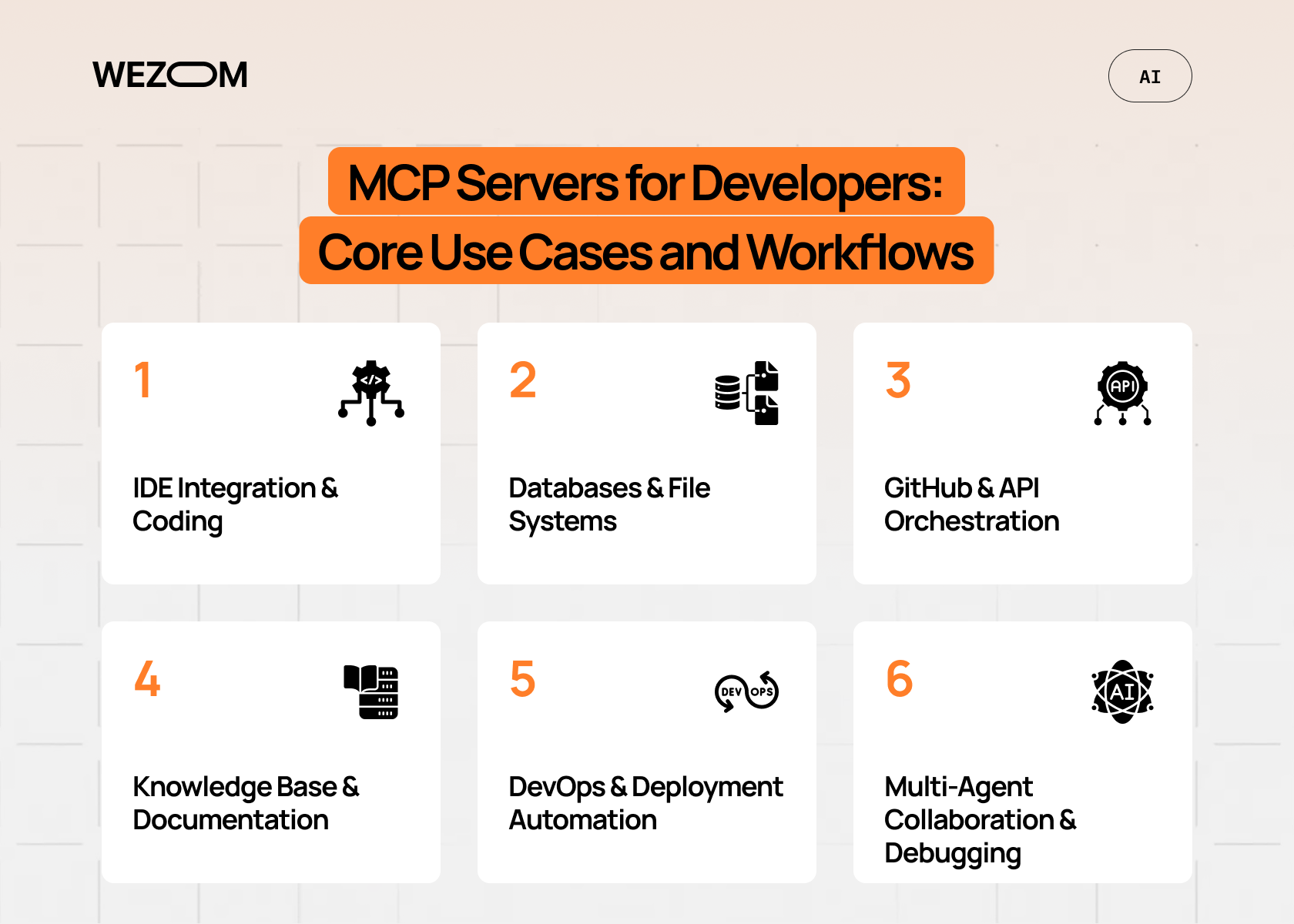
Switching to MCP servers opens up new automation opportunities, such as:
- IDE integrations and coding. An assistant can interact with the IDE via MCP as a full-fledged API to read the project tree.
- Database and file systems. AI servers provide secure access to database schemas and file structures, meaning the model can generate SQL queries and safely read logs without shell access.
- GitHub and API orchestration. Integration with GitHub allows the agent to analyze issues using standardized MCP tools.
- Internal documentation retrieval. This means that the corporate knowledge base is connected as an MCP resource, so the model obtains access to current technical standards.
- DevOps workflows. Here we're talking about deployment automation via MCP servers (they manage CI/CD pipelines).
- Multi-agent collaboration. Agents gain the ability to delegate tasks via the MCP server exchange.
- Debugging automation. An agent can connect to a log server, analyze it through a standardized interface, and initiate code fixes using the IDE server.
Useful MCP Servers for Developers in Real Projects
To implement this protocol, you should know which useful MCP servers for developers are already being used by many enterprises.
GitHub MCP server
This server provides an LLM interface for working with repositories, PRs, issue trackers, branches, and more, eliminating the need for manual context gathering. The model relies only on the current repository version and is therefore ideal for automating code reviews and bug triage. Specifically, an agent can use MCP to read diffs of changes in PRs and post comments based on repo files with linting rules.
Filesystem MCP server
This server provides limited access to specific file system directories, enabling AI to work with a project contextually, without the need to enter it into a prompt. Therefore, this type of server will be extremely useful for refactoring legacy code (specifically, the agent will be able to scan the entire file structure of a specific project to find configuration files before you initiate the database migration process).
Browser automation servers like Puppeteer and Playwright
Such servers enable browser control, which is useful for UI testing (especially when it comes to end-to-end testing and data parsing). Specifically, the agent can walk through the checkout process on the website to verify that all buttons and forms are working correctly, and then generate an error report if any are detected.
Database MCP servers like PostgreSQL or SQLite
These servers expose the database schema and provide access to tools for executing SQL queries. All of this is implemented in a secure environment, without the need to write complex ORM wrappers, meaning these servers will be useful for data analysis and generating sophisticated reports. For example, an agent can use them to analyze the users-and-orders schema to write a query that finds the 10 most active customers over the past month.
Slack and Notion Integrations
With their help, developers can synchronize communications and the knowledge base with the context, integrating all decisions made by the development team. This makes it possible to automatically generate answers to questions from new team members and identify technical debt in documentation. For example, an agent can independently find a document describing the API architecture in Notion to suggest the correct endpoints for a specific task.
Cloud Infrastructure based on AWS, Azure, or Google Cloud
These solutions offer capabilities for cloud resource management, ensuring immediate response to infrastructure issues (meaning they can be used for resource monitoring). For example, an agent can check the status of Lambda functions and, if it detects that the timeout is expiring too quickly, suggest increasing the limit.
Security analysis of MCP Servers
These servers integrate static code analysis tools and dependency scanners, identifying vulnerabilities before code is pushed to main and ensuring a secure SDLC. Specifically, after executing git commit, the agent can automatically run a scanner and block the PR if vulnerabilities are detected in libraries.
MCP Examples for Developers
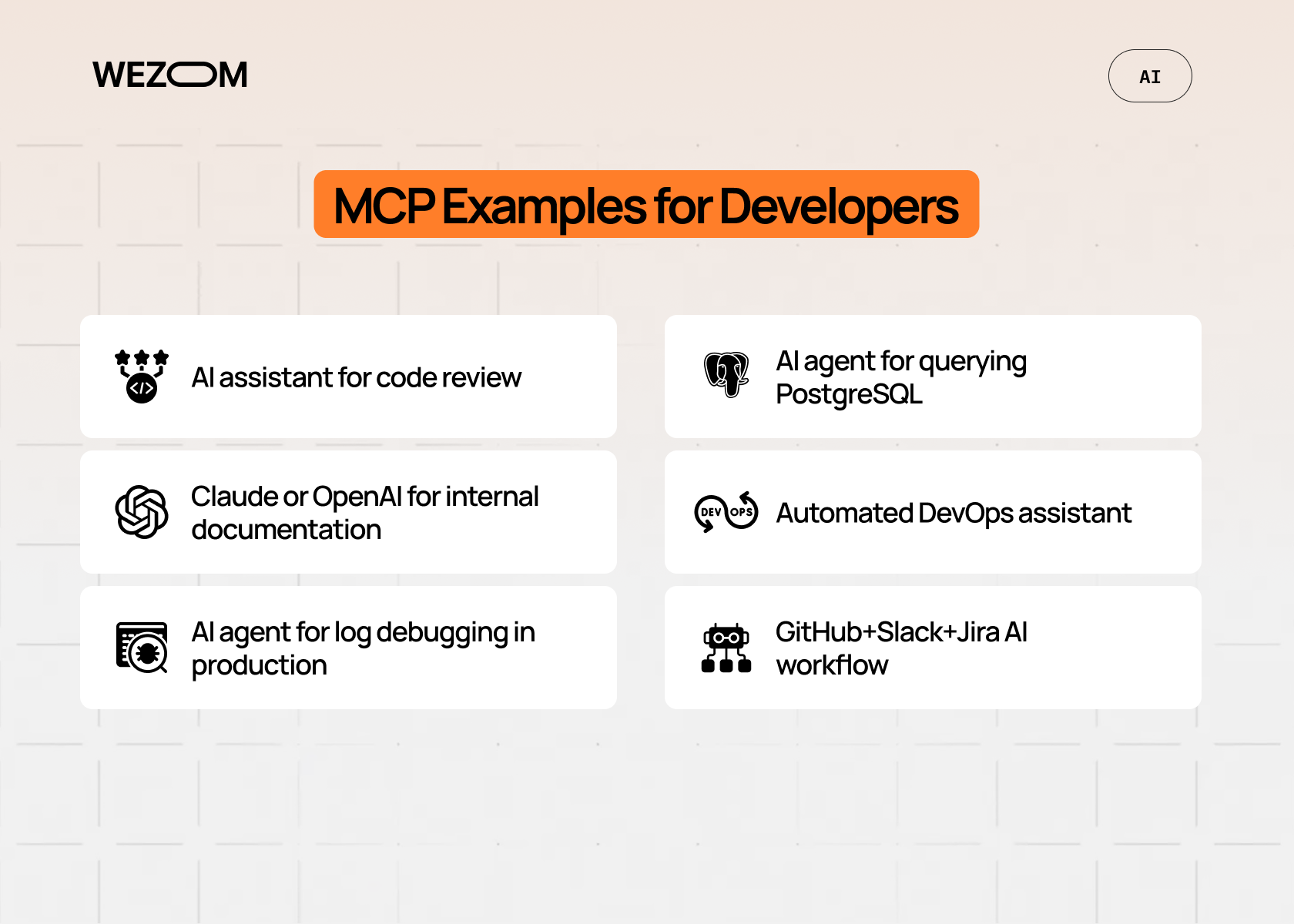
Below we've compiled six MCP examples for developers to explain how these solutions work in real projects.
AI assistant for code review
The scenario is usually simple: an agent monitors new PRs in the repository. In the context of the workflow, this looks like this: the GitHub MCP Server sends a webhook event about a PR being opened, and the agent then reads the modified files via the MCP Filesystem. Simultaneously, it accesses an internal resource that describes the internal Standards of Code Quality, causing the AI to leave comments in GitHub, highlighting syntax errors and inconsistencies with the project's architectural style.
Claude or OpenAI for internal documentation
In this scenario, when a developer asks a question related to the processes implemented in the project, the agent connects to the knowledge base server, performs a semantic search of the documentation, and retrieves the current API schema along with error handling rules. As a result, the model provides an answer within moments, based on the internal documentation (since a general internet search would be useless here).
AI agent for log debugging in production
For the monitoring system to report errors (such as a 500 error), the agent must access the last several dozen lines of the relevant service's logs via the Log MCP Server. Then, via the SQL MCP, this agent executes a database query and checks the state of the record that caused the exception. This allows the agent to compare the log data with the state of the database data and provide a conclusion about the error.
AI agent for querying PostgreSQL
Imagine your business analyst urgently needs a sales report. To do this, the agent retrieves the schema description via the Database MCP and generates an SQL query, executing it through a secure tool. The result is then output as either JSON or a Markdown table. This ensures secure access to the data (since the agent only sees authorized tables).
Automated DevOps assistant
If a developer needs to check the deployment status, the agent uses Cloud Infrastructure MCP to query the pods' status. If a pod is in the CrashLoopBackOff status, the agent analyzes the error description and suggests a rollback command. This significantly reduces incident diagnostic time.
GitHub+Slack+Jira AI workflow
Do your developers need to automatically close bugs? This won't be a problem for an agent – Jira MCP will report the bug, after which the agent will create a branch via GitHub MCP and make the appropriate edit. After the tests are completed, the agent will send a notification via Slack MCP to the team lead asking them to click the Approve button. If the request is approved, the ticket status in Jira will change to Done.
MCP Security Intelligence for Developers
Implementing AI into an enterprise infrastructure is impossible without security monitoring. This means trusting any given model shouldn't be assumed by default. Here are the main principles of security in MCP:
- Sandboxing and isolation, where each MCP server operates in an isolated environment, so even if a model is compromised, it remains limited to the specific APIs provided by the server;
- Least privilege, meaning the server shouldn't provide access to the entire database, instead exposing only certain functions;
- Validation and auditing, meaning the protocol supports audit logging of all calls, so developers can understand which agent accessed which resource and when.
Also, here’s a table briefly explaining how MCP can reduce some security risks.
| Security risk | MCP mitigation strategy |
|---|---|
| Prompt injection | Using tools as a barrier to ensure the model only calls strongly typed APIs |
| Unauthorized access | Implementing OAuth/JWT at the transport layer between the host and the MCP server |
| Data leakage | Static definition of available resources, where the server only returns what is permitted |
| Insecure execution | Implementing containers with Docker to restrict access rights to host system resources |
Building and Deploying an MCP Server
Developing and deploying an MCP server requires building an architecture based on AI tools that become unified APIs. Specifically, to create a server, developers typically use official, open-source SDKs (for example, based on Python and TypeScript, provided by a specific MCP project), which automate the processing of protocol messages. This means you simply describe the server manifest, defining tools and prompts, which are then linked to business logic via standard APIs.
As for deployment models, their choice is determined by the operating environment. For example, local deployment via stdio is ideal for debugging in an IDE, as it allows for instant inclusion of local scripts. Cloud deployment and Docker/container workflows are also preferred for enterprise solutions. This enables orchestration in Kubernetes, with its inherent isolation.
Finally, a few words about the authentication setup. This aspect is covered by the transport layer, where the host passes credentials to the server via environment variables or headers. As for scalability considerations, they are crucial for high-load systems: here, containerization enables horizontal scaling. This means you can launch separate instances for different groups of agents, eliminating lock-ins.
MCP and the Future of AI Developer Ecosystems
The advent of the Model Context Protocol means the transition to a standardized era of AI development. The main benefit lies in interoperability. This eliminates vendor lock-in, allowing any model to interact with corporate data and tools through a single interface. Incidentally, this is the foundation for building standardized AI ecosystems, where components are no longer isolated integrations – they are full-fledged modules within a single framework.
All of this contributes to a shift toward agent-to-agent communication, where agents can discover each other and exchange context to collaborate on multi-step processes. This enables the implementation of autonomous workflows, orchestrating complex business processes and even dynamically managing cloud infrastructure.
Also worth mentioning are AI-native development environments, where AI becomes a full-fledged part of the IDE and where the context of each individual project is taken into account. All these form a whole group of tooling trends, with the emphasis on the creation of high-quality Model Context Protocol servers that allow intelligent systems to scale to global business solutions.
Common Mistakes Developers Make When Implementing MCP
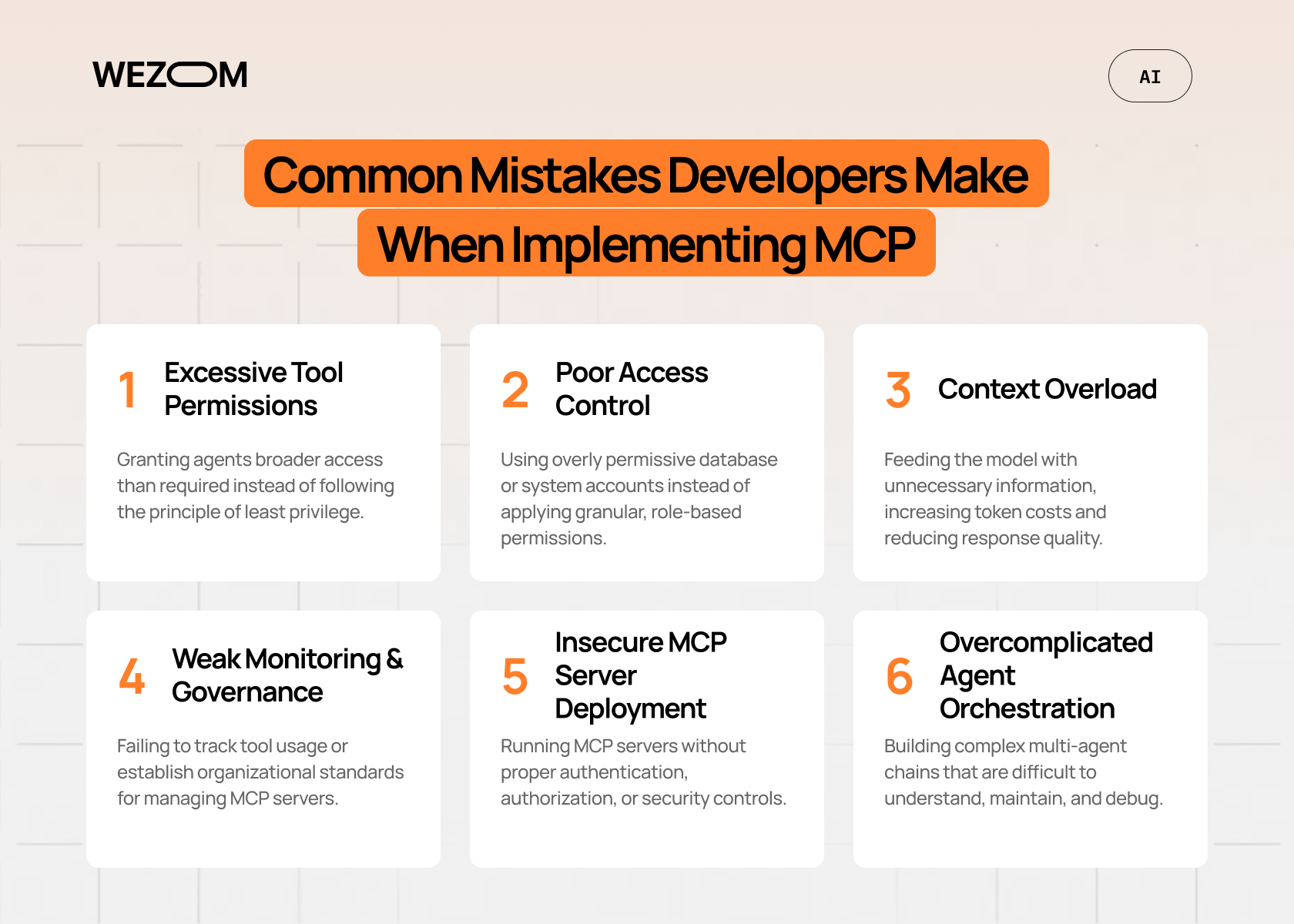
There are several common mistakes that lead to the accumulation of technical debt. Therefore, they should be avoided at the implementation stage:
- Over-permissioning tools, when you inadvertently grant the agent all access rights to tools. Conversely, it's best to allow the agent to see only those functions necessary to solve a specific problem.
- Poor permissions, when you neglect the granularity of access rights. This means that if a server has access to the database, it should have limited rights and not be a superuser.
- Context overload, when you feed the model with unnecessary data, blurring its focus and resulting in unjustified token costs.
- Weak monitoring, when you haven't provided for call tracking and now, don't know exactly how the agent uses the tools. This makes it impossible to detect anomalies and errors.
- Insecure server deployment, which occurs when you launch MCP servers without authentication, creating an attack vector for your IT infrastructure.
- Lack of governance, or, more precisely, lack of server management standards within your organization. This means that each new project will rely on its own rules, compromising the security of the entire ecosystem.
- Overcomplicated orchestration, which occurs when you build chains where one agent calls another through multiple intermediaries. This makes the system unpredictable and difficult to debug.
Conclusion
As we can see, MCP security intelligence for developers helps them transform AI integrations into fully-fledged modules, with role delineation and server isolation, while guaranteeing enterprise-grade security. Also, thanks to containerization and unified APIs, this standard makes it possible to quickly build secure AI systems based on autonomous agents capable of solving multi-layered tasks without human intervention.

FAQ
What is MCP in AI-powered software development?
In a nutshell, it's an open standard that consolidates AI, data, and tools within a single IT infrastructure, eliminating the need for custom connectors.
How does Model Context Protocol work?
MCP relies on a client-server architecture, where the client is an AI assistant that initiates a session with the server, and the server is a context provider with its own tools and prompts, thanks to which the agent dynamically understands how to interact with specific databases, logs, repositories, etc. All this is accomplished through standardized protocols such as stdio/HTTP.
Why do developers use MCP servers?
MCP for developers helps them to transform disparate API calls into a coherent stack, eliminating the need to write separate code for each new integration. This, in turn, allows them to instantly connect new knowledge sources without security risks, since access is provided through unified interfaces.
What are the benefits of MCP for developers?
The main advantages of an MCP server for developers include unification, meaning there will be only one protocol for all tools and models across the entire IT infrastructure, increased scalability, where the agent logic remains the same regardless of the number of servers, security through tool isolation, the ability to focus on creating business logic instead of maintaining connectors, and the opportunity to reuse these servers in other AI-powered projects.
How do MCP servers improve AI workflows?
MCP servers for developers transform AI from a simple chatbot into a powerful automation tool capable of autonomously reading logs to find bugs, executing SQL queries, and performing many other tasks that were previously handled manually by employees familiar with a specific project's context. This reduces the impact of human error and minimizes the hallucinations that AI is prone to when working in isolation.
