
In modern software development, the ability to anticipate problems is as valuable as the skill of writing code. Any IT project is a journey through uncertainty, where unexpected complications can arise at every stage. Instead of relying on luck, successful teams use a systematic approach, turning fears and guesses into a clear action plan. Managing expectations and threats will allow you to deliver on time while keeping your budget under control.
Ignoring risks will cost the industry dearly in money and wasted energy. Projects are often delayed or even abandoned simply because no one asked the question at the outset: "What if things don't go according to plan?" When a company has established sound risk management in software development, any technical challenge or sudden change in requirements turns from a disaster into a routine task.
In this article, we will explain in detail why a risk management system is essential for product survival today and how to transform uncertainty into a manageable process.
What Is Risk Management?
Simply put, risk management is the ability to hedge against potential project failures. In software development, it's not just filling out boring spreadsheets; it's a real way to stay on top of the situation. Essentially, it's your insurance against unexpected problems: you anticipate what could go wrong and decide how to deal with it. Instead of panicking when something breaks, you have a ready-made action plan.
Many people ask: “Why is risk management important if we already have a great team?” The answer is simple: even the best developers aren't immune to a client suddenly changing requirements or a third-party library stopping working. Risk management transforms development from a guessing game into a clear process. When you understand your weaknesses, you spend money and time much more wisely, and your product itself gets much higher quality.
Risk Management Process in Software Development
A systemic risk management process isn't a one-time event, but a continuous cycle that should be integrated into the development lifecycle. It will allow your team to always stay one step ahead of potential problems.
Risk identification
Everything starts with the identification phase. At this stage, the team brainstorms all possible threats, such as a developer leaving or a sudden change to a third-party service's API. The key here is to create an environment where everyone can voice concerns without fear of appearing pessimistic.
Risk analysis (qualitative and quantitative)
Once the list is compiled, you need to run through the analysis. Each item should be assessed according to two criteria: probability (likelihood of occurrence in percentage) and impact (degree of impact on the result in hours or money). This will help you separate truly catastrophic threats from minor issues that can simply be taken into account.
Risk prioritization
Next, based on the data obtained, you need to build a hierarchy. Prioritization helps you understand where to spend resources first. This is a crucial step, as trying to address all risks simultaneously usually results in a spread-out budget and a lack of effective protection.
Risk mitigation planning
For the most critical items, you should develop a risk management planning. The team chooses the appropriate path: mitigation (risk reduction), risk transfer to third parties, or a complete architecture overhaul to eliminate the threat. A risk owner is assigned to each task – a person who monitors indicators of impending problems.
Risk monitoring and control
The cycle is finished with ongoing monitoring. The project is a “living entity”, as some risks may not exist during the entire timeline, and others may occur. By continuously assessing risk status, changes can be identified, and the proper response can be initiated to minimise the potential negative impact of any new or existing risk prior to the event occurring.
Types of Risks in Software Projects
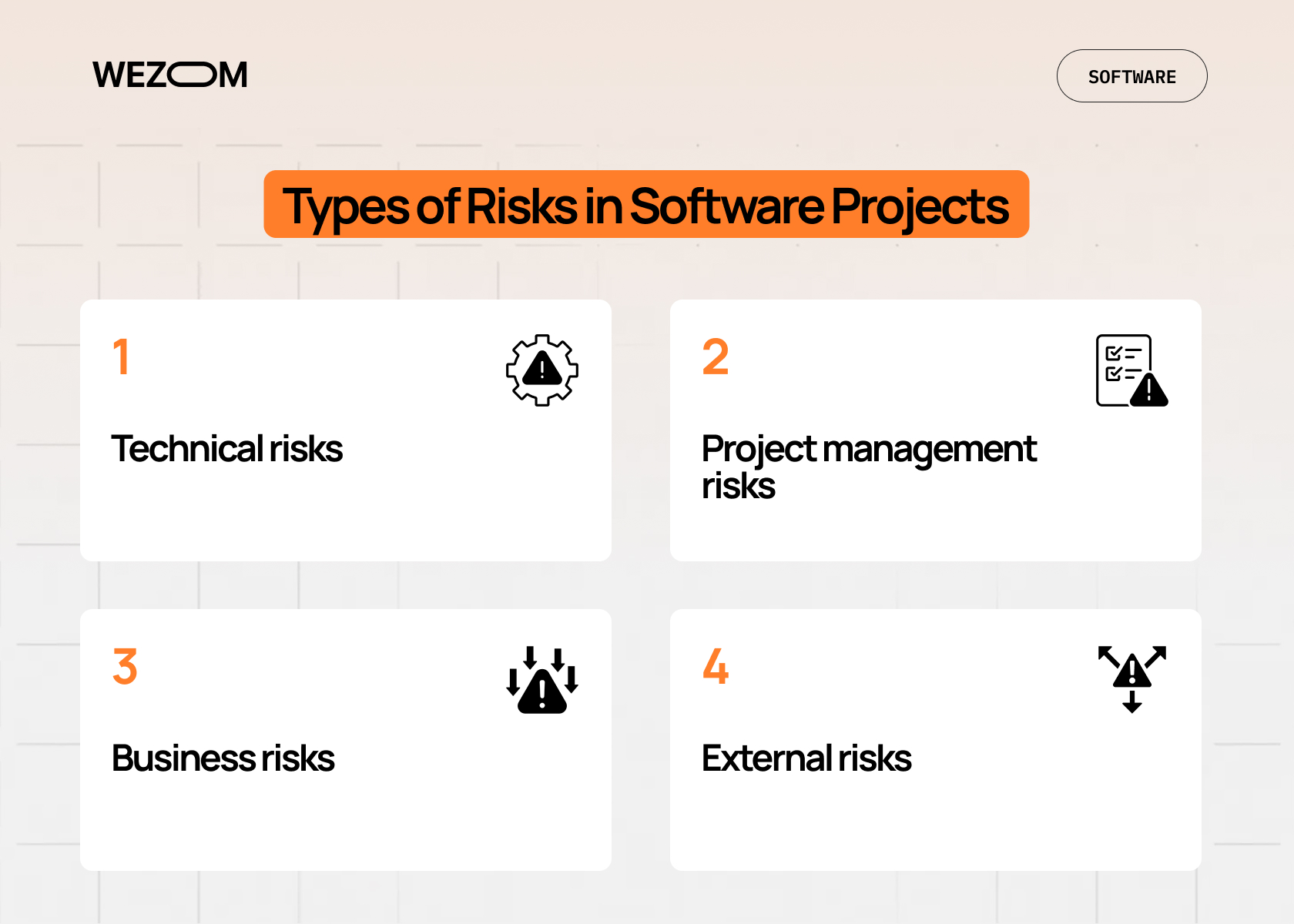
For ease of use, risk management in software project management divides all threats into several categories. This approach helps structure the search process and quickly find effective solutions:
- Technical risks. These include architectural errors, unstable third-party libraries, difficulties integrating legacy code, or sudden incompatibility of updated frameworks. These risks often require deep refactoring or changes to the technology stack early on.
- Project management risks. These are threats related to human factors and processes: incorrect effort estimates, burnout of key specialists, disrupted communication between departments, or a sudden increase in project scope without adjusting deadlines.
- Business risks. These are the risks that the product will become irrelevant by the time of release. These include changes in investor strategy, the emergence of aggressive competitors with similar functionality, or an incorrect assessment of the needs of the target audience.
- External risks. Factors beyond the team's direct control include changes in government personal data laws (compliance), global economic crises, or drastic changes in platform policies (e.g., new App Store or Google Play rules).
Understanding these types of threats allows you to cover all areas of the project, not just coding.
Tools for Risk Management in Software Development
Today, it's impossible to manage risks manually. To automate processes and improve visibility, you should use risk management software tools:
- Risk registers. These are specialized databases or task tracker plugins that record the entire history of each threat. They store the risk description, its current status, the assigned responsible party, and a step-by-step action plan if a trigger is triggered.
- Risk management software tools. These are professional programs (such as RiskOptics or similar) that automate calculations and help the team remember important checks. They allow you to store all scenarios in one place and set up automatic notifications about approaching critical events.
- Automated tracking and reporting. These are automatic tracking systems that integrate with Git repositories and CI/CD pipelines. They alert the manager to critical deviations in metrics, for example, if test coverage has dropped or the number of open bugs has begun to grow too quickly.
- Dashboards and analytics. These are visual dashboards that aggregate data from various sources for the instant project’s health assessment. Dashboards allow stakeholders to see a risk map in real time without having to delve into lengthy text reports.
Using professional integrated risk management solutions allows you to combine data from different departments into a single, understandable picture, preventing the loss of important information when handing off a project between teams.
Benefits of Effective Risk Management
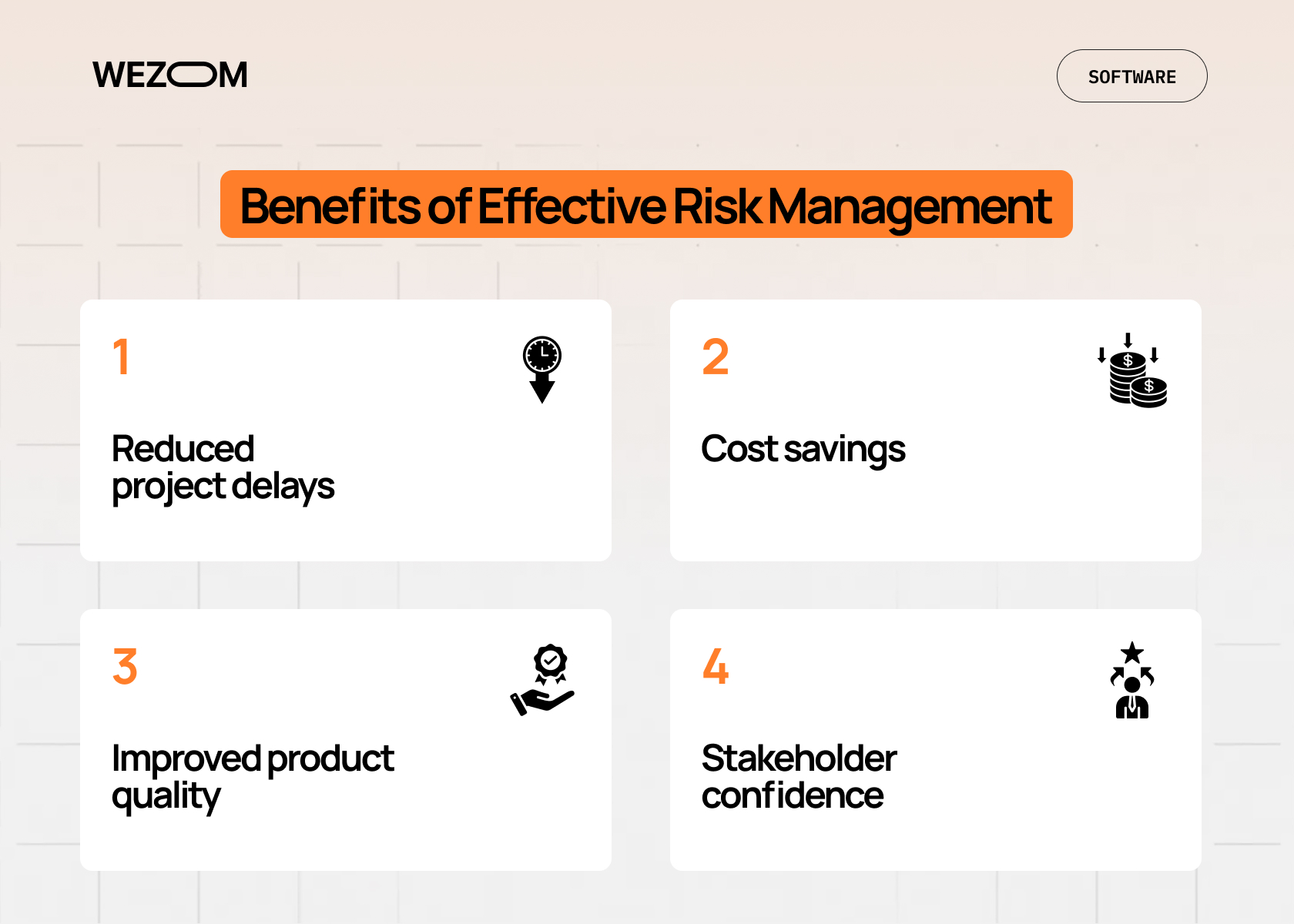
A well-developed software risk management strategy yields tangible results, which can be expressed in the following outcomes:
- Reduced project delays. Having a pre-prepared contingency plan (backup scenario) allows you to continue working when difficulties arise. The team simply switches to the backup plan while maintaining the overall development pace.
- Cost savings. Preventing a problem is always cheaper than fixing it. Early identification of architectural risks during the design phase will cost you tens of times less than urgently fixing bugs in live production under pressure from dissatisfied users.
- Improved product quality. Continuous assessment of technical solutions and security threats leads to cleaner code and a more robust architecture. The result is a product that is more resilient to stress and external attacks.
- Stakeholder confidence. Investors and customers value transparency. When you can demonstrate a clear threat management plan for any scenario, it creates the image of a reliable partner and increases the chances of long-term collaboration.
These advantages make risk management a powerful tool for predictable scaling any business.
Common Challenges in Risk Management
Even experienced teams sometimes stumble. Several typical obstacles hinder the implementation of high-quality threat management processes:
- Poor identification of risks. A formal approach in which the team lists only the most obvious issues (e.g., “the server can crash”), completely ignoring deeper logical or legal risks that could arise six months from now.
- Lack of team collaboration. If the PM alone assesses risks, technical threats go unnoticed. The real magic happens when developers, QA, and business analysts share their specific concerns.
- Inefficient monitoring. If project monitoring doesn’t happen weekly, the information within will become stale and useless very quickly.
- Overlooking small risks. Small defects, while they each are minor individually, over time, when they amass into a large enough volume, can cause a tremendous amount of technical debt and delayed development during the last phases of the project.
To overcome these challenges, IT teams need to adopt new tools, as well as change cultural attitudes toward quality in the workplace.
Best Practices for Software Risk Management
To maximize your effectiveness, it's worth using proven risk management models and industry best practices:
- Involve stakeholders early. Start discussing potential pitfalls with the client at the idea stage. This will help you align expectations and agree on budgets to mitigate the most serious threats in advance.
- Maintain an updated risk register. Make working with the register part of your daily routine. If someone raises a new issue during the morning standup, it should immediately be added to the tracking system with an assigned responsible party.
- Integrate risk management into the project lifecycle. Risk management shouldn't be a separate process. It must be integrated into sprint planning, code reviews, and even product deployment processes.
- Use tools and automation. Don't rely on memory. Use software that will automatically remind you to check risk status or update the response plan when the architecture changes.
- Conduct regular reviews. Conduct a risk retrospective once a month. Analyze how accurate your past forecasts were, what new threats have emerged, and how effective your measures have been.
If you implement these practices, it’ll help make risk management a natural part of the process, accelerating progress toward your goals.
Overall, a deep understanding of risk management separates professional development studios from amateur teams – effective project governance will allow you to avoid problems and use them as growth points, enabling you to find more effective ways to implement your ideas. Are you looking for seasoned risk management experts? Feel free to contact us today!

FAQ
What types of risks exist in software development?
In IT projects, risks are typically divided into technical (like errors in coding or architecture), management (for example, deadlines and communication), and external (changes in laws or the market). There are also business risks when a technically perfect product proves unpopular with the target audience.
Why is risk management important in software projects?
Without managing uncertainty, development turns into a lottery, where any mistake can ruin the budget and the team's efforts. High-quality software risk management makes the process predictable, protects the project from chaos, and helps ensure customer trust.
What is the difference between qualitative and quantitative risk analysis?
Qualitative analysis assesses risks as “high” or “low” based on expert experience, helping to quickly prioritize them. Quantitative analysis translates these assessments into concrete figures, such as hours of delay or financial losses, which is essential for accurate business planning.
How can risk management reduce project delays?
Risk management allows for early identification of bottlenecks and the preparation of contingency plans in advance. This helps the team avoid panic and wasted time during a crisis and instead act according to a pre-established scenario.
Can risk management improve software quality?
Yes, continuous assessment of technical threats encourages the team to pay closer attention to architecture, security, and code quality. This reduces the number of critical bugs after release and makes the final product more stable and user-friendly.
