
Logistics has evolved into a high-tech industry. Today, a company's success depends not on the number of vehicles, but on its ability to manage the information they carry. Indeed, the world is changing: traditional routes have become longer and more sophisticated, cities are more crowded, and customers are more demanding. In these conditions, traditional logistics methods no longer work, so the concept of smart mobility comes into play. In particular, according to statistics, the smart mobility market will grow to a remarkable $194.13 billion by 2032, with an annual growth rate of 20.8%.
In this article, we’ll analyze how smart mobility technology is transforming the transportation industry, turning it from a cost item into a sustainable business advantage. Also, we’ll examine the architecture of these solutions, their practical application, and the barriers that hinder the widespread adoption of such innovations.
What Is Smart Mobility?
The definition of smart mobility can be stated simply as the merging of all transportation processes into a single, intelligent system capable of communication. This represents a major change from the traditional methods used in logistics today. Previously, trucking companies only operated as individual entities. A business would have a trucking company operate independently from a warehouse; therefore, dispatchers often had to connect the two through phone calls and other inconvenient means. However, through smart mobility, all logistics operations are now interconnected, and information flows continuously between all vehicles, cargo sensors, and terminals throughout the transportation process.
By merging technology with logistics, you can reduce wasted time and environmental impact. In short, the goal is to develop a logistics system that operates with the highest degree of efficiency, safety, and sustainability possible. Smart mobility ultimately enables businesses to simplify complex delivery processes and provides reliable service that saves both time and money to all parties involved.
Smart Mobility Technology: Main Components
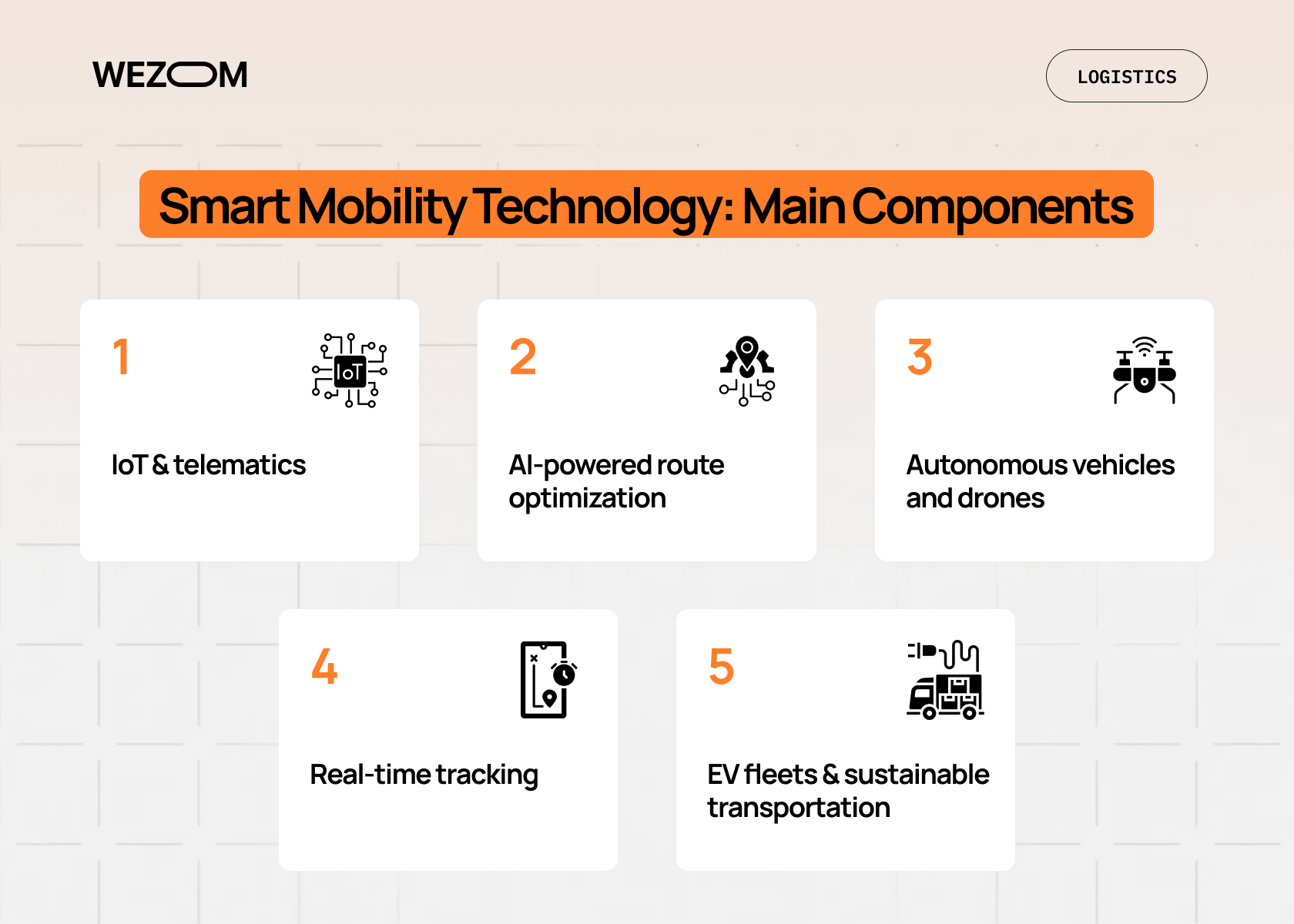
Below are the main components that make smart mobility transportation such a powerful tool.
IoT & telematics
Logistics rely on the Internet of Things as the “eyes” and “ears”. Sensors installed on vehicles, containers, and pallets provide real-time data on their status. Advanced telematics allow dispatchers complete visibility of the vehicle, including the amount of gas left, engine temperature, tire pressure at acceptable levels, and if anyone entered the cargo area without authorization. The information is continuously streamed to the corporate office using high-speed communication, thereby facilitating rapid response times.
AI-powered route optimization
Previously, entire logistics departments had to plan routes; however, today, artificial intelligence does a better job. Smart optimization takes into account mileage, traffic jams, weather, warehouse schedules, and even inclines on the roads to ensure electric vehicles don't run out of battery prematurely. This innovation will help eliminate unnecessary empty runs and save a ton of money.
Autonomous vehicles and drones
Full automation is already in full swing at closed facilities. Autonomous vehicles in ports and warehouses operate without breaks and are not prone to errors due to fatigue. Drones fly alongside them – they are ideal for quickly delivering medicine or small packages to places where a car would otherwise be stuck in traffic.
Real-time tracking
Today, good visibility in logistics means knowing the status of every package at any second. Cloud platforms collect data from all vehicles and provide access to everyone involved in the process, from the sender to the customer. This makes the process fair and transparent.
EV fleets & sustainable transportation
Companies are increasingly switching to electric fleets to reduce their environmental impact. Although electric vehicles require new infrastructure, they are more cost-effective in the long run, as they are easier to maintain and use renewable energy instead of expensive gasoline.
Smart Mobility Solutions for Logistics and Supply Chains
When all these technologies work together, they create powerful smart mobility solutions that solve the most essential pain points of modern businesses.
- Warehouse-transport synchronization. This is a way to forget about endless loading queues. The system automatically detects when a vehicle is approaching and instructs the warehouse to prepare the cargo. As a result, the driver doesn't have to wait, and staff work precisely according to schedule.
- Cargo monitoring. Temperature is crucial for transporting medicines and food products. Smart sensors monitor this and automatically generate reports for regulatory authorities, ensuring full compliance with transportation regulations.
- Last-mile delivery optimization. Door-to-door delivery is the most expensive step. Here, courier management systems and smart dispatch recalculate tasks on the fly if a new order is missed or an accident occurs on the road.
- Predictive maintenance. Why wait until a vehicle breaks down mid-road? The system analyzes component wear and tells you in advance when it's time to visit for service. This helps the equipment operate without unnecessary downtime and increases the overall fleet uptime.
- Fleet management systems. All management functions are now consolidated in a single software. It's a shared database that links orders, transportation, fuel, and accounting. This gives managers a single, transparent picture of all business workflows.
If you're interested in implementing the solutions listed above, or have your own vision for using smart mobility technologies, write or call us, and we'll figure out how to bring it to life in the most cost-effective and quick way.
Benefits of Smart Transportation and Mobility in Logistics

Why does investing in smart transportation and mobility really pay off? Here are a few simple reasons:
- Lower costs. You spend less on fuel, use capacity more efficiently, and avoid idling.
- Fewer delays. Smart traffic management and accurate forecasting help ensure on-time delivery. Delivery accuracy today reaches nearly 100%.
- Sustainability. Environmental care and reduced emissions are no longer just words, but a market demand. A sustainability strategy makes a brand more respected and attractive to investors.
- Safety. Smart assistants ensure that drivers don't fall asleep or violate traffic rules, significantly reducing the risk of accidents and product damage.
- Growth without hassle. Cloud technologies give businesses scalability. This means you can open new branches and connect hundreds of partners to your ecosystems without completely replacing computers and software.
Ultimately, smart mobility in a smart city is no longer a vision of the future, but how market leaders operate today. Logistics has ceased to be a matter of transporting boxes and has become a smart service where everything is automated.
Challenges and Limitations
Of course, the transition to smart mobility and transportation has its challenges, which are worth knowing about in advance.
- High implementation cost. The main barrier is price. To launch such a system, you need to purchase a lot of expensive hardware (sensors, computers, new vehicles, etc.). You also have to invest in software development and training. For many, this seems prohibitively expensive, especially when the market situation is constantly changing.
- Tech integration issues. It often happens that new programs cannot be integrated seamlessly with old ones. So, to make such an integration possible, you must resort to the third-party professionals’ help to develop middleware for configuring data transfer without loss or failure.
- Data security. Since all management is now digital, the risk of hacker attacks arises. All accumulated data must be protected at the proper level. If someone hacks your networks or communications, they can not only steal information but also disrupt vehicle traffic. Therefore, data security is expensive and requires constant attention.
- Lack of infrastructure. Technology sometimes runs ahead of reality. Self-driving cars require perfect roads, and electric cars need charging stations every 50 km. Unfortunately, outside of large cities, such infrastructure and proper telecommunications aren’t available everywhere. This significantly limits the use of smart solutions nationwide.
Of course, overcoming all these challenges requires courage and significant changes in operations. At the same time, the benefits of high efficiency and safety outweigh all the risks. So, if you would like to get the most out of smart mobility technology, feel free to contact us.

FAQ
How does smart mobility technology improve supply chain efficiency?
Smart systems allow you to see everything that's happening with your cargo and eliminate any delays.
Thanks to automated dispatch, orders are distributed faster, and human error is minimized.
What industries benefit most from smart mobility technology?
The biggest winners are those that prioritize speed: retail, food, and medical delivery.
It's also a lifesaver for large-scale manufacturing, where all logistics must run like clockwork to keep facilities running.
Are smart mobility systems expensive to implement?
Yes, purchasing hardware and setting up software is expensive upfront.
But this investment pays off with lower costs on repairs, fuel, and personnel in the future.
Can smart mobility solutions help reduce fuel consumption and emissions?
Of course. Smart route optimization allows you to travel fewer kilometers, which reduces fuel consumption and harmful emissions.
Overall, this is an important part of a sustainability strategy.
What is the future of smart mobility in supply chain management?
We are moving toward a situation where all transportation services will become autonomous and operate within a unified ecosystem.
In the smart cities of the future, delivery will be managed by AI in real time, operating as quickly and seamlessly as possible.
