
The stage-gate process was first defined by Robert G. Cooper in 1988 in an article for the Journal of Marketing Management as a project management model in the pharmaceutical and aerospace industries. However, over time, it has also come to be applied to other industries, particularly IT. Below, as a company that uses the practices underlying it, we’ll define the stage gate process in detail, as well as outline its benefits and challenges.
What Is the Stage-Gate Process?
The stage gate process is a proprietary innovation project management methodology that divides the development of a new product into several sequential stages, each followed by strict gates. Its ultimate objective is to ensure that the team completes the required set of tasks at each stage before receiving approval and resources to move on to the next, more resource-intensive stage.
Essentially, this process requires each project to pass through a mandatory sequence of "checkpoints," consisting of phases, during each of which the team completes a specific set of tasks. Gates, in turn, are decision points located between stages, where project managers evaluate the work against acceptance criteria and make one of three decisions: continue, postpone, or terminate the project.
The core idea of stage-gate is to control and mitigate risk through the phased allocation of resources. In particular, since the lion's share of resource expenditure occurs in later stages (in the IT context, this is usually product development and launch), early gates serve as a kind of "filter" that rejects weak ideas before significant resources are allocated to them. This ensures continuous checking of the product's viability.
How the Stage-Gate Model Works?
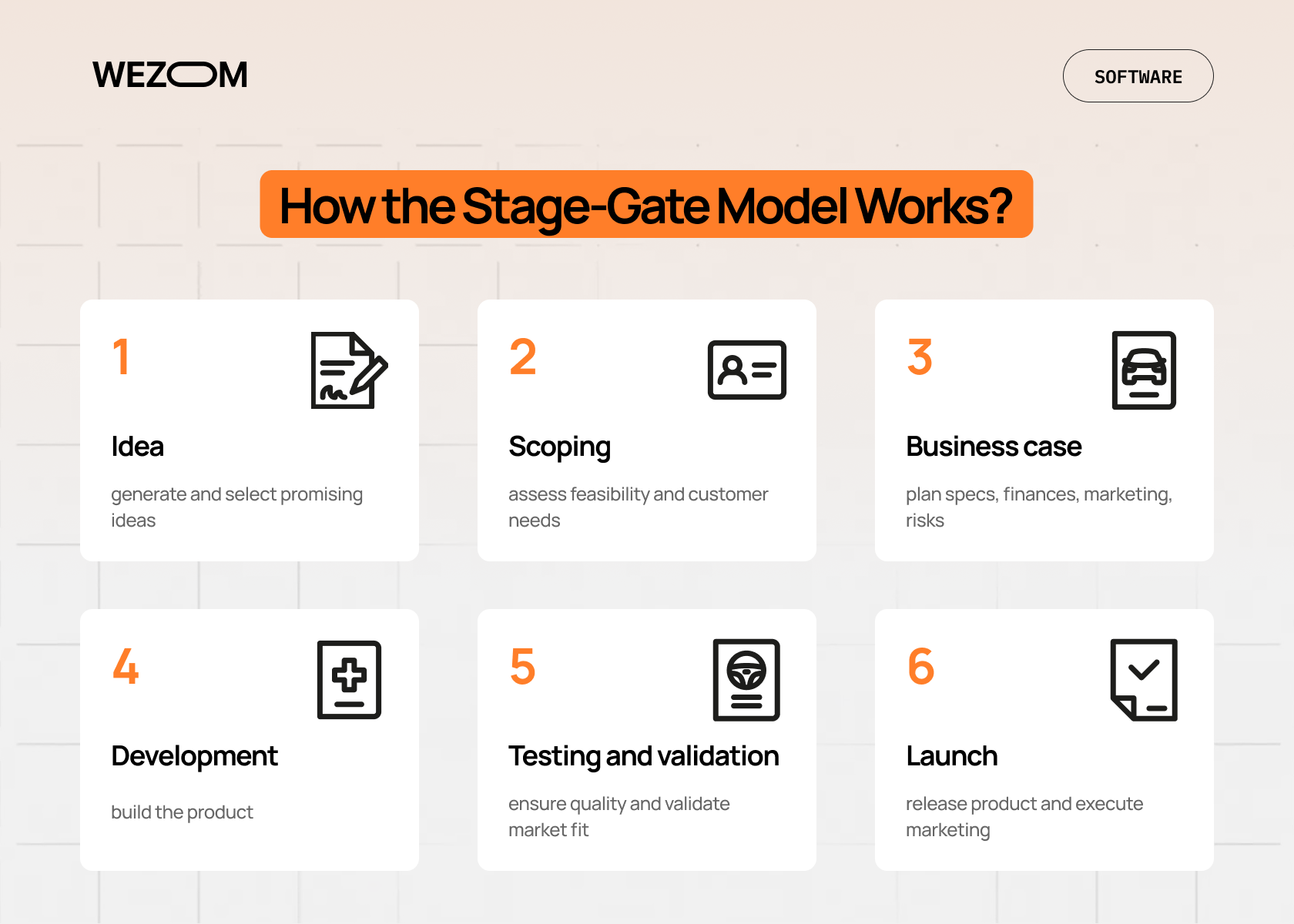
The stage gate model operates like a production line, with each stage requiring a clearly defined set of tasks, and each gate applying a specific set of criteria to the outcomes of these tasks. Typically, there are five to seven stages, sufficient to form a development iteration:
- Idea – this is an informal stage during which the team generates ideas and collects the most viable ones based on customer, competitor, and trend data;
- Scoping – this is a rapid research stage during which the team ensures the evaluation of the technical feasibility and potential of the project by collecting data on the market and customer needs/pain points;
- Business case – this is an analytical stage during which the team builds a detailed product plan, including specifications, financial forecasts, marketing strategy, and risks;
- Development – this is the stage during which the team begins the practical implementation of the product;
- Testing and validation – this stage involves comprehensive quality assurance of the product through internal testing, beta testing with focus groups, as well as testing of production and the marketing plan;
- Launch – at this stage, the team presents the product to its target audience and begins implementing the marketing strategy (this stage often includes a post-release audit as well).
It's important to note that the stage gate process has long been regularly used by world-renowned companies, especially in projects that carry high investment risks. These include 3M, Procter & Gamble, and General Motors. As for the IT sector, this model is popular for managing large projects requiring significant R&D investments (typical use cases include the development of innovative SaaS platforms or hardware).
Stage-Gate Product Development Benefits
Implementing the stage gate methodology in high-risk projects offers businesses a number of advantages, including:
- Reducing project risks. Since decisions to continue project funding are made only after a thorough assessment of its viability at the previous stage, projects with low ROI potential are rejected early, thereby reducing the likelihood that work on them will be continued simply because significant resources have already been invested.
- Optimization of resources. As resources (time, money, personnel) are allocated in stages and only to those projects that have proven viable, this allows businesses to focus on the most promising product portfolio, rather than those that are unviable.
- Increasing the probability of a successful product launch. Because each stage has clear validation requirements, the product that reaches launch will best meet market needs, have high-quality code and design, and can boast a high potential for commercial success.
It should be noted that this approach isn’t universal due to the complexity of its implementation; therefore, its use is poorly justified in small projects and projects that don’t involve innovation.
Stage-Gate Process Steps
Essentially, the stage gate workflow is a sequence of steps aimed at confirming the product’s commercial viability. Upon completion of each step, the team proceeds to checkpoints – the aforementioned gates, each of which has three mandatory components: inputs (i.e., the results of the previous step), the product's viability measurement criteria, and outputs (decisions on the team's next stage gate process steps – go, kill, hold, or recycle).
Let’s consider the stage gate process example on Robert Cooper's classic model, consisting of the following stages.
Idea
This is the zero stage, dedicated to finding and generating new product ideas. Sources of inspiration include internal brainstorming sessions, complaints and requests from potential customers, competitor analysis, research and development, and checking the most promising technology trends. At this stage, ideas are presented in a brief format, outlining the problem they are intended to solve. Meanwhile, gate 1 requires only a basic assessment of viability.
Scoping
At this stage of the new product development stage gate process, the team conducts rapid market research to confirm the existence of a consumer need and estimate the size of the target audience. The team also performs a technical assessment of the idea's feasibility, based on available resources and expertise. This results in a clear product concept, which is validated through gate 2 to determine the accuracy of the collected information and the potential for further in-depth research.
Business case
This is another analytical stage that involves transforming the idea into a fully-fledged project. Specifically, the team develops a detailed product roadmap with comprehensive specifications, marketing and production plans, as well as a full financial analysis (including ROI, NPV, and risk sensitivity calculations). Gate 3 allows the project to be closed before large-scale development requiring significant financial investment begins.
Development
Now, the team moves on to the technical implementation of the product, from building templates to writing code and creating the design. In parallel, specialists test the completed modules to avoid hard-to-fix bugs in the future.
Testing and validation
This milestone includes internal quality testing (to ensure the product meets technical specifications), product validation with representatives of its target audience through beta testing and pilot launches (to check the product's value in practice), as well as production and marketing plan testing (to ensure logistics and sales channels are ready). Gate 4 is used to verify the product's readiness for market launch.
Launch
At this stage, the team performs full product deployment and launches a marketing campaign to move into sales. Also, it almost always includes a post-release audit, during which the team analyzes sales results and customer feedback to perform the strategy refinement.
Stage-Gate Software Tools
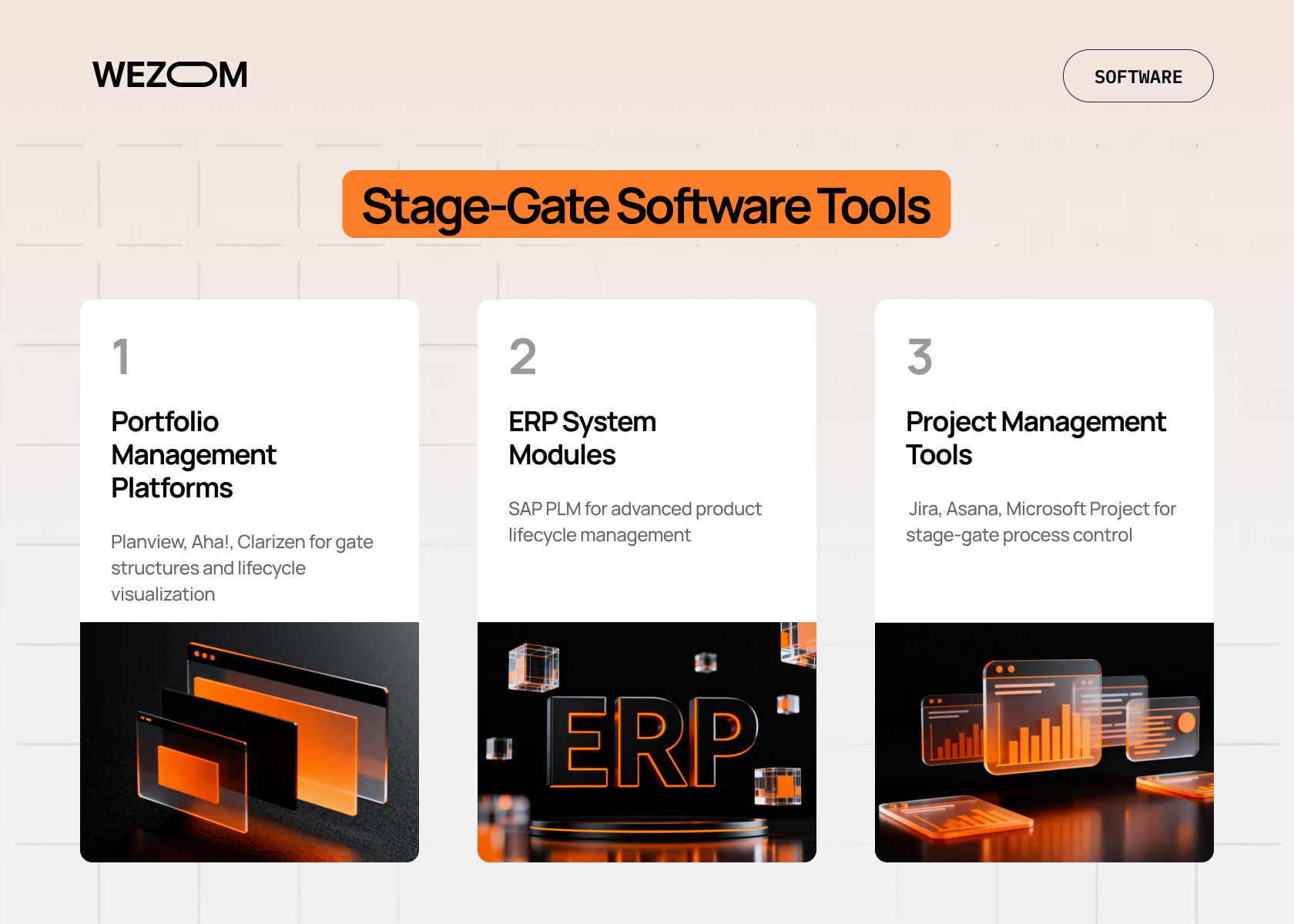
In today's reality, no company can do without specialized stage gate software. It automates routine tasks, provides centralized documentation storage, standardizes the gate review process, and guarantees project managers real-time monitoring of project progress. Specifically, such software can be divided into three main groups:
- Specialized portfolio management platforms like Planview, Aha!, and Clarizen, which allow teams to build a gate structure, define acceptance criteria, and visualize the entire product lifecycle;
- Advanced ERP system modules such as SAP PLM;
- Project management tools like Jira, Asana, and Microsoft Project, which, after appropriate configuration, can be used to build and control the entire stage-gate process.
Ultimately, when choosing a specific tool, it makes sense to evaluate the duration of use of the stage gate approach and analyze your existing software fleet, as your ERP may already have the modules you need.
Common Challenges and Tips
Of course, the stage gate approach isn't perfect. For example, the most common problem faced by companies practicing it is bureaucratization and process slowdown. More specifically, gates are often overloaded with redundant criteria that require unnecessary documentation, making the development process too slow, which is unacceptable for innovative projects that require rapid decision-making.
The second problem is an inability to adapt, which can inhibit the efficiency of an iterative development approach and complicate the collection of customer feedback.
Finally, gates can be insufficiently rigid, meaning management isn't always ready to make tough decisions about cutting funding, thereby allowing unviable projects to move forward.
In turn, for successful implementation of the stage gate process, an agile-gate approach should be used, where early stages such as Ideation, Scoping, and Business Case are as rigorous and consistent as possible, while subsequent stages like Development and Testing have short iterations and feedback cycles. Furthermore, it sometimes makes sense to simplify gate criteria, focusing on information quality instead of extensive documentation. Finally, you should ensure only one decision at each gate, whether Go or Kill, thereby minimizing the likelihood of vague decisions like "Hold."

FAQ
Chat is the purpose of a stage-gate process?
This primarily involves systematization and end-to-end control throughout the entire product development process, from the formation of an innovative idea to its commercial launch. This approach also maximizes the return on investment in new product development and reduces risks by early rejection of unviable ideas.
How does the stage-gate model improve product development?
This model optimizes the product development process by introducing mandatory discipline and structured evaluation (specifically, it ensures that critical but often overlooked tasks such as end-to-end market research, financial analysis, or customer validation are completed within an acceptable timeline).
What are the key stages in the stage-gate process?
The classic model of the stage gate process for new product development includes five stages: Idea, Scoping, Business case, Development, Testing & validation, and Launch.
How to implement a stage-gate process in a company?
The implementation of the stage gate product development process begins with adapting the model to the company's unique culture. It starts with gaining senior management approval, then defining clear and measurable criteria for each stage and gate, then forming cross-functional teams, implementing specialized software, and finally, organizing team training and ongoing process accountability.
What are common mistakes in stage-gate product development?
These include bureaucracy, where the process becomes too cumbersome due to excessive documentation, weak gates (where managers are hesitant to close projects that don’t meet criteria), poor market research (leading to the development of products that aren’t in demand), and silos (where the product development stage gate process isn’t integrated with the company's portfolio management due to poor collaboration between departments).
