
What's the most common programming language you should learn in 2026?
Better question: what do you want to build?
Because the most popular programming languages aren't competing in the same race. Python dominates AI. JavaScript owns the web. Rust is rewriting systems programming. They're not alternatives to each other; they're solutions to different problems.
This guide breaks down the most popular coding languages that actually matter in 2026. We'll show you what each one does best, where it struggles, and when you should reach for it instead of whatever's trending on Twitter this week.
What's Driving the Evolution of Programming Languages
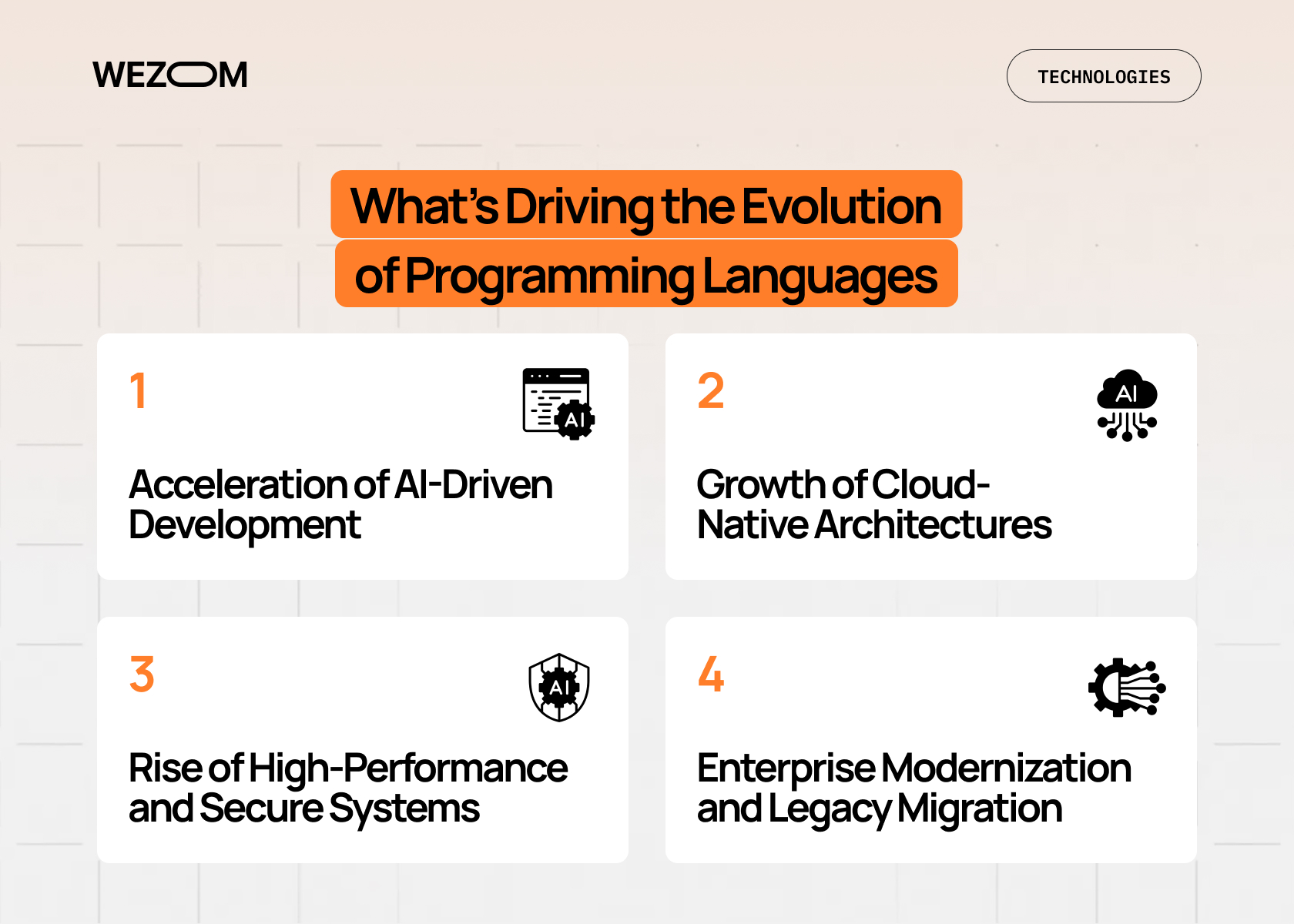
Several massive shifts are pushing developers toward specific languages. Understanding these forces helps you see why certain languages are winning right now.
Acceleration of AI-Driven Development
AI isn't just changing how we write code. It's reshaping what languages we write in. When your workflow involves machine learning models and neural networks, you gravitate toward languages with robust ML libraries. The entire AI ecosystem — from training models to deploying them in production — influences which languages gain traction.
Python's dominance here isn't accidental. The language has become synonymous with AI development, creating a feedback loop where more AI tools support Python, which makes more developers choose Python, which leads to even more tools. Libraries like TensorFlow, PyTorch, and scikit-learn aren't just convenient — they're the industry standard. When researchers publish papers, they often include Python code. When companies hire for AI roles, Python skills are assumed.
But here's what's interesting: once you've trained your model, deployment becomes crucial. That's where compiled languages with strong performance characteristics start making sense. You want your inference to be fast, your memory footprint small, and your latency predictable.
Growth of Cloud-Native Architectures
Microservices, containers, serverless functions — languages designed for concurrency and distributed systems are having their moment. Go's rise makes perfect sense here. Fast compilation, built-in concurrency through goroutines, and a standard library that handles HTTP servers without external frameworks? That's cloud-native gold.
The shift to cloud computing changed what we value in programming languages. Startup time matters when your containers spin up and down constantly. Memory efficiency matters when you're paying for every gigabyte. Concurrency matters when you're handling thousands of simultaneous connections. Languages that make these things easy gain adoption, while those that make them hard fall behind.
JavaScript and TypeScript aren't far behind. Node.js proved JavaScript could handle backend workloads, and frameworks like Next.js and Remix show how powerful full-stack JavaScript can be. Being able to share code between frontend and backend, use the same mental models across your stack, and hire developers who can work anywhere in your application — quite notable advantages.
Rise of High-Performance and Secure Systems
Security breaches aren't getting less expensive. The industry demands languages that deliver both speed and safety. Rust offers memory safety without garbage collection. That sounds boring until you realize roughly 70% of security vulnerabilities stem from memory-related bugs.
When a single breach can cost millions in damages and reputation, preventing bugs at compile time isn't just nice — it's essential. The compiler catches what would become production vulnerabilities in other languages.
Enterprise Modernization and Legacy Migration
Java and C# are still popular because billions of lines of production code run on these platforms. But both ecosystems have evolved dramatically. Modern Java with records and virtual threads looks nothing like Java from 2010. C# with LINQ and .NET's cross-platform capabilities has become genuinely impressive.
The smart enterprises don’t rewrite everything. They're gradually modernizing — adding new features in modern languages while maintaining proven core systems. This pragmatic approach drives different adoption patterns than startups building from scratch. Understanding this reality helps you make better language choices based on your actual situation, not just what's theoretically best.
Main Types of Programming Languages
Before diving into specific languages, let's clarify what kinds of languages exist. Different paradigms solve different problems.
Languages like C organize code into procedures that operate on data. They're straightforward and efficient, giving direct control over memory. For systems programming or embedded development, procedural languages remain unbeatable.
Object-oriented programming bundles data and methods into objects. Java, C#, and Python embrace OOP. The paradigm shines when building large applications with complex domain models.
Functional programming treats computation as mathematical functions, avoiding mutable state. Languages like Haskell and Elixir are purely functional. Functional code tends to be more predictable and easier to test. When concurrency matters, immutability makes parallel processing safer.
Scripting languages are interpreted rather than compiled, meaning slower runtime but faster development. Python, JavaScript, and Ruby excel at automation, prototyping, and rapid development.
Compiled languages like C, C++, Go, and Rust convert source code into machine code before execution. They're the choice for performance-critical applications like game engines and operating systems.
Interpreted languages execute code line by line. Python and JavaScript are classics here, perfect for rapid prototyping where developer productivity trumps raw runtime speed.
SQL deserves special mention — it's been around for decades and remains absolutely critical. Every application with persistent data needs SQL. Master it, and you'll never lack job opportunities.
MATLAB for numerical computing, R for statistical analysis, Julia for scientific computing — these aren't general-purpose tools, but in their niche, they're unmatched.
Low-level languages like assembly and C give direct hardware control. When every CPU cycle counts, when you're writing device drivers or bootloaders, low-level languages are your only option.
Top Programming Languages in 2026
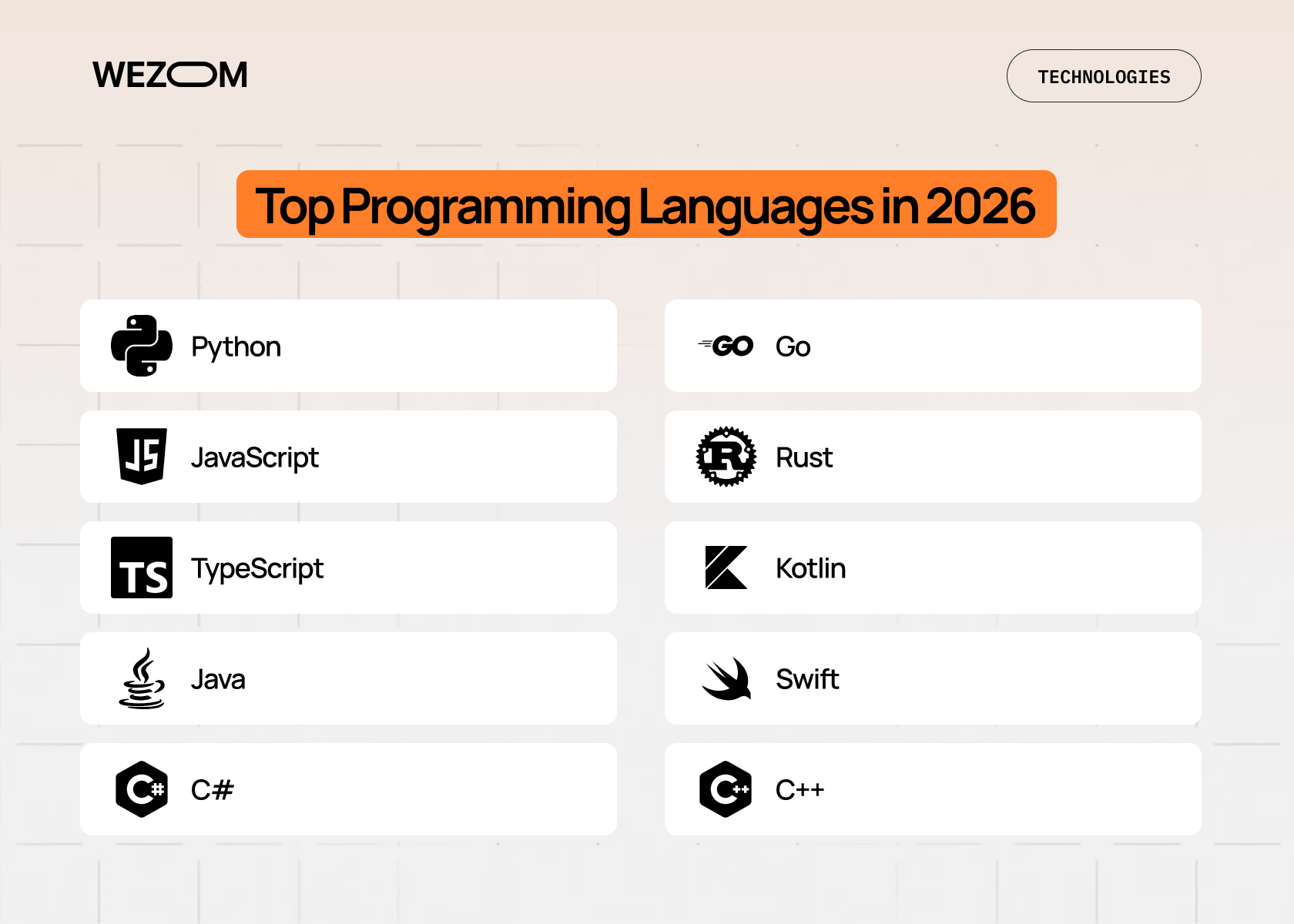
Here are the most used programming languages shaping development in 2026:
1. Python
Still the king. Python's dominance in AI, machine learning, and data science has only intensified. With TensorFlow, PyTorch, and pandas, Python's the default for anything involving data. The ecosystem is unmatched — need to scrape websites? Beautiful Soup. Build web apps? Django or Flask. Automate tasks? Python's got you.
What makes Python special isn't just its syntax (though the readability is genuinely nice). It's the ecosystem. You can build sophisticated applications by essentially connecting existing components. The community has built libraries for almost everything, tested and documented by millions of developers.
Performance criticism is real, though. Python is slow compared to compiled languages. But here's the thing: for most applications, developer productivity gains outweigh runtime slowness. When you do need speed, you can call C libraries or use tools like Cython.
2. JavaScript
Best for: data analytics, machine learning, scientific computing, web backends, automation, rapid prototyping.
JavaScript runs the web. Every browser supports it, and Node.js conquered the backend. Modern JavaScript with ES6+ features like arrow functions, async/await, and destructuring is genuinely pleasant. Frameworks like React, Vue, and Angular dominate frontend development, while Node.js powers countless backend services.
According to TIOBE Programming Community Index for 2025, JavaScript remains among the most popular coding languages, consistently ranking in the top 10 most-used languages worldwide. The language's universal browser support makes it irreplaceable for frontend work, while its backend capabilities through Node.js mean you can build full applications in a single language.
The downside? The ecosystem can be overwhelming. There's a new framework every week, and JavaScript's quirks still catch people off guard. But the ubiquity and versatility make it essential.
Best for: web development (frontend and backend), mobile apps, full-stack development.
3. TypeScript
TypeScript is JavaScript with type safety. Types catch bugs before runtime, your IDE provides better autocomplete, and large codebases become maintainable. The learning curve is gentle if you already know JavaScript — TypeScript is a superset, so valid JavaScript is valid TypeScript. You can adopt types gradually, adding them where they provide the most value.
Modern frameworks increasingly default to TypeScript. Angular requires it, React projects commonly use it, and backend frameworks like NestJS are built with it. If you're doing serious JavaScript development, TypeScript should be on your radar.
Best for: large-scale JavaScript applications, enterprise web development.
4. Java
Java powers critical infrastructure worldwide, from banking to Android apps. The JVM is an engineering marvel. Modern Java has improved dramatically with records and virtual threads. Pattern matching makes code cleaner, sealed classes improve type safety, and the performance keeps getting better with each release.
Best for: enterprise applications, Android development.
5. C#
C# is genuinely excellent. Modern C# combines compiled language performance with developer-friendly features. The .NET ecosystem is now open-source and cross-platform. LINQ makes data manipulation elegant. You can build web APIs with ASP.NET Core, desktop apps with WPF, mobile apps with MAUI, and games with Unity — all in the same language. The tooling with Visual Studio and Rider is top-tier.
Best for: Windows applications, game development with Unity.
6. Go
Go was designed for the cloud era. Fast compilation, built-in concurrency, and deployment as a single binary make it perfect for microservices and distributed systems. Docker and Kubernetes are written in Go for good reasons — the language handles networking, concurrency, and system-level operations elegantly.
The language is intentionally simple. No classes, no inheritance. This simplicity is polarizing — some developers find it refreshing, others miss abstractions. But for cloud infrastructure and DevOps tools, Go's straightforward approach and excellent performance make it a top choice.
Best for: cloud services, microservices, DevOps tools, networking applications.
7. Rust
Rust is the language systems programmers get excited about. Memory safety without garbage collection, performance matching C++, and a compiler that catches bugs that would be security vulnerabilities elsewhere. The ecosystem is growing fast — web frameworks, async runtime, database drivers. Mozilla built parts of Firefox in Rust. Microsoft is using Rust in Windows. The language has moved from experimental to production-ready.
"Rust's ownership system fundamentally changes how you think about memory management. Once you understand it, you wonder how you ever lived without it."
© WEZOM expert
The learning curve is steep, but once it clicks, you gain confidence that if your code compiles, it's likely memory-safe and thread-safe. The ecosystem is growing fast — web frameworks, async runtime, database drivers. Mozilla built parts of Firefox in Rust. Microsoft is using Rust in Windows. The language has moved from experimental to production-ready.
Best for: systems programming, performance-critical applications, security-focused projects, WebAssembly.
8. Kotlin
Google made Kotlin the preferred language for Android development. It's everything Java should be: concise, expressive, and modern, while maintaining full Java interoperability. Null safety eliminates NullPointerException.
Best for: Android development, JVM backends.
9. Swift
Apple's Swift replaced Objective-C. It's fast, safe, and designed with modern principles. The syntax is clean, optionals handle null values safely, and performance matches C++.
Best for: iOS, macOS, Apple ecosystem development.
10. C++
C++ is old, complex, and absolutely essential. When you need maximum performance and control, C++ delivers. Game engines, trading systems, and graphics software rely on C++. Modern C++ has improved significantly.
Best for: game development, high-performance applications.
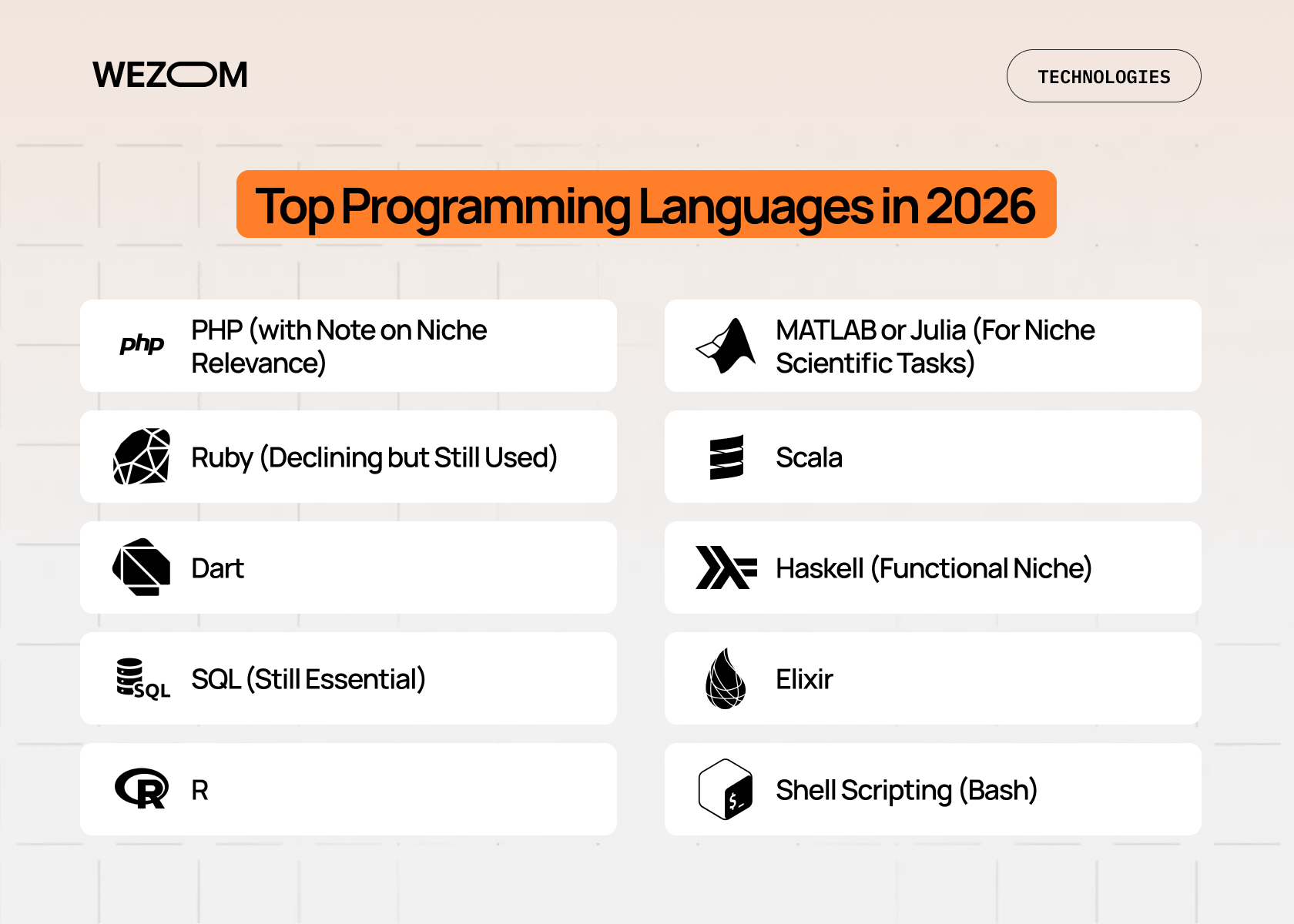
11. PHP (with Note on Niche Relevance)
WordPress powers about 40% of websites, and WordPress is built on PHP. Modern PHP (8+) is quite different from the PHP that earned its poor reputation. Laravel is a legitimately excellent framework.
Best for: WordPress development, web backends.
12. Ruby (Declining but Still Used)
Ruby and Rails had their moment. The language is beautiful, Rails remains productive. But momentum has shifted. New projects use Python, JavaScript, or Go. Ruby's settled into a niche: established companies maintaining Rails applications.
Best for: Rails applications, rapid prototyping.
13. Dart
Dart exists primarily for Flutter, Google's cross-platform mobile framework. Flutter lets you build iOS and Android apps from a single codebase.
Best for: Flutter mobile development.
14. SQL (Still Essential)
SQL isn't a general-purpose language, but it's absolutely essential. Every application that persists data interacts with databases, and SQL is how you query them. Understanding SQL means understanding data relationships and optimization.
Best for: database queries, data analysis.
15. R
R is the statistician's language. If you're doing serious statistical analysis or academic research, R's specialized packages make complex analyses straightforward.
Best for: statistical analysis, data visualization.
16. MATLAB or Julia (For Niche Scientific Tasks)
MATLAB dominates engineering and scientific computing. Julia is the newer alternative, designed to be as fast as C while being as easy as Python. Both are specialized for scientific computing.
Best for: scientific computing, numerical analysis.
17. Scala
Scala combines functional and object-oriented programming on the JVM. For big data processing with Apache Spark, Scala is the primary language.
Best for: big data processing, distributed systems.
18. Haskell (Functional Niche)
Haskell is pure functional programming. It's academically influential and forces you to think differently. Learning Haskell makes you a better programmer, even if you never use it professionally.
Best for: academic research, financial modeling.
19. Elixir
Elixir runs on the Erlang VM, inheriting decades of battle-tested concurrency and fault tolerance. What makes Elixir special is how it handles concurrency through lightweight processes and message passing.
Best for: real-time applications, chat systems.
20. Shell Scripting (Bash)
Bash isn't glamorous, but every developer uses it. Understanding shell scripting means you can automate repetitive tasks and navigate Linux systems efficiently.
Best for: automation, DevOps, deployment pipelines.
How to Choose the Right Language in 2026
Picking a programming language is about matching the language to your specific context:
- Security and Compliance Requirements. If you're building healthcare or financial systems, security isn't optional. Rust's memory safety prevents entire vulnerability classes. Strongly-typed languages catch errors at compile time. Some industries have specific requirements about technology stacks.
- Industry Segment (AI, Fintech, Gaming, Cloud, Embedded). AI and Machine Learning: Python dominates. Fintech: Java and C# for core systems, Python for analysis. Gaming: C++ for engines, C# for Unity. Cloud and DevOps: Go for infrastructure. Embedded Systems: C and C++, Rust gaining ground.
- Community and Ecosystem. A language's ecosystem can make or break your project. When you hit a problem at 2 AM, can you find a solution on Stack Overflow? When you need specific functionality, does a library exist? These practical concerns matter more than theoretical elegance. Large, active communities mean more libraries, better documentation, and easier troubleshooting. Python, JavaScript, and Java have massive ecosystems. You can find libraries for almost anything. The community support is extensive, with tutorials, courses, and forums everywhere. Smaller communities aren't necessarily bad — they're often more focused and passionate. But you might need to build more yourself. Consider the tooling too — IDEs, debuggers, profilers, testing frameworks. Languages with corporate backing (TypeScript from Microsoft, Kotlin from Google, Swift from Apple) often have excellent tooling that boosts productivity significantly.
- Maintainability and Long-Term Support. Writing code is easy. Maintaining it for years is hard. Languages with strong type systems make refactoring safer. Think about who will maintain this code. Python, JavaScript, and Java developers are easy to find. Haskell experts? Less so.
- Evaluate the Total Cost of Ownership. The true cost of a language goes beyond initial development.
Factor in: developer salaries (some specialists command higher rates), infrastructure costs (interpreted languages might need more server resources), training time (how long before developers become productive?), hiring difficulty (can you find developers easily?).
Conclusion
There's no single "best" programming language in 2026. Python's amazing for AI, but really bad for mobile apps. JavaScript dominates web development, but you won't use it for embedded systems. Rust offers incredible safety, but the learning curve is steep.
The most popular programming languages are popular for good reasons: they solve specific problems well, have strong ecosystems, and provide good developer experiences. But popularity doesn't automatically make a language right for your project. A list of the most popular programming languages is a starting point, not a prescription.
Start by understanding what you're building. Consider your team's skills. Think about long-term maintenance. Factor in industry norms and security requirements. Match these needs against what each language offers. The "what is the most common programming language" question matters less than "what's the right language for this specific project?"
And remember: you don't need to pick one language forever. Modern development often combines languages. Python for data processing, Go for microservices, TypeScript for frontends — using languages based on their strengths is perfectly reasonable. The best developers are polyglots who choose tools based on context, not dogma.
Want to explore how the right programming language can accelerate your project? We help teams choose and implement technology stacks that actually work for their specific needs. Let's talk about what would work best for you.

FAQ
What are the best programming languages to learn in 2026?
The best programming languages to learn depend on your goals. For AI and data science, Python remains dominant. For web development, JavaScript and TypeScript are essential. For systems programming, Rust and Go are excellent choices. For mobile development, consider Kotlin (Android) or Swift (iOS). The key is matching the language to your career goals.
What programming language has the highest demand in 2026?
JavaScript and Python consistently show the highest demand across job markets. JavaScript's ubiquity in web development ensures constant demand, while Python's dominance in AI, machine learning, and data science drives massive growth. TypeScript is increasingly required for serious JavaScript development. Java and C# maintain high demand in enterprise environments.
Which programming language is best for beginners?
Python is widely considered the best language for beginners. Its syntax is clean and readable, resembling natural language. The vast ecosystem of libraries and tutorials makes learning easier. JavaScript is another excellent choice, especially if you're interested in web development. Both languages have large, supportive communities ready to help newcomers.
Is Python still worth learning in 2026?
Absolutely. Python's position in AI, machine learning, and data science has only strengthened. The language powers critical infrastructure at major tech companies and research institutions. Python's versatility — from web development to automation to scientific computing — ensures its relevance. If anything, Python's importance is growing, not diminishing.
Is JavaScript still the most popular language?
JavaScript remains one of the most popular programming languages, particularly for web development. Its universal browser support makes it irreplaceable for frontend development. With Node.js, JavaScript expanded into backend development. TypeScript's addition of type safety addressed JavaScript's biggest weakness. While Python competes in overall popularity, JavaScript's dominance in web development keeps it at the top.
