
You've probably heard the term “solution architect” thrown around in meetings. Maybe your company is hiring one. Or maybe someone just told you that you should become one. But here's the thing — solution architect is one of those job titles that sounds important without telling you much about what the person actually does.
So let's fix that.
We’ve spent years working alongside solution architects, watching them untangle impossible requirements and turn vague business goals into systems that actually work. And to be honest, the role is harder to explain than it should be, mostly because it sits at this weird intersection of technical depth, business thinking, and (surprisingly) a lot of communication.
In this article we'll give a detailed solution architect job description, what skills you need to become one, and how to know if your company needs this kind of expertise. Whether you're exploring this career path or trying to figure out if hiring an architect makes sense for your team, this guide should give you a clear picture.
Who Is a Solution Architect?
A solution architect is the person who designs the technical blueprint for solving a specific business problem. They don't just code (though many can). They don't just manage projects (though they're deeply involved). Instead, they figure out how technology should be structured to deliver what the business actually needs.
Think of it this way: if your company decides to build a new e-commerce platform, someone needs to decide which cloud platform to use, how the payment system will integrate, what security protocols make sense, and whether the whole thing will still work when traffic spikes during Black Friday. That's the solution architect's job.
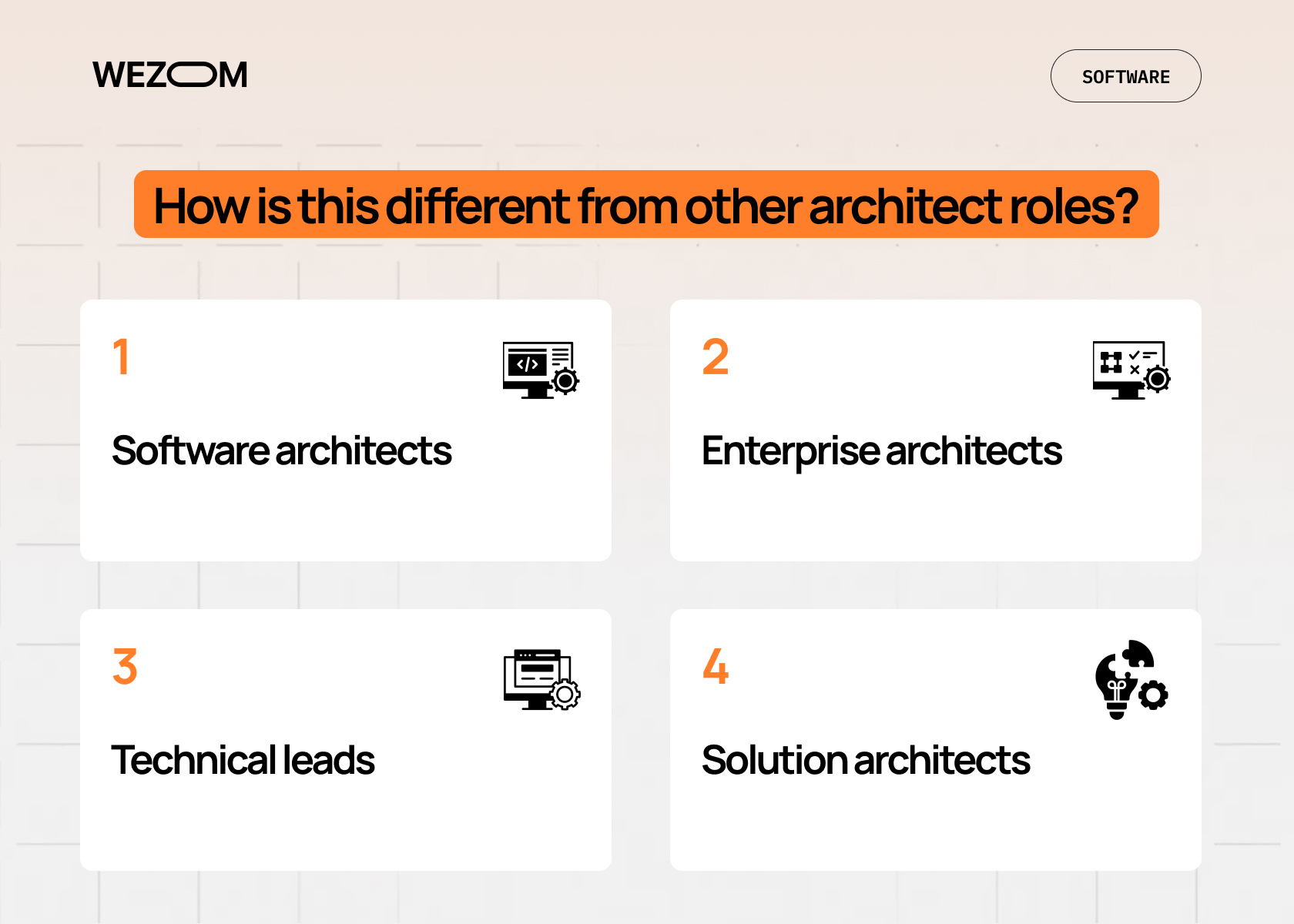
How is this different from other architect roles?
Honestly, the titles get confusing. Let's break it down:
- Software architects focus on code structure: how applications are built internally, which frameworks to use, how to handle data flow within a single system. They're deep in the technical weeds making sure the codebase is clean, maintainable, and performs well. Their scope is usually one application or a tightly connected set of services.
- Enterprise architects work at the organizational level. They look at how all systems across a company should align with long-term business strategy. Think of them as the people who make sure your CRM, ERP, data warehouse, and customer-facing apps all play nicely together, not just today, but five years from now. They're less hands-on with code and more focused on standards, governance, and strategic roadmaps.
- Technical leads manage development teams and make day-to-day technical decisions within a project. They're in the trenches with developers, reviewing code, unblocking issues, and making sure the team delivers on time. Their focus is execution, not long-term architecture.
- Solution architects sit somewhere in the middle. They design solutions for specific projects or products, connecting business requirements to technical implementation. Unlike enterprise architects, they're hands-on with a particular initiative. Unlike software architects, they think beyond just the code, considering infrastructure, integrations, security, and how everything fits into the bigger picture. They bridge the gap between "what the business wants" and "what the tech team builds."
The key difference? A solution architect's work is project-focused but crosses multiple technical domains. They might touch infrastructure, security, cloud services, APIs, databases, and user experience, all while keeping business stakeholders in the loop.
What Does a Solution Architect Do: Core Responsibilities
Here's where it gets interesting. The solutions architect roles and responsibilities vary depending on the company, but there's a core set of things they almost always handle.
Translating Business Needs Into Technical Solutions
This is the big one. Business people say things like "we need to improve customer retention" or "our platform should handle international expansion." A solution architect takes those fuzzy requirements and figures out what they mean technically.
It's not just about asking good questions (though that helps). It's about understanding what's actually feasible, what trade-offs exist, and how to communicate those constraints back to stakeholders without making their eyes glaze over.
Designing System Architecture
Once requirements are clear (or clear enough), the solution architect designs how the system will actually work. This includes defining components, how they communicate, what data flows where, and how everything scales.
Documentation is a huge part of this. Diagrams, technical specifications, roadmaps, all the stuff that lets development teams actually build what's been designed. A good architect creates blueprints that are detailed enough to be useful but flexible enough to handle changes.
Evaluating Technologies and Platforms
Should you use AWS or Azure? PostgreSQL or MongoDB? Build custom or buy off-the-shelf? These aren't simple questions, and the answers depend on context: budget, timeline, existing systems, team expertise, long-term maintenance costs.
Solution architects evaluate these options and make recommendations. They also have to defend those choices to both technical teams (who might have strong opinions) and business leaders (who care about cost and time).
Ensuring Scalability, Security, and Performance
A system that works today but crashes next year isn't a good solution. Solution architects think about scalability from the start: how the system handles growth, peak loads, and unexpected demand.
Security is equally critical. They work with security teams to ensure data protection, compliance with regulations, and resilience against threats. Performance optimization, making sure things run fast and efficiently, rounds out this responsibility.
Collaboration With Stakeholders
This part surprises people. Solution architects spend a lot of time in meetings talking to developers, project managers, executives, vendors, and sometimes customers.
They're translators, essentially. Technical concepts need to be explained to non-technical people. Business constraints need to be communicated to engineering teams. Keeping everyone aligned is half the job.
Managing Integrations and Complex Workflows
Modern systems don't exist in isolation. They connect to payment processors, CRM tools, analytics platforms, third-party APIs, legacy databases. Solution architects design how these integrations work, handling data formats, authentication, error handling, and all the other details that can derail a project.
Essential Solution Architect Skills
So what does it take to actually do this job? The solution architect skills split pretty evenly between technical expertise and soft skills, and you need both.
Technical Skills
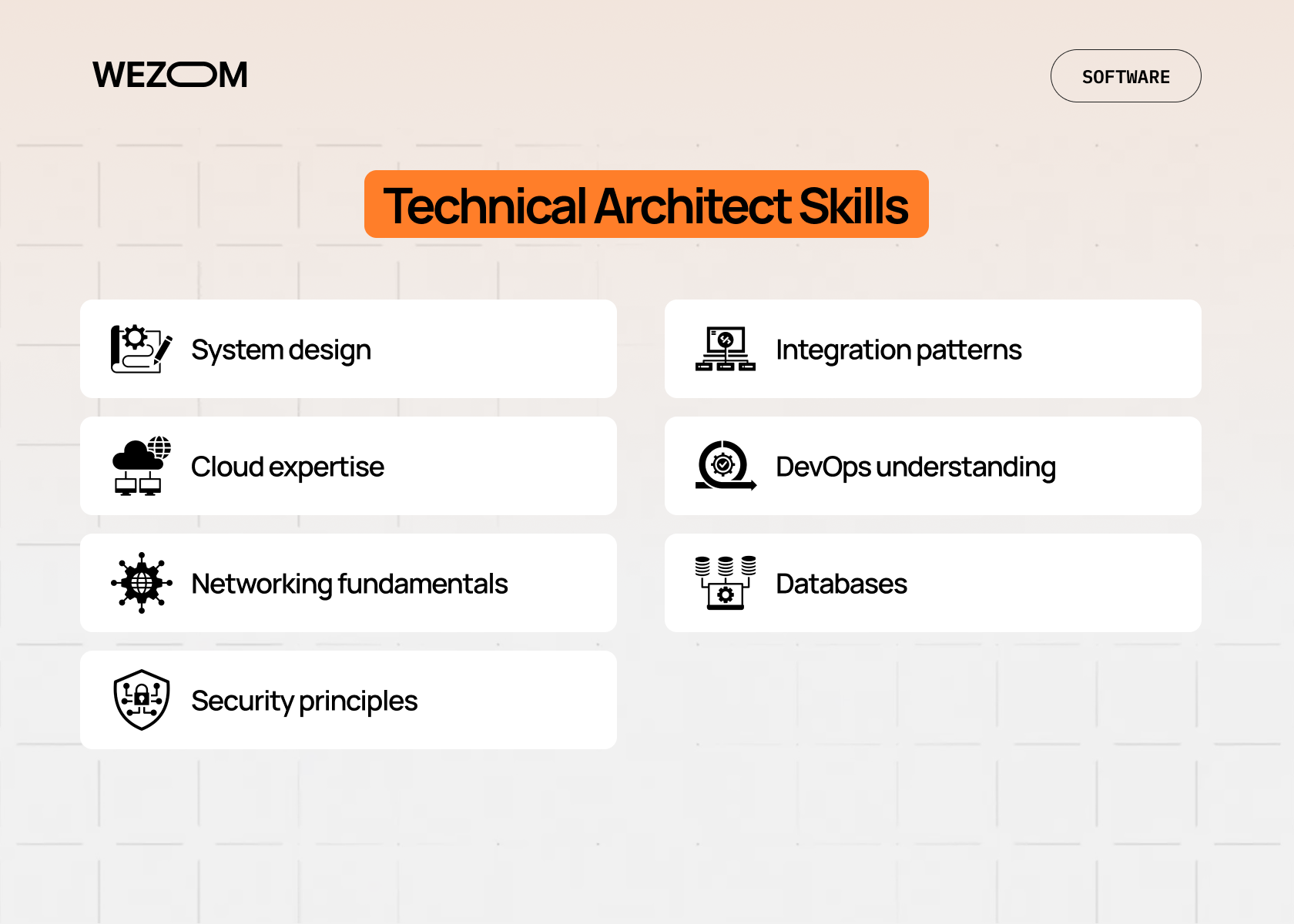
Let's start with the hard stuff:
- System design. Understanding how to structure complex systems, distribute workloads, and handle data at scale.
- Cloud expertise. Deep knowledge of AWS, Azure, Google Cloud, or other platforms. A cloud solution architect specialization is increasingly common.
- Networking fundamentals. How systems communicate, load balancing, DNS, firewalls, VPNs.
- Security principles. Authentication, encryption, compliance frameworks, threat modeling.
- Integration patterns. REST APIs, message queues, event-driven architecture, microservices.
- DevOps understanding. CI/CD pipelines, infrastructure as code, deployment automation.
- Databases. Both SQL and NoSQL, data modeling, performance tuning, replication strategies.
Do you need to be an expert in all of these? Not necessarily. But you need enough depth to evaluate options and enough breadth to see how everything connects.
Soft Skills
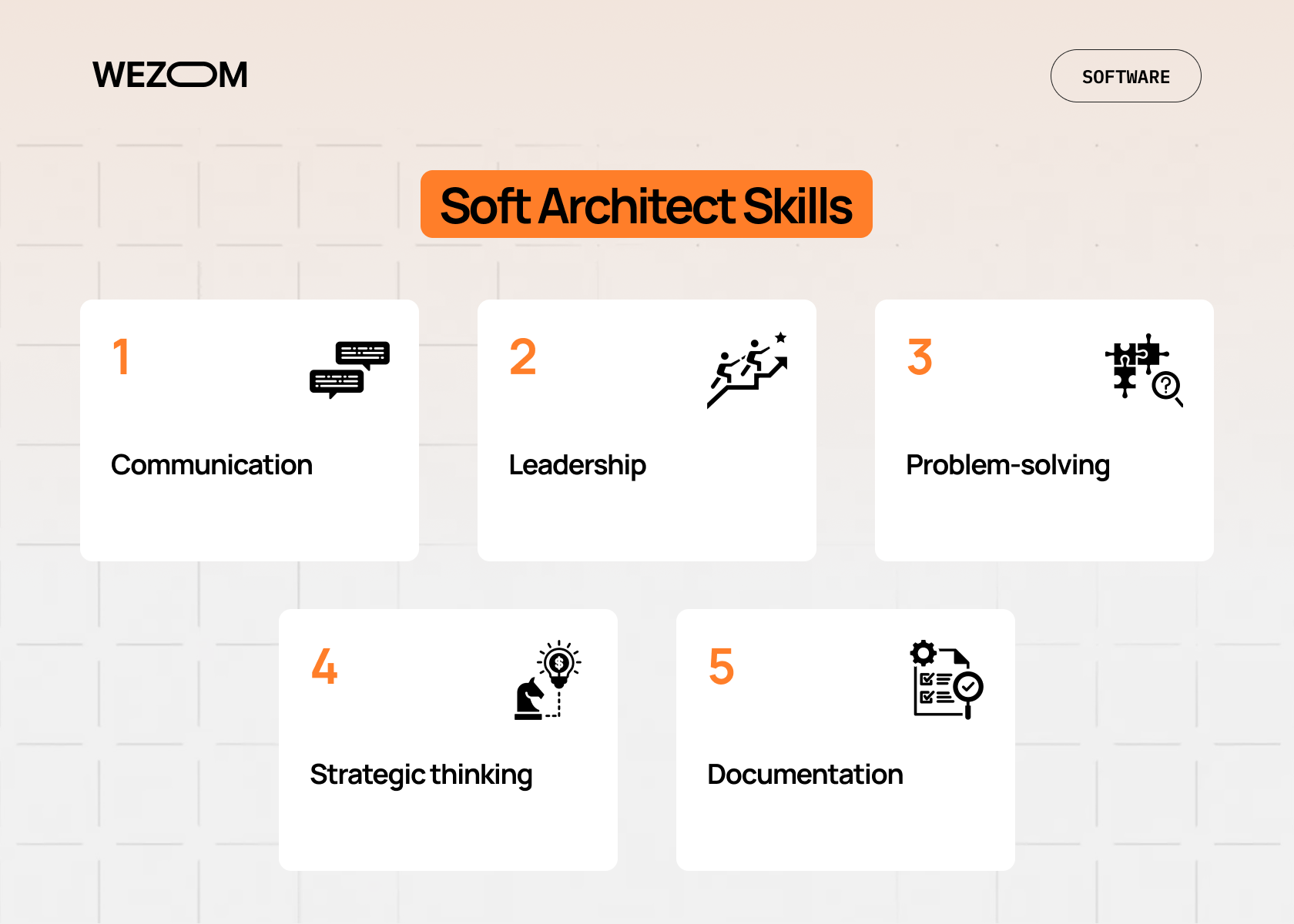
Here's where things get interesting. We've seen technically brilliant architects fail because they couldn't communicate or lead. The soft skills matter just as much:
- Communication. Explaining complex ideas simply, writing clear documentation, presenting to executives.
- Leadership. Guiding teams without direct authority, building consensus, handling pushback.
- Problem-solving. Breaking down ambiguous problems, finding creative solutions under constraints.
- Strategic thinking. Seeing the big picture, anticipating future needs, balancing short-term and long-term goals.
- Documentation. Creating useful technical specs, decision records, and architectural diagrams.
Solution Architect Career Path
Nobody starts as a solution architect. The solution architect career path typically takes 8-10 years of progressive experience. Here's what it usually looks like.
| Stage | Role & Focus |
|---|---|
| Entry Level | Junior Developer, DevOps Engineer, or QA. Building foundational technical skills. |
| Mid-Level | Software Engineer or Systems Engineer. Deeper technical expertise, some design work. |
| Senior Level | Senior Engineer. Leading projects, mentoring others, making architectural decisions. |
| Architect | Solution Architect. Full ownership of technical solutions, stakeholder management. |
| Senior Architect | Lead/Principal Solution Architect. Guiding multiple projects, setting standards. |
| Executive | Enterprise Architect or CTO. Organization-wide strategy, executive leadership. |
The transition from senior engineer to solution architect is the trickiest. It requires shifting from "how do I build this?" to "what should we build and why?". Some engineers love that shift. Others find it frustrating. One client told us that the hardest part wasn't learning new technical skills, it was learning to let go of implementation details and trust the team.
Certifications can accelerate the transition, particularly cloud certifications from AWS, Azure, or Google Cloud. They demonstrate knowledge and often open doors for interviews. But they're not a substitute for hands-on experience making architectural decisions and living with the consequences.
Why does this matter now? The cloud skills gap is real. According to TechTarget, more than 90% of organizations will face IT skills shortages by 2026. Cloud architecture and design top the list of missing competencies. For companies, this means fierce competition for talent. For professionals, it means strong demand and salaries that reflect scarcity. Senior cloud architects in the US can command $170K–$190K or more.
When Does a Company Need a Solution Architect?
Not every company needs a solution architect. Small startups with straightforward tech stacks can often get by with senior engineers making architectural decisions. But there are clear signals that it's time to bring in dedicated architectural expertise.
The most obvious one? Scaling a product. Your MVP worked, customers are signing up, and now your system needs to handle 10x the load, but the quick decisions that got you here are becoming technical debt. A solution architect can redesign for scale without rebuilding from scratch. This often goes hand-in-hand with launching complex features, adding a new payment system, expanding into a new market, or integrating with enterprise customers. These aren't just development tasks. They require careful planning around compliance, security, and system reliability.
Then there's cloud migration. Moving from on-premise to cloud (or switching cloud providers) is a major undertaking. The wrong approach wastes money and creates operational headaches. A cloud solution architect can plan the migration, optimize costs, and ensure nothing breaks along the way. Similarly, building enterprise systems for large organizations with multiple departments, legacy systems, and strict compliance requirements demands architectural oversight. Without it, you end up with disconnected systems, duplicated data, and integration nightmares.
Sometimes the problem isn't growth, it's cleanup. Reducing tech debt is a common trigger for bringing in an architect. Sometimes the existing architecture is... well, a mess. A solution architect can assess the current state, prioritize what needs fixing, and create a roadmap for improvement that balances new development with cleanup work. And when you're dealing with complex integrations, connecting your CRM to your billing platform, your warehouse management to your e-commerce site, your legacy database to new cloud services — someone needs to design how data flows and stays consistent. Without architectural oversight, these integrations become fragile and hard to maintain.
Quick question: how many of these apply to your organization? If it's more than one, you probably need architectural help, whether that's hiring, consulting, or upskilling existing team members.
Conclusion
The solution architect role is one of those behind-the-scenes jobs. You won't ship features or close deals. But you'll shape how technology serves your business, make decisions that affect systems for years, and bridge the gap between people who speak different professional languages.
If you're considering this career path, start building breadth now. Work on different types of systems. Learn about business processes. Practice explaining technical concepts to non-technical people. Find mentors who've made the transition and learn what surprised them about the role.
And if you're looking to hire one? Look beyond certifications. The best architects combine technical depth with curiosity, communication skills, and the ability to make decisions when there's no perfect answer. Ask candidates about trade-offs they've navigated, not just technologies they've used.
Want to discuss how architectural expertise could help your team? We'd love to hear about your challenges and explore whether a solution architect could make a difference for your projects.

FAQ
What skills are required to become a solution architect?
You'll need a combination of technical expertise (system design, cloud platforms, security, databases) and soft skills (communication, leadership, strategic thinking). Most successful architects have 8+ years of progressive experience across multiple technical domains.
Do solution architects need coding experience?
Yes, though they don't necessarily code daily. Understanding how software is built helps architects make realistic design decisions and communicate effectively with development teams. Most architects spent years as developers before transitioning into architecture roles.
Is a solution architect a high paying job?
Yes. According to 2025 salary data, solution architects in the United States earn between $121,000 and $195,000 on average, with senior roles and specialized areas (like cloud architecture) commanding even higher compensation. Location, industry, and certifications also impact earnings.
How long does it take to become a solution architect?
Typically 8–10 years of experience, though this varies. The path usually goes: junior developer → software engineer → senior engineer → solution architect. Some people move faster with strong mentorship and diverse project experience, others take longer routes through specializations.
What certifications are recommended for solution architects?
Cloud certifications are most valuable: AWS Solutions Architect, Microsoft Azure Solutions Architect, Google Cloud Professional Architect. Framework certifications like TOGAF can be useful for enterprise roles. That said, practical experience matters more than certifications — they're evidence of knowledge, not a substitute for it.
