
There are two types of fleet managers right now.
The first type still tracks driver qualification files in Excel. They set calendar reminders for expirations. They dig through filing cabinets during audits. They worry constantly about missing something.
The second type sleeps better. They get automatic alerts. They access any file in seconds from anywhere. They pass audits without breaking a sweat.
Want to know the difference? It's called a digital DQF system, and it's not as complicated as you think. Here's the useful information you need to know.
Understanding What Is Safety Compliance in the Trucking Industry
Safety compliance means meeting all the regulatory requirements that keep drivers, cargo, and everyone else on the road safe. But compliance in transportation is about protecting your business from catastrophic risks: multi-million dollar lawsuits after accidents, immediate operational shutdowns, and penalties that can bankrupt smaller fleets.
The Federal Motor Carrier Safety Administration (FMCSA) sets the standards. They decide what qualifies a driver, how records must be kept, and what happens when companies don't comply.
What happens if you don't comply?
- Fines ranging from hundreds to thousands of dollars per violation.
- Out-of-service orders that can halt operations.
- Legal liability if an unqualified driver causes an accident.
- Reputation damage that costs you clients.
One fleet manager got hit with $15,000 in penalties during a roadside inspection. Why? Missing documents in three driver dq files.
What is a DQ file?
A driver qualification file is the collection of documents proving that someone behind the wheel of your truck is qualified, trained, and medically fit to drive. It's the professional resume and safety record for each commercial driver.
Who needs a driver qualification file?
Anyone operating commercial motor vehicles under FMCSA regulations:
- Trucking companies;
- Logistics providers;
- Bus operators;
- Any business with commercial drivers.
If you've got someone driving a commercial vehicle for your company, you need a DQF.
What Is Required in a Driver Qualification File
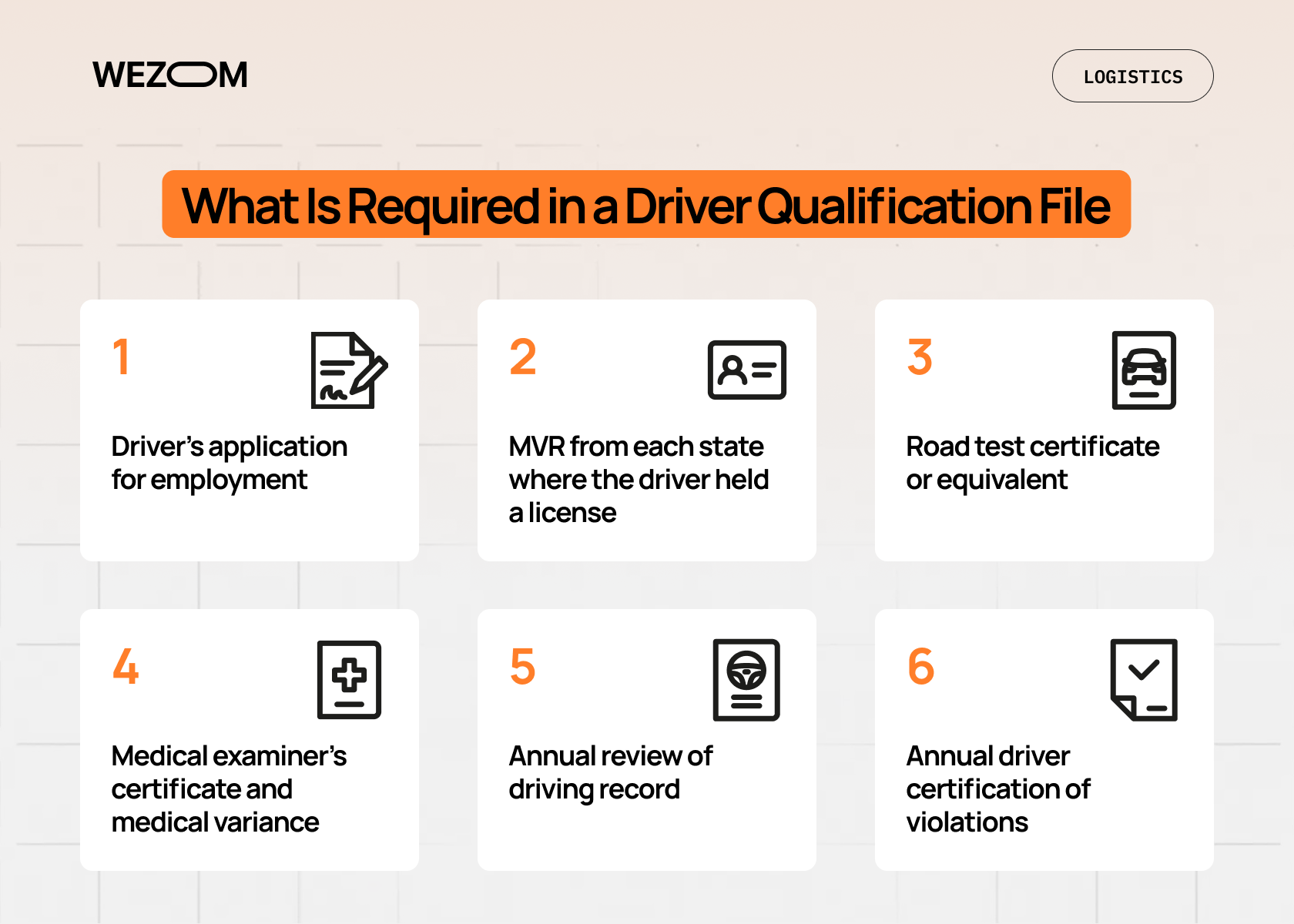
Driver qualification file requirements are mandatory. Every DQF must include:
- Driver's application for employment;
- Motor vehicle record (MVR) from each state where the driver held a license (past 3 years);
- Road test certificate or equivalent;
- Medical examiner's certificate and medical variance (if applicable);
- Annual review of driving record;
- Annual driver certification of violations.
DQF updates aren't a one-time thing. Medical certificates typically expire every 2 years. MVRs need annual reviews. Violation certifications? Also annual.
Common mistakes businesses make:
- Forgetting annual violation certifications from drivers.
- Not tracking medical certificate expiration dates.
- Failing to obtain MVRs from all required states.
- Missing signatures or dates on documents.
During audits or inspections, each missing item can trigger violations.
Challenges of Managing DQFs Manually
Picture this: filing cabinets full of folders. Spreadsheets tracking expiration dates. Sticky notes everywhere. Someone's medical certificate was buried in an email from six months ago.
Traditional paper-based or spreadsheet systems create massive headaches:
- Time consumption. Someone has to manually check every file, track every deadline, and chase down every driver for renewals. That's hours each week.
- Human error. When you're managing 50, 100, or 200 drivers, things slip through the cracks. A missed expiration here, a forgotten document there, suddenly you're non-compliant.
- Audit nightmares. Try producing complete files for 30 drivers during a DOT audit when your system is paper files, random PDFs, and "I think Sarah has that document."
Manual systems don't just affect compliance, they impact your safety performance scores, insurance rates, and ability to win contracts.
The Shift to Digital DQF Management
Companies are rapidly moving toward digital driver qualification file systems. According to Fleetio's 2025 State of Fleet Management report (based on a survey of nearly 300 fleet professionals conducted between November 2024 and January 2025), 72% of fleets now use dedicated maintenance software, while technology adoption continues to accelerate as compliance pressures intensify across the trucking industry.
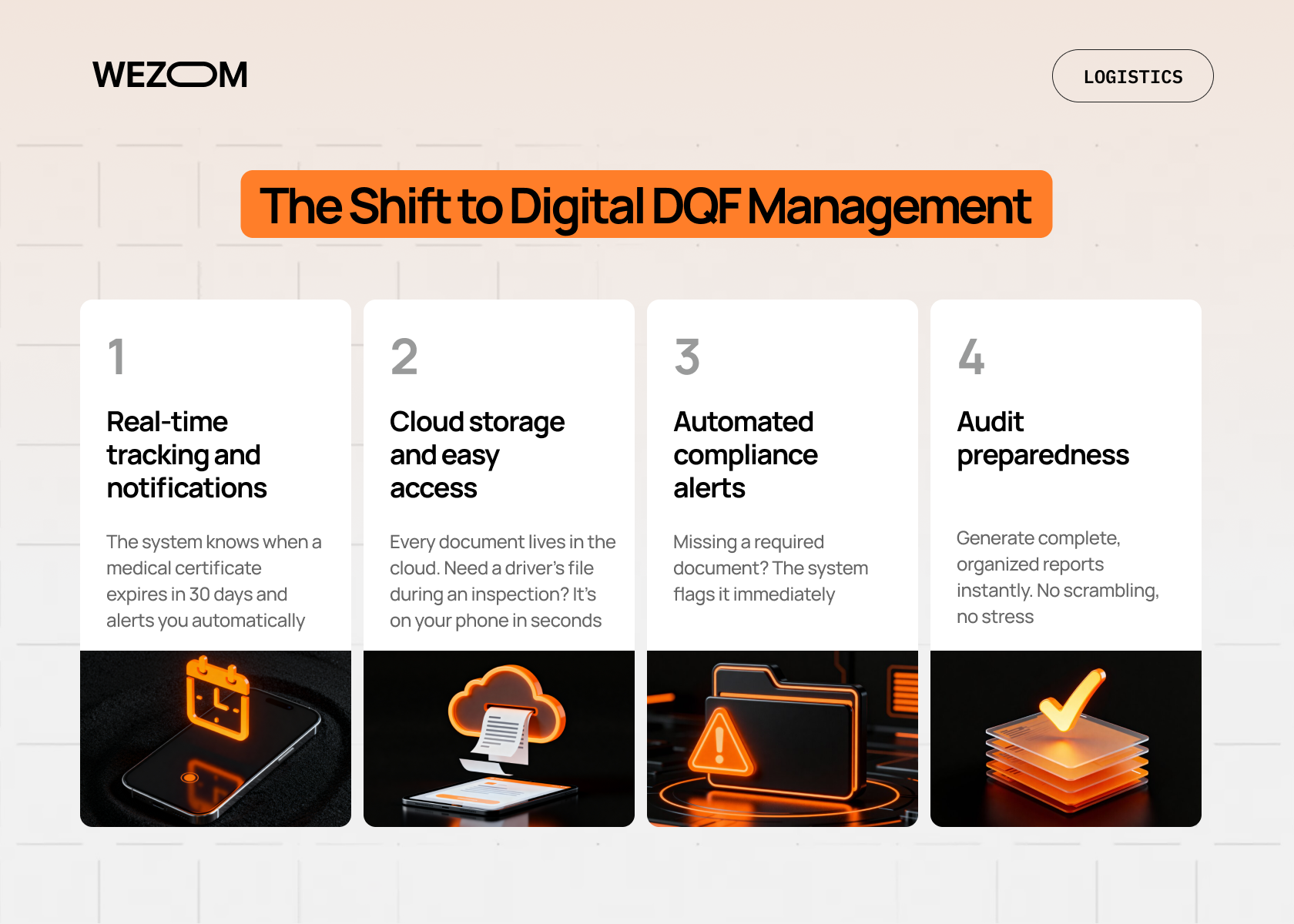
Digital DQF management solves decades-old problems:
- Real-time tracking and notifications. The system knows when a medical certificate expires in 30 days and alerts you automatically.
- Cloud storage and easy access. Every document lives in the cloud. Need a driver's file during an inspection? It's on your phone in seconds.
- Automated compliance alerts. Missing a required document? The system flags it immediately.
- Audit preparedness. Generate complete, organized reports instantly. No scrambling, no stress.
Once companies make the switch, they wonder how they ever managed without it.
Why DQF Should Be a Standalone Product
You might be thinking: "Can't I just use my existing fleet management software for this?"
Maybe. But should you?
DQF management shouldn't be just a feature bolted onto fleet software, it deserves to be a dedicated compliance tool.
Many fleet management platforms treat compliance as an afterthought. They're great at tracking vehicles, routing, fuel, but when it comes to the detailed requirements of truck driver qualification files, they fall short.
| Feature | Generic Fleet Software | Dedicated DQF Platform |
|---|---|---|
| Compliance depth | Basic document storage | Comprehensive regulatory coverage with built-in FMCSA updates |
| Automation | Limited reminders | Intelligent workflows for renewals, verifications, and audits |
| Integration | Primarily vehicle-focused | Seamless connection with HR, safety, and payroll systems |
| Updates | Manual tracking of regulation changes | Automatic updates reflecting latest FMCSA requirements |
| Reporting | Generic reports | Compliance-specific analytics and audit-ready documentation |
| Support | General tech support | Compliance experts who understand regulations |
Centralized record-keeping means everything related to driver qualification lives in one place, not scattered across different modules.
Scalability matters too. Whether you're managing 5 drivers or 500, a dedicated DQF system grows with you.
Think of it this way: you wouldn't use a Swiss Army knife to perform surgery. Compliance is critical. Use the right tool.
How to Get or Set Up a Driver Qualification File
How to get a driver qualification file set up digitally:
Step 1: Gather required documents. For each driver, collect employment applications, current medical certificates, MVRs from all states (past 3 years), previous employment verification, and road test certificates.
Step 2: Verify driver eligibility. Check that medical certificates are valid, MVRs show acceptable history, and all forms are properly signed and dated.
Step 3: Use digital software or compliance platforms. Upload documents, set automatic renewal reminders, and let the system monitor compliance.
Look for platforms that offer mobile access for drivers, integration with MVR monitoring services, automated FMCSA updates, and customizable workflows.
The Future of DQF and Safety Compliance
Digitalization is just the beginning. We're seeing automation expand into predictive analytics, systems that predict which drivers might be at risk based on patterns in their records.
Integration is getting deeper. Expect DQF platforms to connect with telematics, ELD systems, and insurance providers for a unified view of driver safety.
Also mobile-first experiences are becoming standard. Drivers can submit documents and update their files directly from their phones.
Companies that embrace digital transformation for critical functions like safety & compliance will be the ones that thrive.
Final Thoughts
The shift from paper chaos to digital clarity helps you to protect your business, your drivers, and everyone sharing the road.
Going digital with a dedicated DQF solution means fewer sleepless nights worrying about audits. It means more time focusing on growing your business instead of chasing paperwork.
If you're still managing each DQ file for drivers with spreadsheets and filing cabinets, maybe it's time to reconsider. The tools exist. The benefits are clear.
Ready to make the switch? Contact us, we’ll be happy to consult you.

FAQ
What is a driver qualification file (DQF)?
A driver qualification file is a collection of documents that proves a commercial driver is qualified, trained, and medically fit to operate a commercial vehicle. It's required by FMCSA regulations and must be maintained by every carrier for each driver.
Who needs a driver qualification file?
Any company operating commercial motor vehicles under FMCSA jurisdiction needs to maintain DQFs. This includes trucking companies, logistics providers, bus operators, and any business with commercial drivers on staff.
What documents are required in a driver qualification file?
Required documents include: driver's employment application, motor vehicle records from the past 3 years, road test certificate, current medical examiner's certificate, annual driving record reviews, annual certification of violations, and skill performance evaluation certificates when applicable.
Why should companies use a digital DQF system?
Digital DQF systems provide real-time compliance tracking, automated renewal alerts, cloud-based storage, instant audit reporting, and reduced risk of missing documents or deadlines. They save time, reduce errors, and improve overall safety management.
How does DQF digitalization improve safety and compliance?
Digital systems ensure nothing falls through the cracks by automating monitoring, sending proactive alerts, maintaining complete audit trails, and providing instant access to all required documentation. This leads to better compliance rates, fewer violations, and improved safety performance scores.
