
Most classic RAG systems are quite primitive in their operation – they find data fragments based on keywords and deliver them “as is”, increasing the risk of context loss. Agentic RAG, on the other hand, implements an autonomous reasoning loop, taking on the tasks of context analysis, filling data gaps and data verification, as well as generating reasoned responses. Below, we’ll answer the fundamental question: “What is AI RAG?”, as well as explain how it works and where it can be implemented.
What Is Agentic RAG?
So, what is RAG AI? In a nutshell, it is an AI framework that combines retrieval-augmented generation capabilities with autonomous agentic behavior. This technology implies the integration of large language models with external databases, enabling dynamic information extraction for complex problem-solving.
Unlike classic RAG, which follows a linear “retrieve-augment-generate” pipeline and is prone to failures due to irrelevant retrieval, an agentic system can iteratively evaluate its output and restart the pipeline to achieve the required accuracy. Furthermore, while classic RAG relies on predefined “if-then-else” workflows, an agentic RAG works dynamically based on both the user request’s semantics and the agent's reasoning.
Fundamentals of Agentic RAG
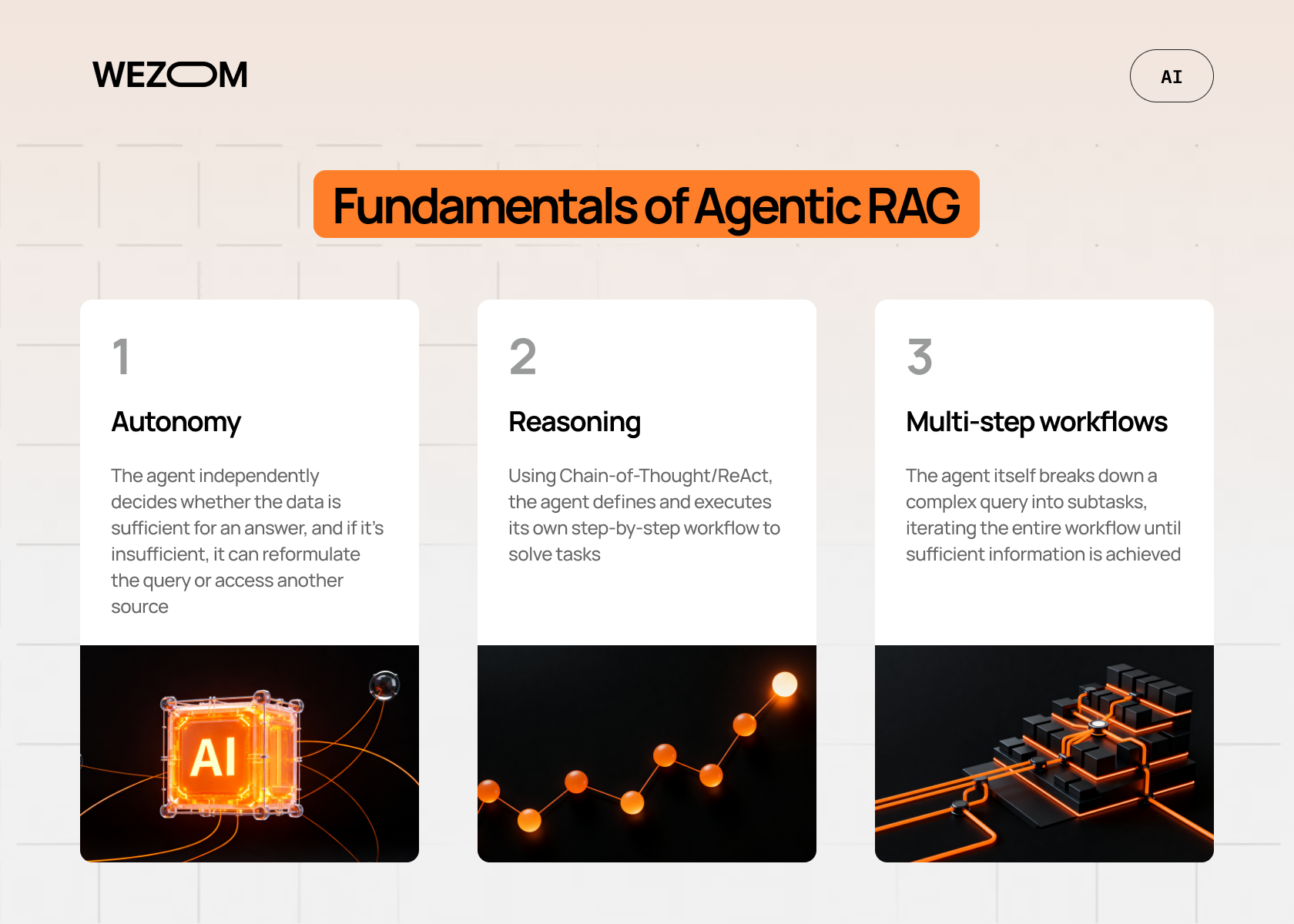
Generally speaking, instead of passively executing a predefined algorithm, an agent-based RAG performs research and makes decisions based on it independently. Here are the main fundamentals of agentic RAG:
- Autonomy. The agent independently decides whether the data is sufficient for an answer, and if it’s insufficient, it can reformulate the query or access another source;
- Reasoning. This is achieved through the use of techniques such as Chain-of-Thought/ReAct, according to which the agent itself defines the workflow – for example, “to answer this question, I first need to find the financial indicators for Q3, and then compare them with the forecast”.
- Multi-step workflows. The agent itself breaks down a complex query into subtasks, iterating the entire workflow until sufficient information is achieved.
A drawback of the classic RAG is the so-called semantic gap, due to the fact that vector search often finds fragments that match keywords but aren’t directly related to the query. In turn, the RAG agent uses critical thinking to filter data, characterized by:
- Self-correction, due to the agent's ability to run a Self-RAG cycle to ensure the response is appropriate for the specific context;
- Tool use – instead of just a vector index, the agent can also call APIs, perform the execution of Python code for calculations, and access knowledge graphs.
This achieves higher output quality simply by shifting decision making to the context processing level. And, while a static system would simply return “information not found”, the RAG agent says something like, “I didn't find the information in the PDF documents, so I checked the log table and synthesized a response based on it”.
How Does Agentic RAG Work?
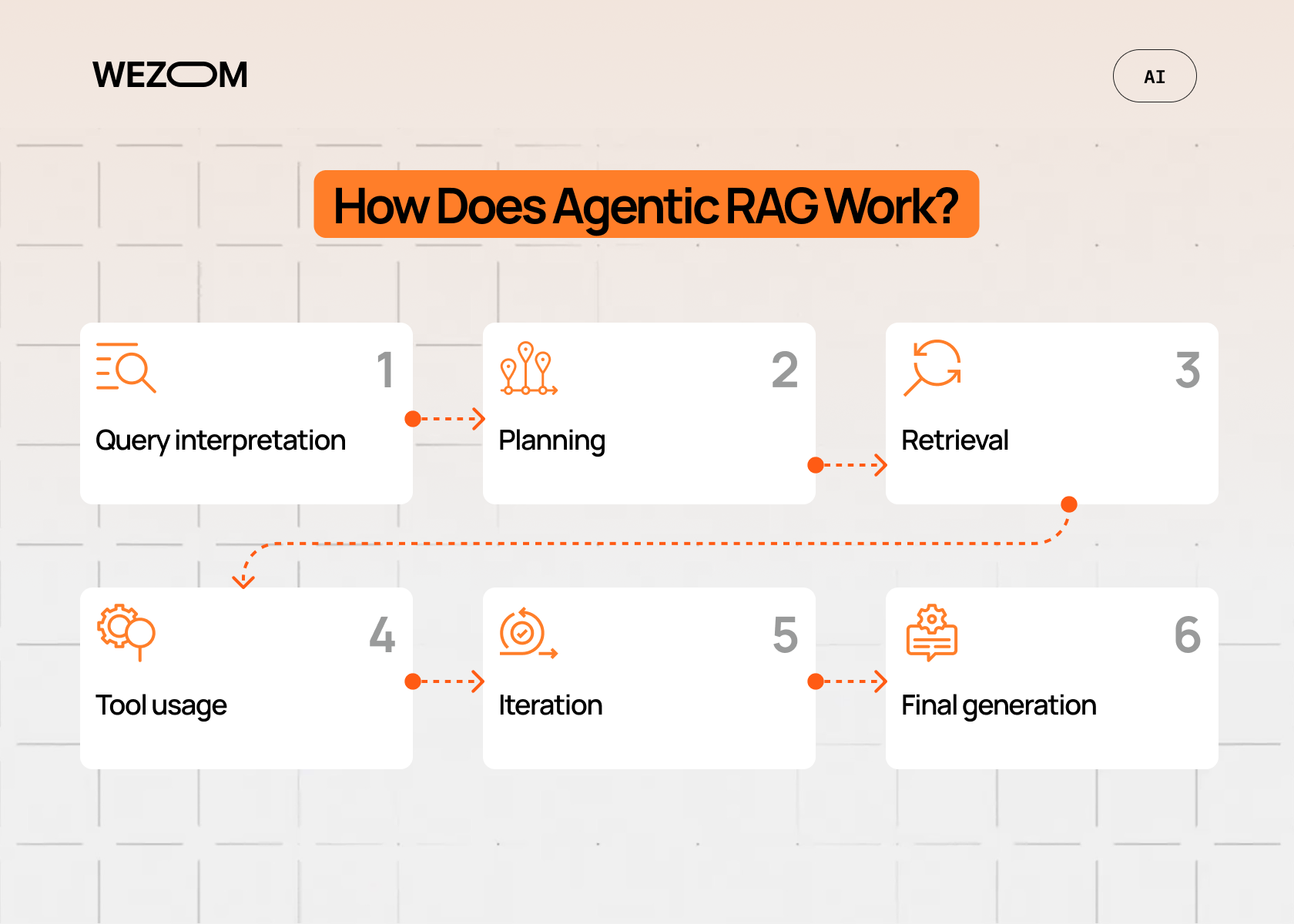
A classic RAG processes a user query once, while an agent-based RAG launches an iterative process, as if it were a researcher consulting independent data. Here's how it works:
- Query interpretation. Using a search string, the agent analyzes the intent, extracting entities, and, if the query is imprecise, can launch a query expansion process;
- Planning. At this stage, the agent breaks down the goal into subtasks, building a roadmap – what to search for first and which tool to use second;
- Retrieval. Now, the agent accesses sources, assessing the relevance of the data found;
- Tool usage. If the vector database is insufficient, the agent uses tools, such as SQL databases, Google Search, or Python scripts, to perform a deeper analysis of what has already been found;
- Iteration. If the data is insufficient/contradictory, the agent returns to the planning stage, repeating the cycle until it finds an answer with the required accuracy;
- Final generation. Once all the facts are confirmed and match the context of the request, the agent generates a response, adding links to the sources.
Agentic RAG Architecture
The Agentic RAG architecture is multi-layered, with each layer responsible for its own part of the decision-making process.
Core Components
Large language models with high reasoning capabilities, such as GPT-4o/Claude 3.5 Sonnet/Llama 3, serve as the brains of RAG agents; they are also responsible for planning and tool selection. As for the orchestration layer, it’s typically based on LangChain/LangGraph/CrewAI, taking responsibility for managing the agent's state and memory. Next the retriever comes – a module that organizes connections to databases (often equipped with a reranking function to filter out noise). Another layer is a vector database, which represents the system's long-term memory. Finally, the next layer comprises external tools and APIs, such as calculators, enterprise systems, converters, and so on.
RAG Agent Architecture Explained
At the heart of the RAG agent architecture is an orchestration layer: when a request comes into the system, it creates a reasoning loop. So, how does agentic RAG work?
- The user asks a complex question;
- The agent decides which tool to use;
- The agent calls the retriever or API;
- After receiving the result, the agent analyzes it for usefulness and accuracy;
- If the answer is “no”, the agent updates the plan and takes the next step.
This eliminates the main problem of AI – the superficiality of answers – because the system can independently connect disparate facts, even if they are located in different databases.
Benefits of Agentic RAG
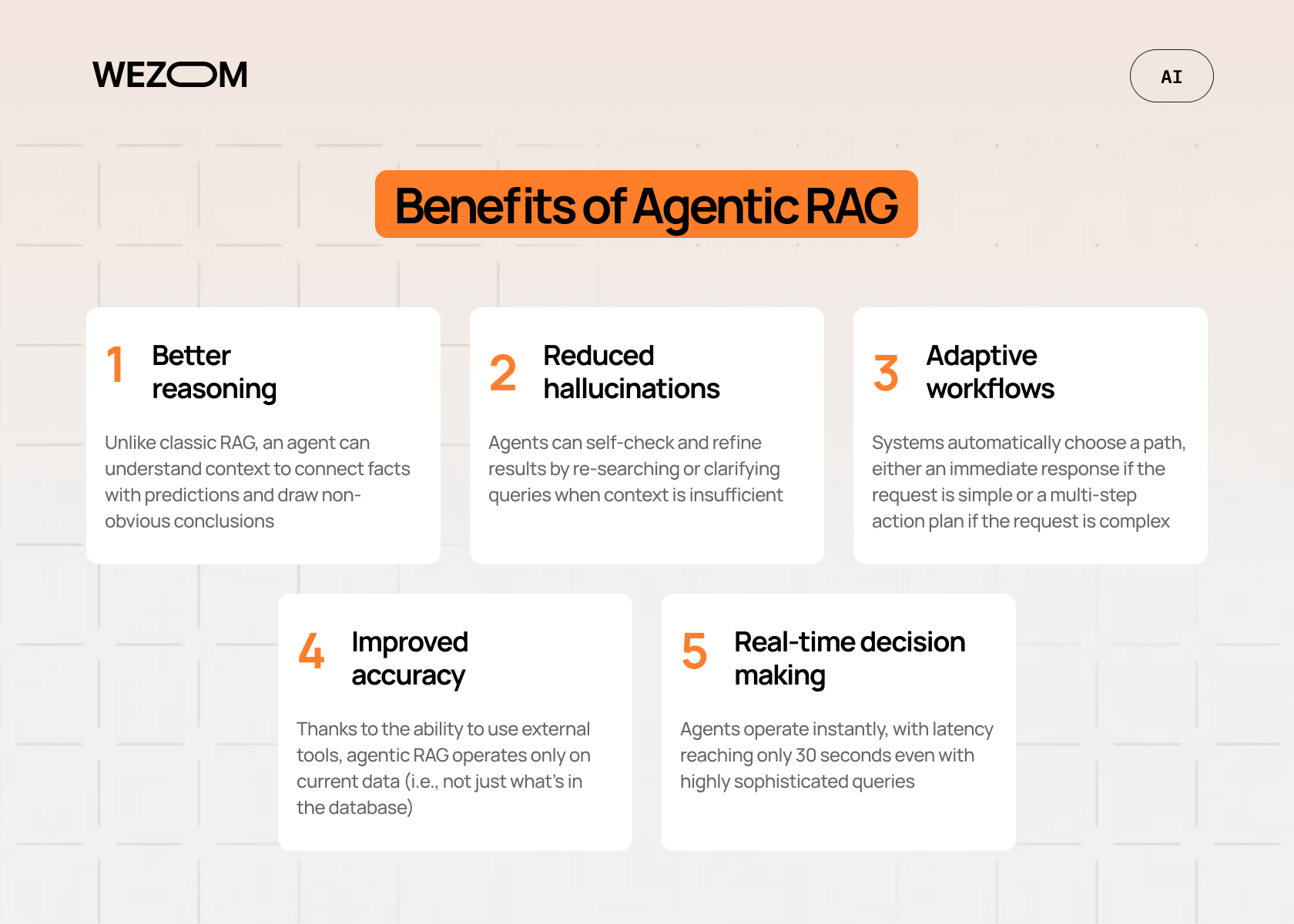
The transition to agent-based systems optimizes data processing. Actually, here are the benefits of agentic RAG:
- Better reasoning. Unlike classic RAG, an agent can understand context to connect facts with predictions and draw non-obvious conclusions;
- Reduced hallucinations. Agents can self-check, so if they discover that the identified context doesn't provide a comprehensive answer to a question, they initiate a second search or clarify the user's request;
- Adaptive workflows. Systems automatically choose a path, either an immediate response if the request is simple or a multi-step action plan if the request is complex;
- Improved accuracy. Thanks to the ability to use external tools, agentic RAG operates only on current data (i.e., not just what's in the database);
- Real-time decision making. Agents operate instantly, with latency reaching only 30 seconds even with highly sophisticated queries.
Challenges and Limitations
The agentic RAG implementation always comes with a number of challenges, such as:
- Complexity. Developing and maintaining an orchestrator requires high developer skill levels, as they must implement both agent state and memory management;
- Cost. An agent-based RAG makes multiple calls to the model to generate just one response, which increases token consumption. Therefore, developers should consider hybrid schemes using both cheaper and more powerful (and correspondingly more expensive) models;
- Latency. Multi-step reasoning is time-consuming, taking an average of 10-30 seconds, which requires a special approach to developing UX;
- Debugging. It can be difficult to trace the logic failure, so developers must additionally use tracing tools like LangSmith/Arize Phoenix.
Agentic RAG Use Cases
Now, you know the answer to the question: “What is an agentic RAG?”, so, let’s consider the top agentic RAG use cases below.
Enterprise Knowledge Assistants
Since data in large companies is scattered across various systems and applications, instead of providing a set of links to the required information, an agent analyzes the request, crawls the log database to find relevant data, and generates a concise report. This means managers no longer have to waste time searching and comparing data.
Customer Support Automation
Standard bots are often limited and lack expertise, while a RAG agent, instead of leaving a link to an FAQ as feedback, utilizes tools and either makes decisions independently or creates a support ticket associated with a specific user query.
Healthcare Decision Support
Considering that the likelihood of error increases directly with the volume of medical research, an agent can independently study a patient's medical history and simultaneously search relevant databases like PubMed and Cochrane. This way, the doctor will obtain a conclusion like, “The patient's symptoms indicate rare pathology X in 15% of cases, according to study Y, which isn’t included in the standard protocol”.
Financial Analysis Tools
Market analysis requires comparing hundreds of variables in real time, and this is what an agent excels at. It can parse news, check stock quotes, analyze competitors' annual reports, and more – basically, everything needed to build complex logical chains for accepting data like, “If inflation in region A rises, logistics will become more expensive, and company B's margins will fall”.
Developer Assistants
Instead of simply autocompleting code, the agent analyzes the project's entire codebase, checking that new code blocks comply with the existing project architecture and searching for vulnerabilities in library documentation. The agent can also independently propose unit tests and run them in an isolated environment.
Multi-Step Research Agents
Manual marketing research or scientific searches take weeks, sometimes even months. Instead of this time-consuming work, you can simply assign tasks to an agent, and it will break this large task down into subtasks, iterating the search, filtering out irrelevant sources, and finally generating a multi-page report with links.
Autonomous Copilots
Agentic RAG is capable of acting proactively within its assigned authority. In the context of logistics, it can monitor traffic jams/weather/transport breakdowns in real time, and if a failure occurs, it can find alternative solutions, leaving the human operator with only clicking the “Approve” button.
AI Workflows with Tools
The agent isn't limited to text – it can also call up a calculator to check calculations in a document, run a script to visualize data, send a request to a CRM, and more. And all without manual intervention.
Agentic RAG Implementation Strategies
The transition to RAG agents requires a revision of the entire technology stack, workflow, and data.
Choosing the Right Tech Stack
The choice of tools determines the system's scalability in the context of the required iteration speed and sophisticated logic. In particular, it's important to understand that not all large language models can be used -- GPT-4o and Claude 3.5 Sonnet are typically at the top (thanks to their long-term context retention and precise function calling). You can also consider Llama 3 (70B) for simpler tasks.
As for the vector database, search speed and metadata support are a priority here – that's why we recommend considering Pinecone, Weaviate, and Milvus first.
Finally, in terms of orchestration, LangGraph, which allows you to build cyclic graphs, is considered a standard solution today. Also, you can consider using CrewAI, which is ideal for multi-agent systems where one agent searches and another criticizes.
Designing Agent Workflows
The decision-making architecture can be presented in the plan-and-execute format, where the agent first builds a complete list of steps to solve the problem and only then begins execution (this is necessary to reduce the number of API calls, but also makes the system less flexible when changing inputs).
The second format is ReAct, where the agent decides on the next step only after analyzing the result of the previous one, which is optimal for searching in uncertain data. Such systems can adapt to newly discovered information on the fly.
Data Preparation & Indexing
To ensure that an agent operates on high-quality data, in addition to data cleaning and indexing, the following approaches are commonly used:
- Chunking, where the agent uses logically complete blocks of information instead of simple chunks of text containing several hundred tokens to avoid contextual confusion;
- Embedding, using models such as Cohere Rerank after the initial search, so that the agent deals with, say, the top three ideally matching documents instead of the top 20 roughly similar ones.
Evaluation & Optimization
To ensure the agent is working properly, we focus on the following metrics:
- Accuracy, which indicates whether the response matches the facts in the database;
- Latency, which often involves implementing the ability to run multiple search queries in parallel;
- Hallucination control, which includes the implementation of a so-called “critic” (here, we mean another model call that checks the final response for statements not supported by sources);
- Cost efficiency, which monitors token consumption at each stage of the cycle.
Future of Agentic RAG
We are currently in the midst of widespread adoption of autonomous intelligent systems, so the RAG agent can hardly be considered the final stage of AI development.
In particular, in the near future, we’ll see the complete autonomy of business processes, where agents will independently initiate actions such as updating documentation when new laws are issued, restructuring supply chains due to rising fuel prices, and so on.
Also, instead of a single universal agent, companies will deploy specialized agents across departments, depending on whether they need to collect data, search for patterns, generate reports, or something else. This will achieve record-low hallucination rates that we could only dream of previously.
Finally, the line between the knowledge base and the real world will be completely erased, as agent latency will be reduced to seconds, regardless of how many databases/tools/iterations are used.
FAQ
What is agentic RAG in simple terms?
Based on the generally accepted agentic RAG definition, in simple terms, it is an experienced researcher who will find the required book in the library, read it in its entirety, check the data in other sources, perform calculations if necessary, and produce a ready-made solution to the prompt.
Why is agentic RAG important for modern AI systems?
Because businesses require high precision and logic, an agent-based approach enables AI to reason, identify data gaps, and apply external tools when necessary, thereby maximizing the accuracy and usefulness of responses.
What industries use agentic RAG?
This technology is being actively implemented in the fintech, healthcare, legaltech, logistics, and software development sectors.
What are the top agentic RAG use cases?
The most widespread agentic RAG use cases include customer support, comprehensive marketing research, financial audit, assistance to developers, and corporate knowledge management systems.
Why is agentic RAG important for modern AI systems?
Instead of simply searching, businesses are increasingly faced with complex challenges, which the RAG agent is good at thanks to its ability to critically evaluate the information, correct its own errors, use external tools, and, overall, ensure the end-to-end automation of these processes.
