
Practical Applications of AI Agents in Business Operations
AI agents for business operations are increasingly becoming a practical automation layer, connecting systems, data, and workflows. Unlike traditional scripts, AI agents handle semi-structured processes where simple rules are insufficient, making them valuable for improving efficiency without completely redesigning operations.
One key area where AI agents deliver value is workflow orchestration. Businesses often rely on disconnected tools – CRM, email, and dashboards, which create delays and dependencies. AI agents act as a coordination layer, ensuring processes move seamlessly across systems. For example, when a lead is generated, an agent can enrich data, assign ownership, and trigger follow-ups automatically, improving productivity and reducing friction.
Customer-facing operations are another strong use case. AI-powered chatbots and digital assistants handle simple queries and transactional requests. When integrated with backend systems, they can retrieve order data, update records, or escalate issues, improving customer experience and service consistency.
Common practical applications include:
- workflow management across CRM, ERP, and communication tools;
- customer support automation using chatbots and virtual assistants;
- scheduling and coordination of meetings and resources;
- internal process automation for approvals and reporting.
AI agents for small business automation are especially useful for reducing manual workload and enabling growth. At the enterprise level, custom AI agents support complex workflows across departments.
However, not all processes suit automation. AI agents perform best in structured or semi-structured environments with accessible data. In creative or strategic tasks, they act as support tools rather than autonomous decision-makers, so careful use case selection is essential.
AI Agents in Business Process Automation
AI agents for business process automation are particularly effective in high-volume, repetitive tasks where efficiency and accuracy are crucial. These systems help organizations reduce operational overhead while maintaining consistency across processes.
A major application is data handling. AI agents can extract, validate, and input data from sources like documents, emails, and forms. Adaptive AI agents for business can manage variations in data formats, reducing errors and speeding up processing.
Reporting is another key area where AI and predictive analytics improve operations. AI agents aggregate data, generate reports, and identify trends in real time, helping businesses make faster decisions and reducing the burden on analytics teams.
Customer support automation extends beyond chatbots when integrated into business platforms. AI agents can route tickets, prioritize requests, and resolve common issues autonomously, improving response times and service consistency. Similarly, HR operations, like onboarding and document processing, benefit from automation.
High-impact processes typically include:
- data entry and document processing;
- reporting and analytics automation;
- customer support and ticket management;
- HR operations, such as onboarding.
Integration with ERP, CRM, and other systems is critical for maximizing AI agent value. Without it, their impact remains limited. Key performance indicators for AI agents include time saved, cost reduction, and error reduction, though broader metrics like productivity and scalability should also be considered.
Risks must be managed carefully, as poorly configured agents can propagate errors at scale. Ongoing monitoring and governance are necessary for stable and reliable performance.
Industries Where AI Agents Deliver the Most Value
The effectiveness of AI agents for business processes varies across industries depending on data availability, process standardization, and regulatory requirements. Some sectors demonstrate particularly strong alignment with AI-driven automation.
In e-commerce and retail, AI agents are widely used for customer support, order processing, and personalization. These environments generate large volumes of structured data, making them ideal for automation. AI agents can handle order inquiries, process returns, and recommend products based on behavior, improving both efficiency and conversion rates.
Healthcare organizations use AI agents primarily for patient communication, scheduling, and documentation. Virtual assistant systems can manage appointment booking and follow-ups, reducing administrative workload. However, strict compliance requirements necessitate the use of secure AI agents for businesses to ensure data protection.
In finance and banking, AI agents support fraud detection, reporting, and customer interactions. Predictive analytics allows these systems to identify anomalies and flag risks in real time. They also improve response times for customer queries, reducing operational costs while maintaining service quality.
Logistics and supply chain operations benefit from route optimization, inventory tracking, and demand forecasting. AI agents analyze real-time data to improve efficiency and reduce delays. This is particularly valuable in environments with complex variables and dynamic conditions.
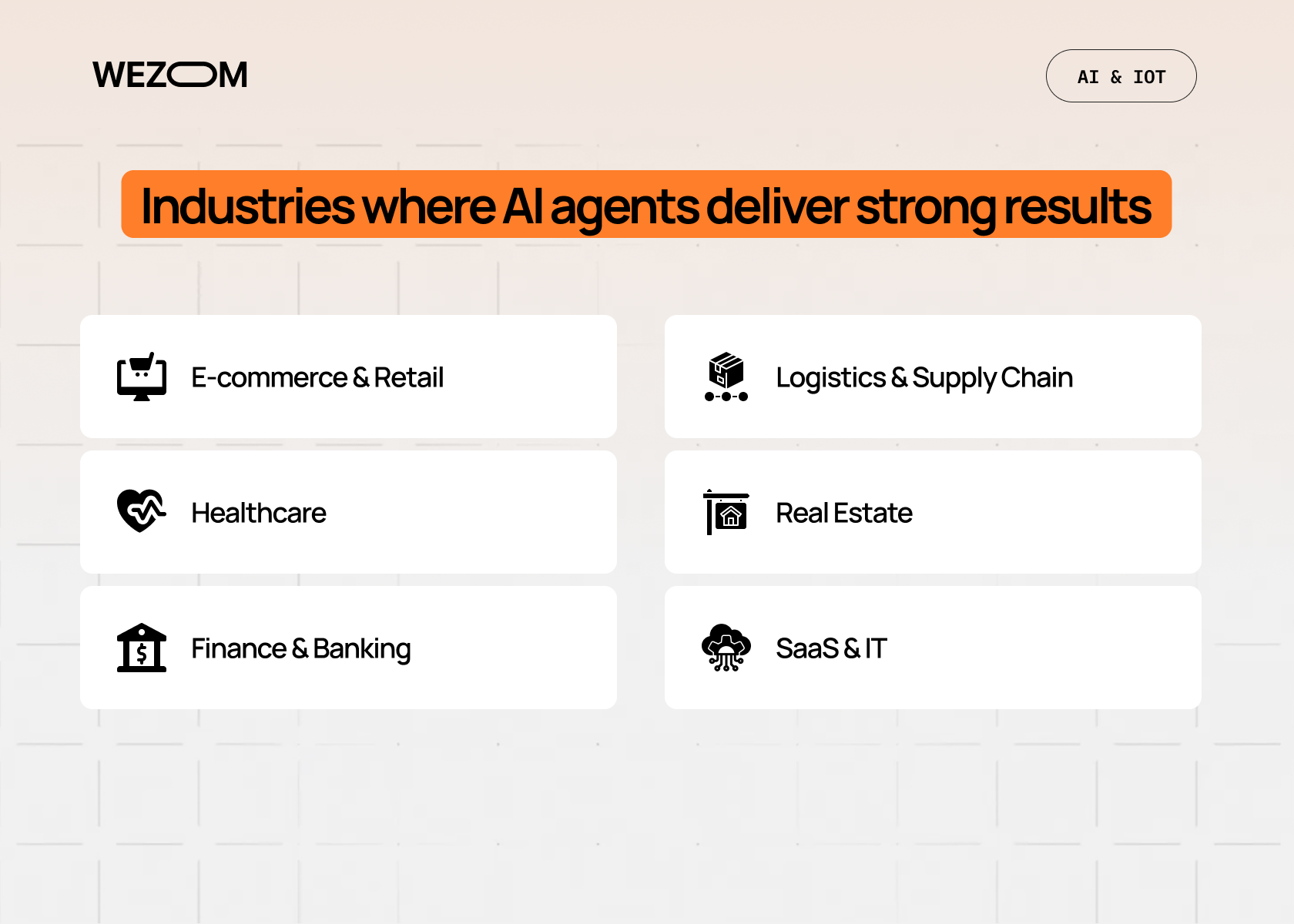
Industries where AI agents deliver strong results include:
- E-commerce & Retail: support automation, order management, and personalization;
- Healthcare: scheduling, patient communication, documentation;
- Finance & Banking: fraud detection, reporting, customer queries;
- Logistics & Supply Chain: route optimization, inventory tracking;
- Real Estate: lead qualification, communication, document handling;
- SaaS & IT: onboarding, support automation, internal workflows.
Despite these advantages, industry-specific challenges must be considered. Legacy systems, fragmented data, and regulatory constraints can limit effectiveness. Successful implementation requires a tailored approach that aligns AI capabilities with operational realities.
Custom and Adaptive AI Agents
The true value of AI agents for business lies in their customization and adaptability. While off-the-shelf solutions address basic needs, they often lack the flexibility required for complex workflows. Custom AI agents are designed to align with specific operational needs and integrate into existing systems.
For example, companies can develop agents for marketing automation to manage campaigns, segment audiences, and optimize performance using real-time data. Similarly, sales forecasting agents analyze historical trends to provide accurate predictions, supporting strategic planning.
Adaptive AI agents extend this by continuously learning from new data, refining performance over time. For instance, an inventory management agent can adjust predictions based on seasonal trends or market shifts to ensure optimal stock levels.
Typical use cases for custom and adaptive AI agents include:
- marketing automation and campaign optimization;
- sales forecasting and pipeline analysis;
- inventory management and demand prediction;
- internal workflow automation.
However, these systems require high-quality data to function effectively. Poor data quality leads to inaccurate predictions, so businesses must invest in data governance and validation. Scalability is another important factor; as businesses grow, AI agents must handle increased workloads and integrate with new systems. Custom solutions should be designed with scalability in mind.
While benefits are significant, development and integration costs must be carefully considered. A phased approach, starting with pilot projects, helps organizations validate ROI before full-scale implementation.
AI Voice Agents for Business Communication
AI voice agents for business extend automation into real-time communication, enabling organizations to manage interactions through natural language. Unlike traditional IVR systems, these agents use machine learning and speech recognition for dynamic, context-aware responses.
In customer service, AI voice agents manage inbound calls related to orders, support, or account information. By integrating with internal systems, they can retrieve data and resolve issues autonomously, reducing response time and improving efficiency, especially during peak periods.
Outbound communication is another key use case. Businesses can automate reminders, notifications, and follow-ups, ensuring consistent engagement. For example, healthcare providers can confirm appointments, while financial institutions can notify clients about transactions.
Internal communication also benefits from voice automation. AI agents act as digital assistants, helping employees access information, manage schedules, and update workflows, improving productivity and reducing communication overhead.
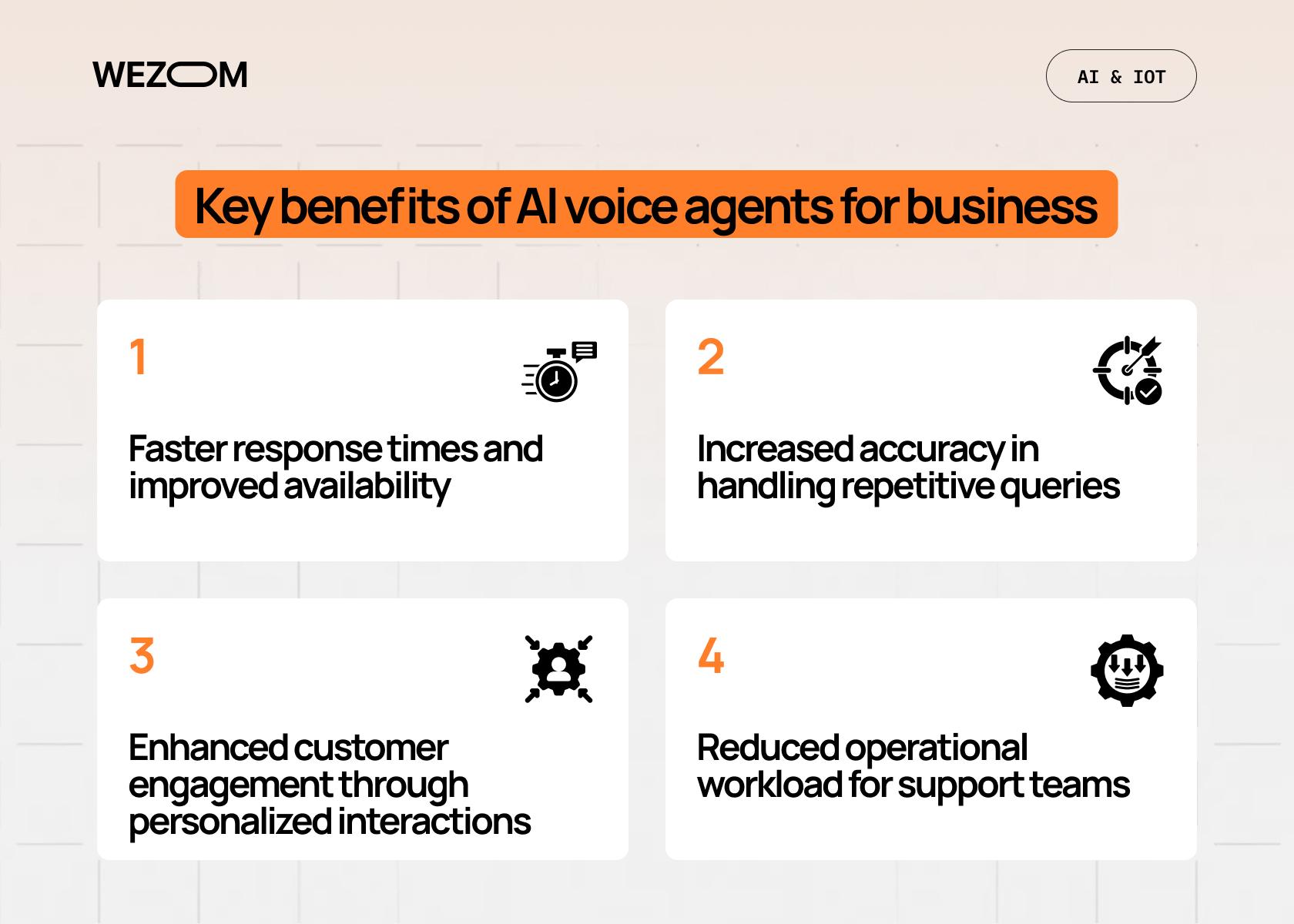
Key benefits of AI voice agents for business include:
- faster response times and improved availability;
- increased accuracy in handling repetitive queries;
- enhanced customer engagement through personalized interactions;
- reduced operational workload for support teams.
However, limitations must be addressed. Misinterpretation of user intent can affect customer experience, especially in complex interactions. Additionally, secure AI agents for business must comply with data protection regulations when processing voice data.
AI voice agents are most effective when combined with human support, handling routine interactions and allowing teams to focus on more complex tasks.
AI Agents for Business Development and Growth
AI agents are increasingly used in business development to automate lead generation, improve targeting, and support strategic decision-making. By leveraging predictive analytics and machine learning, these systems enable organizations to scale growth initiatives more effectively.
Lead generation automation is one of the most impactful applications. AI agents can analyze multiple data sources, identify potential prospects, and qualify leads based on predefined criteria. This reduces manual effort and increases the efficiency of sales pipelines.
CRM enrichment and scoring further enhance sales operations. AI agents update customer profiles with relevant data and assign scores based on engagement and behavior. This helps teams prioritize high-value opportunities and improve conversion rates.
Predictive analytics supports decision-making by identifying trends and forecasting outcomes. Businesses can use these insights to optimize pricing, allocate resources, and plan strategies more effectively. In this context, AI agents act as decision-support systems rather than replacements for human judgment.
Despite these advantages, risks must be considered. Inaccurate data can lead to flawed insights, and over-reliance on automation may reduce human oversight. Organizations should combine AI capabilities with strategic input to achieve balanced outcomes.
Benefits and ROI of Implementing AI Agents
The benefits of AI agents for business include cost reduction, efficiency improvements, and scalability. However, evaluating ROI requires a comprehensive view that considers both financial and operational impacts.
Cost savings are achieved by reducing manual labor and minimizing errors. For example, automating support or data processing tasks can significantly lower operational expenses. Efficiency gains further enhance ROI by accelerating workflows and improving productivity.
Scalability is a major advantage, allowing businesses to handle increased workloads without proportional resource growth. Adaptive AI agents for business enhance this capability by adjusting to changing conditions and requirements.
Key benefits include:
- reduced operational costs;
- improved efficiency and productivity;
- faster response times and better customer experience;
- enhanced scalability and flexibility.
Secure AI agents for business ensure that these benefits are achieved without compromising data protection. Implementing security measures such as encryption and access control is essential to mitigate risks.
However, ROI is not always immediate. Implementation costs, data preparation, and change management must be considered. Businesses should adopt a long-term perspective and focus on continuous optimization.
Challenges of Implementing AI Agents
Implementing AI agents for business processes involves several challenges that can impact success. Data quality is one of the most critical factors, as AI systems rely on accurate and structured data. Fragmented or incomplete data can limit performance and lead to unreliable outcomes.
Integration with existing systems is another major challenge. Many organizations operate on legacy platforms that are difficult to connect with modern AI solutions. Without proper integration, AI agents cannot deliver full value.
Security and data privacy risks must also be addressed. Secure AI agents for business require compliance with regulatory standards and robust protection mechanisms. Failure to do so can result in legal and reputational issues.
Additional challenges include:
- model accuracy and reliability;
- change management and employee adoption;
- ongoing monitoring and maintenance.
Organizations must approach implementation strategically, addressing these challenges through planning, governance, and continuous improvement.
How to Successfully Implement AI Agents in Business Workflows
Successful implementation of AI agents for business automation requires a structured approach that aligns technology with business goals. Organizations must focus on practical use cases and scalable solutions rather than experimental deployments.
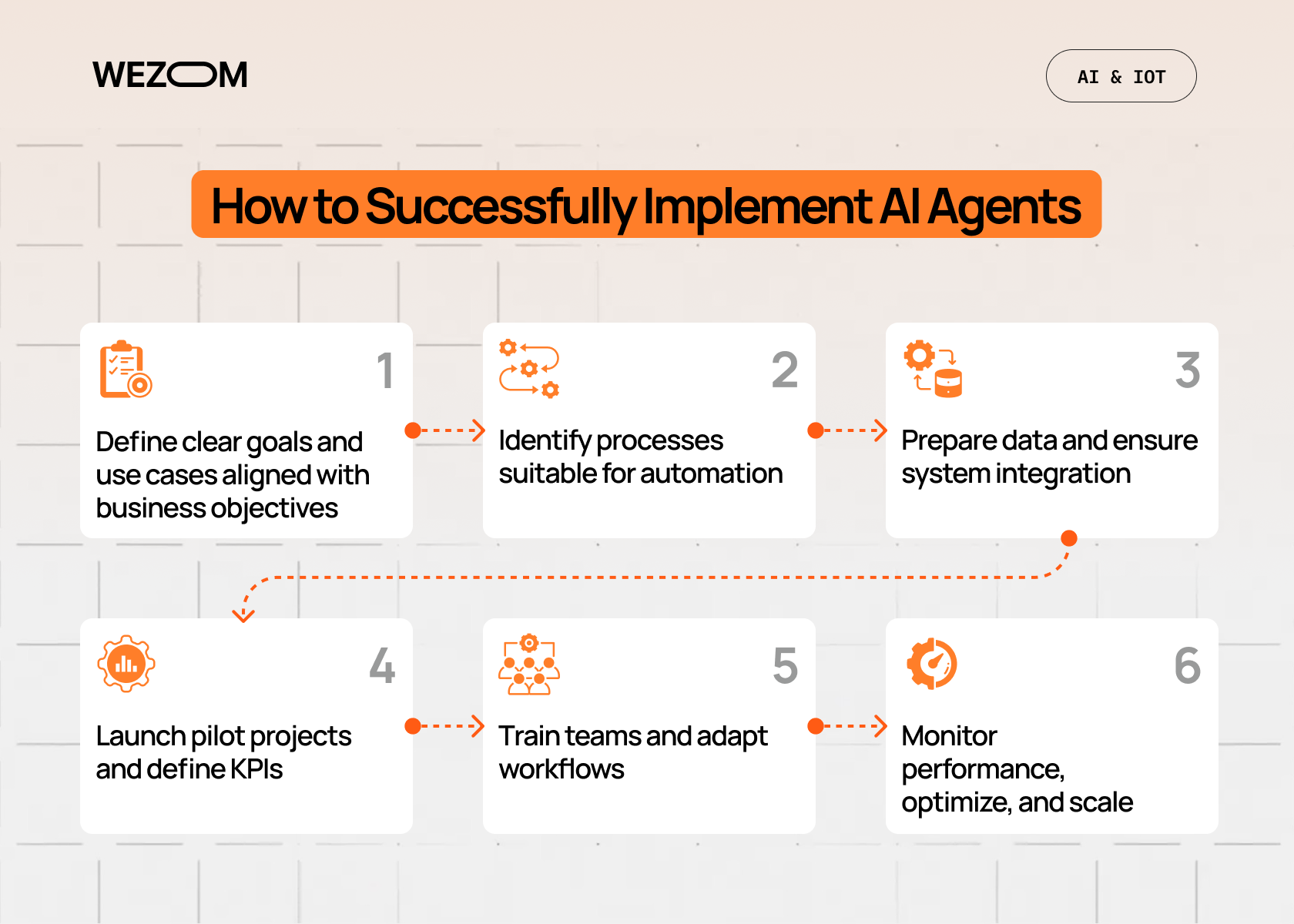
The process typically involves several key steps:
- define clear goals and use cases aligned with business objectives;
- identify processes suitable for automation;
- prepare data and ensure system integration;
- launch pilot projects and define KPIs;
- train teams and adapt workflows;
- monitor performance, optimize, and scale.
Each step requires careful planning and execution. For example, selecting the right use cases ensures that AI agents deliver measurable value, while pilot projects help validate assumptions before scaling.
Data preparation and integration are often the most resource-intensive stages. Ensuring data quality and connectivity is essential for successful implementation. Training employees and managing change are equally important to ensure adoption.
Continuous monitoring and optimization allow businesses to refine AI systems and adapt to changing conditions. Over time, this enables organizations to scale AI initiatives and achieve sustainable results.
FAQ
How can AI agents benefit business operations?
AI agents improve business operations by automating repetitive tasks, optimizing workflows, and enhancing decision-making. For example, they can manage customer support, process data, and coordinate internal workflows. This reduces manual effort and improves efficiency, allowing teams to focus on higher-value activities.
What are the most common use cases of AI agents for business automation?
Common use cases include customer support automation, data entry, reporting, and workflow management. AI agents are also used for lead generation, CRM enrichment, and predictive analytics. These applications are most effective in structured environments with accessible data.
How do AI agents help reduce operational costs in businesses?
AI agents reduce costs by minimizing manual labor, improving accuracy, and increasing efficiency. For example, automating support or data processing tasks reduces staffing requirements and error rates. However, businesses must consider implementation and maintenance costs when evaluating savings.
How secure are AI agents in terms of business data protection?
Secure AI agents for business can provide strong data protection when implemented correctly. This includes encryption, access controls, and compliance with regulations. However, ongoing monitoring and proper configuration are essential to prevent security risks.
What are the advantages of using AI agents for business process automation?
The main advantages include improved efficiency, scalability, and accuracy. AI agents can handle large volumes of tasks consistently, enabling businesses to scale operations without increasing resources. They also support better decision-making through predictive analytics and automation.
