
Route optimization has become a critical operational capability for companies managing logistics, delivery, and field service operations. As businesses scale, manual route planning or basic navigation tools no longer provide the level of efficiency required to remain competitive. This is where solutions such as best route optimization software and best route planning software come into play, enabling organizations to streamline operations, reduce costs, and improve overall service performance.
At its core, route optimization software uses advanced algorithms to calculate the most efficient routes based on multiple variables. These include distance, traffic conditions, delivery time windows, vehicle capacity, and driver availability. Unlike standard navigation tools, the best routing software focuses not only on getting from point A to point B, but on optimizing entire multi-stop journeys across fleets of vehicles. This is particularly relevant for businesses managing last-mile delivery, regional distribution, or mobile service teams.
The business value is directly tied to measurable outcomes. Companies using the best route management software often report significant reductions in fuel consumption, improved driver productivity, and fewer missed delivery windows. For example, a logistics company handling 200 daily deliveries can reduce route distances by 15–25%, which translates into substantial cost savings over time. Similarly, field service teams benefit from optimized scheduling, allowing more appointments per day without increasing workforce size.
Common use cases span multiple industries:
- logistics and freight companies managing complex distribution networks;
- delivery services optimizing last-mile operations;
- field service businesses coordinating technicians across regions.
In all these scenarios, the best truck routing software and best delivery route planning software play a central role in aligning operational efficiency with customer expectations. As customer demand for faster and more predictable service grows, adopting a best route optimization system is no longer optional–it becomes a strategic necessity.
Best Route Optimization Software
Choosing the best route optimization software depends on the scale of operations, industry requirements, and integration needs. Below is an overview of leading solutions that represent the current landscape of best route mapping, route planning, and optimization software.
Routific
Routific is designed primarily for last-mile delivery businesses that need to optimize routes quickly without investing in complex enterprise infrastructure. The platform focuses on balancing ease of use with meaningful operational impact, making it a strong candidate among the best route optimization software for businesses operating with small to mid-sized fleets.
In practice, Routific enables dispatchers to upload delivery data, automatically generate optimized routes, and distribute them to drivers via a mobile interface. Its algorithm considers delivery time windows, traffic patterns, and driver availability, allowing companies to reduce delays and improve route predictability. This is particularly valuable for businesses managing daily recurring deliveries, such as food distribution or retail logistics.
Key features:
- Multi-stop route optimization
Automatically calculates the most efficient order of stops, reducing distance and balancing driver workload. - Delivery time window management
Builds routes that respect delivery time constraints, helping avoid delays and missed deliveries. - Real-time route updates
Allows dispatchers to adjust routes instantly and send updates to drivers during execution. - Driver mobile application
Provides drivers with navigation, delivery details, and real-time updates via a simple mobile interface.
Pros:
- fast onboarding and intuitive interface;
- Reliable performance for last-mile delivery.
Cons:
- limited customization for complex logistics scenarios;
- fewer integrations compared to enterprise tools.
Best for: Small and mid-sized delivery operations
Pricing: Starts around $49/month
OptimoRoute
OptimoRoute stands out among the best route planning software due to its strong focus on both routing and scheduling. Unlike tools that focus purely on route calculation, OptimoRoute integrates workforce planning into the optimization process, which is critical for companies balancing multiple operational constraints.
The platform allows businesses to plan routes days or weeks in advance while dynamically adjusting schedules based on real-time conditions. For example, a field service company can assign jobs based on technician availability, skills, and location, ensuring efficient utilization of resources. The system also provides proof of delivery and performance tracking, giving managers visibility into execution quality.
Key features:
- Route and schedule optimization
Combines route planning with job scheduling to optimize both travel and workforce allocation. - Driver workload balancing
Distributes tasks evenly across drivers based on availability, capacity, and location. - Real-time tracking
Provides live visibility into driver locations and route progress for better control. - Proof of delivery
Captures confirmations such as signatures or photos to verify completed deliveries.
Pros:
- high optimization accuracy;
- strong analytics and reporting.
Cons:
- requires initial setup and training;
- pricing scales with team size.
Best for: Medium to large logistics and service companies
Pricing: Starts around $35/driver/month
Circuit for Teams
Circuit for Teams is positioned as an accessible entry point into the best routing software, particularly for businesses that need a straightforward solution without complex configuration. Its primary advantage lies in simplicity, allowing teams to generate optimized routes with minimal setup.
Operationally, Circuit is well-suited for businesses transitioning from manual planning or spreadsheet-based processes. Dispatchers can quickly create routes, share them with drivers, and track execution. While it lacks some advanced features, it covers essential needs such as stop sequencing and navigation support.
Key features:
- Multi-stop route planning
Automatically organizes stops into an efficient sequence, reducing travel time and manual planning effort. - Driver mobile app
Provides drivers with routes, navigation, and task details in a simple, easy-to-use interface. - Delivery tracking
Allows teams to monitor delivery progress and status updates in real time.
Pros:
- very easy to use;
- fast implementation.
Cons:
- limited advanced optimization capabilities;
- basic analytics.
Best for: Small businesses and startups
Pricing: Freemium with paid upgrades
Route4Me
Route4Me is one of the most established platforms in the best route management software category, offering a robust set of features for enterprises with complex routing requirements. It is particularly valuable for organizations that require deep customization and integration capabilities.
The platform supports advanced route optimization scenarios, including territory planning, dynamic routing, and large-scale fleet coordination. Its API-first approach allows businesses to integrate route optimization directly into existing systems such as ERP or CRM platforms, enabling end-to-end automation.
Key features:
- Advanced route optimization algorithms
Uses sophisticated algorithms to handle complex constraints like capacity, time windows, and large volumes of stops. - API integrations
Enables seamless connection with CRM, ERP, and other systems for automated data exchange and workflows. - GPS tracking
Provides real-time visibility into vehicle locations and route execution. - Territory planning
Allows businesses to define and optimize delivery zones to balance workload and improve efficiency.
Pros:
- highly scalable;
- extensive integration options.
Cons:
- complex onboarding;
- Higher total cost of ownership.
Best for: Enterprises and large fleets
Pricing: Custom pricing
Onfleet
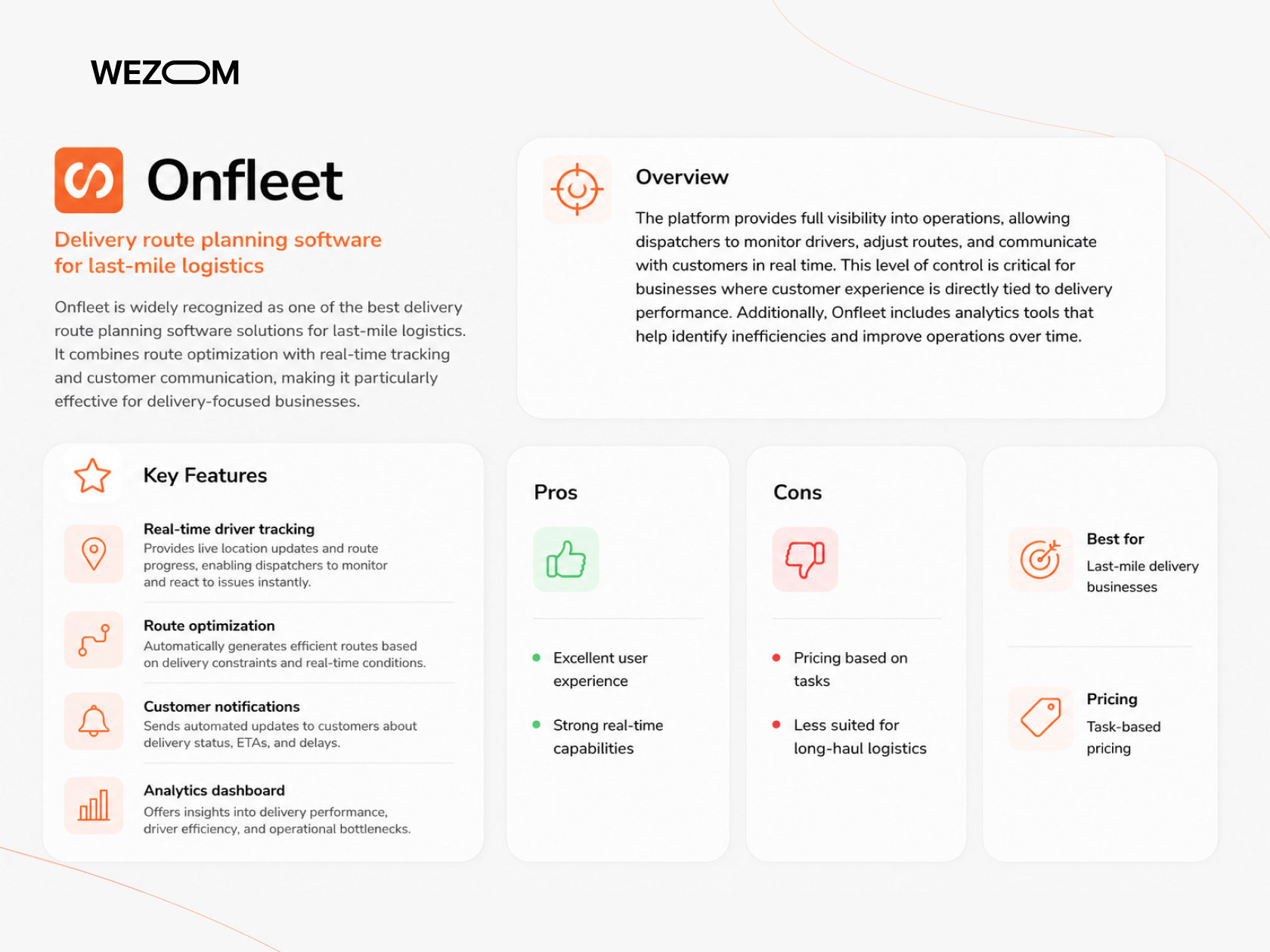
Onfleet is widely recognized as one of the best delivery route planning software solutions for last-mile logistics. It combines route optimization with real-time tracking and customer communication, making it particularly effective for delivery-focused businesses.
The platform provides full visibility into operations, allowing dispatchers to monitor drivers, adjust routes, and communicate with customers in real time. This level of control is critical for businesses where customer experience is directly tied to delivery performance. Additionally, Onfleet includes analytics tools that help identify inefficiencies and improve operations over time.
Key features:
- Real-time driver tracking
Provides live location updates and route progress, enabling dispatchers to monitor and react to issues instantly. - Route optimization
Automatically generates efficient routes based on delivery constraints and real-time conditions. - Customer notifications
Sends automated updates to customers about delivery status, ETAs, and delays. - Analytics dashboard
Offers insights into delivery performance, driver efficiency, and operational bottlenecks.
Pros:
- excellent user experience;
- strong real-time capabilities.
Cons:
- pricing based on tasks;
- less suited for long-haul logistics.
Best for: Last-mile delivery businesses
Pricing: Task-based pricing
Verizon Connect
Verizon Connect goes beyond traditional route optimization by integrating telematics and fleet management into a single platform. This makes it a comprehensive solution for companies looking for more than just routing capabilities.
In real-world operations, Verizon Connect provides deep insights into vehicle performance, driver behavior, and route efficiency. This allows companies to not only optimize routes but also improve safety and reduce operational risks. However, implementation often involves hardware integration, which can increase complexity.
Key features:
- GPS tracking
Delivers real-time visibility into vehicle locations, routes, and movement history. - Fleet management
Centralizes control over vehicles, drivers, and operations within a single system. - Route optimization
Generates efficient routes based on traffic, distance, and operational constraints. - Driver behavior monitoring
Tracks driving patterns such as speeding or harsh braking to improve safety and reduce risk.
Pros:
- comprehensive data insights;
- strong enterprise capabilities.
Cons:
- requires hardware setup;
- higher cost.
Best for: Fleet-intensive businesses
Pricing: Custom pricing
Samsara
Samsara is a cloud-based platform that combines IoT, fleet management, and route optimization. It is particularly relevant for companies operating large fleets where visibility and control are critical.
The system collects real-time data from vehicles and uses it to optimize routes, monitor performance, and ensure compliance. For example, trucking companies can use Samsara to track fuel usage, monitor driver behavior, and adjust routes based on traffic conditions. This makes it one of the best truck routing software solutions available.
Key features:
- Real-time fleet tracking
Provides live visibility into vehicle locations, routes, and operational status across the entire fleet. - Route optimization
Uses real-time data and traffic conditions to generate and adjust efficient routes. - Safety monitoring
Tracks driver behavior and safety metrics to reduce risks and improve compliance. - Advanced analytics
Delivers detailed insights into fleet performance, fuel usage, and operational efficiency.
Pros:
- end-to-end visibility;
- scalable infrastructure.
Cons:
- hardware dependency;
- premium pricing.
Best for: Large logistics and trucking companies
Pricing: Custom pricing
Upper Route Planner
Upper Route Planner is a modern SaaS solution aimed at businesses looking for affordable and efficient route planning tools. It strikes a balance between functionality and simplicity, making it attractive for growing companies.
The platform allows users to upload delivery data, generate optimized routes, and track execution through a mobile interface. While it may not offer the depth of enterprise solutions, it provides enough functionality to significantly improve operational efficiency.
Key features:
- Multi-stop optimization
Automatically sequences multiple delivery points to minimize distance and improve route efficiency. - Route mapping
Visualizes routes on a map, helping dispatchers easily plan and adjust deliveries. - Delivery tracking
Provides visibility into delivery progress and status updates in real time. - Mobile support
Enables drivers to access routes, navigation, and updates through a mobile app.
Pros:
- affordable;
- easy to use.
Cons:
- limited advanced features;
- fewer integrations.
Best for: SMBs and startups
Pricing: Starts around $40/month
WorkWave Route Manager
WorkWave Route Manager is tailored for service-based businesses that need to coordinate technicians and appointments rather than deliveries. It integrates routing with scheduling, making it a specialized tool within the best route optimization software.
The platform helps businesses assign jobs based on location, availability, and priority, ensuring efficient workforce utilization. It also integrates with CRM systems, allowing companies to manage customer relationships alongside operational workflows.
Key features:
- Route optimization
Generates efficient routes for technicians based on job locations and priorities. - Scheduling tools
Aligns appointments with technician availability, skills, and time constraints. - CRM integration
Connects customer data with operations, enabling better service coordination and communication.
Pros:
- strong scheduling capabilities;
- industry-specific focus.
Cons:
- complex interface;
- higher pricing.
Best for: Field service companies
Pricing: Custom pricing
MyRouteOnline
MyRouteOnline is a lightweight solution designed for businesses that need basic route planning without complex infrastructure. It is particularly useful for teams transitioning from manual processes.
The platform allows users to upload addresses via spreadsheets and generate optimized routes quickly. While it lacks advanced features such as real-time tracking or deep analytics, it provides a cost-effective entry point into route optimization.
Key features:
- Spreadsheet-based routing
Allows users to upload delivery addresses directly from Excel or CSV files for quick route generation. - Multi-stop optimization
Automatically organizes multiple stops into an efficient route to reduce travel time. - Map visualization
Displays optimized routes on an interactive map for easy planning and review.
Pros:
- simple and affordable;
- no setup complexity.
Cons:
- limited scalability;
- basic functionality.
Best for: Small teams
Pricing: Pay-per-use
Comparison Table of Route Optimization Software
Before selecting a solution, decision-makers should evaluate tools based on operational fit rather than feature lists alone. Factors such as scalability, integration capabilities, and total cost of ownership often outweigh surface-level functionality. For example, a SaaS-based platform may appear cost-effective initially, but a lack of API flexibility or integration with existing systems can create bottlenecks as the business grows.
Similarly, companies with large fleets may prioritize telematics integration and real-time tracking over user interface simplicity. In contrast, small businesses often benefit from quick deployment and minimal onboarding complexity. Understanding these trade-offs is essential when comparing the best route optimization software for businesses.
| Tool | Best for | Key features | Pricing (starting) | Platforms |
|---|---|---|---|---|
| Routific | Small delivery teams | Time windows, route optimization | $49/month | Web, Mobile |
| OptimoRoute | Medium logistics | Scheduling, tracking | $35/driver/month | Web, Mobile |
| Circuit | Small businesses | Simple routing | Freemium | Web, Mobile |
| Route4Me | Enterprise | API, optimization | Custom | Web, Mobile |
| Onfleet | Last-mile delivery | Real-time tracking | Task-based | Web, Mobile |
| Verizon Connect | Fleet management | GPS, telematics | Custom | Web, Mobile |
| Samsara | Large fleets | IoT, analytics | Custom | Web, Mobile |
| Upper | SMBs | Route mapping | $40/month | Web, Mobile |
| WorkWave | Field service | Scheduling | Custom | Web, Mobile |
| MyRouteOnline | Small teams | Spreadsheet routing | Pay-per-use | Web |
Key Features to Look for in Route Optimization Software
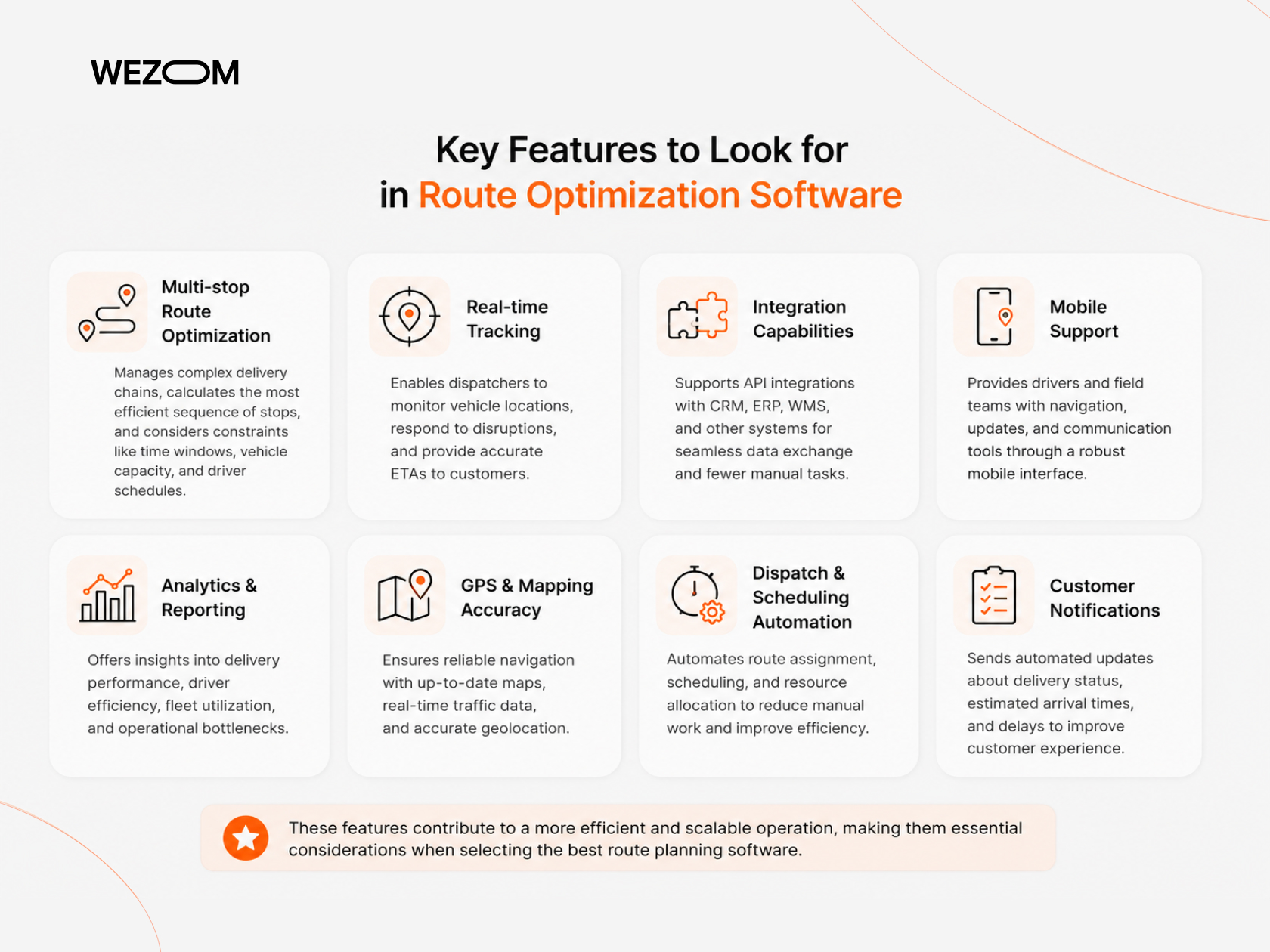
When evaluating the best route optimization system, it is important to move beyond basic functionality and focus on features that directly impact operational efficiency and scalability. Not all solutions are built with the same level of sophistication, and selecting the wrong tool can lead to inefficiencies rather than improvements.
One of the most critical capabilities is multi-stop route optimization. Businesses rarely operate with single-destination routes; instead, they manage complex delivery chains. Advanced algorithms calculate the most efficient sequence of stops, taking into account constraints such as delivery windows, vehicle capacity, and driver schedules. Without this capability, companies risk increased fuel consumption and missed deadlines.
Real-time tracking is another essential feature, especially for delivery and logistics operations. It enables dispatchers to monitor vehicle locations, respond to disruptions, and provide accurate ETAs to customers. This level of visibility is particularly important in industries where delays directly affect customer satisfaction and retention.
Integration capabilities also play a significant role. Modern businesses rely on interconnected systems, including CRM, ERP, and warehouse management platforms. The best route optimization software for businesses should support API integrations, allowing seamless data exchange. Without integration, teams may need to manually transfer data, increasing the risk of errors and inefficiencies.
Mobile support is equally important, as drivers and field technicians rely on mobile apps for navigation, updates, and communication. A robust mobile interface ensures that operational plans are executed effectively in the field.
Additional features that influence decision-making include:
- analytics and reporting for performance tracking;
- GPS and mapping accuracy for reliable navigation;
- automation of dispatch and scheduling processes.
Each of these features contributes to a more efficient and scalable operation, making them essential considerations when selecting the best route planning software.
Route Optimization Software by Use Case
Different industries and business models require different approaches to route optimization. While many platforms position themselves as all-in-one solutions, their effectiveness often depends on how well they align with specific operational needs.
For delivery businesses, the primary focus is last-mile efficiency. Solutions like Onfleet or Routific are optimized for high-volume, short-distance deliveries with strict time windows. These platforms emphasize real-time tracking, customer notifications, and route adjustments, making them suitable for e-commerce and food delivery operations.
Trucking companies, on the other hand, require more advanced capabilities. Long-haul routes, regulatory constraints, and fuel optimization play a larger role. Tools like Samsara or Verizon Connect provide deeper integration with fleet management systems, including telematics and compliance monitoring. In this context, the best truck routing software must go beyond route planning and support broader operational requirements.
Small businesses typically prioritize simplicity and cost-effectiveness. Platforms such as Circuit or MyRouteOnline offer straightforward solutions without the complexity of enterprise systems. While they may lack advanced features, they provide sufficient functionality for smaller teams with limited resources.
Field service teams have unique requirements related to scheduling and workforce management. WorkWave Route Manager, for example, focuses on aligning technician availability with service requests. In this scenario, route optimization is closely tied to workforce efficiency rather than delivery speed.
Understanding these distinctions is crucial when selecting the best route mapping software, as a solution that works well for one use case may not be suitable for another.
Benefits of Using Route Optimization Software
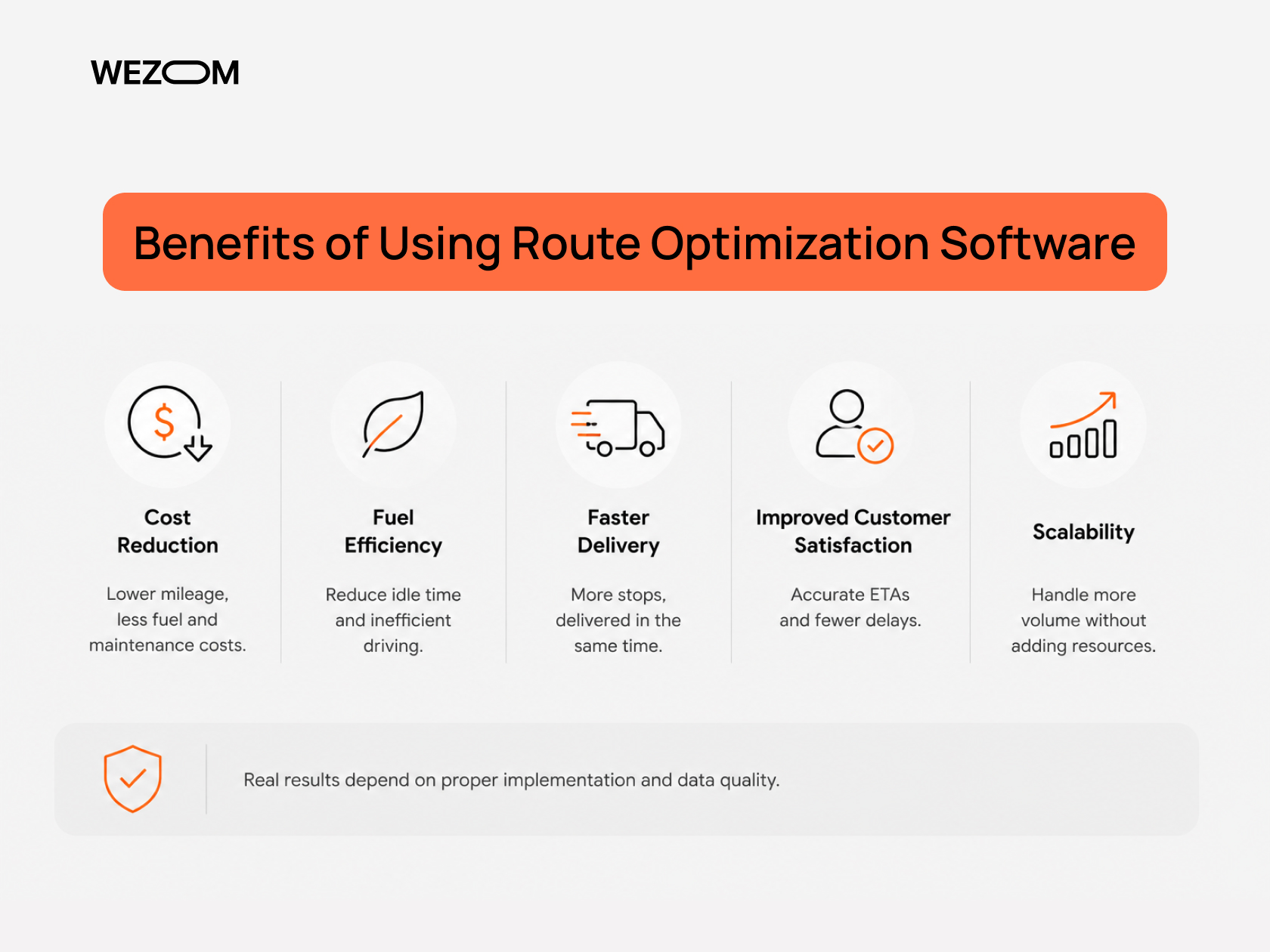
Implementing route optimization software delivers measurable improvements across logistics, delivery, and field service operations. Unlike manual planning, which often leads to inefficiencies and inconsistent execution, modern solutions use algorithms and real-time data to streamline routes and resource allocation. This directly impacts operational costs, service speed, and overall business scalability.
One of the key advantages is the ability to standardize and automate planning processes. Instead of relying on dispatcher experience or static routes, businesses can dynamically adjust routes based on current conditions such as traffic, order volume, and driver availability. This reduces operational risks and improves consistency, especially as the company grows. At the same time, better route planning enhances visibility, allowing managers to monitor execution and quickly respond to disruptions.
The most important benefits include:
- Cost reduction – minimizing unnecessary mileage lowers fuel expenses and vehicle maintenance costs
- Fuel efficiency – optimized routes reduce idle time and inefficient driving patterns
- Faster delivery – improved routing enables more stops within the same timeframe
- Improved customer satisfaction – accurate ETAs and fewer delays increase trust and retention
- Scalability – automation allows businesses to handle higher volumes without proportional growth in resources
However, achieving these benefits depends on proper implementation and data quality. Without accurate input data or alignment with operational workflows, even the best route optimization system may not deliver expected results.
How to Choose the Best Route Optimization Software
Selecting the best route optimization software requires a structured evaluation process that aligns technology capabilities with business needs. One of the first factors to consider is business size. Small teams may prioritize ease of use and affordability, while larger organizations require scalability and integration capabilities.
The number of vehicles and drivers also plays a critical role. Solutions designed for small fleets may not perform well when scaled to hundreds of vehicles. Conversely, enterprise platforms may be overly complex for smaller operations.
Delivery complexity is another key consideration. Businesses with simple routes can rely on basic tools, while those with multiple constraints–such as time windows, capacity limits, and regulatory requirements–need more advanced systems.
Integration requirements should not be underestimated. The ability to connect with existing systems, such as CRM or ERP platforms, determines how efficiently data flows across the organization. Lack of integration can create operational silos and reduce overall efficiency.
Budget is the final factor, but it should be evaluated in terms of the total cost of ownership rather than upfront pricing. This includes implementation costs, training, and ongoing maintenance.
A structured approach to evaluation helps ensure that the selected solution delivers long-term value rather than short-term convenience.
FAQ
What is route optimization software?
Route optimization software is a digital system that uses algorithms to calculate the most efficient routes for vehicles and drivers. It considers factors such as distance, traffic, delivery windows, and resource constraints. In practice, businesses use it to automate planning processes, reduce manual effort, and improve operational efficiency. Implementation typically involves integrating the software with existing systems and training teams to use optimized routes in daily operations.
Which route optimization software is best for small businesses?
The best route optimization software for small businesses depends on budget and operational complexity. Tools like Circuit or MyRouteOnline are often suitable due to their simplicity and affordability. However, businesses should also consider scalability. If growth is expected, choosing a platform with integration capabilities and advanced features may prevent the need for migration later.
What is the best delivery route planning software?
The best delivery route planning software varies by use case. For last-mile delivery, platforms like Onfleet or Routific are commonly used due to their real-time tracking and customer communication features. Businesses should evaluate these tools based on delivery volume, required integrations, and operational workflows rather than relying solely on popularity.
Can route optimization software reduce fuel costs?
Yes, route optimization software can significantly reduce fuel costs by minimizing travel distance, avoiding traffic congestion, and reducing idle time. In real-world scenarios, companies often achieve 10–25% savings in fuel expenses. However, results depend on data accuracy, implementation quality, and how consistently optimized routes are followed by drivers.
How accurate are route optimization systems?
The accuracy of route optimization systems depends on the quality of data and the sophistication of algorithms. Modern systems use real-time data, GPS tracking, and predictive analytics to improve accuracy. However, external factors such as unexpected traffic conditions or weather disruptions can still affect outcomes. Continuous monitoring and adjustments are necessary to maintain high accuracy levels.

