
The global drone software market is expected to reach $24.39 billion by 2030, with a CAGR of 16.0%. This growth is driven by the adoption of drones not only in civilian sectors like agriculture and construction, but also in defense, where such software solutions perform tasks that pose a serious risk to human life. At the same time, unlike the civilian sector, UAV detection and defense software is subject to stricter regulations and must meet some other requirements that have to be considered during development. Actually, this article covers all these aspects.
The Rising Importance of Counter-Drone Systems in Modern Security
As UAVs have become more widespread across various sectors, they have also begun to be actively used for autonomous reconnaissance missions, posing a global security threat. They are now capable of disrupting airport operations, spying on industrial facilities, and attacking both critical infrastructure and people. For example, an enemy drone flying over an oil refinery could disrupt production, while data interception by a UAV equipped with Wi-Fi traffic monitoring boards poses a cyber threat. Moreover, for countries like Ukraine, where drone technology is being field-tested in real combat conditions, its accuracy, effectiveness, and speed are becoming a matter of survival.
So, to prevent these threats, so-called counter-drone systems or C-UAS are developed, which, depending on the UX level and availability, can be used by both the military and the corporate sectors. Specifically, counter drone software can combat drones with frequency hopping (which complicates electronic countermeasures), autonomous UAVs based on computer vision (which makes them immune to GPS spoofing), and even drone swarms, which, through coordinated actions, overwhelm conventional detection and defense systems.
How Counter-Drone Systems Work
So, let’s find out how drone detection software works. Modern anti drone software is based on a layered defense architecture: first, it detects a UAV (usually through radar, acoustic sensors, or radio frequency analysis), then determines its type and trajectory, and, finally, neutralizes it through signal jamming, physical destruction, or cyber interception.
Given the complex nature of drone security solutions, they must include the following components:
- Sensors. Larger drones typically use radars, while smaller ones have acoustic sensors and/or optical/thermal imaging cameras. Both types of drones are also typically equipped with radio frequency detection systems.
- Software. Drone software collects and processes data from all sensors in real time to classify the threat and make a specific countermeasure decision.
- Effectors. These typically include electronic warfare systems, lasers, net-throwing devices, and/or kinetic energy interceptors.
Ultimately, the effectiveness of drone defense technology systems is determined not so much by the radars themselves as by their ability to integrate with various sensors. In particular, software must be able to instantly combine disparate data and filter out false alarms (for example, when detecting birds or its own traffic). This is what drives developers of such systems to integrate artificial intelligence, which can cope with increased airspace congestion. This technology most often performs the following tasks:
- Drone type classification and identification;
- Noise filtering (birds, debris, etc.) to focus only on real threats;
- Autonomous decision-making based on the trajectory and type of threat.
It’s important to note that all these tasks are performed by AI-driven software many times faster than by human operators, which can be critical during attacks by swarms or jet-powered UAVs.
Types of Drone Detection and Anti-Drone Solutions
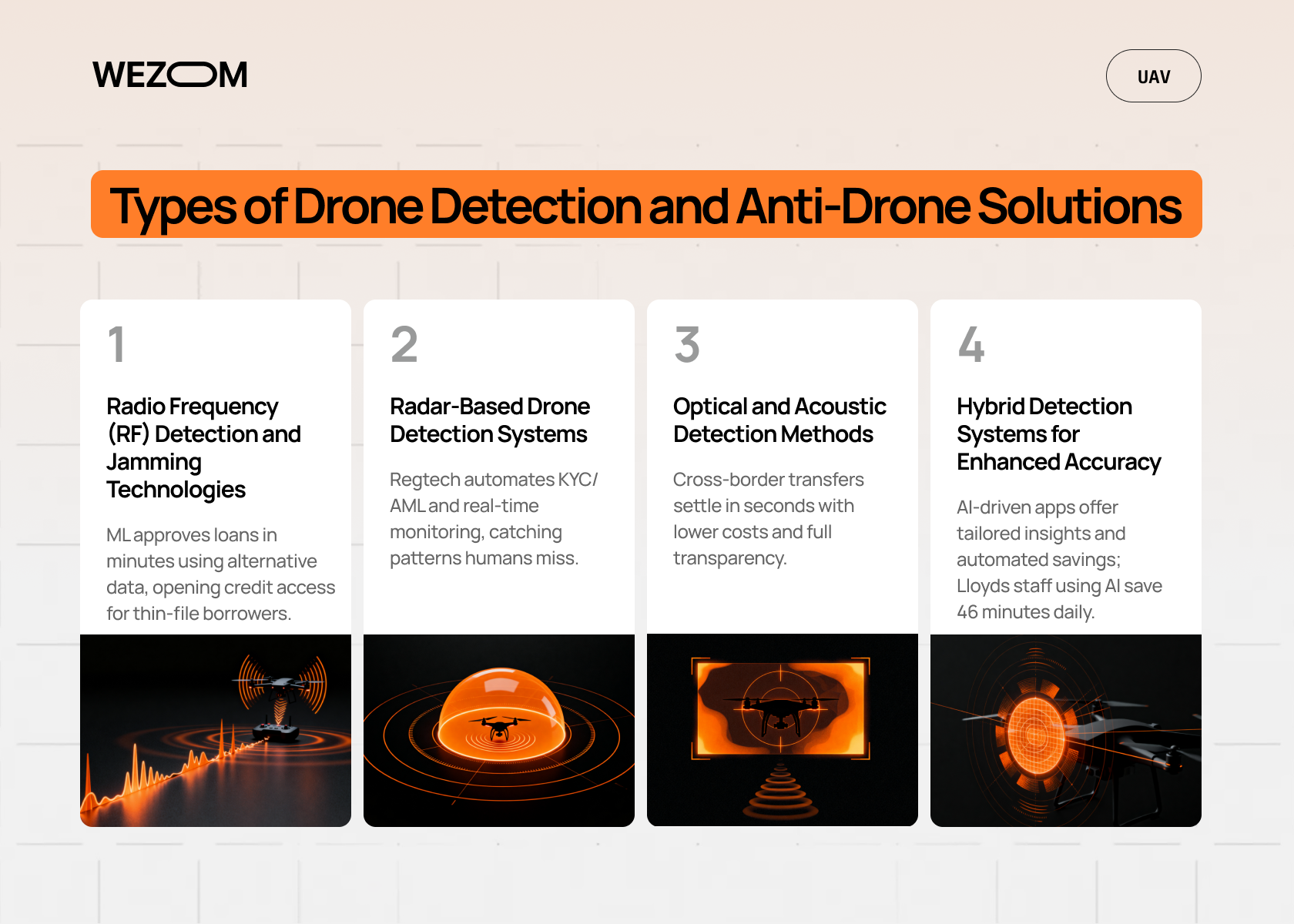
Now let's compare the main types of UAV detection and tracking systems.
Radio Frequency (RF) Detection and Jamming Technologies
RF drone detection solutions are based on a passive method that demonstrates superior performance against the vast majority of commercial drones (particularly those from DJI, Autel, and others) that operate on 2.4 GHz and/or 5.8 GHz radio channels or broadcast a video signal. RF analyzers scan the airwaves and capture the unique digital signatures emitted by the drone and its remote controller, enabling the operator's geolocation after detection. As for RF jamming, it’s the most common countermeasure, creating interference by disrupting the connection between the drone and its remote controller in conditions of instantaneous radio frequency changes.
Radar-Based Drone Detection Systems
These drone intrusion prevention solutions use radio waves to detect and track objects using micro-Doppler radars, which are fully adapted to small targets and can distinguish the signature of a drone's rotating blades from birds and other interference. These radars provide long-range detection, up to several kilometers, and precise positioning regardless of weather conditions. The only drawback of radar-based counter drone software is the increased risk of false alarms in high-noise urban environments.
Optical and Acoustic Detection Methods
Optical detection methods rely on cameras and thermal imaging, providing visual confirmation of a threat. They work well in situations where active RF or radar systems cannot be used (for example, near airports). However, their effectiveness is highly dependent on weather conditions and the presence of integrated AI for object recognition. Acoustic detection methods, on the other hand, are passive, don’t emit interference, and utilize ultra-sensitive microphones to capture the acoustic signature of drone engines. The main drawback of acoustic methods used in autonomous counter-drone systems is their near-zero effectiveness in noisy urban or industrial environments.
Hybrid Detection Systems for Enhanced Accuracy
The best counter-drone systems rely on a sensor fusion approach, whereby embedded software integrates all the disparate data: for example, if an RF drone detection analyzer intercepts a signal, radar confirms a trajectory, and a thermal imager provides visual confirmation, the confidence level that an object poses a threat approaches 100%. Such systems are typically used in the defense sector, where a false alarm could cost a human life and/or cause serious damage to critical infrastructure.
Leading Drone Detection Software Solutions
The software serves as the brains of C-UAS systems, handling functions such as data collection from all sensors, data fusion (which implies merging this data into a single 3D airspace model), protocol identification (by comparing UAV signatures with a constantly updated database of known commercial and military protocols), and, finally, threat classification, that is, whether the drone is actually friendly or hostile.
Furthermore, such C-UAS software must be capable of not only detecting the threat but also providing the operator with relevant information about it in real time – that is, the exact coordinates, target, drone model, and recommended countermeasures. In addition to instant alerts, this type of software also collects general analytics, including intrusion frequency maps, routes, and types of UAVs used – in short, everything needed to continually refine the defense strategy.
Finally, top drone mitigation systems provide seamless integration with existing security systems (ACS/CCTV/fire control systems/etc.) – which is why, upon detecting a threat, they can automatically launch relevant scenarios, from locking doors to activating specific UAV suppression systems.
Comparing Counter Drone Software and Anti Drone Software
The difference between these two types of software is functional.
Counter-drone software is a broad term encompassing the detection, tracking, identification, and neutralization of drones, while anti-drone software refers to specific neutralization tools, such as signal jamming software. However, these terms are often used interchangeably.
However, it's important to understand that drone detection is a passive function permitted almost everywhere, while neutralization involves active intervention, which is strictly regulated by law (especially in the civilian sector – for instance, in the case of smart city drone surveillance solutions or airport drone security systems) and requires a separate license and approval. This is because the latter type of software most often combines hardware (such as jammers and guns) and software countermeasures (essentially cyber interception or the introduction of malicious code into the drone's control system). This is why, for example, in active warfare, we can see the emergence of sophisticated military-grade counter drone technology solutions that allow for the soft takeover of UAV control without resorting to brute force electronic warfare.
Incidentally, cloud platforms are also coming to the rescue here, enabling the consolidation of data from multiple geographically dispersed facilities. This is critical for protecting critical infrastructure networks with the help of corporate drone defense solutions.
Applications of Counter-Drone Systems in Various Industries
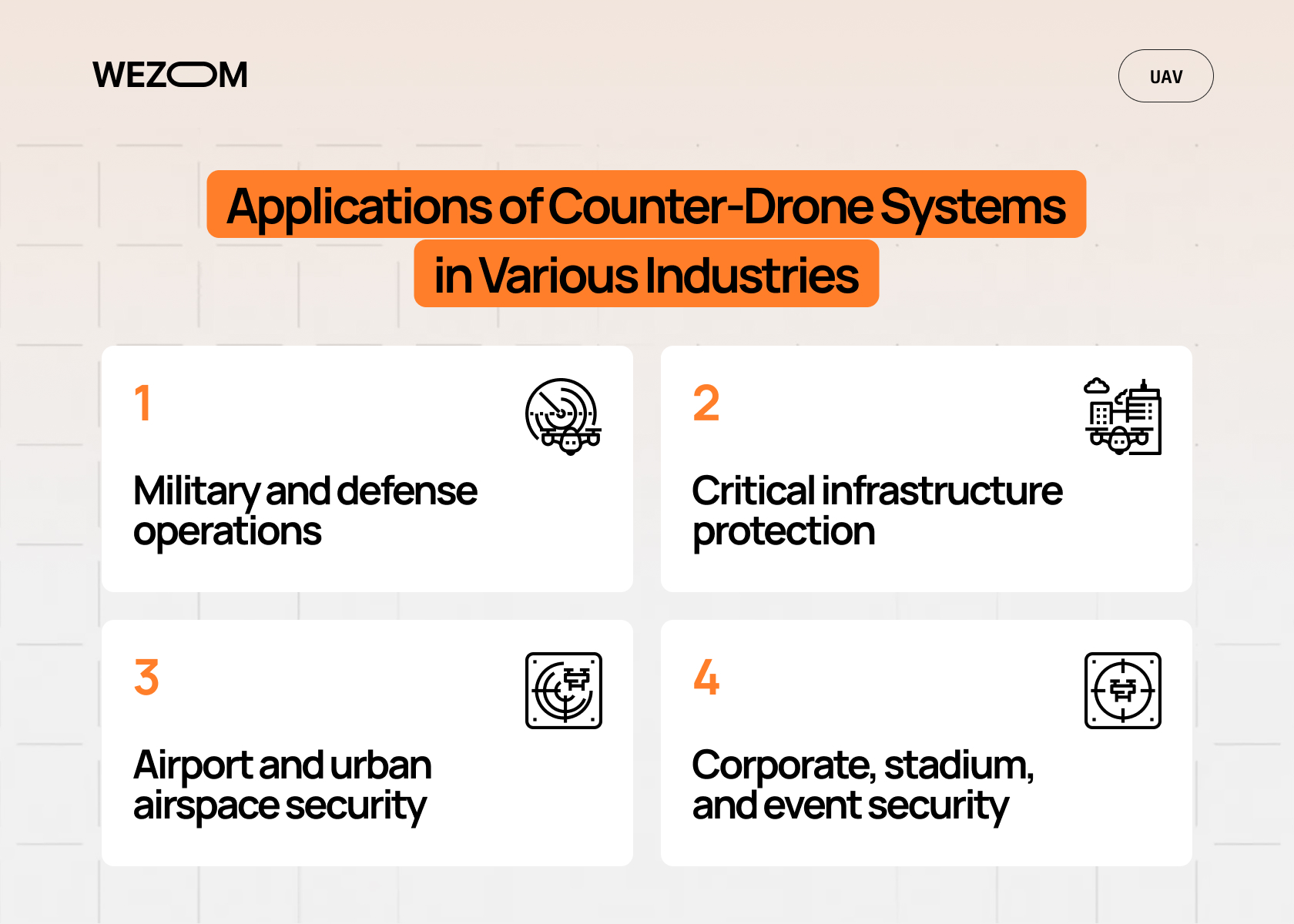
In this section, we would like to highlight the main types of counter-drone system applications.
- Military and defense operations. In this area, C-UAS software integration is needed to protect forward positions, headquarters, ammunition depots, and airfields. Moreover, Ukraine's unique experience allows developers like WEZOM to test and refine their software in the face of the massive use of FPV drones, satellite-guided UAVs, and active enemy electronic warfare, enabling the implementation of solutions that are unparalleled anywhere in the world.
- Critical infrastructure protection. This category includes nuclear and hydroelectric power plants, gas pipelines, oil refineries, data centers, and other facilities that are highly vulnerable to drone attacks and therefore require 24/7 monitoring. In this case, C-UAS solutions are used to create a protective shield capable of automatically detecting hostile drones and alerting security personnel.
- Airport and urban airspace security. Airports cannot use powerful signal jamming due to the risk to civil aviation, so it makes sense for this sector to focus on implementing passive detection and precision tracking systems to provide managers with a complete picture of the airspace, distinguish authorized from unauthorized drones, and apply targeted countermeasures without disrupting regular processes within the airfield.
- Corporate, stadium, and event security. Large stadiums, government buildings, and corporate headquarters should rely on AI-powered drone detection tools to protect against espionage and terrorist threats, so the latter must be discreet and easily integrated with local security networks.
If you're interested in implementing a smart counter-drone solution for these or any other sectors, feel free to contact us.
Challenges in Drone Security Implementation
The implementation of comprehensive drone jamming systems, particularly in densely populated and regulated areas, presents a number of challenges that must be addressed at both the software and legislative levels.
Regulatory and Legal Limitations
This is perhaps the most limiting challenge, especially when it comes to using radar-based drone detection systems in civilian airspace. For example, in most countries, active countermeasures like electronic warfare are strictly prohibited for use by civilians and companies due to their potential to disrupt civil aviation, emergency services, or satellite communications. This means that drone detection system suppliers (except for military use) are limited to passive detection and alerting methods.
Balancing Privacy and Safety
Since drone intrusion prevention also involves the geolocation of its operator, this raises privacy concerns in densely populated areas, as systems may monitor private radio channels. Therefore, autonomous drone threat detection software must comply with regional data protection laws, which means processing only technical signatures and coordinates, minimizing the collection of personal information without losing its effectiveness and accuracy.
Cost and Scalability Concerns
Finally, the most advanced AI drone detection software, including radars, RF analyzers, thermal imagers, and other hardware, is typically extremely expensive, which inherently poses a scalability challenge, as effective protection of large facilities requires many such systems. Therefore, developers of systems based on drone neutralization methods must find the optimal balance between counter UAV system pricing and its effectiveness to make drone defense accessible to more than just the largest corporations.
Future of Drone Security and Counter-Drone Innovations
As you may have already realized, the key technology determining the future of drone detection software is artificial intelligence. While it currently only accelerates and automates decision-making based on the analysis of colossal amounts of disparate data, in pilot projects of counter UAV systems, it can predict attacks by analyzing historical data on trajectories, time of day, weather conditions, and the geopolitical situation to calculate the likelihood of an intrusion in each individual zone, too. This makes it possible to preemptively activate sensors on high alert and prepare countermeasures long before an enemy drone begins its mission.
Smart city drone security systems will also be increasingly integrated into smart city infrastructure and IoT networks, where CCTV cameras, streetlight microphones, and even traffic sensors will participate in drone detection, while the software controlling them will automatically coordinate the response of the relevant services.
At the same time, for all of this to work on a large scale and maintain compatibility with external systems at the international level, global standards for drone mitigation and jamming systems must be created – something that leading digital nations are currently actively working on. These standards include protocols for data exchange between sensors, the definition of safe frequencies for electronic warfare, and the implementation of uniform performance criteria.

FAQ
What is the difference between drone detection software and counter-drone systems?
Drone monitoring solutions handle passive functions such as sensor data collection, identification, classification, and alerting, while counter-drone systems, in addition to these features, also include hardware-based neutralization solutions such as radars, electronic warfare jammers, and kinetic systems.
Can anti-drone software operate autonomously without human intervention?
Yes, modern AI-driven UAV detection and tracking systems are capable of autonomously detecting threats, classifying them, and activating countermeasures without waiting for operator confirmation. However, in the civilian sector, legislation often requires the implementation of Human-in-the-Loop mechanisms for countermeasures.
What are the most reliable drone detection methods available today?
The most reliable method used by leading drone defense technology providers is the sensor fusion approach, which combines radio frequency analysis for rapid operator detection and geolocation with micro-Doppler radars, considered the most effective for trajectory tracking and all-weather operation.
How do counter-drone solutions comply with airspace regulations?
This is achieved by selecting passive methods such as RF and acoustic detection for civilian areas. If neutralization is required, the software must operate in a selective mode and use electronic warfare only on unlicensed frequencies and strictly within a clearly defined air corridor.
Are counter-drone systems effective against swarm drone attacks?
Yes, but only hybrid AI-controlled drone threat detection systems are effective, as swarm drone attacks can easily overload traditional counter-drone solutions.
What are the top challenges when deploying counter drone software at airports?
The main challenges include preventing false alarms, avoiding radio interference, restrictions on the use of electronic warfare systems that could disrupt communication between dispatchers and pilots, high ambient noise levels, and mandatory certification by aviation authorities.
How does AI improve detection accuracy in anti drone software?
AI improves the accuracy of counter-drone systems through high-precision pattern recognition, filtering of interference and false alarms, and protocol identification via instant comparison of captured RF signals with extensive drone protocol libraries.
