
Medical device embedded software is a core component of modern healthcare technologies, enabling devices to perform precise, real-time operations. Embedded software for medical devices is tightly integrated with hardware such as sensors and microcontrollers, allowing efficient monitoring, signal processing, and control within constrained environments. Unlike general-purpose applications, embedded systems in medical devices are designed for reliability, safety, and compliance with strict regulations.
Today, embedded systems in medical field applications power everything from diagnostic equipment to continuous patient monitoring solutions. Healthcare embedded systems must operate with high precision and stability, as they directly impact clinical decisions and patient outcomes. The growing complexity of embedded medical devices increases the importance of robust architecture, validation, and performance optimization. As a result, embedded medical software development has become a critical discipline, combining firmware, hardware integration, and real-time processing to ensure safe and effective healthcare delivery.
What is Medical Device Embedded Software?
Medical device embedded software is specialized software integrated directly into hardware components to perform specific medical functions. Embedded software for medical devices operates on microcontrollers and interacts with sensors, enabling real-time monitoring, control, and signal processing. Unlike general-purpose applications, it is optimized for performance, reliability, and operation within limited hardware resources.
The relationship between hardware and software is central to embedded medical software development. Hardware collects data through sensors, while the software processes this input and controls device behavior. For example, in embedded medical devices used for diagnostics, software interprets signals and delivers accurate outputs for clinical decision-making.
Embedded systems in medical devices must meet strict requirements for safety, compliance, and precision. This includes adherence to regulatory standards and implementation of fail-safe mechanisms. As part of healthcare embedded systems, these solutions ensure stable operation in critical environments. Overall, embedded software medical devices combine firmware, hardware integration, and real-time capabilities to support reliable and effective healthcare applications.
Embedded Systems in the Medical Industry
Embedded systems in medical devices are purpose-built solutions designed to perform specific healthcare functions with high precision and reliability. An embedded system in medical industry applications typically combines hardware components such as sensors and microcontrollers with software that enables real-time monitoring, signal processing, and control. These systems are optimized for stability and performance within constrained environments.
Embedded systems in the medical field use cases must handle continuous data flows while ensuring accurate outputs. For example, in patient monitoring, healthcare embedded systems process vital signals in real time and trigger alerts when anomalies are detected. This requires deterministic behavior, low latency, and efficient resource utilization.
A key characteristic of embedded medical devices is their need for reliability and safety. Embedded software for medical devices must operate without interruption, often in critical care scenarios. This is supported by fault tolerance mechanisms, validation processes, and compliance with regulatory standards. Overall, embedded systems in medical devices play a vital role in diagnostics, monitoring, and automation, forming the backbone of modern healthcare technology.
Embedded Medical Software Development Process
Embedded medical software development is a structured process focused on safety, reliability, and compliance. Unlike standard software, embedded software for medical devices must align closely with hardware constraints and regulatory requirements. The process begins with detailed requirements gathering, where functional needs, performance expectations, and compliance standards are clearly defined.
The architecture design follows, covering system structure, hardware selection, and software logic. This stage defines how embedded systems in medical devices will handle real-time processing, connectivity, and integration with sensors. Hardware-software integration is a critical step, ensuring seamless communication between firmware and physical components such as microcontrollers and monitoring devices.
The development lifecycle is typically aligned with standards like IEC 62304, emphasizing traceability, validation, and risk management. Embedded systems in medical field applications require continuous testing and refinement to meet strict safety and performance criteria.
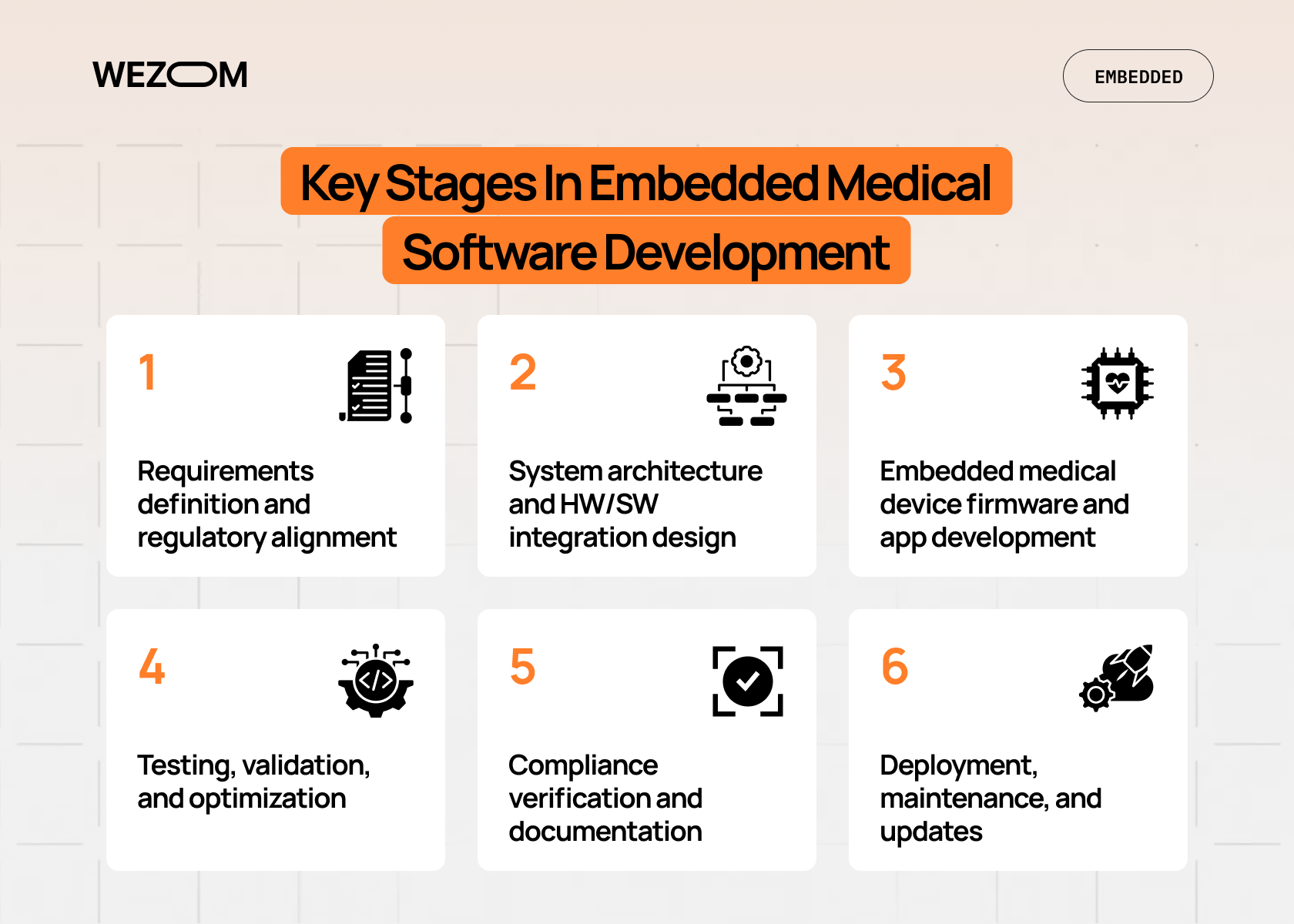
Key stages in embedded medical software development include:
- requirements definition and regulatory alignment;
- system architecture and hardware-software integration design;
- firmware and application development for embedded medical devices;
- testing, validation, and performance optimization;
- compliance verification and documentation;
- deployment, maintenance, and updates.
From a business perspective, this approach ensures that healthcare embedded systems are scalable, secure, and ready for certification, reducing risks and supporting long-term product evolution.
Testing and Validation of Embedded Medical Systems
Testing and validation are critical for ensuring that embedded systems in medical devices operate safely and reliably in real-world conditions. Embedded software for medical devices must be verified not only for functional correctness but also for performance, stability, and compliance with strict regulatory standards. This process is more complex than traditional software testing due to tight hardware integration and real-time constraints.
Functional testing ensures that embedded medical devices perform intended operations, including accurate signal processing, monitoring, and control. However, healthcare embedded systems must also be evaluated under stress conditions and edge cases to confirm consistent behavior. Safety testing focuses on how systems respond to failures, such as hardware faults or unexpected inputs, ensuring fail-safe mechanisms and fault tolerance are properly implemented.
Validation must align with standards such as FDA guidance, ISO 13485, and IEC 62304. This requires full traceability between requirements, implementation, and test results. Embedded systems in medical field applications also demand structured risk management, where potential hazards are identified and mitigated throughout the lifecycle.
From an operational perspective, thorough testing reduces risks related to device failure, regulatory issues, and costly recalls. For embedded software medical devices, robust validation is essential to ensure compliance, maintain reliability, and support safe use in clinical environments.
Challenges in Embedded Software for Medical Devices
Developing embedded software for medical devices involves complex technical and regulatory challenges that directly impact safety, performance, and time-to-market. One of the primary issues is meeting real-time constraints. Embedded systems in medical devices must process data and respond instantly, especially in monitoring and diagnostic scenarios where delays can affect patient outcomes.
Reliability is another critical factor. Embedded medical devices are expected to operate continuously with minimal failure risk. This requires robust fault tolerance, redundancy mechanisms, and precise control logic. At the same time, developers must work within hardware limitations such as restricted memory, processing power, and energy consumption.
Cybersecurity has become increasingly important as healthcare embedded systems adopt connectivity features. Protecting sensitive patient data and ensuring secure communication between devices is essential. However, implementing security measures must not compromise system performance or usability.
Regulatory complexity further adds to the challenge. Embedded medical software development must comply with standards such as FDA, ISO 13485, and IEC 62304, requiring extensive documentation, validation, and traceability.
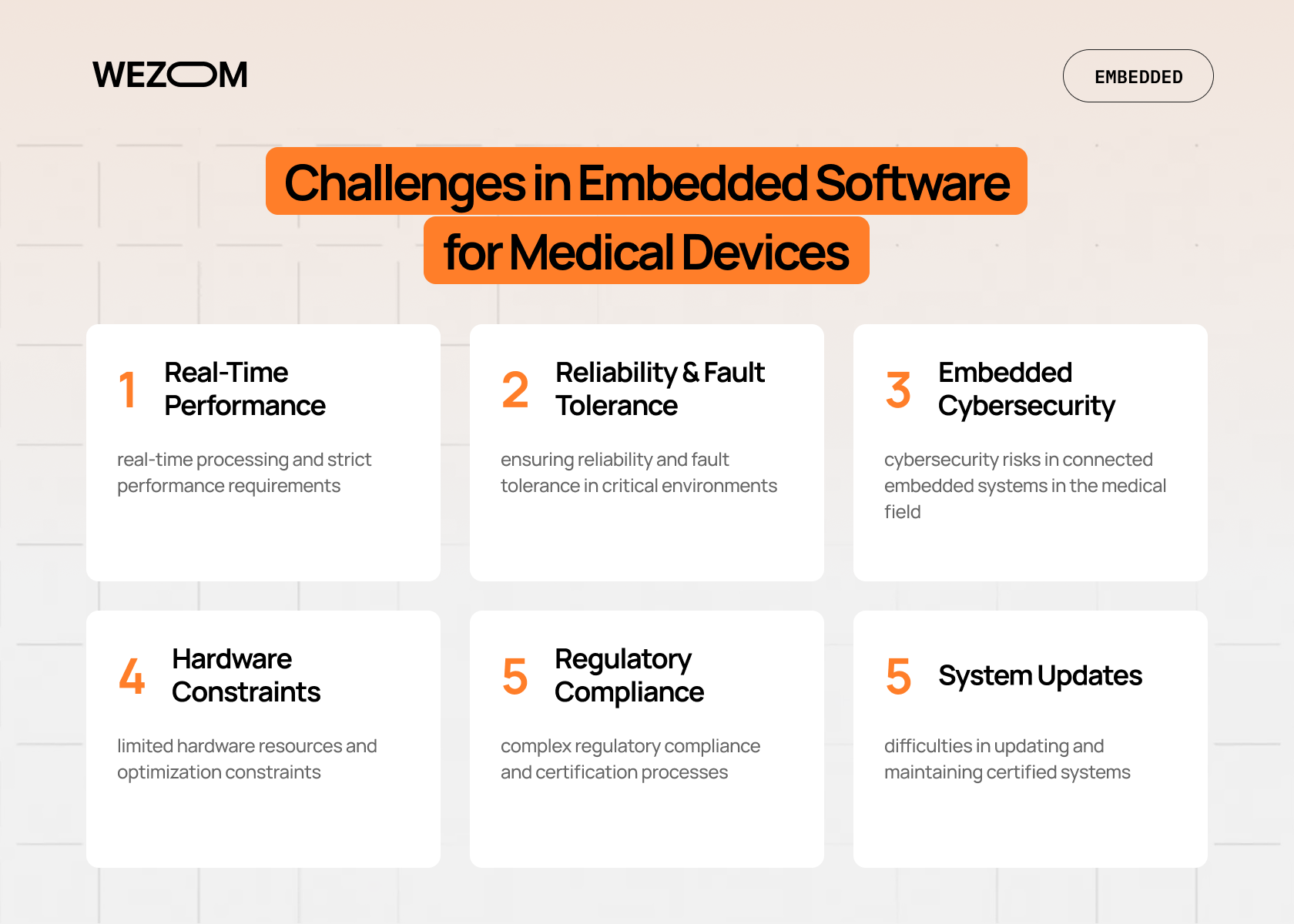
Key challenges include:
- real-time processing and strict performance requirements;
- ensuring reliability and fault tolerance in critical environments;
- cybersecurity risks in connected embedded systems in the medical field;
- limited hardware resources and optimization constraints;
- complex regulatory compliance and certification processes;
- difficulties in updating and maintaining certified systems.
Addressing these challenges requires a structured approach, combining engineering expertise with deep knowledge of healthcare regulations and system architecture.
Real-World Applications of Embedded Medical Systems
Embedded medical devices are widely used across healthcare environments, enabling precise monitoring, diagnostics, and automated control. Embedded systems in medical devices combine hardware, sensors, and software to deliver real-time performance in critical scenarios, making them essential for modern clinical workflows.
One of the primary applications is diagnostic equipment. Devices such as analyzers and imaging systems rely on embedded software for medical devices to process complex data through signal processing and deliver accurate results. These systems must operate with high precision and minimal latency to support timely clinical decisions.
Patient monitoring is another key area. Healthcare embedded systems continuously track vital signs such as heart rate, blood pressure, and oxygen levels. Embedded systems in medical field environments ensure stable monitoring, real-time alerts, and reliable data transmission, often supporting remote care scenarios.
Wearables and connected devices extend these capabilities beyond hospitals. Embedded medical devices like fitness trackers and portable monitors use embedded medical device software logic for real-time data collection, automation, and connectivity with healthcare platforms.
Advanced applications also include surgical equipment and imaging systems, where embedded systems provide precise control and high-performance data processing. Overall, embedded systems in medical devices enable scalable, reliable, and data-driven healthcare solutions across clinical and home environments.
Future Trends in Healthcare Embedded Systems
Healthcare embedded systems are rapidly evolving alongside advances in artificial intelligence, connectivity, and computing architectures. One of the key trends is the integration of AI into embedded software for medical devices. This allows embedded medical devices to move beyond basic monitoring toward predictive diagnostics, automated decision-making, and improved signal processing accuracy in real time.
The expansion of IoT is also reshaping embedded systems in medical devices. Connected healthcare embedded systems enable continuous data exchange between devices, clinicians, and cloud platforms. This improves coordination of care and supports more efficient, data-driven healthcare delivery, especially in remote environments.
Remote patient monitoring continues to grow as a practical use case for embedded systems in medical field applications. Devices equipped with sensors and connectivity allow continuous monitoring outside hospitals, reducing the need for frequent visits while maintaining high levels of care and reliability.
Edge computing is another important direction in embedded medical software development. By processing data locally on the device, embedded software medical devices can reduce latency, improve performance, and enhance data privacy. This is particularly critical for real-time control and diagnostic scenarios.
Overall, these trends point toward more intelligent, connected, and autonomous embedded systems in medical devices, where performance, safety, and compliance remain central to innovation.
Conclusion
Embedded software for medical devices is a core driver of modern healthcare innovation, enabling precise diagnostics, real-time monitoring, and reliable device control. Its tight integration with hardware ensures that embedded medical devices operate with high accuracy, stability, and safety in critical environments.
Embedded medical software development requires a structured approach that balances performance with regulatory compliance. From architecture design to testing and validation, every stage must ensure reliability and risk mitigation.
As technologies like AI, IoT, and edge computing evolve, embedded systems in medical devices will become more intelligent and connected. For businesses, investing in healthcare embedded systems is essential to deliver scalable, compliant, and future-ready solutions.
FAQ
What is embedded software in medical devices?
Embedded software in medical devices is specialized code integrated into hardware components to control device functionality, process sensor data, and ensure real-time operation. It is designed for specific tasks such as monitoring, diagnostics, or control. Unlike general software, it must meet strict safety and regulatory requirements, as it directly impacts patient outcomes and device reliability in clinical environments.
How is embedded medical software developed?
Embedded medical software development follows a structured lifecycle that includes requirements definition, architecture design, hardware-software integration, development, testing, and validation. The process must comply with standards like IEC 62304 and ISO 13485. It involves close collaboration between hardware and software teams, with a strong focus on risk management, traceability, and regulatory compliance to ensure safety and performance.
What are embedded systems in medical devices used for?
Embedded systems in medical devices are used for real-time monitoring, diagnostics, therapeutic control, and data processing. They power applications such as patient monitoring systems, imaging equipment, wearable health devices, and surgical tools. These systems enable automation, precision, and continuous operation, making them essential for both hospital-based and remote healthcare scenarios.
Why is embedded software important in healthcare?
Embedded software is important in healthcare because it ensures the accurate and reliable operation of medical devices. It enables real-time data processing, supports critical diagnostics, and maintains system stability under demanding conditions. Without embedded software, modern healthcare technologies would not be able to deliver the level of precision and responsiveness required for effective patient care.
What are examples of embedded medical devices?
Examples of embedded medical devices include infusion pumps, cardiac monitors, wearable fitness trackers, imaging systems, and robotic surgical equipment. Each of these devices relies on embedded software to process data, control hardware components, and deliver accurate results. These systems are widely used in hospitals, clinics, and home care environments, demonstrating their versatility and importance in healthcare.
