
Fintech development in 2026 comes down to three technical realities: AI must be explainable, infrastructure must be resilient, and compliance must be automated.
The operational requirements changed. You can't compete without real-time processing. You can't scale on monolithic architecture. You can't deploy AI without audit trails. Regulatory frameworks aren't guidelines anymore — they're hard constraints on system design.
The technology exists. Regulatory clarity exists. What separates execution from failure is understanding how these pieces fit together into production systems.
This article provides operational guidance for fintech development in 2026 — covering AI implementation with regulatory compliance, cloud-native architecture patterns, real-time analytics infrastructure, security-first development practices, and integration strategies for payments, KYC, and risk systems. We'll examine what works in production, which architectural patterns scale, how to build for regulatory requirements from the start, and strategic frameworks for technology investment. For technical leaders building or modernizing financial infrastructure.
The State of Fintech in 2026: Market Snapshot
Quick question: when was the last time a financial technology surprised you? We're not talking about a cool app feature, the one that genuinely made you rethink how money works.
That's happening more often now. The future of fintech isn't about flashy features anymore, it's about fundamental shifts in how financial services operate. The current trends in fintech and financial technology that'll matter six months from now.
Let's talk about money for a second.
Global fintech funding in H1 2025 reached $44.7 billion across 2,216 deals. That might sound lower than the 2021 highs (remember when everything was getting funded?), but it's actually healthier. Investors are being selective. They're betting on infrastructure, compliance, and companies with actual revenue.
The median annual revenue for fintech companies raising Series A? $4 million, up from just $1 million four years ago. Today's baseline would've put you in the top quartile back in 2020.
Meanwhile, payments revenue hit $2.4 trillion in 2023 and it's projected to reach $3.1 trillion by 2028. Payments are the backbone keeping this whole thing running.
Not all fintech segments are created equal. Some are exploding, others are steady, and a few are facing real headwinds.
Payments still dominate (over 45% of revenue), but honestly, that's old news. What's interesting is the specialization happening. Neobanking, lending platforms, insurtech, wealthtech, regtech — each one's carving out its own space. These emerging trends in financial services are reshaping the entire industry landscape.
The neobanking market jumped from $143.29 billion in 2024 to an expected $3.4 trillion by 2032. That's not a typo. Digital banks are eating traditional banking's lunch, and they're doing it with better user experiences and lower fees.
Buy Now, Pay Later (BNPL) went from $19.22 billion to a projected $83.36 billion by 2034. And wealthtech? Half of the top 10 companies have rolled out AI tools or made AI acquisitions this year. The race is on.
Now, we know what you're thinking. How are macroeconomic factors playing into all this?
Interest rates have stabilized. That alone is huge. After years of uncertainty, institutions can actually plan beyond the next quarter. We're seeing institutional appetite for later-stage fintech investments. The US-based fintechs are getting 60% of total investment dollars and 43% of all deals — both all-time highs.
But here's something you might not expect: emerging markets are the real story. India surpassed 500 million digital payment users in 2025. Latin America saw 35% year-over-year growth in fintech startups. These aren't markets to ignore anymore — they're where the next wave is building.
Core Drivers Behind Fintech Innovation in 2026
As fintech becomes more integrated into everyday life, emerging technologies in fintech create trust as the ultimate differentiator.
Look, we were skeptical too. Every company claims to be "AI-powered" these days. But the numbers don't lie, and fintech industry analysis shows AI has crossed from experimental to operational.
The AI in fintech market is worth $30 billion in 2025 and projected to hit $83.1 billion by 2030. Generative AI specifically? Growing from $1.29 billion in 2024 to $21.57 billion by 2034.
That's not hype. That's operational reality.
AI adoption among top-performing fintech startups reached 88%. It's expected to save the global financial industry over $500 billion annually by 2030, with $120 billion already saved in 2025.
But here's what makes it interesting. It's not just about efficiency. 55% of robo-advisor users now trust algorithms more than human advisors. AI-based fraud detection reduced financial losses by 40% for major platforms this year.
One client told us their loan approval time dropped from 48 hours to 8 minutes using AI-powered underwriting. Eight. Minutes.
Nobody gets excited about cloud architecture (well, maybe some of us do), but it's what makes everything else possible. And it's one of the most critical fintech industry trends shaping competitive advantage.
Financial institutions are moving to cloud-native infrastructure with microservices, containerization, and real-time observability. This isn't about cost savings anymore. It's about speed and scalability.
Real-time data processing has become table stakes. You can't compete in payments, fraud detection, or risk analytics without it. The companies winning in 2026 are the ones that built their data architecture right from the start.
As fintech becomes more integrated into everyday life, trust becomes the ultimate differentiator.
Users want personalization, but they also want security. They want innovative features, but they need compliance. That tension? That's where the magic happens.
Biometric authentication is now used in 70% of fintech logins globally. Cybersecurity became the #1 spending category for fintechs in 2025. That's not defensive — that's smart business.
Top Fintech Trends in 2026
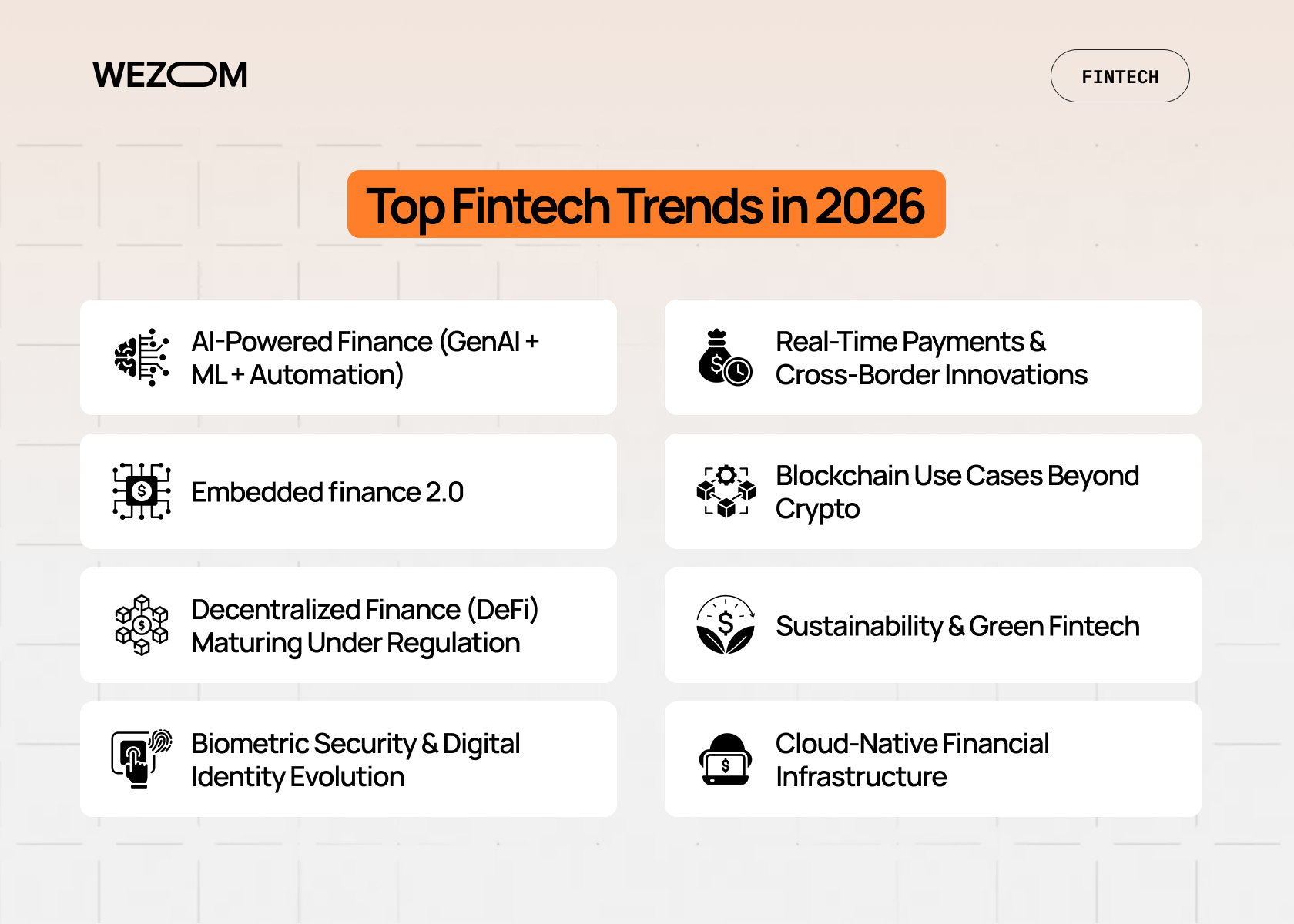
Alright, let's get into what's really changing. The financial technology trends that'll matter six months from now.
AI-Powered Finance (GenAI + ML + Automation)
We're past the "AI chatbot" phase. What's happening now is deeper.
Autonomous decision systems are handling risk scoring, fraud detection, and credit decisioning. Predictive analytics drives 60% of all loan decisions in digital lending platforms.
AI-powered customer service? It's resolving 78% of queries without human intervention. And customers are happier about it because response times improved by 300% using natural language processing.
Robo-advisors aren't replacing wealth managers, they're making wealth management accessible to people who never had access before.
Embedded finance 2.0
Remember when "embedded finance" was this abstract concept? Not anymore.
Financial services are getting baked into apps, vehicles, IoT devices — basically anywhere there's a transaction. You're buying a car? Finance it through the manufacturer's app. Shopping online? Check out with BNPL right there.
The API proliferation and Banking-as-a-Service infrastructure made this possible. Now we're seeing seamless integration into non-financial platforms.
Commerce platforms, mobility apps, SaaS products — they're all becoming financial platforms too. These digital finance trends are unlocking new monetization opportunities nobody expected three years ago.
Look at what's happening in B2B. Ramp nearly doubled its headcount over 12 months. Mercury more than doubled its valuation in a $300 million Series C. These aren't consumer plays, they're B2B financial tools with embedded finance at their core.
Businesses accelerating digital transformation post-pandemic created a massive addressable market for financial software that can be embedded anywhere. Expense management, treasury, payments, credit — all available through API-first platforms.
The shift toward B2B solutions suggests that fintech's next growth phase will be driven by businesses digitizing their financial operations. Larger deal sizes, stickier revenue models, and enterprise clients provide stability that consumer fintech sometimes lacks.
Decentralized Finance (DeFi) Maturing Under Regulation
DeFi had its wild west phase. That's over.
In July 2025, the US passed the GENIUS Act — the first major federal stablecoin legislation. Europe's MiCA regulation is creating a single passportable license across the EU. The rules are here, and surprisingly, that's good news.
We're seeing compliance-ready smart contracts, institutional adoption, and blockchain use cases beyond crypto — tokenization of assets, supply chain finance, clearing systems.
Coinbase's $2.9 billion acquisition of crypto derivatives exchange Deribit in Q2 2025? That's institutional capital betting on mature infrastructure, not speculation.
Biometric Security & Digital Identity Evolution
Passwords are dying. Finally.
Biometric authentication, zero-trust security, and advanced digital identity verification are becoming standard. Digital identity verification startups saw 85% funding growth year-over-year.
Fingerprint scans, facial recognition, voice authentication — these aren't futuristic concepts anymore. They're how millions of people access their banking apps every day. And the technology keeps improving. Liveness detection prevents spoofing attempts. Behavioral biometrics analyze typing patterns and device handling to detect fraudsters even when credentials are correct.
The shift goes beyond convenience. It's about fraud prevention and regulatory compliance. Real-time anti-money laundering systems are operational in over 75 countries now. KYC processes that used to take days now complete in minutes with higher accuracy rates.
Multi-factor authentication without passwords is becoming the baseline. Passkeys, biometric tokens, and hardware security keys are replacing the username-password paradigm that's plagued security for decades. Financial institutions are seeing fraud attempts drop by 60-70% after implementing modern identity verification stacks. Regulatory frameworks are catching up too. eIDAS 2.0 in Europe creates standards for digital identity wallets. Users can control their identity data while institutions get verified credentials. That's the future — secure, private, and compliant all at once.
Real-Time Payments & Cross-Border Innovations
If your payment system isn't instant in 2026, you're already behind.
ISO 20022 adoption is standardizing financial messaging globally. Cross-border payments that used to take days now settle in seconds.
Adyen surpassed €1 trillion in payments processed in 2024, with revenues rising 23% and EBITDA up 34% year-over-year. That's what happens when you nail the infrastructure.
Multi-currency wallets, instant settlement, Project Nexus linking payment systems across continents — the payment landscape is fundamentally reshaping. And with instant payments now standard within Europe, the competition's shifted to cross-border corridors and customer relationships.
Blockchain Use Cases Beyond Crypto
We’ll be honest — we were tired of hearing about blockchain solving every problem. But now? It's actually delivering.
Tokenization of assets, supply chain finance, clearing and settlement systems — these aren't concepts anymore, they're deployed infrastructure.
The European Central Bank expects digital euro pilot exercises could begin in 2027 if legislation passes during 2026. Wholesale CBDC trials are advancing. This is about fundamental market infrastructure redesign, not cryptocurrency speculation.
Sustainability & Green Fintech
Sustainability and green fintech are becoming competitive advantages, not just nice-to-haves.
Carbon tracking, ESG scoring, climate-risk modeling — these capabilities are being built into core financial products. Investors want to see ESG performance, and fintechs are building the tools to measure and report it.
Think about it. Every transaction leaves a carbon footprint. Green fintech platforms are now tracking this at scale, giving consumers and businesses real-time insights into their environmental impact. Some banks are offering lower interest rates for sustainable investments. Others are building entire product lines around climate finance.
The European green bond market alone reached hundreds of billions. Climate-risk modeling is getting baked into underwriting and portfolio management. If your fintech platform doesn't have ESG capabilities in 2026, you're missing a growing segment of conscious investors and institutional mandates.
Cloud-Native Financial Infrastructure
Let's get technical for a minute (but we'll keep it practical).
Cloud-native architecture isn't optional already. The financial institutions winning in 2026 built their systems on microservices, deployed in containers, with full observability.
Why? Because monolithic systems can't handle the velocity and scale modern fintech demands. When you need to process millions of transactions per second, handle real-time fraud detection, and deploy updates multiple times per day, your infrastructure needs to be built for it.
Event-driven architectures are becoming standard. Message queues, stream processing, distributed caching — these are the requirements for performance at scale.
The companies that built on legacy infrastructure? They're struggling to compete. The ones that went cloud-native from day one? They're scaling effortlessly and shipping features faster than their competitors can plan roadmaps.
New Fintech Regulations in 2026 and Their Impact on Development
The regulatory landscape in 2026 is probably the most complex it's ever been. But weirdly enough, it's also the most clear.
The EU AI Act became law in August 2024, with obligations rolling out through 2027. The high-risk AI system obligations hit in August 2026.
Every financial institution in the EU will need to map and remediate their AI deployments. Companies won't debate whether to comply; they'll compete on how well they implement.
The Act categorizes AI into risk tiers. Financial services fall into the "high-risk" category because of decision-making for loans, employment, and customer eligibility. That means specific rules for transparency, auditability, and bias prevention.
The European Banking Authority clarified there aren't significant contradictions between the AI Act and existing banking legislation. That's actually good news, it means you can build one compliance framework that works for both.
The US doesn't have a single federal AI law. Yet.
The One Big Beautiful Bill Act passed the House in May 2025, seeking a 10-year moratorium on state and local AI regulation. That hasn't gone into effect yet, but it's signaling direction.
Meanwhile, states are moving. Colorado's SB 24-205 (effective February 2026) requires financial institutions to disclose how AI-driven lending decisions are made. Illinois amended its Consumer Fraud Act to expand oversight of AI in credit decisions.
The GENIUS Act provided clarity on stablecoins with a federal framework for issuers and reserves. For crypto companies, that's huge — finally, clear rules.
The CFPB and FTC are actively enforcing against UDAAP (Unfair, Deceptive, or Abusive Acts or Practices). If your AI model creates bias or lacks transparency, you're exposed.
MiCA (Markets in Crypto-Assets Regulation) is creating a licensing regime across the EU. The 18-month transitional period runs into mid-2026. No license? No business.
DORA (Digital Operational Resilience Act) came into effect in early 2025, strengthening IT risk management across financial services. Even if you're not based in the EU, working with EU financial institutions could pull you into DORA's scope.
Singapore's Monetary Authority is refining its FEAT and Veritas frameworks, offering some of the most sophisticated AI auditing tools outside Europe.
Nearly all G20 nations now have fintech-specific regulatory sandboxes. That's an opportunity — use them.
"The regulatory framework switches from adoption to enforcement. Financial institutions won't debate whether to comply; they'll compete on how well they implement."
© WEZOM specialist
What this means for development teams?
Regulations are shaping architecture, security, and development lifecycles.
You need:
- Regulatory-by-design approach from day one.
- Data governance frameworks built into your architecture.
- Audit trails for AI decision-making.
- Security-first development practices.
Regulatory fines dropped 35% in 2025 for compliant fintechs using regtech solutions. Compliance tech is a competitive advantage.
Emerging Technologies Transforming Fintech

Some tech still sounds futuristic when you describe it. But it's already working in production:
- Quantum-resistant cryptography. Quantum computing isn't mainstream yet, but smart fintech companies are already preparing quantum-resistant cryptography. When quantum computers can break current encryption (and they will), do you want to be scrambling then, or ready now?
- Synthetic data for model training. Privacy regulations make it harder to use real customer data for training AI models. Synthetic data — artificially generated data that maintains statistical properties of real data — is becoming essential for model development without compliance headaches.
- Real-time analytics engines. Financial decisions can't wait for batch processing. Real-time analytics engines are processing billions of events per second, detecting fraud, adjusting risk scores, and triggering actions as transactions happen — not hours later. Apache Kafka, Apache Flink, stream processing architectures — these aren't experimental anymore, they're core infrastructure. One payment processor reduced fraud losses by 60% just by switching from daily batch analysis to real-time streaming. The fraudsters were caught before legacy systems would've even noticed them.
- Digital twins for financial modeling. Creating virtual replicas of financial systems to test scenarios, stress-test portfolios, and model risk before deploying in production. Digital twins are moving from experimental to practical.
- API-first ecosystems. Open banking, Banking-as-a-Service, embedded finance — they all run on APIs. The companies winning in 2026 built their entire architecture API-first, making integration and partnership frictionless.
Fintech software development: best practices for 2026
Alright, enough theory. Let's talk about how you actually build this stuff.
Core development principles for modern fintech.
| Practice Area | Key Implementation Points |
|---|---|
| Security-First Development | Zero-trust architecture, end-to-end encryption, regular penetration testing, incident response plans, and board-level cybersecurity oversight (required by regulations like NYDFS 23 NYCRR 500). |
| Regulatory-by-Design | Build compliance into architecture from day one. Data governance frameworks, audit trails for AI decisions, automated compliance reporting, and clear documentation of data lineage. |
| Scalability Patterns | Microservices architecture, containerization with Kubernetes, event-driven design, horizontal scaling capabilities, and database sharding for performance at scale. |
| Integration Layer | Robust API design, integration with payment providers (Stripe, Adyen), KYC/AML services, risk engines, and credit bureaus. Use API gateways for rate limiting and monitoring. |
| Testing Requirements | AI model validation and bias testing, comprehensive cybersecurity testing, stress tests for transaction volumes, failover testing, and compliance validation for regulatory requirements. |
The difference between companies that succeed and those that struggle often comes down to how well they execute on these fundamentals.
Performance matters more than ever. Users expect sub-second response times. Real-time analytics, instant payments, immediate fraud detection — these aren't features, they're baseline expectations.
Real-world fintech innovation examples
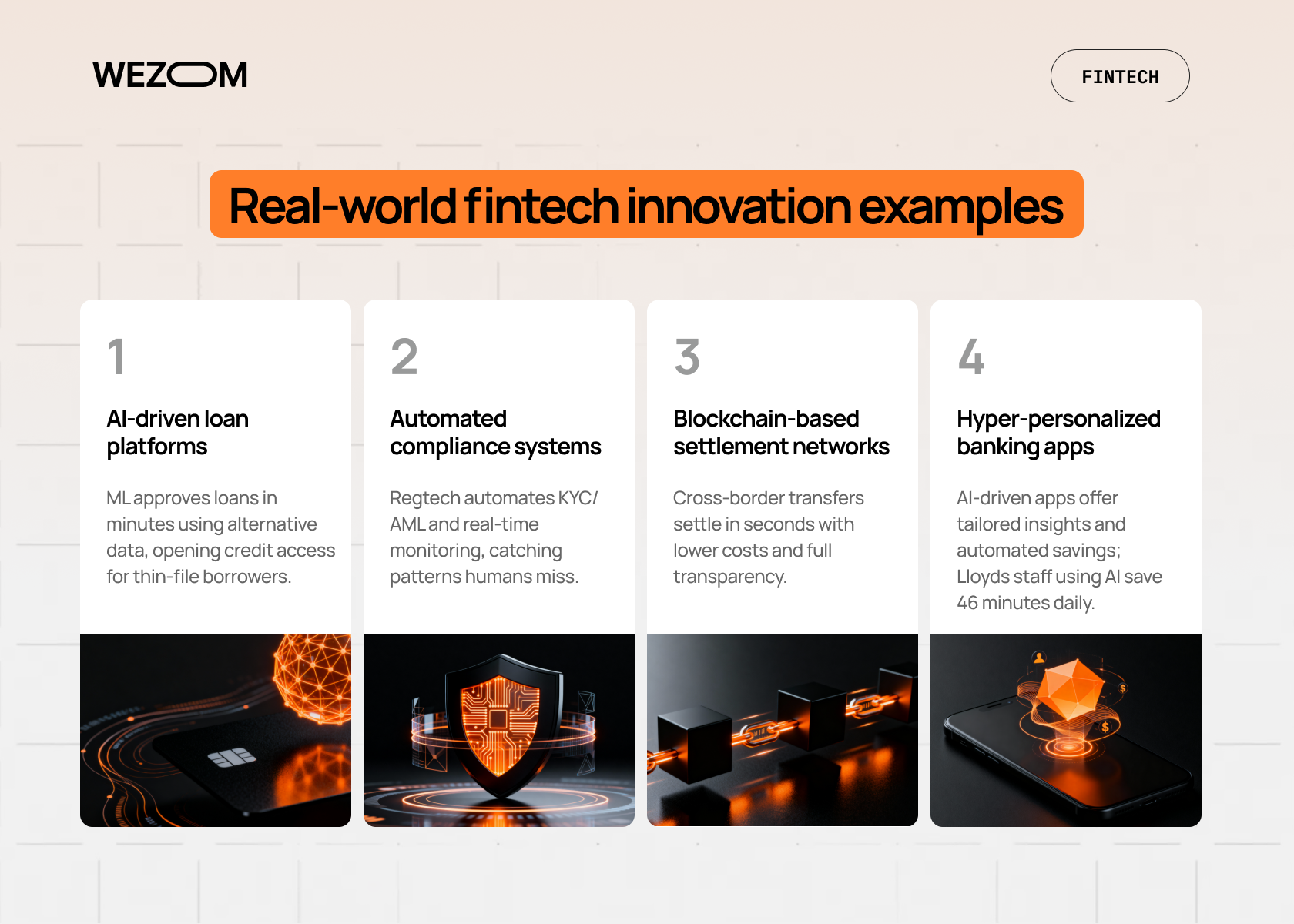
Theory's great. But let's see what's actually working in production:
- AI-driven loan platforms.
Digital lending platforms using predictive analytics and machine learning for credit decisioning are processing applications in minutes, not days. They're using alternative data, not just credit scores, to assess risk. Thin-file underwriting is bringing financial services to people traditional banks wouldn't touch.
- Automated compliance systems
Regtech platforms automating KYC, AML monitoring, transaction screening, and regulatory reporting. Real-time anti-money laundering systems catching suspicious patterns humans would miss.
- Blockchain-based settlement networks.
Cross-border payment networks using blockchain for instant settlement. What used to take 3-5 business days now happens in seconds with full transparency and lower fees.
- Hyper-personalized banking apps.
Neobanks use AI to deliver personalized financial advice, spending insights, and automated savings. Lloyds Banking Group reported that 93% of staff using AI save 46 minutes daily. That's productivity at scale.
But it's not just about internal efficiency. Customers are getting personalized experiences that feel custom-built for their financial situation. AI analyzes spending patterns, predicts cash flow crunches, and suggests optimal savings strategies.
Digital banks like Chime went public at a $9.8 billion valuation in Q2 2025. Monzo reported £113.9 million profit for the year ending March 2025 — an eightfold increase. These aren't startups anymore; they're profitable financial institutions with millions of customers.
The secret? They built their tech stacks for personalization from day one. Every customer interaction feeds the AI. Every transaction refines the recommendations. The result is banking that actually feels helpful, not bureaucratic.
Fintech strategy for companies entering 2026
So, you want to compete in this space. Here's what you need to know.
Not every trend matters for your business. Focus on:
- Customer pain points you can actually solve.
- Regulatory requirements that'll hit in the next 12-18 months.
- Technologies that create actual competitive advantage (not just cool features).
- Scalability from day one — fixing architecture later is painful and expensive.
Here's the reality: you can't do everything. The companies that succeed pick three core capabilities and execute them brilliantly. Everything else? Partner or buy.
Fintech M&A deals rose to 205 in Q2 2025. That's significant growth.
Two of the most prominent M&A deals went to blockchain companies. Coinbase acquired Deribit for $2.9 billion. Stripe acquired Privy for white-label crypto wallet infrastructure. These aren't acqui-hires, they're strategic plays for infrastructure control.
Xero's $3 billion acquisition of Melio (accounts payable/receivable) was the largest of the quarter. That ties directly into the surge in B2B fintech interest we discussed earlier.
In 2025, nearly half of VC-backed fintech acquisitions were made by other VC-backed companies, up from roughly a quarter in 2021. Private consolidation is becoming a viable strategy for companies struggling with valuation overhang from the zero-interest-rate era.
Circle went public in June at a $6.9 billion valuation. The IPO pipeline is reawakening, with eToro successfully listing and potential debuts from Chime and others on the horizon.
Build vs. buy vs. partner: a framework. This is probably the most important decision you'll make. Build when it's your core differentiator. If it's what makes you unique in the market, build it. Own it.
Buy when it's commodity infrastructure. Payments processing, KYC, fraud detection — these problems are solved. Don't reinvent wheels.
Partner when you need market access or regulatory licensing fast. Over 65% of incumbents now partner with or acquire fintechs. That's an opportunity.
Don't wait for regulators to force your hand. Map upcoming requirements now:
- EU AI Act high-risk obligations (August 2026);
- MiCA licensing deadlines (mid-2026);
- State-level AI disclosure requirements in US;
- DORA IT resilience standards.
Build your product roadmap around these. Companies that get ahead of regulation have 18-24 months of competitive advantage while others scramble to catch up.
Your 2026 roadmap should address:
- AI integration (where can it create real value?);
- Compliance preparation (what's legally required by when?);
- Infrastructure modernization (cloud-native, API-first);
- Security enhancements (zero-trust, biometric auth);
- Partnership opportunities (who fills your gaps?).
Conclusion
Fintech in 2026 comes down to one thing: execution.
The playbook exists. AI integration with compliance. Cloud-native architecture. Real-time processing. Security-first development. Regulatory-by-design systems. The companies dominating 2026 are the ones implementing these today, not planning for tomorrow.
The market's growing toward $1.1 trillion by 2032. Opportunity is real. But only if you execute with precision.
Build for scalability. Design for compliance. Prioritize security. Move with intention.
That's what we do. We build production-ready fintech infrastructure — compliant AI, cloud-native systems, real-time processing, regulatory frameworks. We help companies execute on their 2026 strategy with technical rigor and regulatory clarity.
Let's build your fintech infrastructure. Contact us to discuss architecture, compliance, AI implementation, or strategic technology decisions.
The infrastructure exists. The regulations provide clarity. What's left is execution, and we're here to help.

FAQ
How is AI transforming financial technologies in 2026?
AI's moved beyond experimental. The AI in the fintech market reached $30 billion in 2025, with 88% adoption among top performers. It's automating fraud detection (40% reduction in losses), powering credit decisions (60% of digital lending), and handling 78% of customer queries without human intervention.
The technology saves the industry an estimated $120 billion in 2025 alone. We're seeing autonomous decision systems, predictive analytics, and natural language processing delivering measurable ROI — not just efficiency gains, but new revenue models through hyper-personalized advisory services.
What new regulations affect fintech software development in 2026?
The EU AI Act's high-risk system obligations take effect August 2026, requiring financial institutions to map and remediate AI deployments with strict transparency and auditability requirements. MiCA's 18-month transitional period ends mid-2026, creating a single EU crypto licensing regime.
In the US, the GENIUS Act established federal stablecoin regulation (July 2025), while states like Colorado require AI lending disclosure (SB 24-205, effective February 2026). DORA strengthened IT resilience requirements across EU financial services.
What is the role of blockchain in modern financial systems?
Blockchain's evolved beyond cryptocurrency speculation into practical financial infrastructure. We're seeing tokenization of assets, supply chain finance, and clearing systems running on distributed ledgers.
The GENIUS Act provided regulatory clarity for stablecoins, while MiCA created passportable crypto licensing across the EU. Institutional adoption is real — Coinbase's $2.9 billion Deribit acquisition signals serious infrastructure investment.
The European Central Bank's digital euro pilots could begin in 2027. Blockchain now powers cross-border payments with instant settlement, transparent audit trails, and reduced counterparty risk. It's about fundamental redesign of market infrastructure, not speculation.
How is digital identity changing in fintech?
Passwordless authentication became mainstream — biometric authentication is now used in 70% of fintech logins globally. Digital identity verification startups saw 85% funding growth year-over-year.
We're moving to zero-trust security architectures with behavioral biometrics, liveness detection, and multi-factor authentication beyond passwords. Real-time anti-money laundering systems operate in over 75 countries.
This shift addresses both fraud prevention and regulatory compliance while enabling faster onboarding, better user experience, and stronger security.
What skills are required for fintech software development?
Modern fintech development requires both technical depth and regulatory awareness. Core technical skills include cloud-native architecture (microservices, Kubernetes), AI/ML implementation for risk scoring and personalization, API design, real-time data processing, and cybersecurity.
Equally important are understanding financial regulations (EU AI Act, MiCA, DORA, state-level requirements), data governance frameworks, and compliance-by-design principles.
Security-first development practices, experience with regtech tools, and familiarity with payment infrastructure (ISO 20022, instant settlement) are essential. The best teams combine engineering excellence with deep domain expertise and regulatory literacy.
