
The transition to UAV-based inspections is primarily an attempt to prevent costly downtime and eliminate risky work at height. Actually, that’s why UAV inspections are becoming the standard for industries where infrastructure requires continuous monitoring without interrupting production processes. But how are such solutions created, and what challenges are involved in their development? Let's find out right now.
What Are Industrial Drone Inspections?
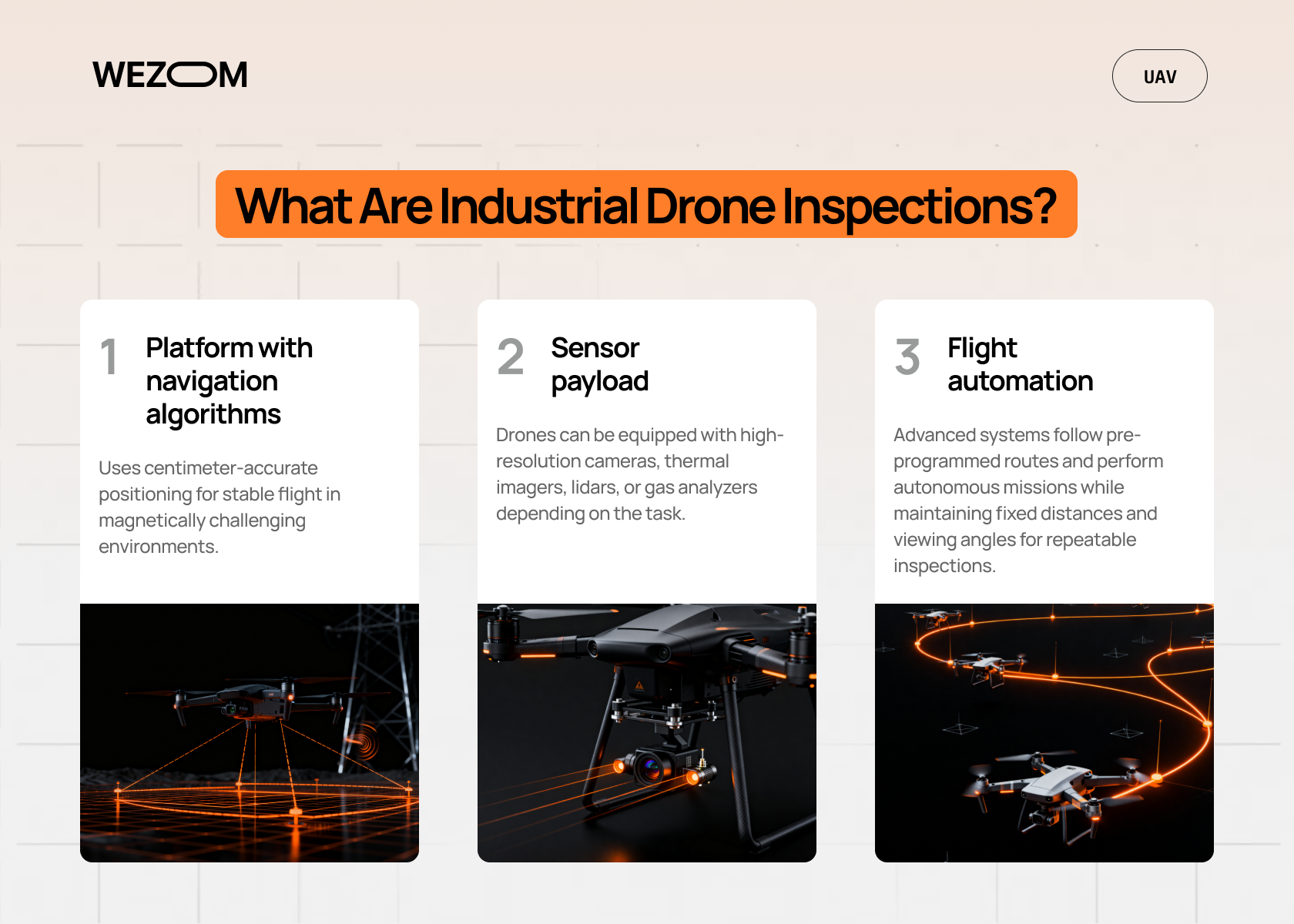
Industrial drone inspections combine both surface inspections of industrial facilities and remote non-destructive testing, where unmanned aerial systems play the main role. Specifically, such inspections involve collecting high-precision visual/thermal/laser data on objects that are difficult or too expensive to access using conventional methods.
From a technological standpoint, industrial UAV operations are built on three pillars:
- Platform with navigation algorithms. This involves the use of centimeter-accurate positioning systems that allow drones to maintain their position even in conditions of strong magnetic interference, particularly near power lines or inside metal structures.
- Sensor payload. Depending on the task, drones are typically equipped with either high-resolution cameras, thermal imagers with radiometric sensors, lidars (used to generate 3D point clouds), or gas analyzers.
- Flight automation. The most advanced solutions operate along pre-programmed trajectories, with all drones in the system able to perform missions autonomously via waypoints. This means they are enriched with the ability to maintain a preset distance to objects and viewing angles, allowing them to repeat the same mission over time (taking into account previously collected data).
Main Benefits of Industrial Drone Inspections
If everything is built correctly, industrial drone inspection systems offer businesses significant advantages. Specifically, here's what we're talking about.
Increased Operational Efficiency
UAV-based inspection significantly impacts both metrics measuring efficiency in industry – task completion time and the cost of resources expended on the process.
In particular, for tasks that would take several days for a crew of climbers (for example, the typical time for full surveying of a single chimney or power transmission tower), a drone can complete a full survey in just 20-30 minutes. This means scheduled inspections can be carried out more frequently, allowing the company to finally implement a proactive maintenance strategy.
Downtime is also reduced, which is critical in the energy and petrochemical industries (as standard inspection methods require a complete shutdown of equipment to ensure personnel safety). UAVs equipped with powerful zoom and thermal imaging cameras, on the other hand, conduct diagnostics of operating equipment from a safe distance, meaning the company can continue generating profits without interrupting operations.
Improved Safety
In the industrial sector, safety relates to both maintaining employee health and minimizing legal risks. In this regard, UAV-based inspections reduce the need for work at height, thereby eliminating the need to dispatch personnel to high-risk sites, which is statistically considered the main cause of injuries in the energy and construction industries.
Furthermore, this approach to inspections reduces exposure to aggressive environments, which is typical in the petrochemical industry, where workers can inhale toxic fumes or spend extended periods in areas with elevated radiation levels.
Finally, UAVs help ensure compliance with safety standards such as ISO/OSHA, as the digital trace of each flight serves as direct evidence that the inspection was conducted according to regulations.
Enhanced Asset Monitoring
Unmanned aerial solutions help companies introduce proactive maintenance of assets. Specifically, this is achieved through real-time data collection (implemented through integration with 5G and secure communication channels), with drone telemetry transmitted directly to a situational awareness center, enabling experts to make immediate decisions.
It's also worth noting that regular overflights enable the accumulation of datasets for training neural networks, meaning that over time, AI integrated into company processes will be able to predict asset deterioration months before it becomes visible.
Finally, UAVs enable the creation of digital twins (based on LiDAR point clouds/photogrammetry), allowing companies to monitor asset degradation in real time throughout their entire service life.
| Criteria | Conventional inspection methods | UAV inspections |
|---|---|---|
| Time to implement | Days or months | Minutes or hours |
| Safety | High risk of injury | Zero risks for employees |
| Total cost of ownership | High | Low (OPEX reduction by 50-70% for specialist visits to the inspection point) |
| Precision | Dependent on the inspector's vision | Objective |
| Availability | Limited due to the need for cranes, climbers, etc. | High, as it opens access to hard-to-reach and hazardous areas |
| Downtime | Often requires a complete shutdown of the facility | Conducted without interrupting work processes |
Industries Using Drone Inspection Solutions
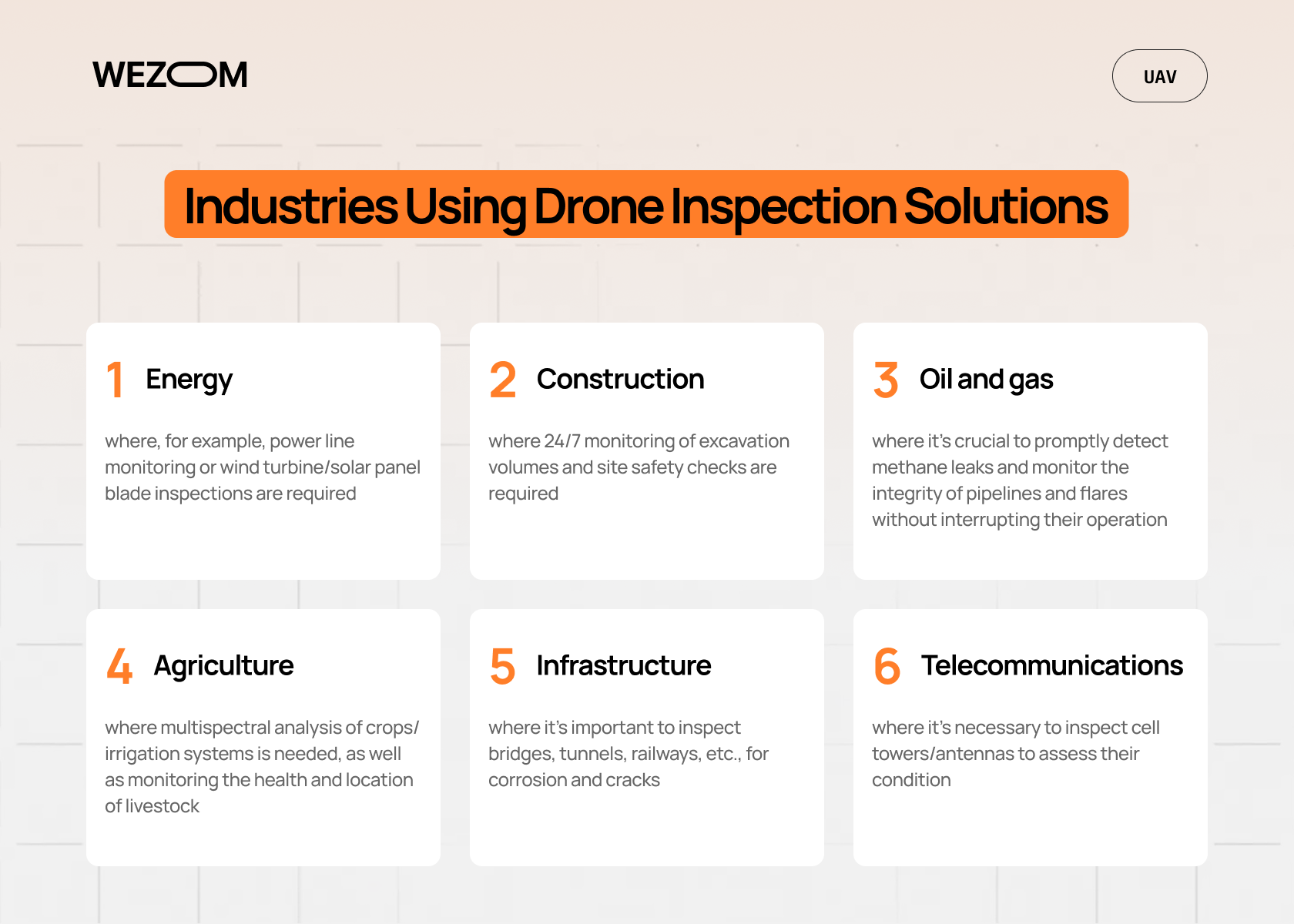
Drone-based industrial inspection solutions are finding effective application in the following sectors:
- Energy, where, for example, power line monitoring or wind turbine/solar panel blade inspections are required;
- Construction, where 24/7 monitoring of excavation volumes and site safety checks are required;
- Oil and gas, where it’s crucial to promptly detect methane leaks and monitor the integrity of pipelines and flares without interrupting their operation;
- Agriculture, where multispectral analysis of crops/irrigation systems is needed, as well as monitoring the health and location of livestock;
- Infrastructure, where it’s important to inspect bridges, tunnels, railways, etc., for corrosion and cracks;
- Telecommunications, where it’s necessary to inspect cell towers/antennas to assess their condition.
Technologies Behind UAV Industrial Inspection
Here are some technologies that underlie the average UAV industrial inspection solution.
AI and Computer Vision
Modern developers often use hybrid neural network architectures, where some models are optimized for onboard edge computing, while others handle deep analysis tasks in cloud clusters.
As for object/defect detection, ensembles of models come in handy, as they minimize false negative results (since they are trained on proprietary datasets with high variability). For example, using YOLOv8 will allow your solution to process a video stream in real time at up to 30 FPS, which is crucial for immediate pilot response.
Additionally, it makes sense to consider implementing semantic segmentation (for example, using DeepLabV3+) instead of bounding boxes. This will allow you to accurately calculate the damage area, which is essential for planning the scope of restoration/repair work. Thus, the algorithms underlying your project will segment images at the pixel level, distinguishing normal metal from that covered in corrosion and other damage.
Finally, it's important to adapt the solution to GPS-negative zones (particularly under overpasses and inside storage tanks). Since your drone will rely on visual odometry, it will require ORB-SLAM3 algorithms, which analyze feature descriptors in stereo camera footage. This means your software can automatically construct a sparse point cloud to prevent collisions between the drone and an object.
IoT Ecosystem
Here, we're talking about integrating your UAV fleet into an Industrial Internet of Things topology, where M2M protocols come to the rescue. For example, to transmit telemetry and high-priority alerts, we use MQTT with configured Quality of Service parameters. This helps us guarantee the delivery of messages about critical changes in inspection environments, even with an unstable communication channel. For more complex distributed systems, it makes sense to implement a DDS protocol, which ensures direct data exchange between the drone, ground station, and the control center.
Furthermore, it's important to understand that the logic of any UAV-based inspection system is built on API interaction, with stationary sensors acting as triggers. When indicators exceed reference values, the control server must immediately send a flight task to the drone (this should be implemented via a REST API). This allows the UAV to fly out to verify the anomaly, transmitting a video stream directly to the situation center.
Radiometric Thermography
Your system needs to handle massive amounts of temperature data in RAW format. FLIR Tau 2/Duo Pro R sensors are ideal for collecting this data, capturing temperature values at every pixel, enabling in-depth post-analysis in the cloud.
Furthermore, your software should be able to automatically adjust values based on material emissivity, distance to the object, and air humidity. Otherwise, you risk false positives caused, for example, by sun glare on metal surfaces.
LiDAR for High-Precision 3D Scanning
Since laser scanning is the only way to obtain precise physical parameters of an object regardless of lighting conditions, it’s important to include point cloud processing algorithms (since lidar generates up to 2 million points per second, processing an array of this size will require specialized noise filtering/normalization algorithms). Actually, architectures such as PointNet++, which are originally designed for automatic classification of objects in a point cloud, are particularly useful here.
Another critical point is to implement the identification of dangerous proximity, for example, through algorithms for calculating wire sag vectors and their distance to vegetation. This will allow your system to automatically detect areas where the distance to tree canopies is less than the specified limit.
Cloud Analytics and Digital Twins
At this stage, the data collected by the drones is transformed into management decisions. To make this a reality, we build a scalable pipeline (for example, based on Apache Kafka and Kubernetes) necessary for efficiently processing terabytes of data using distributed computing. Specifically, to achieve this, we deploy processors in Kubernetes containers, while Apache Kafka orchestrates task queues such as orthophoto stitching and PDF report generation.
As for digital twins, you’ll need to implement time series comparison so that the system can superimpose a new 3D model on the historical one. Automatic comparison algorithms will be useful in this context, as they will help identify deformations and structural tilts that are currently only visible over time.
Drone Inspection Workflow
A professional inspection process requires a strict sequence of stages, with each of them impacting the validity of the report.
Mission Planning
Everything starts with geospatial data analysis. For this, we import KML/KMZ and LOD terrain models (which is necessary for configuring the function in which the drone maintains a constant altitude relative to the terrain based on radar data or an uploaded digital model). Next, we calculate the ground sample distance mathematically, which will be needed for the effective detection of microcracks no wider than 1-2 mm.
Finally, it's important to consider the overlap strategy (this is necessary for creating high-quality digital twins). To achieve this, we specify excessive frontal overlap (80-90%) and lateral overlap (75%), which, in turn, allows structure-from-motion algorithms to find a sufficient number of tie points even on homogeneous textures.
Data Collection
At this stage, the UAV should handle complex geodetic tasks such as RTK/PPK positioning. Dual-frequency L1/L2 RTK modules are likely to be useful here, providing real-time image coordinate correction with an accuracy of a few centimeters. As for areas with unstable connectivity, it's best to use the PPK method, where satellite data is recorded in a log and adjusted during post-processing relative to a stationary base.
Another important task is to implement control of the survey vector through Gimbal Pitch and Yaw automation. This will allow you to inspect vertical surfaces of bridges or power line supports, where the camera must maintain a 90° angle to the object's plane.
Also, don't forget to simultaneously record an extended log in .DAT or .CSV format along with the media files, which will include roll/pitch/yaw angles, as well as wind speed, humidity, and battery temperature. This will ensure the thermal imaging data you collect is accurate.
Data Processing
Now, your system can begin orchestrating processing. This is implemented via compute nodes (for example, based on Pix4Dengine) in Docker containers. This allows your system to synchronously process thousands of images, creating orthophotos and point clouds. However, before all this data is processed for analytics, you'll need to implement a quality assurance layer (in modern solutions, this is AI-based) to filter out frames with motion blur and those where inspection objects are obscured by obstacles. This can save you up to 30% of resources in the final rendering.
Finally, the results must be calibrated against ground control points; otherwise, you won't be able to guarantee the required accuracy of the 3D model in global coordinate systems.
Reporting
Since you need to obtain structured data that can be used in business logic decisions, you will have to develop a web portal where all anomalies are marked on a 3D model (it's important to include metadata such as the defect type, its severity, as well as its coordinates).
Also, as all data must be transferred to other digital systems within the company, it's crucial to implement a high-quality API and, of course, don't forget the system's ability to generate industry-standard reports.
Limitations
Despite technological maturity, the widespread use of UAVs for inspection missions faces a number of barriers.
Regulatory and Legal Restrictions
Legal frameworks for UAVs aren’t yet fully defined – the problem is that technical capabilities currently outpace legislation.
This primarily concerns flights beyond visual line of sight, which are essential for inspecting pipelines and power lines. Obtaining permits for these operations requires, in addition to pilot certification, the presence of onboard detect-and-avoid systems and backup communication channels. To overcome this problem, it makes sense to integrate Remote ID software modules – they transmit the drone's identifier and coordinates to government air traffic monitoring systems in real time.
It's also important to understand that the use of standard software is often prohibited at critical infrastructure facilities, so companies are forced to build air-gapped systems with custom firmware and proprietary encryption protocols, where drone data is transmitted only through secure local channels without access to the global network.
Environmental Limits
The inspection must be carried out on schedule, regardless of weather conditions. Therefore, the UAV-based system must be climate-resistant (while standard drones lose up to 40% of their battery capacity at temperatures below -10°C, their industrial counterparts must be equipped with active cell heating systems and have a housing made of composite materials resistant to embrittlement).
Furthermore, the system must be electromagnetically compatible; otherwise, when inspecting ultra-high-voltage power lines, the drone will inevitably encounter induced currents and magnetic fields, which will disrupt its compasses and navigation modules. Specifically, to address this, you will need to use visual odometry-based positioning systems and redundant magnetometers with shielding to ensure the device remains operational near live wires.
The Data Processing Gap
Data collection is no longer as complex as filtering it. For example, just one day of filming generates up to 500 GB of data in RAW formats and point clouds. Technically, transmitting such a volume over cellular networks is impossible, while manually processing it is extremely resource-intensive and can take weeks.
As a solution, we recommend considering the integration of Edge AI, specifically on-board processing algorithms that automatically remove uninformative frames, retaining only anomalies, and send only compressed incident metadata to the cloud. As for 3D model rendering, it should be migrated to GPUs with automatic task prioritization. This will significantly minimize the load on communication channels.
Complexity of Integration into Legacy Processes
Industrial inspection drones are often perceived as standalone devices, which creates a disconnect between informational and operational technology.
More precisely, the data collected during inspections (namely, defect photos) must be instantly transferred to asset management systems. If you don't have standardized APIs for your legacy enterprise software, you'll need to create intermediate layers (usually, this is a custom development task). These layers will essentially take on the role of translating data from the drone cloud to the enterprise database.
CAPEX vs OPEX
The high entry threshold often confuses business owners. The cost of the hardware itself accounts for only 30% of the implementation budget, while the remaining 70% goes toward developing the methodology and training certified operators. If you add to this the need for risk insurance and IT infrastructure support, it will become clear that the initial project budget can put a significant dent in a company's budget.
At the same time, companies often evaluate the benefits solely through the prism of savings on industrial climbers. But the true profit lies in reducing unscheduled downtime, meaning that even preventing just one accident at an object through an in-time defect detection will fully pay for the entire UAV fleet for years to come.
How to Choose the Right Drone Inspection Solution
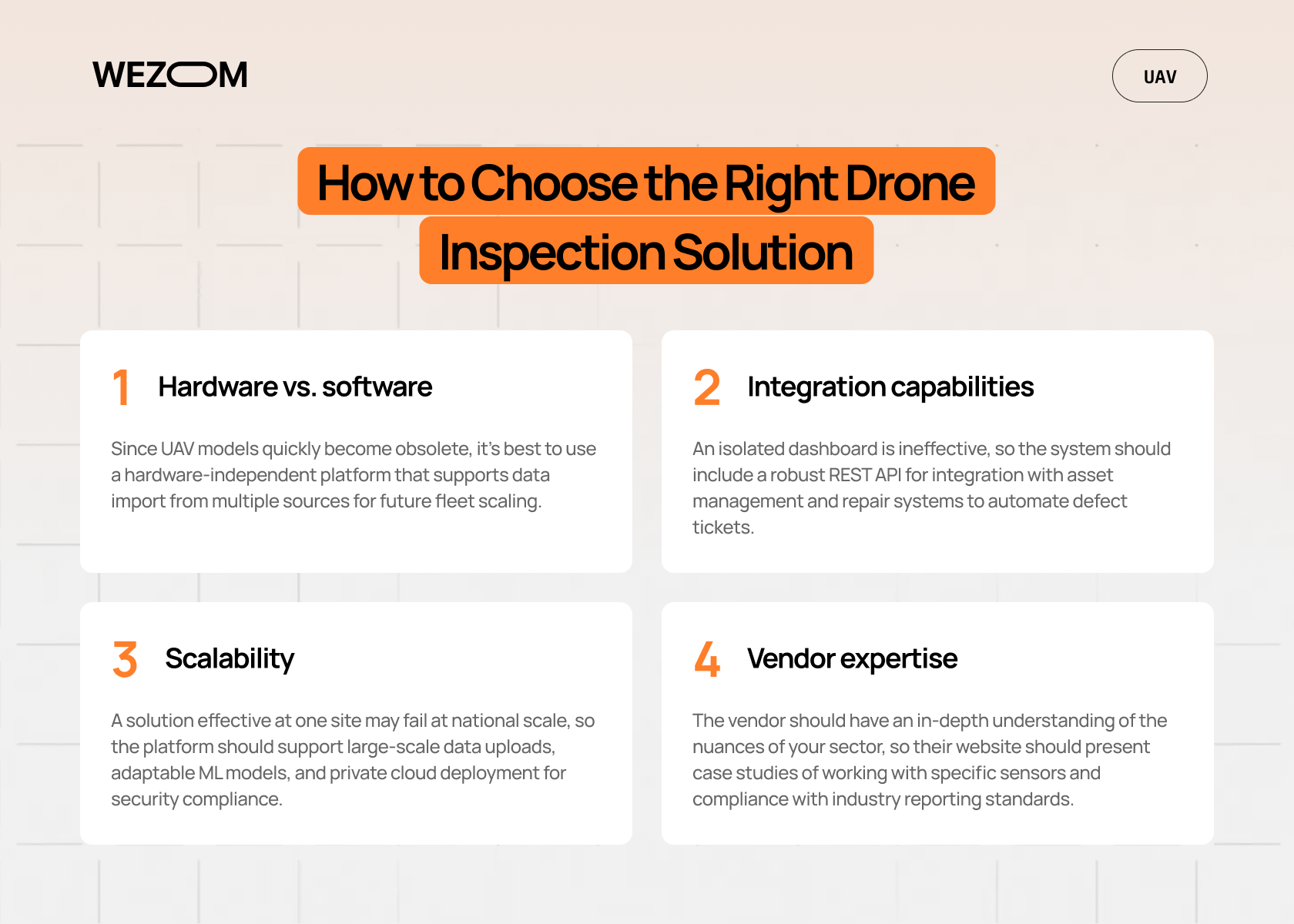
When choosing drone inspection solutions, we recommend evaluating them based on four criteria:
- Hardware vs. software. Since specific UAV models quickly become obsolete (while data remains forever), it's best to look for a solution that isn't tied to a single hardware manufacturer. This means the software platform should support data import from various sources (this will allow you to scale your fleet in the future without replacing the entire software).
- Integration capabilities. An isolated dashboard with photos won't provide any benefit. Therefore, the ideal system should have a well-developed REST API for seamless integration with your internal asset management systems and repair planners. This will allow you to automate the creation of tickets for defect resolution.
- Scalability. A solution that demonstrates top-notch performance at a single site may prove of little use when attempting to scale nationwide. Actually, that’s why it's so important to ensure that the vendor's cloud allows for simultaneous data uploads from 50 regions, that its ML models can quickly learn to handle new types of objects, and that the solution itself can be deployed in a private cloud to meet industry/corporate security requirements.
- Vendor expertise. The vendor should have an in-depth understanding of the nuances of your sector, so their website should present case studies of working with specific sensors and compliance with industry reporting standards.
Future Trends in Industrial Drone Inspections
In recent years, we have been gradually moving from implementing isolated missions for controlled aerial vehicles to fully autonomous agents. In this regard, we bet on the following trends in industrial inspection:
- End-to-end AI automation, where onboard systems become capable of adjusting flight missions in real time will become ubiquitous (i.e., if a neural network installed on them detects a suspicious object, the drone will automatically change its trajectory, take photos, and return to its main route);
- Drone-in-a-box with full autonomy, where a station is installed at a remote site, and the drone itself takes off on a schedule (to conduct an inspection, return, and upload data without human intervention);
- Integration with digital twins, where data collected by UAVs becomes the primary source of truth for dynamic digital twins, which, in turn, enables simulations;
- Zero-latency analytics, coupled with the development of 5G networks and lossless data compression protocols, means the delay between a detected damage and its appearance on a manager's dashboard will be a fraction of a second (which will enable the use of drones for rapid incident management).
Conclusion
As we can see, using UAVs for industrial inspections significantly reduces operational risks and allows companies to eliminate dangerous manual labor. Therefore, if you're still hesitant to implement them, now is the perfect time.

FAQ
What industries use drone inspections?
These are sectors with distributed or high-altitude infrastructure, such as energy, oil and gas, construction, telecommunications, and transportation.
Are drone inspections safe?
Yes, because they eliminate the need for inspectors to be at height and in risky areas.
How do drones improve inspection efficiency?
Efficiency is achieved by reducing inspection time by 5-10 times, and the ability to conduct inspections without interrupting production processes.
Are drone inspections cost-effective?
The ROI of such projects is typically achieved within the first 6-12 months after implementation due to reduced costs for specialized equipment, reduced staffing of aerial crews, and early defect detection.
How accurate are UAV inspections?
If an inspection system uses RTK positioning and high-precision optics, the georeferencing accuracy of images will be only 1-3 cm. If it's based on LiDAR scanners, developers can achieve 3D modeling accuracy down to millimeters.
Can drones replace manual inspections completely?
At the data collection stage, replacement can be completed by 90-95%, but it’s still important to leave the final decision and verification of critical defects to live inspection specialists.
