
In today's SaaS industry, security is no longer a selling point – it's a requirement. Large corporations are looking for auditable proof that your data management within the platform won't fail them at the first attack. This is why it's so important to ensure your SaaS solution complies with ISO/IEC 27001, as it transforms chaotic attempts to protect everything into measurable business processes. Below, as a company specializing in tailoring SaaS solutions to this standard, we’ll answer the question: “What is ISO 27001?” and share our expertise on this topic.
Why Companies Actually Start ISO/IEC 27001
First, let’s answer the question: “What is ISO 27001 certification?”. Based on the generally accepted ISO 27001 meaning, it’s the international standard for information security management systems that helps companies identify and reduce confidentiality risks caused by people, processes, and technology.
As for real businesses, ISO 27001 implementation is typically driven by specific market triggers. So, to understand why ISO 27001 certification is important, we’d like to determine the four main drivers for SaaS providers in the US and Europe:
- Enterprise procurement requirements (RFPs, security questionnaires). If your sales team spends weeks filling out multi-page security questionnaires from Fortune 500 prospects, you definitely have an efficiency problem. This is where ISO 27001 certification comes in handy – it increases sales velocity and sometimes even allows you to bypass about 80% of routine checks during the RFP process. Conversely, without this certification, you risk getting stuck in the pre-sales stage for months or even being eliminated from the tender altogether.
- Investor due diligence during funding rounds. When evaluating SaaS startups, investors and venture capital funds check both MRR and churn rate, as well as technology risks, so the lack of a systematic security approach is essentially a red flag. At the same time, the ISO 27001 standard confirms that intellectual property and client data are protected at the corporate cultural level.
- Regulatory and data protection pressure. Although ISO 27001 is a voluntary standard, it can be used as the best way to demonstrate compliance with the GDPR and CCPA. Specifically, the standard helps systematize PII, which is important for SaaS platforms in the FinTech, HealthTech, and HR-tech sectors. Moreover, it will help you make informed answers when your clients ask questions like, “How do you guarantee privacy?”.
- Client trust and risk management. Today, a data breach can destroy a SaaS vendor's reputation in a single day, so ISO 27001 serves as insurance against this. Because clients need to know that your employees don't have uncontrolled access to their data, with this certificate, your backups will be verified, and incidents will be handled according to a clear protocol.
If you've encountered any of the above issues and don’t understand how to get ISO 27001 certification on your own, feel free to contact us.
Common ISO 27001 Misconceptions That Slow Companies Down
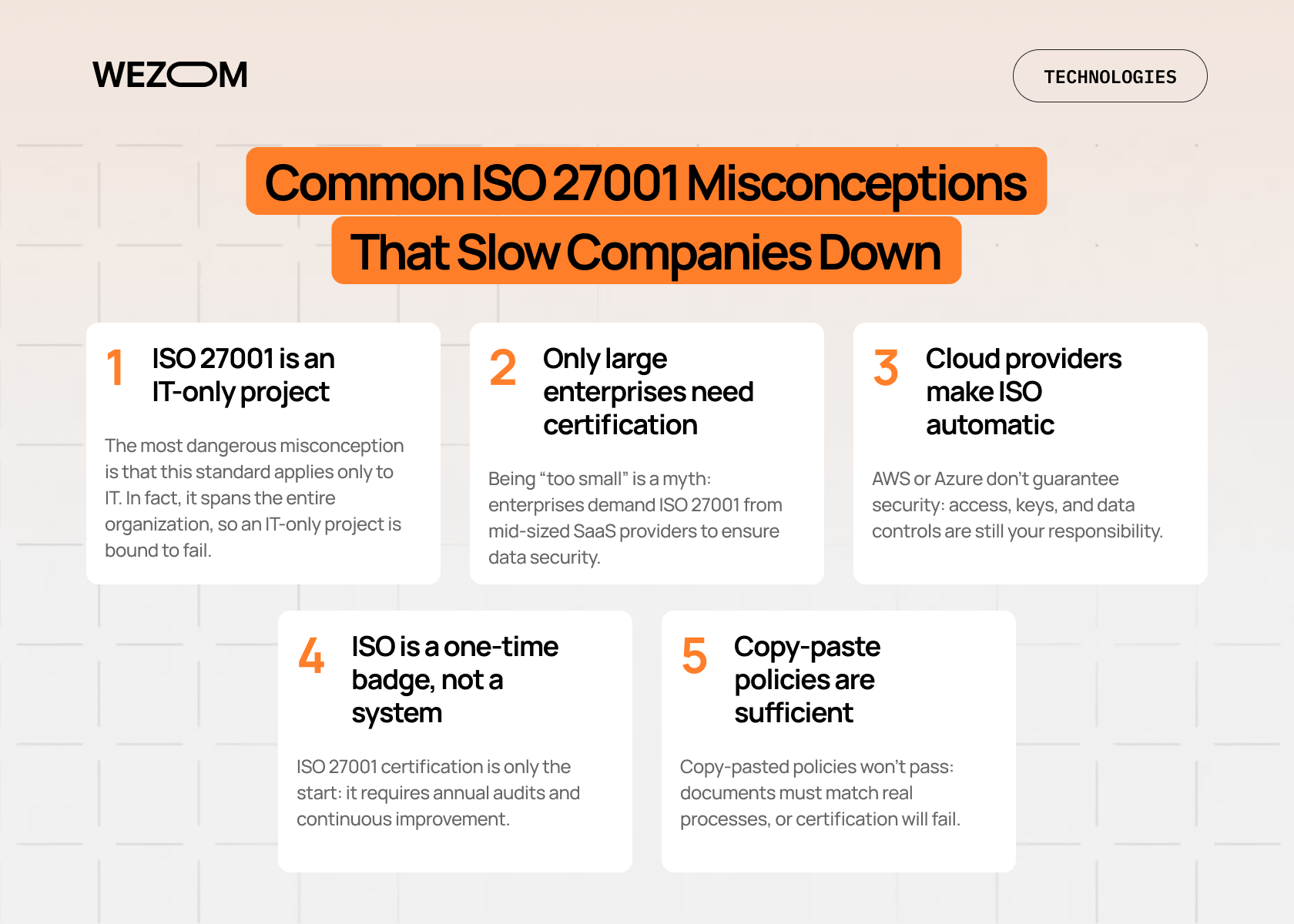
Our experience shows that the main delays and failures occur in meeting rooms and administrative processes. Therefore, to successfully navigate the ISO 27001 certification process, management must dispel a number of common misconceptions.
ISO 27001 is an IT-only project
This is the most common and dangerous misconception. In reality, this standard covers everything from how HR screens employees during hiring to how the sales department handles private client data. Therefore, if a project is limited to the IT department alone, it is doomed to failure.
Only large enterprises need certification
Do you think your company is too small for this and that only giants need certification? That's not true – in modern supply chains, mid-market companies are the weak link, as enterprise clients demand ISO 27001 certification from smaller SaaS providers to get guarantees that their data is as securely protected as that of their larger competitors.
Cloud providers make ISO automatic
Are you confident in security simply because you're hosted on AWS or Azure? That's not entirely true – cloud providers are only responsible for cloud security, not for security within it. Specifically, your access settings, key management, and data management policies are your responsibility, so the auditor will review them separately.
ISO is a one-time badge, not a system
ISO 27001 is a management system, so obtaining the relevant certification is just the beginning of your journey. Specifically, this standard requires annual audits and continuous improvement cycles.
Copy-paste policies are sufficient
You can't simply copy policy templates from the internet, as world-class auditors will instantly recognize copy-pasting. The policies you define must reflect your company's actual processes. Therefore, if a document states one thing, but employees implement something else, it's a guaranteed failure.
Where SaaS Companies Fail Most Often
Based on our experience in preparing companies for certification, we can identify three black holes that consume their resources.
Incorrectly defining the scope (too narrow to build trust or too broad to manage)
A scope that's too narrow won't inspire clients’ trust, while one that's too broad (for example, when it encompasses the entire company and all its subsidiaries) will become an unmanageable slab that will choke your business with bureaucracy. The right approach to achieving ISO 27001 certification is to find a happy medium that covers the main SaaS business processes.
Underestimating risk assessment depth (treating it as a checkbox exercise)
Many people treat risk management as just another item on a to-do list. But ISO 27001 is built around risks, so if your assessment doesn't take into account the specifics of SaaS (for example, the risk of supply chain compromise through open-source libraries), the auditor will find your system ineffective.
Lack of visible senior management commitment documented in meeting minutes and resource allocation
Visible commitment primarily refers to decisions on budget allocation, discussion of incidents, and active participation in system revisions, all recorded in meeting minutes. Therefore, without senior management involvement, a project becomes a compliance sham, which is exposed at the first audit.
The Most Underestimated Effort in ISO 27001
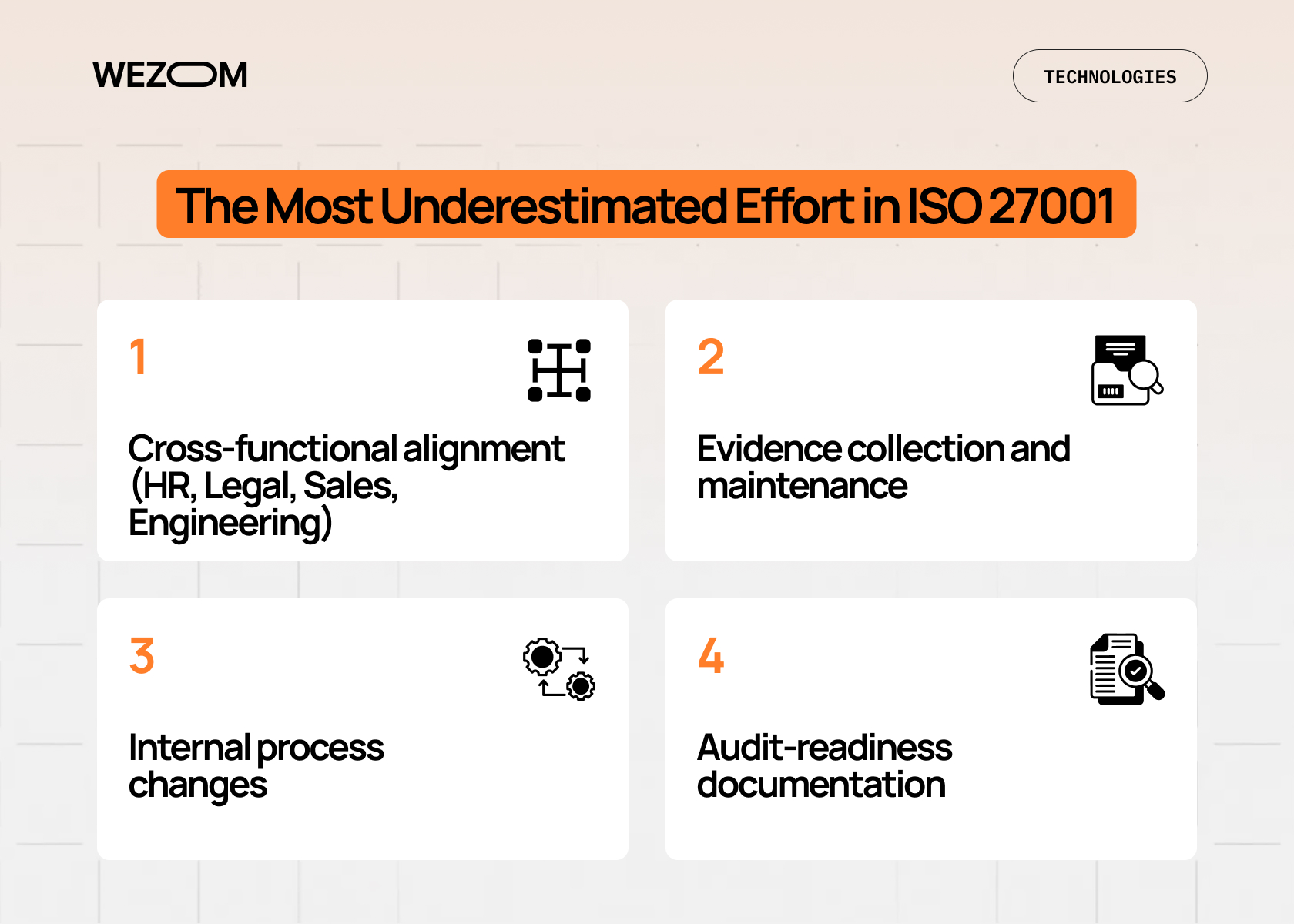
If you ask a company that has been certified what the most challenging part was, they will likely point to the following ISO 27001 certification process steps.
Cross-functional alignment (HR, Legal, Sales, Engineering)
ISO 27001 is an organizational standard, so you'll need to get different departments to work as a unified whole. For example, HR will have to revise candidate screening and onboarding processes; the legal department will have to update contracts with vendors to meet security requirements; the sales department will have to learn to classify client data, and so on. At the same time, synchronizing departments, each with its own KPIs and priorities, is a real challenge, requiring dozens of hours of meetings and approvals.
Evidence collection and maintenance
The main principle of an audit is that if something isn't documented, it doesn't exist. Specifically, the auditor won't believe your claims about conducting access reviews – they'll demand system logs, screenshots of settings, physical signatures on policies, training records for each employee, and so on. As you can understand, organizing the collecting process takes a significant amount of time, as you'll need to build a pipeline that will generate evidence of your compliance 24/7, year-round.
Internal process changes
Our experience shows that this standard forces companies to physically change their traditional ways of working, by implementing a strict change management process and the principle of least privilege (where even the CEO loses access to the client database without a Jira ticket), as well as transforming onboarding/offboarding processes. As a result, you'll likely have to convince top developers that every extra click for security is worth protecting the company's capital.
Audit-readiness documentation
A huge amount of resources goes into translating your processes into the auditor's language. This includes creating a fundamental statement of applicability document, conducting a full internal audit that records all nonconformities, and preparing employees for face-to-face interviews. Each team member must be able to clearly explain the policies under their purview and how to proceed in the event of an incident. Staff training and a dress rehearsal before the external inspector's visit are essential steps, too, as their success accounts for 90% of certification success.
Internal vs External Ownership in ISO 27001
In an environment where time to market determines the company’s success, it's important to properly assign roles in an ISO 27001 project. One of the most common causes of failure is a misunderstanding of the difference between accountability and execution, so the task of meeting ISO 27001 compliance requirements cannot be completely outsourced.
Internal teams must own accountability and governance
Senior management and department heads must retain governance of processes, meaning the HR director should take responsibility for employees’ security, the CTO or Head of Engineering should take responsibility for access management and development security, the CEO should take responsibility for allocation of assets, and so on. The auditor will assess the engagement of internal leaders during interviews, so if only a hired consultant answers the risk question, the company will be deemed non-conforming.
External partners should handle task execution
External partners and consultants can provide significant implementation and methodology benefits by undertaking the initial gap analysis, developing draft policies tailored to your business, and conducting an internal audit prior to formal review. However, all of these processes must still be managed by your own employees, as only this hybrid approach will allow you to retain expertise in-house.
When External ISO 27001 Support Becomes Critical
For many SaaS providers, attempting to achieve ISO 27001 compliance on their own leads to team burnout. For example, we can identify a number of signs that it's time to engage external expertise.
- Tight enterprise deal deadlines. If signing a contract directly depends on obtaining a certificate within the next four to five months, you have no room for failure or time-consuming self-training. An external expert will cut this process in half by using time-tested methodologies and frameworks, ensuring you pass the audit on the first try without sabotaging a crucial deal.
- No internal security ownership. In companies with 200-300 employees, a dedicated CISO position is often lacking, as security functions are distributed among CTOs, DevOps engineers, and system administrators. At the same time, since these specialists already have full-time jobs, they physically lack the resources to deeply analyze the standard and write 50+ detailed procedures and policies. Given this, external technical support can fill this gap by providing you with a qualified expert to take on all the methodological burden.
- Sales pressure tied to certification. When your sales team reports regularly that 70% of your sales funnel is blocked during the security review stage, compliance becomes a matter of your business’s survival. Indeed, as it requires quick responses to complex security questionnaires from enterprise clients, an external partner will be indispensable here, as they can effectively communicate your successes to clients, thereby helping to unlock deals faster.
- Overwhelming documentation requirements. The most exhausting stage of certification is proving to the auditor that your security measures are effective. If your team can't meet the evidence collection ISO 27001 requirements and doesn't understand how to link the risk map to specific version controls for 2022, the project could stall. Along with this, an external expert can help you collect these documents and implement and configure compliance automation tools, automating all these processes.
Perhaps you're looking for an external expert to help you with your ISO 27001 certification? If so, write or call us!

Real Consequences of Getting ISO 27001 Wrong
When meeting ISO 27001 certification requirements becomes a formality, a company faces a number of bad consequences.
Delayed or lost enterprise contracts
In the enterprise sector, ISO 27001 certification is often a binary requirement: either you have it, or the deal is impossible. If you don't receive the certificate on time due to scope errors or a failed audit, your window of opportunity to close deals closes, too, as clients won't wait six months for your next attempt and will simply choose a competitor who has already proven their reliability.
Re-audit costs and extended timelines
The certification process is expensive – fees charged by reputable bodies run into the thousands of dollars, and these fees are non-refundable in the event of failure. Therefore, failure in the first or second stage of an audit entails a number of additional expenses: additional consulting hours, repeat auditor visits, etc. Consequently, a project that was supposed to last five months takes over a year, draining your budget and your team's resources.
False sense of security
The worst thing that can happen is a nominal ISO 27001 assessment without a real transformation of the security culture. When management believes that the presence of a logo on a website automatically protects the company, it creates the illusion of security, while critical vulnerabilities remain unpatched and employees continue to violate protocols.
Failure to prevent real incidents
If your regulations exist only as PDFs for auditors, they won't save you during a real attack. For example, in the case of ransomware incidents or insider leaks, a lack of practice will lead to costly downtime. Furthermore, ISO 27001 accreditation, if security measures are neglected, will be an aggravating factor in court, as regulators and clients will perceive it as deliberate misrepresentation.
Practical Pre-Start Advice Before Launching ISO 27001
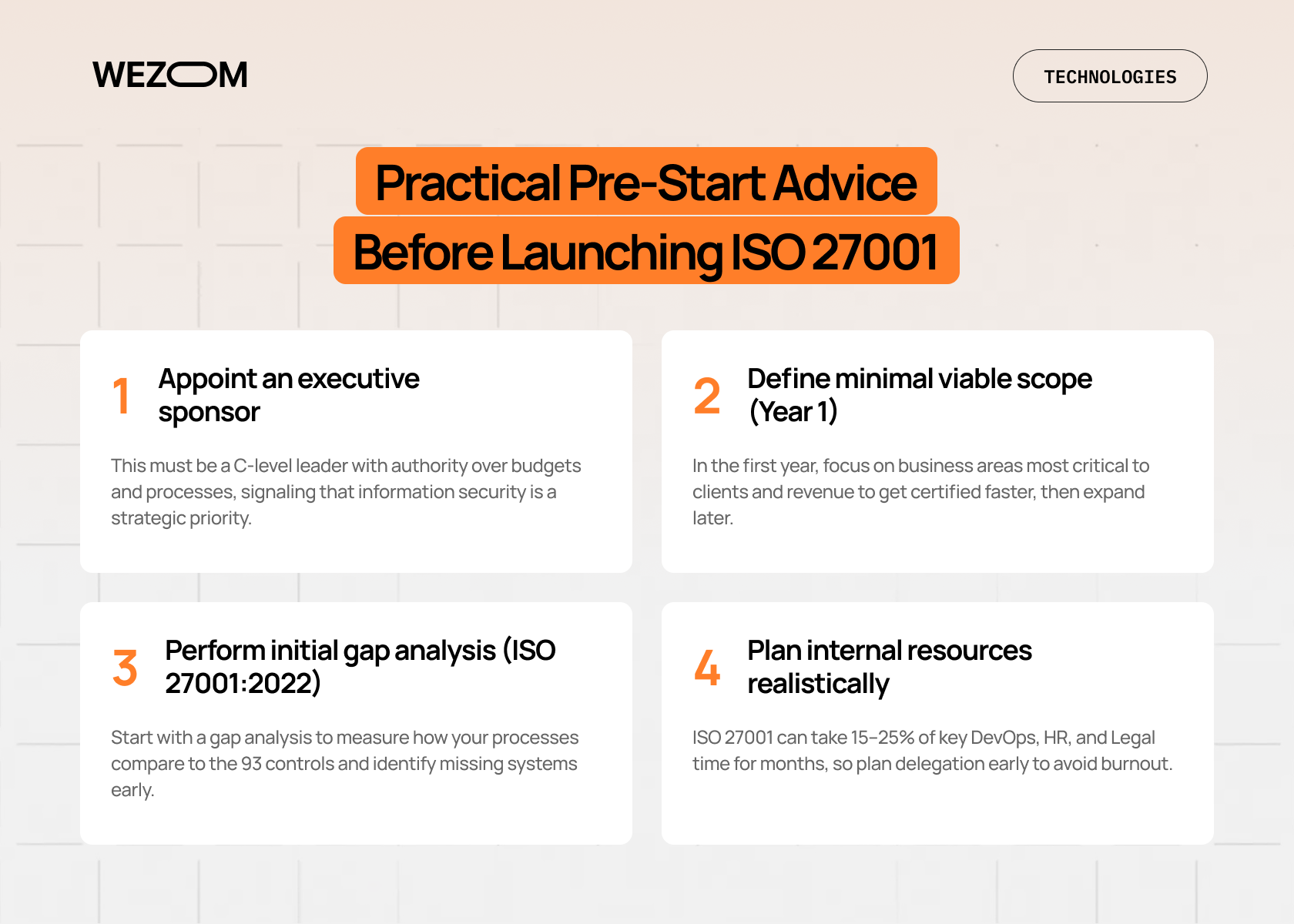
If you don't lay the right foundation during the preparation process, the entire project will be bogged down in endless rework. Here's an ISO 27001 audit checklist to take before officially announcing the project internally.
Appoint an executive sponsor
This should be a C-level specialist with the authority to approve budgets and change business processes. Their job is to communicate to the entire team that information security is a strategic priority (i.e., not just a whim of the CIO).
Define minimal viable scope (Year 1)
During the first year of certification, it makes sense to focus on the areas of your business that are most critical to your clients and revenue. This way, you’ll be able to obtain certification faster, and then gradually expand your scope.
Perform initial gap analysis (ISO 27001:2022)
You can't manage what you don't measure, so you'll need to conduct a gap analysis. This will reveal the distance between your current processes and the 93 controls required by the new version of the standard, helping you assess the scope of work and avoid a situation where you suddenly discover you have no incident management system or risk assessment process at all.
Plan internal resources realistically
ISO 27001 will require 15% to 25% of your top DevOps, HR, and Legal specialists' time for several months, so you'll need to plan in advance which of their regular work tasks can be delegated or postponed to prevent team burnout.
Real-World Example
One of the most recent ISO 27001 risk assessment examples we encountered personally is the Ukrainian company Innoware, a major Microsoft Gold Partner specializing in the implementation of complex ERP and CRM systems for global clients. In particular, when dealing with multinational corporations, Innoware faced a situation where trust in its market reputation was insufficient. US and EU clients who outsourced the management of their financial data and client databases to the company, began demanding independent security verification, so deal closings were delayed due to forced audits by the clients' security services.
With this in mind, Innoware's management decided to engage WEZOM to implement an information security management system compliant with ISO/IEC 27001:2022. The project covered both the IT infrastructure and all customer interaction processes. As a result, through our joint efforts, the company has obtained the 2022 version of the certificate, thereby resolving most compliance audit issues.
After that, Innoware became one of the few partners in the region to confirm compliance with the most current standard requirements and transitioned from targeted security measures to a cyclical “Plan->Act->Check->Improve” process, thereby minimizing operational risks when working with global cloud infrastructures.
How Much ISO/IEC 27001 Certification Costs
How much does ISO 27001 certification cost? Actually, this issue often becomes difficult to resolve because it involves more than just the auditor’s bill. For the EU and American SaaS markets, the total ISO 27001 certification cost consists of four components:
- Tools and platforms. Using specialized software like Vanta or Drata costs $5,000-$15,000 per year; without it, you won't be able to save hundreds of hours collecting evidence.
- Internal time and effort. Your team of DevOps, HR, and CTO will spend from 200 to 500 hours in total, which, when converted into salaries, is guaranteed to reach six figures.
- External consulting. If you don't have an internal expert, turnkey consulting services for preparation will cost between $5,000-$25,000. This typically includes policy development, internal audits, and support during external reviews.
- Certification and surveillance audits. Certification body services cost between $5,000 and $15,000 for the first year, covering Stages 1 and 2. The price depends on the number of employees and locations covered.
It's worth noting that after the first year, expenses decrease – annual surveillance audits cost approximately 30-50% of the initial cost of ISO 27001 certification.
FAQ
What is ISO/IEC 27001 in simple terms?
By the generally accepted ISO 27001 definition, it's an international standard that describes how an organization should build an information security management system.In practice, it's not a checklist of technical settings like “update your antivirus” – it's a full-fledged business system that ensures you've identified your most critical risks and implemented auditable processes to mitigate them.
Who needs ISO 27001 certification?
The benefits of ISO 27001 certification are most noticeable for B2B SaaS companies whose business model is built on processing and storing corporate client data.These typically include Fortune 500 companies, as well as banking, insurance, and government agencies.
Is ISO 27001 mandatory for SaaS companies?
From a legal perspective (particularly in US law), there is no direct requirement to have this certificate.However, from a market perspective, it has become mandatory, as major clients now automate their vendor risk assessment process, so the absence of an ISO 27001 or similar SOC 2 report is often considered a default red flag.
How long does ISO 27001 certification take?
On average, completing an ISO 27001 checklist takes between 3 and 9 months.Ultimately, the timeline depends on the current maturity of your processes and whether you use automation. It's also important to note that obtaining certification too quickly (for example, within a month) usually doesn't stand up to end-to-end client review.
How much does ISO 27001 certification cost?
The total cost of ownership in the first year is determined by the tools and platforms used for compliance automation, as well as internal efforts, the need for external consulting, and the costs of certification body services.It's also essential to assess the scale of your company. Generally, for most SaaS startups, the total cost in the first year is $35,000-$80,000.
