
The widespread use of generative AI by businesses has, on the one hand, provided them with an outstanding automation tool, but on the other hand, opened up new risks of intellectual property leakage. The fact is that the vast majority of employees who use AI tools in their daily workflows are unaware that the data they upload, such as software code or financial reports, ultimately becomes the property of third parties. This is precisely the problem that Private AI addresses.
What Is Private AI?
In a nutshell, this is an architecture that organizes access to neural networks so that data remains exclusively within the organization's secure perimeter and never leaves. Unfortunately, public models cannot boast this in their basic versions, so their developers actively use custom prompts to fine-tune subsequent algorithm iterations.
Generally speaking, the main difference between private and public AI is how data ownership is distributed and how the computing circuit is controlled. In particular, in public models, every prompt and document is sent to the vendor's servers, which often reserves the right to use it for further training of new versions.
In contrast, private AI creates an impenetrable digital barrier around a specific business's intellectual property – either through open-source solutions deployed on-premise or through the use of isolated cloud instances with prohibited third-party access. This makes AI integration into business processes in accounting, legal, R&D, and other departments possible – in short, anywhere any data leak would result in financial and/or reputational losses. Below, we explain how to use AI securely in more detail.
AI and Data Privacy Challenges
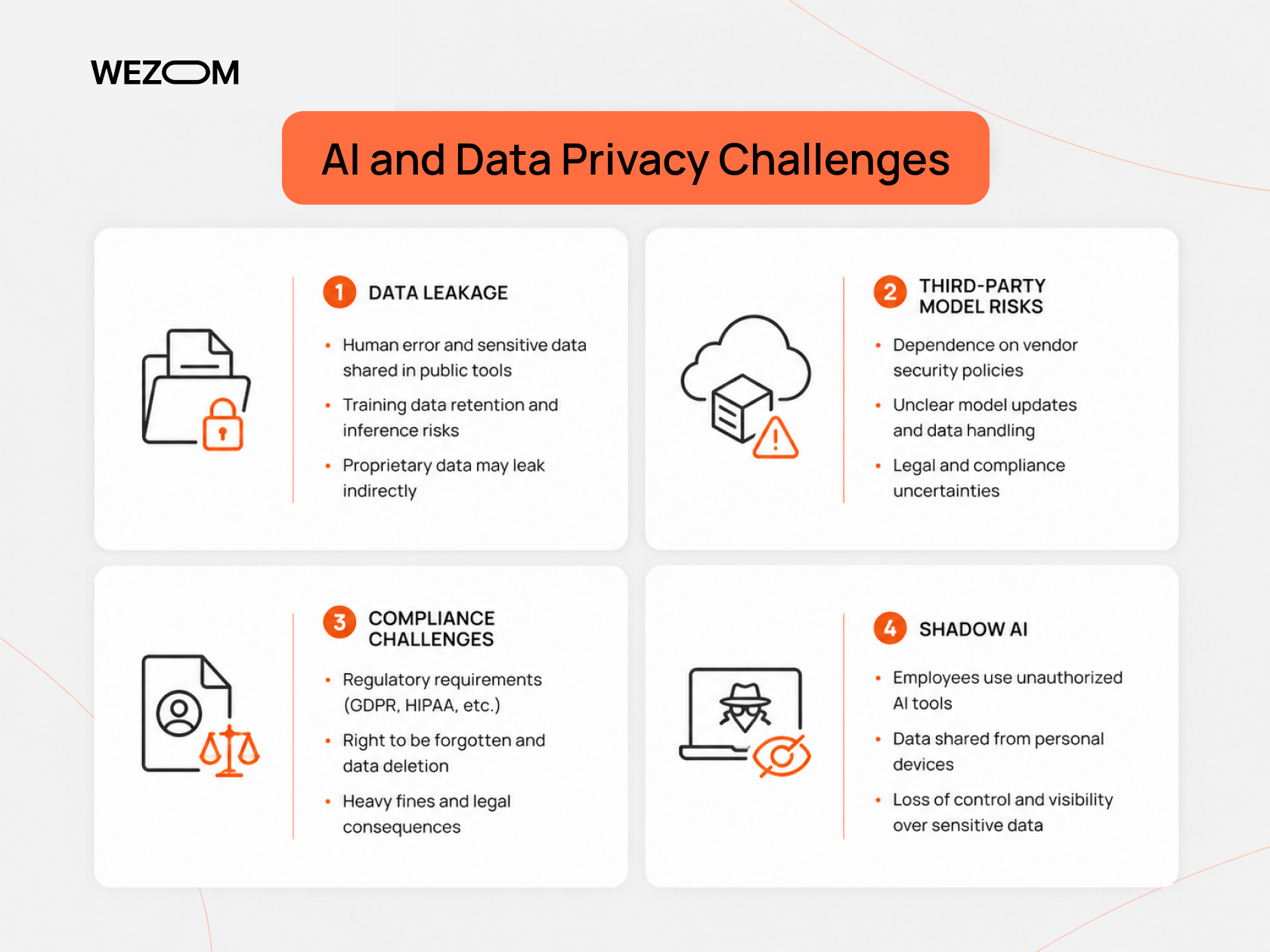
After many years of implementing AI into business processes and optimizing its uncontrolled use, we can identify three types of threats.
Data Leakage
The most obvious risk is human error, such as when employees copy confidential code into chatbots or financial spreadsheets for analysis. Add to this the fact that public solutions often memorize rare tokens from the training dataset, making them vulnerable to inference-based data extraction attacks, where an attacker extracts parts of the data on which the model was trained. In other words, if your proprietary sales plan leaks into a provider's cloud, it could theoretically surface in a competitor's response months later.
Third-Party Model Risks
Even if you use an API, you are still dependent on the third-party vendor's security policies, as you never know exactly how model weights are updated or what additional filters are applied to your data in transit. Meanwhile, for highly regulated sectors, any external data transfer will have serious legal consequences.
Compliance Challenges
Regulators often evaluate AI requests in the context of storing/processing of personal data. For example, the GDPR, relying on the right to be forgotten clause, states that data must be deleted upon request. In this regard, you cannot unlearn a neural network if it has already used your data for its calculations. As for HIPAA, in the healthcare sector, transferring patient data to an uncertified cloud can result in millions of dollars in fines.
Shadow AI
Another problem is what's called Shadow AI, when an enterprise prohibits the use of AI, but its employees continue to resort to its help secretly, from their personal devices. Private AI, on the other hand, solves this problem by providing employees with a legal and secure tool that's governed by internal access policies.
How AI Handles Sensitive Business Data
The standard request path looks like this:
- Input – at this stage, the user enters data (the request itself);
- Preprocessing – now, cleaning, normalization, and transformation of text into vectors occur;
- Inference – the data is run through the weights to generate a response;
- Post-processing – the response is formatted;
- Logging and feedback – finally, the history is saved either for auditing or for further training.
Considering this path, the following exposure points may arise:
- Data in transit, when requests are intercepted during transmission to external APIs;
- Logging on the provider side, which means permanent storage of your corporate data (or the data of your clients/partners) on the third-party server infrastructures;
- Leaks from the context form, occuring when the model operates in multi-user mode without session isolation (in this situation, data from one department could theoretically leak into responses for another through cached states).
Ultimately, only deployment in a controlled environment makes it possible to intercept the data flow (specifically, at the preprocessing stage) to apply anonymization filters in time.
Data Privacy in AI: Main Principles
So, it’s time to find out how to protect data when using AI. Actually, to combine AI and data privacy effectively, we rely on the following five principles:
- Data minimization. The model shouldn’t receive excessive data – for example, if you need to analyze a contract, the system doesn't necessarily need to know the name of the counterparty or the transaction amount. For such cases, we use semantic masks.
- Encryption. To implement this principle, we use AES-256 standards for data at rest and TLS 1.3 for all data in transit. We also encrypt the vector database itself to prevent anyone from reconstructing the original meaning of the text.
- Access control. AI shouldn't be given free rein; on the contrary, access to its knowledge bases should be strictly controlled.
- Anonymization. For this, we implement automatic deletion of personal data using regular expressions or lightweight local models.
- Safe training. If you decide to fine-tune an AI, it should be done in a sandbox to prevent updated model weights from becoming carriers of sensitive information that can easily be extracted through reverse engineering.
AI Data Protection Strategies
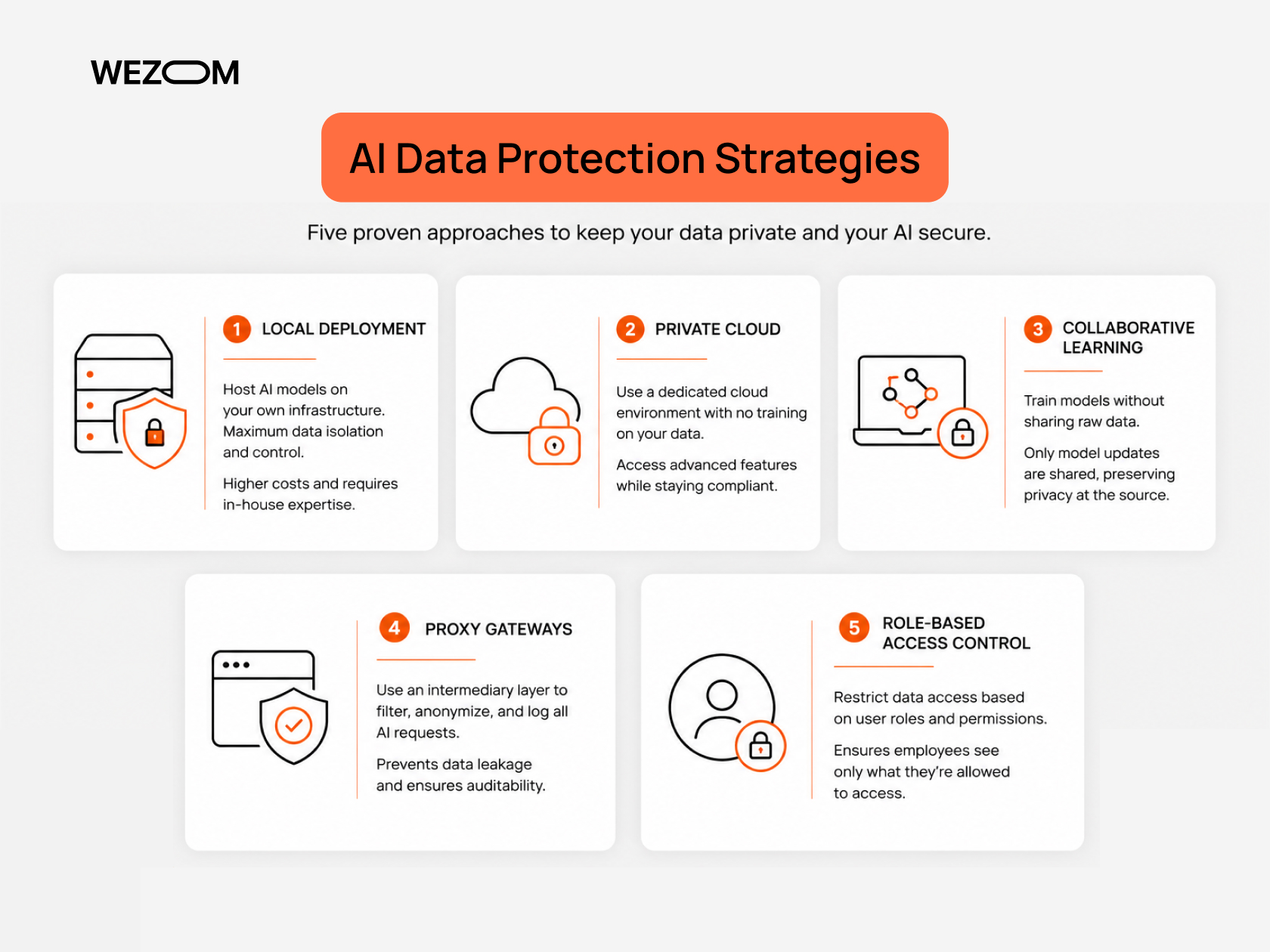
We identify five approaches at all – each of them addresses a specific isolation issue.
Local Deployment
There, the network is hosted on the company’s servers. Open-source models are suitable for this – they're ideal for deployment within a specific business's GPUs. Overall, this is the only viable option for those dealing with critical infrastructure; the only drawback is the high TCO and the need for in-house DevOps experts.
Private Cloud
Here, we mean renting a dedicated server – some vendors (like AWS) can guarantee that your prompts won’t be used for training, and the approach itself opens access to advanced functionality without violating generally accepted rules.
Collaborative Learning
This approach allows training to be performed without transferring data outside. Instead, this process occurs on devices or local servers, after which updated weights are transmitted to the central server (and not the data itself). This opens up the full potential of advanced technologies without any risks for the privacy of each individual node.
Proxy Gateways
This approach requires building an intermediate layer, essentially a kind of AI gateway that blocks accidental data transmission, performs de-identification (replacing sensitive data with tokens before it reaches an external API), and ensures audit logging, recording who and when sent the specific request.
Role-Based Access Control
The AI must not misuse data. To achieve this, it must be integrated with the corporate directory. This ensures that if an employee in one department lacks data for which another department is responsible, the model will also be unable to retrieve that data to respond.
Benefits of Private AI Adoption
Investments in private AI quickly pay off due to:
- Unprecedented levels of data protection, eliminating the risk of your secret data leaking into your competitors' neural network responses over time;
- Ensuring compliance with regulation standards such as GDPR/HIPAA/SOC2, as well as regional data protection laws;
- Increased trust, as you can guarantee them confidentiality and simply state that their personal data is processed by isolated AI and never leaves your company;
- Reduced risks of data breach by minimizing the number of exit points (meaning the attack surface will be significantly smaller, and the likelihood of prompt injection will be reduced to zero).
Common Mistakes Companies Make
Companies make common mistakes when attempting to integrate AI into their workflows. The first and most obvious is using public AI for sensitive data, such as financial statements or the code of a product they plan to sell. The second mistake is a lack of governance, meaning that the company doesn't have a unified AI policy, and each department uses its own tools at its own discretion.
Problem number three is insufficient monitoring, meaning a lack of control over the model's output; to prevent this, you must implement prompt logging at the corporate level. Finally, there's another problem: weak internal policies, where a company relies solely on the common sense of employees and fails to implement clear instructions and technical restrictions.
Best Practices for AI Privacy Protection
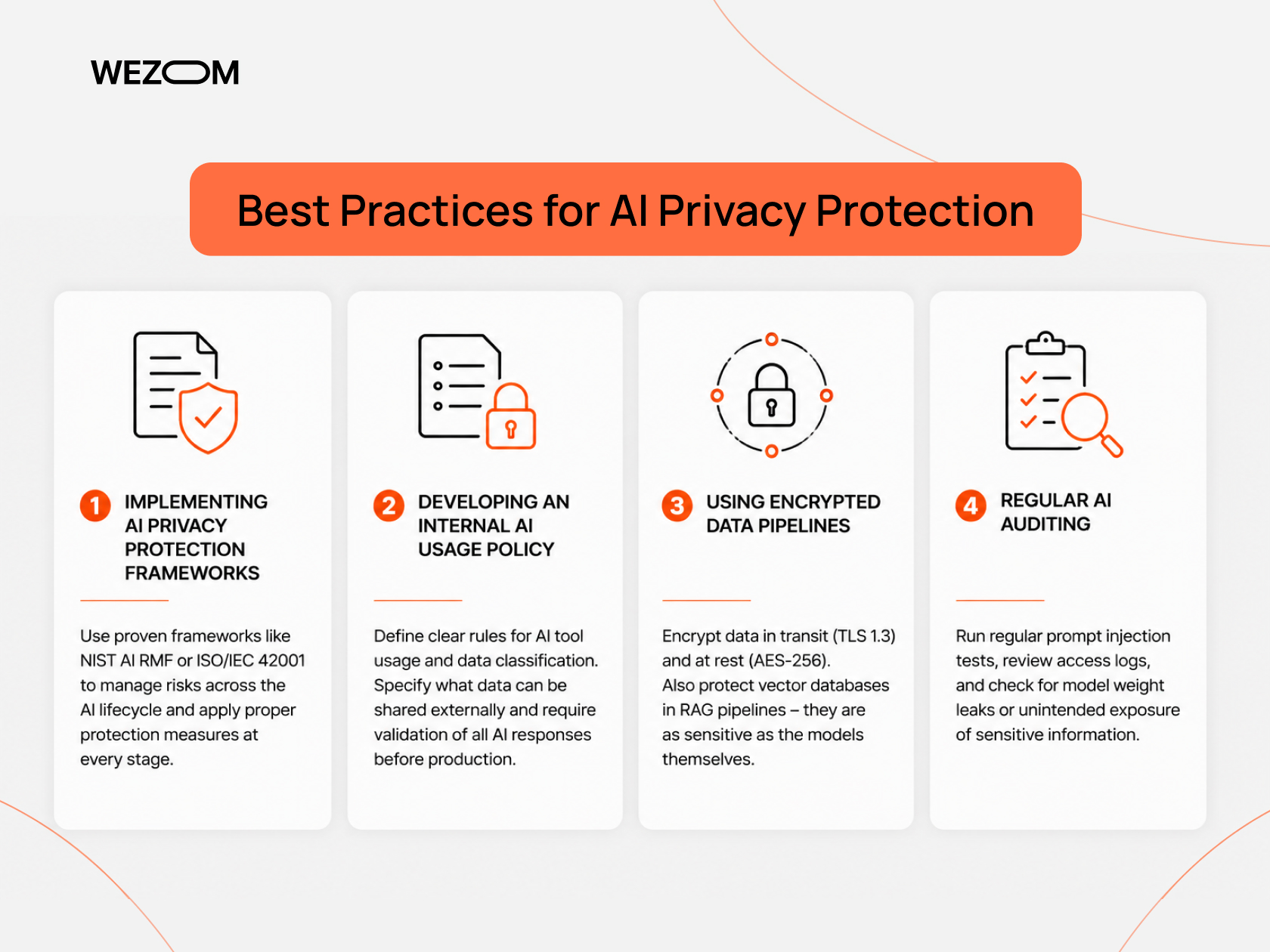
Secure AI usage requires implementing a comprehensive data culture based on the following four pillars.
Implementing AI Privacy Protection Frameworks
Tested methodologies like the NIST AI Risk Management Framework or ISO/IEC 42001 will help you with AI data protection. They will ensure an end-to-end risk assessment at every stage of interaction with AI and help classify such systems to apply appropriate protection measures.
Developing an Internal AI Usage Policy
In the context of data privacy in AI, technical restrictions are most effective when supported by standard rules. This means implementing a list of permitted/prohibited AI tools, as well as data classification regulations (i.e., a description of what can be sent to cloud models and what can only be sent to on-premises alternatives). Also, don't forget to establish mandatory validation of all AI responses before using them in production.
Using Encrypted Data Pipelines
To ensure AI privacy protection, you can use TLS 1.3 for transmitting prompts and AES-256 for storing vector representations. It's also worth remembering that in the RAG architecture, the intermediate vector data store is equally vulnerable to attack as the model itself.
Regular AI Auditing
Finally, for using AI safely, don't forget to implement regular prompt injection tests, audit access logs, and check models for weight leaks or potential disclosure of sensitive information used in the training dataset.
FAQ
What is private AI and how does it work?
Essentially, Private AI for business is a type of software architecture that enables the use of AI capabilities while ensuring that both input data and generated output remain within the company's closed perimeter. In this context, AI data security is implemented either through local deployment of open-source models or through the use of isolated cloud instances.
How does private AI protect sensitive business data?
Private AI doesn’t use personal data to further train global models, anonymizing and processing all requests only in an environment where the model provider doesn’t have technical access to the content of the prompts.
How can companies ensure data privacy in AI systems?
To achieve AI data privacy, you have to use on-premise or private cloud solutions, implement proxy gateways to anonymize data before sending, as well as introduce RBAC and integrate AI with corporate security systems.
What are the risks of using AI without data protection?
AI and privacy issues primarily include intellectual property leaks, disclosure of clients' personal data, violation of regulatory requirements such as GDPR, and reputational damage (for example, if your confidential data appears in the neural network responses of your competitors).
What industries benefit most from private AI?
The industries that need the highest data protection in AI are those with highly regulated and high data costs, including fintech, banking, healthcare, legal, IT development, and the public sector.
