
The average web developer evaluates 4-5 different frameworks before choosing one for a new project.
That's a lot of time spent reading docs, watching tutorials, and building test apps just to figure out which tool fits best. And the stakes are high — pick the wrong framework and you might be rewriting your entire codebase six months later.
We've compiled the definitive list of the top 20 development frameworks for 2025. This isn't just theory, we're covering the most popular web frameworks that are actively used by companies like Netflix, Instagram, and Spotify. You'll learn what makes each one unique, where it excels, and most importantly, which one matches your project needs.
Ready to make an informed choice? Let's dive in.
Why Developers Use Frameworks
Web development frameworks are basically pre-built architecture that solves common problems. Whether you're looking for examples of frameworks for specific use cases or trying to identify the best web framework for your project, understanding how they work is essential. You don't need to figure out routing, database connections, or security protocols from scratch. Someone's already done the heavy lifting.
Speed matters. A lot.
According to recent research by Stack Overflow's 2025 Developer Survey, developers using established frameworks report up to 40% faster development cycles compared to building from scratch. That's not just convenient — it's a competitive advantage.
But there's more to it:
- Consistency across projects. When your team uses the same framework, everyone speaks the same language. New developers can jump in faster because they already know the structure.
- Built-in best practices. Most frameworks enforce patterns that prevent common mistakes. You can't accidentally create a security nightmare because the framework won't let you.
- Community support. Stuck on a weird bug at 2 AM? Popular frameworks have massive ecosystems of plugins, tutorials, and people willing to help.
- Scalability. Good frameworks handle growth. Your prototype might serve 10 users today, but the same codebase can handle 10,000 tomorrow.
"Frameworks don't make you lazy, they make you strategic. Why spend three days building authentication when you could spend those three days building features that actually differentiate your product?"
© WEZOM specialist
Types of Development Frameworks
Not all frameworks are created equal. They're built for different purposes, different parts of your application, and different development philosophies. Let's break down the popular web development frameworks by category. Front-end frameworks handle everything users see and interact with.
React, Vue, and Angular dominate here, but Svelte is shaking things up with different approaches to reactivity.
Back-end frameworks handle databases, API endpoints, authentication, and all the stuff that happens behind the scenes. Django, Express, and Rails are battle-tested classics.
Full-stack frameworks like Next.js and Nuxt.js handle both ends, offering server-side rendering, API routes, and front-end components in one package.
Mobile frameworks — Flutter and React Native let you write once and deploy to both iOS and Android, saving enormous amounts of time.
Cross-platform frameworks work across web, mobile, and sometimes desktop. Ionic and Kotlin Multiplatform fall here.
Microservices frameworks like NestJS help manage complexity when building distributed systems.
Top 20 Development Frameworks
The "best" framework depends entirely on what you're building. A framework that's perfect for a real-time chat app might be terrible for a content-heavy marketing site. Below are the top web frameworks organized by category.
Front-End Frameworks:
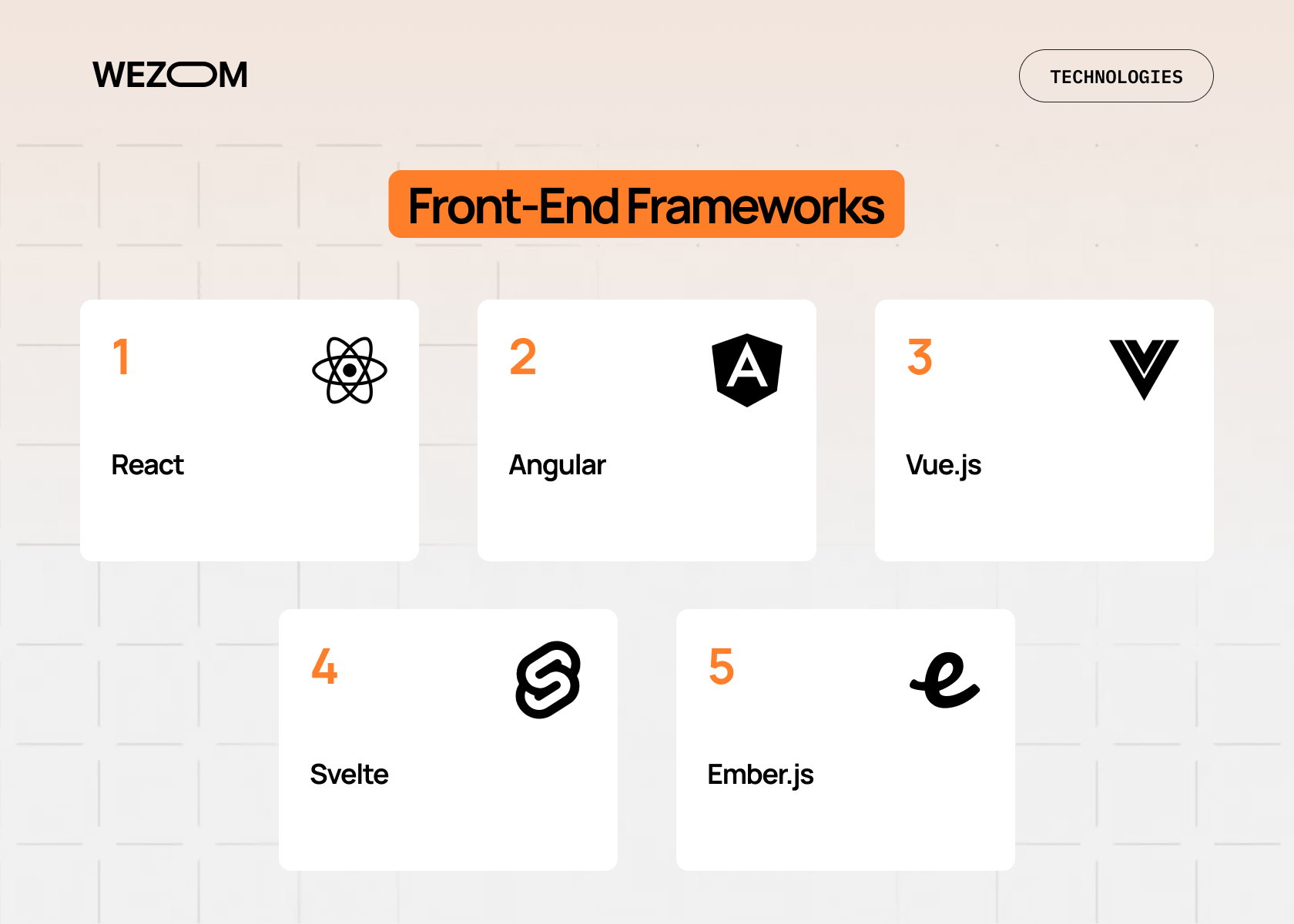
- React. The 800-pound gorilla of front-end development. Created by Facebook, React introduced the component-based architecture that everyone else copied. Its virtual DOM makes updates incredibly fast, and the ecosystem is massive. With hooks, functional components became way more powerful. The learning curve can be steep, but once you get it, you get it.
- Angular. Google's opinionated framework for building large-scale applications. Angular is the full package — routing, forms, HTTP client, testing tools, all included. It's TypeScript-first, which means better tooling. Great for enterprise applications where you need structure across a large team.
- Vue.js. The progressive framework that's easier to learn than React or Angular but still powerful enough for serious applications. Vue's syntax is clean, documentation excellent, and you can adopt features gradually. Vue 3 brought the composition API and better TypeScript support.
- Svelte. Instead of shipping a framework to the browser, Svelte compiles your components into vanilla JavaScript at build time. Smaller bundles, faster apps. No virtual DOM, no complex state management, just reactive declarations. SvelteKit makes it even more compelling.
- Ember.js. Incredibly mature with conventions that make team development smooth. Heavily used in finance and healthcare, where stability matters. If you're building a long-term application, Ember's worth considering.
Back-End Frameworks:

- Django. Python's heavyweight champion. Django comes with everything — an ORM, admin interface, authentication, and form handling. The admin panel alone saves weeks of development time. Instagram, Spotify, and YouTube use Django for parts of their infrastructure.
- Flask. The minimalist alternative to Django. Flask gives you just enough to build a web application, then gets out of your way. Perfect for APIs, small to medium applications, or when you want full control over your architecture.
- Ruby on Rails. The framework that changed web development forever. Rails popularized MVC architecture and convention over configuration. Incredibly productive for building full-featured web applications. GitHub, Shopify, and Airbnb all started with Rails.
- Laravel. PHP's answer to Rails. Laravel makes PHP development enjoyable with elegant syntax and powerful ORM. Includes everything — authentication, queues, caching, and file storage. The documentation is outstanding.
- Express.js. The minimalist web framework for Node.js. Fast, unopinionated, and flexible. It's the standard for building APIs in JavaScript. You add middleware for whatever you need, building exactly what you want.
Full-Stack Frameworks:
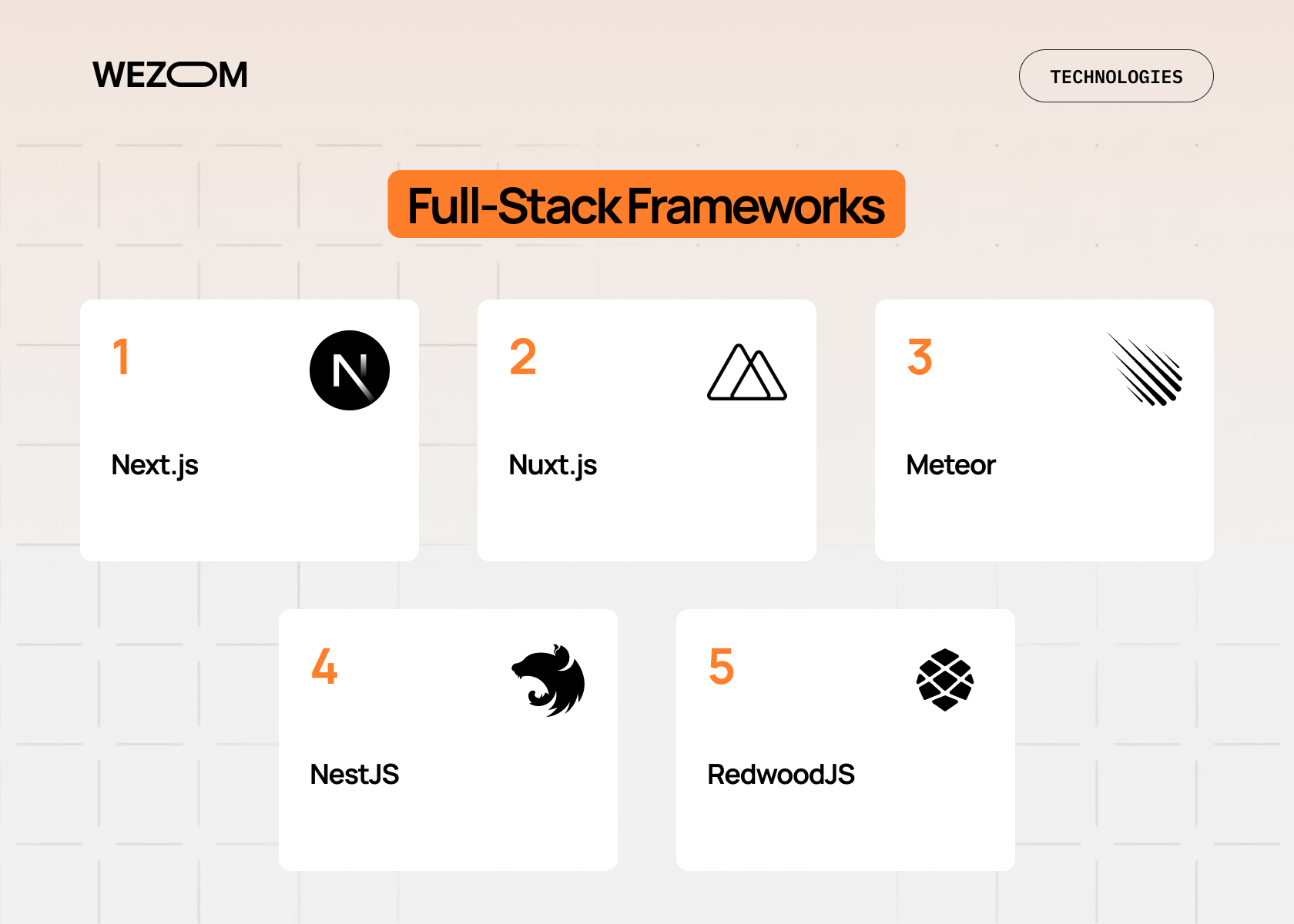
When you need a web application development framework that handles both front-end and back-end, these options deliver complete solutions:
- Next.js. React's full-stack evolution. Next.js adds server-side rendering, static site generation, API routes, and more. The default choice for React applications that need more than a basic client-side app. Companies like Netflix and TikTok use Next.js.
- Nuxt.js. The Vue equivalent of Next.js. Brings server-side rendering and great developer experience to Vue applications. Built on Vue 3 with composition API and improved performance.
- Meteor. The OG full-stack JavaScript framework with real-time data synchronization. Great for rapid prototyping and building real-time applications. Change something in the database, and every connected user sees the update instantly.
- NestJS. Node.js meets enterprise architecture. Brings Angular's structure and TypeScript-first approach to server-side development. Perfect for building scalable, maintainable back-end systems with decorators and dependency injection.
- RedwoodJS. Wants to be Rails for the modern JavaScript era. Integrates React, GraphQL, Prisma, and deployment tooling into one opinionated framework. Handles the full stack with clear conventions and code generation.
Mobile and Cross-Platform Frameworks:
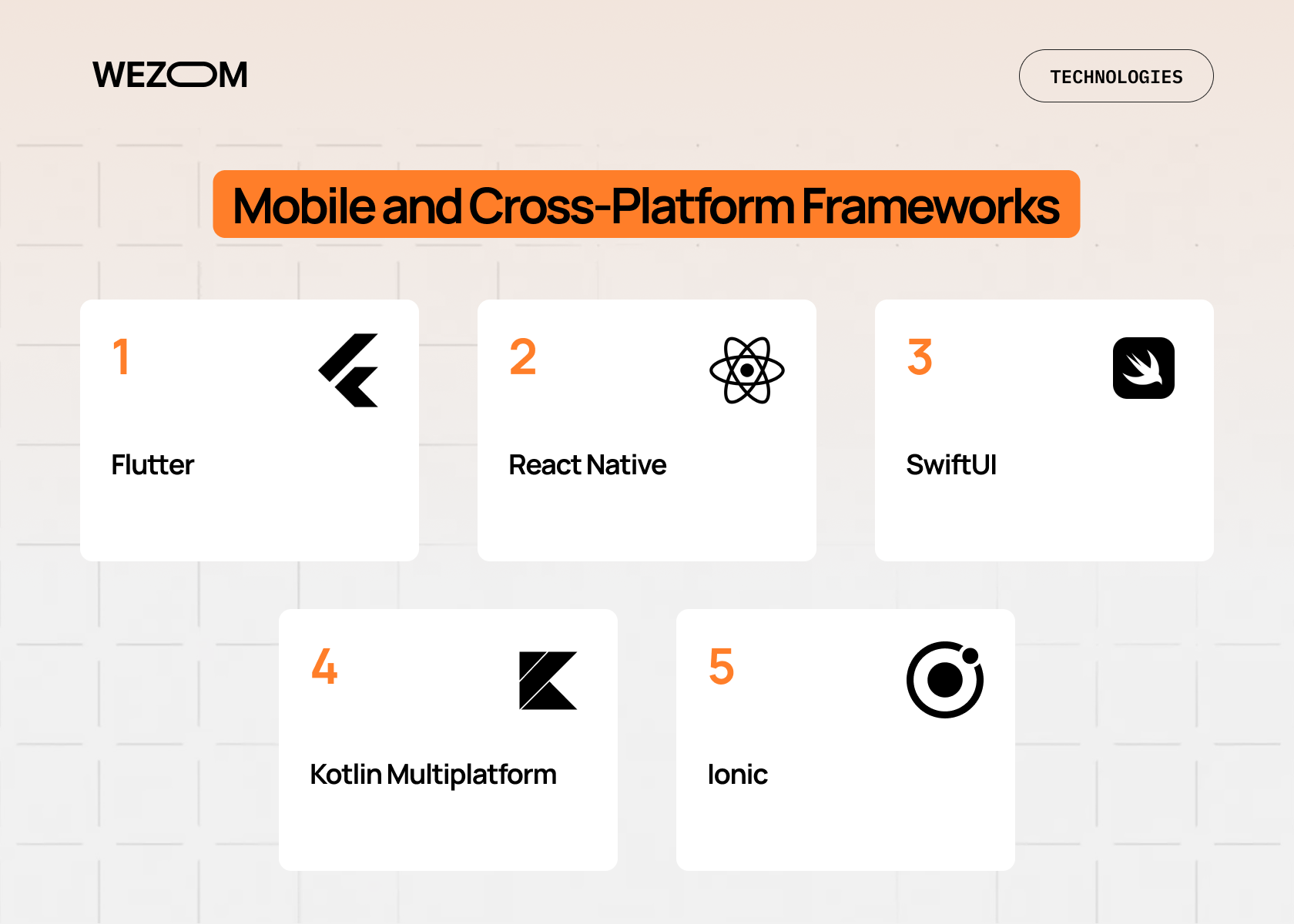
- Flutter. Google's UI toolkit for building natively compiled applications. Uses Dart but delivers impressive results. Hot reload is incredibly fast, and performance is genuinely close to native. Companies like Alibaba and BMW use Flutter.
- React Native. Build mobile apps using React and JavaScript. Your code compiles to actual native components. A more mature ecosystem than Flutter with more third-party libraries. Facebook, Instagram, and Discord use React Native.
- SwiftUI. Apple's declarative framework for iOS, macOS, watchOS, and tvOS. Apple-only, but incredibly powerful for their ecosystem. Clean syntax, amazing preview canvas, seamless integration with Apple frameworks.
- Kotlin Multiplatform. Share business logic across platforms while keeping native UI. Write your core code once and use it on Android, iOS, web, and desktop. More pragmatic than full cross-platform frameworks. Netflix and VMware use it.
- Ionic. Build mobile apps using web technologies — HTML, CSS, and JavaScript. Works with Angular, React, or Vue. Particularly good for apps that are mobile versions of web applications. Deploy to web, iOS, and Android from the same codebase.
Need a quick reference? Here's how six most popular web development frameworks stack up across key criteria.
| Framework | Best For | Learning Curve | Performance |
| React | Interactive UIs, SPAs | Moderate | Excellent |
| Django | Rapid development, data-driven apps | Moderate | Very Good |
| Next.js | SEO-critical sites, full-stack apps | Moderate to High | Excellent |
| Flutter | Beautiful mobile apps | Moderate | Near-native |
| Express.js | APIs, microservices | Low | Excellent |
| Vue.js | Progressive enhancement | Low to Moderate | Very Good |
The takeaway? If you need something fast to learn, start with Express or Vue. Building something performance-critical? React, Next.js, or Flutter deliver. Want the full package without too much complexity? Django's your friend.
How to Choose the Right Framework
So you've got 20 frameworks to choose from. How do you actually make the decision?
Start with your project requirements. Are you building a real-time application? A content-heavy website? A mobile app? An enterprise dashboard? Different frameworks excel at different things.
Project Requirements
Don't pick a framework because it's trendy. Pick it because it solves your specific problems.
Need SEO? Server-side rendering frameworks like Next.js or Nuxt.js are essential. They render your content on the server, which means search engines can actually crawl your pages. Client-side only frameworks like traditional React setups? Search engines receive pre-rendered content, improving initial indexing and social media previews.
Building a dashboard with lots of data? React or Vue with a good state management library makes sense. They're built to handle complex UI updates efficiently. Creating a simple API? Express or Flask will do the job without unnecessary complexity. No need to bring in a heavyweight framework when you're just routing requests and returning JSON.
Think about your scale too. Prototyping an MVP? Go lightweight. Building something that needs to handle millions of users? You'll want a framework with proven scalability.
Learning Curve
Be honest about your timeline. If you need to ship in two weeks, don't pick a framework you've never used. Go with what you know, or pick something with a gentle learning curve like Vue or Flask.
Learning curves are not just about documentation quality. Some frameworks are opinionated and force you to do things their way. Angular, for instance, has a steeper learning curve because it's a complete system. But once you learn it, you know exactly how to structure everything.
React is popular but has a moderate learning curve, especially when you add in state management, routing, and build tools. Vue strikes a nice balance — approachable for beginners but powerful enough for complex apps. Flask and Express are minimal, which sounds easy, but you'll need to make a lot of architectural decisions yourself.
Performance Needs
Most frameworks are fast enough for most projects. Seriously. You'll hit database bottlenecks or network issues long before framework performance matters. That said, if you're building something that needs to handle millions of requests or render complex UIs with thousands of elements, then framework performance becomes critical.
Community Support
A vibrant community means better documentation, more tutorials, more libraries, and faster solutions when you're stuck. React, Angular, Django, and Rails have massive communities. Newer frameworks like Svelte are growing fast but are still smaller.
Why does community size matter? Because at 3 AM, when you're debugging a weird issue, you want to find someone who's already solved it. Stack Overflow questions, GitHub discussions, Discord channels — these become invaluable resources.
Check GitHub activity, Stack Overflow questions, and job postings. A framework with declining activity might still work fine, but you'll have fewer resources when problems arise. Plus, if you're hiring, popular frameworks mean a larger talent pool.
Community also affects the ecosystem. React's massive community means there's a library for virtually anything you need. Working with a niche framework? You might need to build things from scratch.
Integration with Other Tools
What else are you using? If you're already invested in the JavaScript ecosystem, Node.js frameworks make sense. Heavy Python shop? Django or Flask. Working with existing Java infrastructure? Spring Boot is your friend.
Check that your framework has good support for your required integrations. Need to connect to PostgreSQL? Most frameworks handle it easily. Working with a specialized database or API? Make sure there are mature libraries available.
Some frameworks play nicer with certain deployment platforms. Next.js works great with Vercel (obviously — same company). Django deploys easily to Heroku or AWS. Flutter apps need special consideration for app store deployment, including certificates, provisioning profiles, and store-specific requirements.
Think about your tooling too. Does your team use TypeScript? Some frameworks have better TypeScript support than others. Need GraphQL? Check for mature integrations. Planning to use Docker? Most modern frameworks containerize well, but some are easier than others.
Team Experience
What does your team already know? Training everyone on a new framework takes time and money. If your team is comfortable with React, maybe stick with React or explore Next.js. Got Ruby developers? Rails is the obvious choice. Python experts? Django or Flask.
That doesn't mean never try new things. But be strategic about when you introduce new technology. Side projects and internal tools are great places to experiment. Mission-critical customer-facing applications? Maybe stick with proven choices your team already understands.
Conclusion
There's no single "best" framework. The best framework for web development is the one that fits your project, your team, and your constraints. What matters is choosing from the best web development framework options based on your actual requirements, not hype.
React remains dominant in front-end development, but Vue and Svelte offer compelling alternatives. Django and Rails are excellent for full-featured web applications. Next.js and Flutter are pushing boundaries in full-stack and mobile development.
The landscape keeps evolving. But the fundamentals (solving real problems, writing maintainable code, shipping on time) never change.
Want to explore these frameworks in more depth? We've got teams experienced with all of them. Whether you need help choosing the right framework, building a prototype, or scaling an existing application, we can help you make the right technical decisions.

FAQ
What framework is best for web development?
It depends on your specific needs. For the front-end, React offers the largest ecosystem and job market. For full-stack, Next.js provides excellent performance. For the back-end, Django and Laravel are solid choices with everything built in. The "best" framework matches your project requirements, team skills, and timeline.
What is the most popular front-end framework today?
React dominates with the largest market share, followed by Vue.js and Angular. However, Svelte is gaining significant momentum. Popularity doesn't always mean "right for your project" — Vue might be easier to learn, Angular better for enterprise apps, and Svelte offers superior performance for certain use cases.
Which frameworks are best for large enterprise projects?
Angular and Django excel in enterprise environments due to their opinionated structure. NestJS is increasingly popular for enterprise back-end services. For full-stack applications, Next.js combined with a robust back-end offers excellent scalability. These provide the consistency, testing tools, and architecture patterns that large teams need.
What frameworks have the largest developer communities?
React has the largest and most active community worldwide. Django, Angular, and Vue also have massive communities. Larger communities mean more third-party libraries, better documentation, more tutorials, and faster answers. Check GitHub stars, Stack Overflow questions, and npm downloads for current metrics.
Which framework is best for beginners?
Vue.js is often considered most beginner-friendly due to clear documentation and a gentle learning curve. For the back-end, Flask or Express.js are excellent starting points because they're minimalist. Django is also beginner-friendly if you want a complete framework from day one. Pick something with good documentation and a supportive community.
