
If your company processes thousands of requests and reports daily, your employees likely spend hundreds of man-hours sorting them, identifying problems, or predicting which customers are at risk of defecting to competitors. At the same time, hiring more people is a fast way to operational gridlock, as the cost of human error increases as the data grows. This is where supervised learning can come in handy – it already underpins Netflix's recommendation system, anti-fraud monitoring for large banks, Google search, and many other platforms. If you're considering implementing this technology into your business processes, this article, answering the question “What is supervised machine learning?”, will be especially helpful.
What Is Supervised Learning?
So, what is supervised learning? Briefly, it's a machine learning method in which a model learns from reference question-answer pairs. Imagine teaching a child to distinguish ripe apples from spoiled ones. You give them a basket of fruit and label each apple: “This one is red, hard, and fragrant – it's ripe; this one is brown, soft, and blemished – it's spoiled”. You're not just showing them specific apples; you're teaching the child to identify ripeness/spoiledness characteristics. After this training, when you give the child a new apple they've never seen before, they'll be able to independently classify it as ripe or spoiled. In the context of machine learning, the teacher is a labeled dataset. The model receives thousands of examples and correct answers to them, revealing hidden patterns that link the input conditions to the final outcome.
Another important aspect of supervised learning is error minimization. The algorithm takes input data, extracts features from it (these will be used to make a prediction), makes a prediction about the outcome (label), and compares it to the benchmark answers provided by a human. If the prediction is incorrect, the algorithm adjusts its internal parameters and tries again. This cycle is repeated millions of times until the model produces results with an acceptable error. In the business paradigm, this means that the whole history of transactions or client profiles your company accumulated over the years becomes a kind of textbook, from which the system learns to make decisions in milliseconds.
How Does Supervised Learning Work?
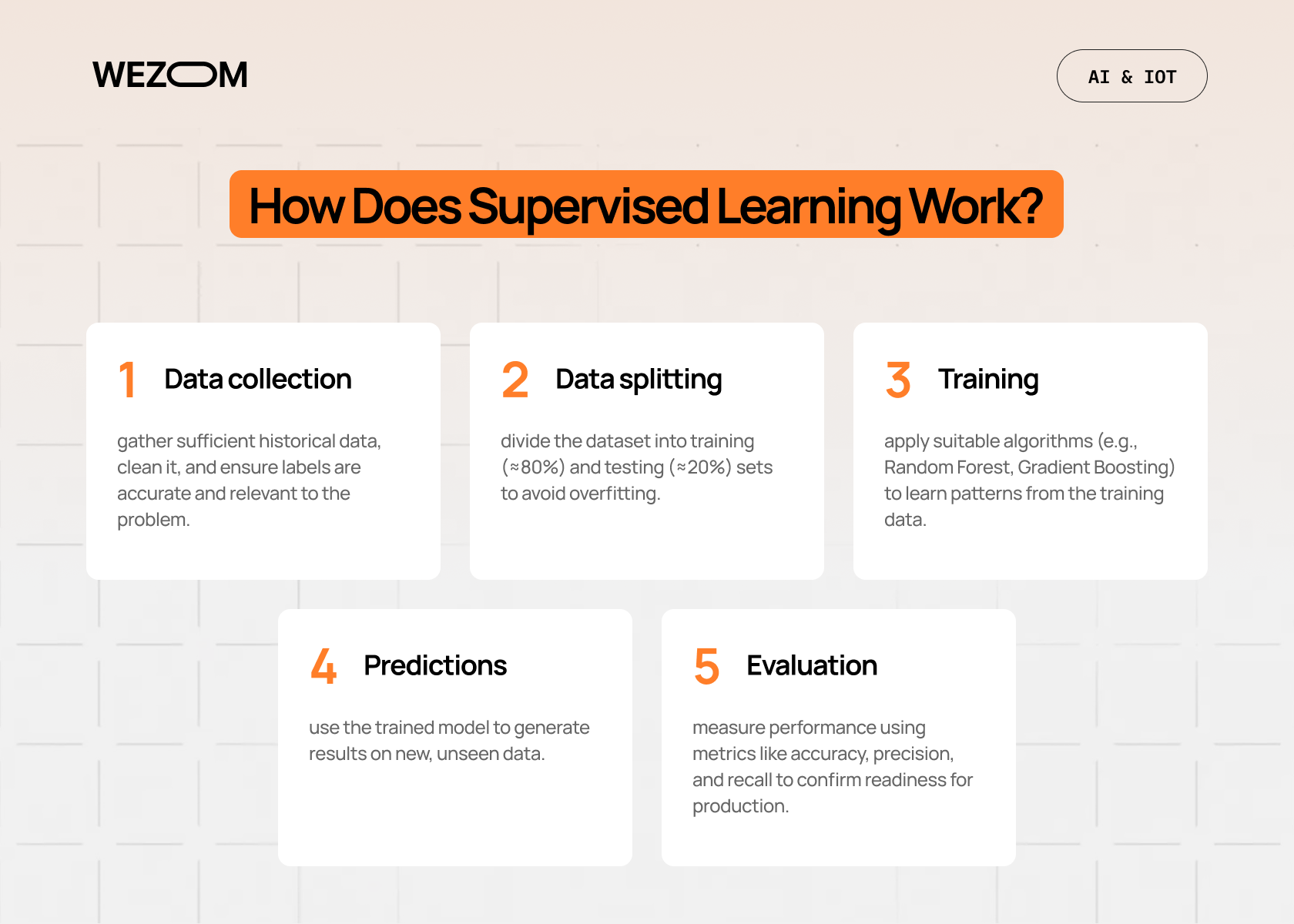
No supervised learning model is complete once its code is written; it goes through the production cycle described below.
Data collection
At this stage, the development team collects historical data, primarily performing its optimization and ensuring its relevance to obtain accurate answers. For example, if you're building a system for recognizing defects in manufacturing, you'll need thousands of photos of parts labeled “normal” and “defective”.
Data splitting
According to development guidelines, the model is never tested on the same data it was trained on; instead, the data is split 80/20. 80% is allocated to the training set, and 20% remains the testing set. This way, the developers gain basic confidence that the model has truly understood the logic and hasn't simply memorized answers based on the provided examples.
Training
Now, supervised learning algorithms such as Random Forest or Gradient Boosting come into play – they analyze the training set, looking for complex mathematical relationships between features and labels. In general, the final choice of an algorithm is based on the specifics of a particular business problem – this helps achieve the optimal balance between performance and accuracy.
Predictions
Once the model has been trained, the development team feeds it new, previously unknown, unlabeled data. Thus, drawing on its experience, the system generates a result, which is subsequently verified for correctness.
Evaluation
To determine whether the model is ready for production, the team typically uses evaluation metrics such as accuracy (the overall percentage of correct answers), precision (how often the model worked correctly), and recall (how many real-world cases the system was able to detect).
Types of Supervised Learning
If we talk about supervised machine learning classification, initially, there are two types of supervised learning, each of which determines the type of output the system should produce:
- Classification. In this case, the system divides the input data into categories or classes, and its response will be to assign each input example to a specific group, such as “yes/no” or “A, B, or C”. Specifically, such supervised learning models can detect spam by analyzing the content of each incoming message (in this case, there will only be two categories – “Spam” or “Inbox”), perform sentiment analysis (usually needed by companies to monitor reviews to identify negative, neutral, and positive ones), and recognize images (relevant for smart surveillance cameras or product classification by photos).
- Regression. The main task of such supervised machine learning examples is to generate a specific value. They are typically used in price predictions (particularly in assessing the market value of assets and implementing dynamic pricing solutions, such as those at Uber) and sales forecasting (actively used in purchasing and inventory planning, taking into account seasonality, demand, exchange rates, trends, etc.) – the result is a revenue forecast for a fixed period with the accuracy up to one dollar.
If you are interested in implementing such highly intelligent solutions, write or call us, and we’ll handle your project from requirements and training datasets collection to system deployment and its ongoing support.
Common Supervised Learning Algorithms
Generally speaking, the choice of specific supervised learning techniques depends on the training-set size, the required accuracy, and the available computation power; however, there are some that are more universal, which we will briefly describe below.
Linear regression
This is the simplest algorithm for predicting specific numerical values, identifying a direct relationship between features and results. For example, it can understand how office rental prices increase with its size and many other things – those that can be useful in financial planning and trend analysis.
Logistic regression
This is a classification algorithm that predicts the probability of an object belonging to a certain group (for example, whether a specific customer will buy a product or not). The result will always be either 0 (false) or 1 (true), making this algorithm indispensable for scoring.
Decision trees
This algorithm builds a logical flowchart. For example, it can produce an inference like, “If a specific client's income is above X and their age is below Y, they can be granted a loan”. In general, decision trees are very easy to interpret, meaning you can always trace why the model made a particular decision (which is crucial for highly regulated industries).
Random forest
To avoid the errors inherent in a single decision tree (as in the previous case), you can use multiple decision trees, each generating its own response, while the final result is selected by the majority. This is one of the most stable algorithms for working with tabular data in enterprise-grade systems.
Support vector machines
This algorithm searches for an optimal boundary in the dataset that logically separates it into two classes. It's an excellent choice for tasks with clear boundaries, such as detecting AI-generated text or classifying complex medical images.
K-nearest neighbors
This algorithm classifies an object based on the classes of its closest neighbors in the data. Overall, it's an excellent choice for highly intelligent recommendation systems that operate on principles like: “If user A behaves similarly to user B, we'll offer them the same products”.
Naive bayes
This algorithm is based on probability theory – it inherently assumes that each feature is independent of the others. Due to its high speed, it demonstrates top effectiveness in spam filtering and real-time text document classification systems.
Neural networks
This form of machine learning mimics the functioning of the human brain. Such neural networks consist of neuron layers capable of finding subtle relationships in unstructured data. This makes them an excellent choice for implementing solutions based on deep learning, computer vision, and natural language processing (such as chatbots and voice assistants).
Advantages of Supervised Learning
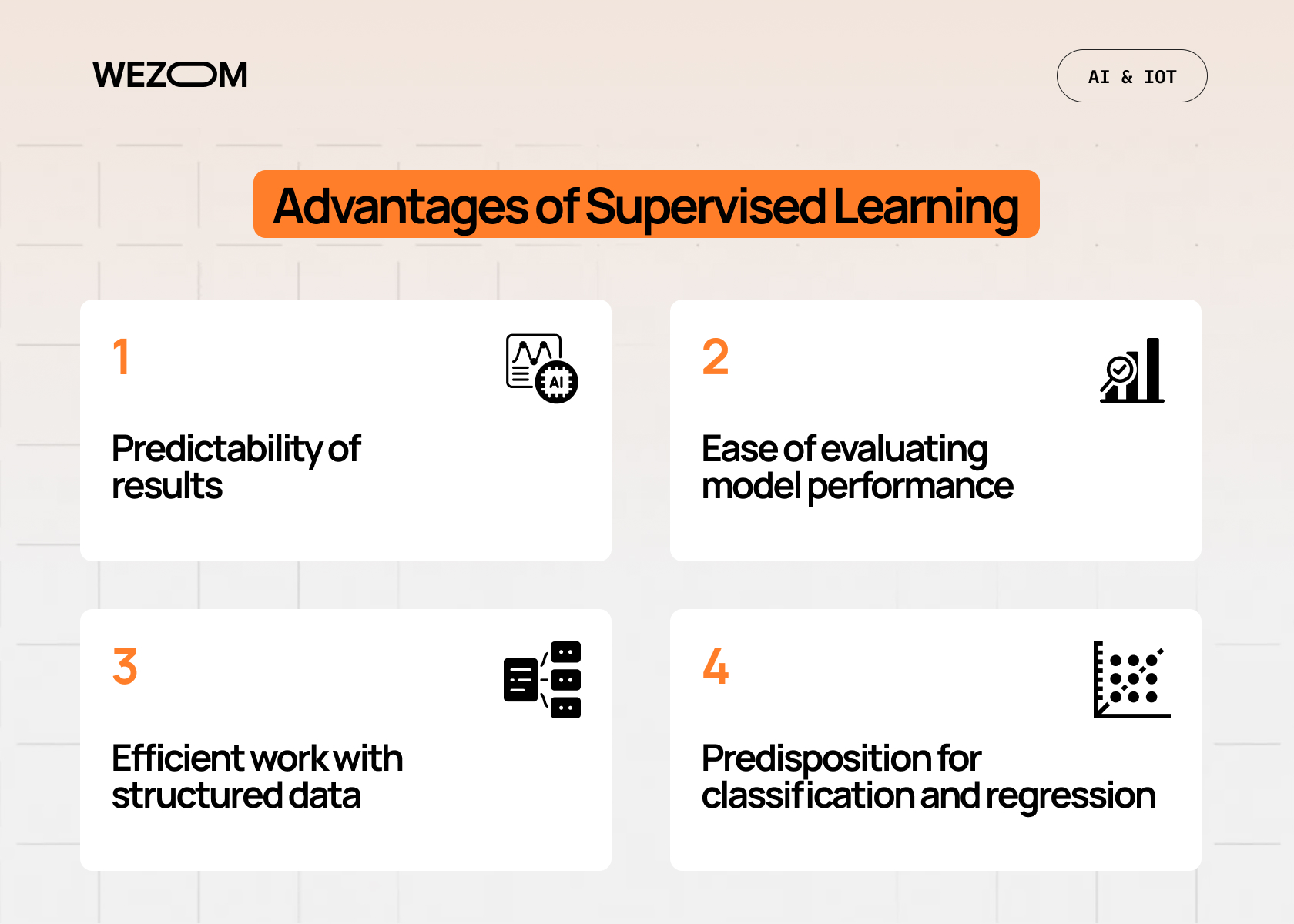
Here's why most companies begin implementing AI/ML with supervised learning:
- Predictability of results. Since the model is trained on verified historical data, its behavior is easier to predict. In essence, you provide the system with a benchmark, and it strives to match it as it trains, ultimately minimizing the risk of inappropriate responses.
- Ease of evaluating model performance. With supervised learning, you have correct answers from the start, so you can quantify its performance by understanding the percentage of incorrect responses. This will help you calculate the ROI of the system's implementation even during the testing phase.
- Efficient work with structured data. Since the vast majority of corporate data is represented as tables in SQL databases and CRM/ERP systems, you can get the maximum benefit from supervised learning algorithms, as they are initially designed to work with such input datasets.
- Predisposition for classification and regression. Our experience shows that these tasks cover approximately 80% of business needs, from automatically sorting incoming requests to accurately forecasting next year's revenue. Therefore, you can launch a universal solution for all of them.
If you would like to get all these benefits for your business, feel free to contact us, and we'll implement a supervised learning-based solution tailored to your unique needs.
Limitations of Supervised Learning
We always warn our clients about technological barriers to implementing supervised learning, such as:
- It requires large amounts of labeled data. The algorithm needs data with answers – that is, if we're teaching a system to predict equipment failure, we need thousands of examples stating “there’s a failure”, “here everything is OK”. For many young companies, the lack of such a historical database becomes a serious bottleneck, as in their cases, the model will produce hallucinations instead of accurate predictions.
- Labeling is time-consuming and costly. The data labeling process often requires the participation of highly qualified specialists. For example, to teach AI to recognize legal risks in contracts, labeling must be done by lawyers, whose time is expensive (even if you outsource them). Overall, in highly specialized niches like healthcare and heavy industry, this stage can take up to 60-70% of the entire project time and a similar amount of budget.
- Risk of overfitting. This means that the model has memorized the training examples so much that it cannot work with new data. It sees patterns where there aren't any (it's essentially just random noise in the data). As a result, testing shows 99% accuracy, but in real life, the system is ineffective. That’s why we use regularization and cross-validation methods to ensure the model’s generalization.
- It's not suitable for discovering hidden patterns. Supervised learning can't go beyond what it's been taught. If your data contains a hidden anomaly or a new market trend that you didn't suspect or label, supervised learning won't find it, either. If you need your system to search for something non-obvious and find it, you should consider unsupervised learning.
To ensure that all the above limitations don't become an obstacle to implementing machine learning in your business processes, just write or call us.
Real-World Uses of Supervised Machine Learning
Now that you know the answer to the question: “What is supervised learning in machine learning?”, you can check the main real-world supervised machine learning applications below.
Finance and banking
In this sector, supervised learning could form the basis of credit scoring systems, whose algorithms can analyze thousands of borrower parameters and generate a verdict in seconds. Another promising area is anti-fraud systems, in which models are trained on millions of legitimate and fraudulent transactions, blocking suspicious operations in real time.
Healthcare
In this field, supervised learning can automatically classify medical images, thereby enabling the early detection of pathologies with accuracy superior to human capabilities. Also, using regressive algorithms, doctors can calculate personalized drug dosages based on a patient's physical characteristics.
Marketing and advertising
Supervised learning models solve the problem of churn prediction, instantly identifying which customers are likely to churn and offering them bonuses. Supervised learning can also form the basis of LTV forecasting systems, predicting how much revenue a specific customer will generate over a period of several years.
eCommerce and retail
Online stores should consider dynamic pricing systems based on this technology. They can automatically analyze competitors' prices, inventory levels, and current demand to instantly adjust product prices to maximize profits. Supervised learning can also form the basis of recommendation engines to increase the average order value by 15-30%.
Cybersecurity
In addition to antifraud, classification algorithms can be used for intrusion detection and malware analysis, automatically recognizing signatures of well-known attacks and anomalous traffic behavior. This gives you a powerful solution that instantly isolates threats before they can damage your business's IT infrastructure.
Production
In this field, supervised learning is most often used for predictive maintenance: in particular, machine sensors can collect data, while a supervised learning model can predict how many hours it will take for a breakdown to occur. This allows companies to replace a part during a scheduled downtime, avoiding colossal expanses of downtime for the entire line.

FAQ
What is the main goal of supervised learning?
Referring to the supervised learning definition, this is predicting the result based on input data with certain features, with acceptable accuracy for new objects that haven’t previously been processed by the model.
What are examples of supervised learning?
Every time your email sends an incoming message to your spam folder, your bank approves your transaction, or Instagram offers you an ad for a product you've been thinking about before, you face supervised learning.
What is the difference between supervised and unsupervised learning?
Supervised learning uses ready-made responses (essentially labeled data) to inform the model's learning. Meanwhile, in unsupervised learning, there are no such responses, meaning the model must learn to identify patterns by itself, clustering objects by similarity or, for example, identifying anomalies in the input data.
Which supervised learning algorithm is the best for beginners?
If your task is a yes/no classification, you can start with Logistic Regression. If you need to predict a number, Linear Regression is a better choice. If your dataset is too large and heterogeneous, you must consider Random Forest – this algorithm often produces excellent results without any additional modifications.
How much data is needed for supervised learning?
There is no universal answer; however, as our experience shows, solving simple tasks requires several thousand high-quality examples, while deep learning and complex image or text classification tasks may require tens or even hundreds of thousands of examples.
