
Modern logistics and transportation operations rely on speed, precision, and adaptability. Yet in many companies, dispatching decisions still depend heavily on individual employees. When routing, scheduling, and load assignment are tied to a small group of experienced dispatchers, operational stability becomes fragile.
This is where AI dispatch software becomes a strategic asset rather than a technical upgrade. Instead of relying on manual coordination, spreadsheets, and phone calls, companies are increasingly implementing AI-powered dispatch software that analyzes fleet data, capacity, load parameters, and real-time traffic conditions to automate dispatching decisions.
At WEZOM, we see this shift across logistics providers, distribution companies, and transportation operators aiming to reduce downtime, improve asset utilization, and scale operations without proportionally increasing headcount. The core objective is not replacing people – it is reducing dispatcher dependency and transferring operational knowledge into a scalable dispatch automation system powered by algorithms, machine learning, and predictive analytics.
The key question is no longer whether automation is needed but how fast companies can move from manual dispatch workflows to an intelligent automated dispatch system.
Why Dispatcher Dependency Is a Hidden Business Risk
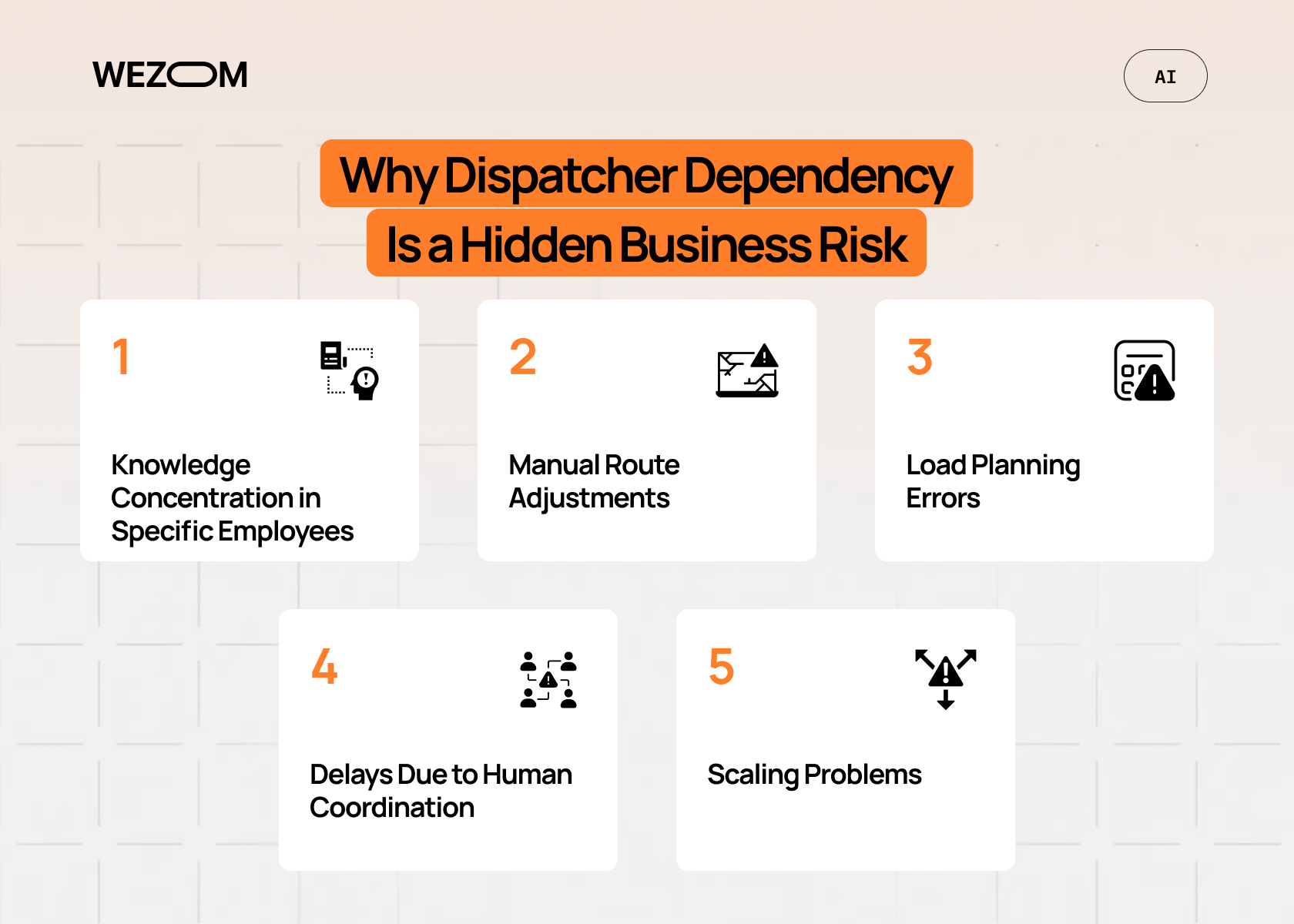
Many transportation businesses underestimate how much risk is concentrated in their dispatch department. On the surface, operations seem stable. In reality, knowledge concentration and manual decision-making create structural vulnerabilities.
Knowledge Concentration in Specific Employees
In traditional models, dispatchers accumulate operational intelligence over years:
- Which routes are optimal at specific hours?
- Which drivers handle certain loads best?
- Which clients require special scheduling?
- Where do delays frequently occur?
This knowledge often lives only in people’s heads. When a dispatcher resigns or is unavailable, operational performance drops immediately. An AI dispatcher transfers that intelligence into a centralized algorithmic model, making knowledge part of the system rather than a single employee’s expertise.
Manual Route Adjustments
Manual route optimization depends on human judgment. Even experienced dispatchers cannot process thousands of variables simultaneously – traffic patterns, fuel consumption, vehicle capacity, service time windows, and delivery priorities.
Without an AI agent for intelligent route dispatch software, route changes are reactive rather than predictive. This leads to:
- Suboptimal fuel consumption.
- Increased idle time.
- Missed time windows.
- Higher operational costs.
Load Planning Errors
Load planning errors directly affect profitability. Incorrect capacity allocation results in half-empty trucks or overloaded vehicles requiring last-minute adjustments.
Automated dispatch software uses algorithm-driven load planning to calculate:
- Vehicle capacity utilization.
- Load compatibility.
- Delivery sequence optimization.
- Warehouse synchronization.
This reduces human error and increases fleet efficiency.
Delays Due to Human Coordination
When dispatch depends on phone calls and manual confirmations, workflow bottlenecks appear. A dispatcher coordinating multiple drivers simultaneously can only react – not orchestrate operations dynamically.
Integrated dispatch AI software enables real-time tracking, automated assignment, and predictive delay detection.
Scaling Problems
The biggest hidden issue is scalability. As fleet size grows, dispatcher workload increases linearly – or even exponentially. Adding vehicles means hiring more dispatchers.
With a dispatch automation system, scaling becomes infrastructure-driven rather than headcount-driven. The algorithm handles complexity without proportionally increasing costs.
What Is AI Dispatch Software?
AI dispatch software is a data-driven dispatch automation system that uses algorithms, machine learning, and predictive analytics to optimize route planning, load assignment, scheduling, and real-time dispatching decisions. Unlike static routing tools, it continuously processes operational data to improve fleet performance and logistics efficiency.
At its core, this software transforms dispatching from a coordination task into a structured optimization process. It connects transportation infrastructure, fleet tracking, order management systems, and driver applications into a single intelligent workflow.
Difference Between a Traditional Dispatch System and AI-Powered Dispatch Software
A traditional dispatch system primarily records and displays information. It may show vehicle locations or delivery statuses, but decision-making remains manual. Dispatchers analyze data and choose routes, assign loads, and resolve conflicts.
AI-powered dispatch software, by contrast, actively participates in decision-making. It evaluates multiple constraints simultaneously, including:
- Vehicle capacity and load compatibility.
- Delivery time windows.
- Driver availability and performance.
- Traffic conditions and predictive congestion models.
- Fuel optimization factors.
Instead of reacting to problems, the system forecasts them. For example, if traffic data indicates a high probability of delay, the system recalculates the route before the vehicle reaches the congestion zone.
What an AI Dispatcher Does
An AI dispatcher functions as an automated decision engine within the logistics environment. It performs tasks traditionally handled by dispatch staff, including:
- Generating optimized delivery routes.
- Assigning loads based on capacity and priority.
- Balancing fleet utilization.
- Monitoring real-time performance.
- Triggering automatic adjustments.
However, it does so using structured optimization logic rather than intuition. It can process thousands of data points across the fleet simultaneously – something human dispatchers cannot realistically achieve under time pressure.
Role of AI Agent for Dispatch Automation Software
An AI agent for dispatch automation software serves as the intelligent core of the system. It does not simply follow predefined rules; it adapts based on operational data.
Its responsibilities include:
- Learning from historical delivery patterns.
- Identifying recurring delay sources.
- Refining route optimization models.
- Improving load planning accuracy.
- Supporting predictive scheduling.
This creates a self-improving dispatch automation system where performance increases over time as more operational data becomes available.
How Automated Dispatch Systems Work
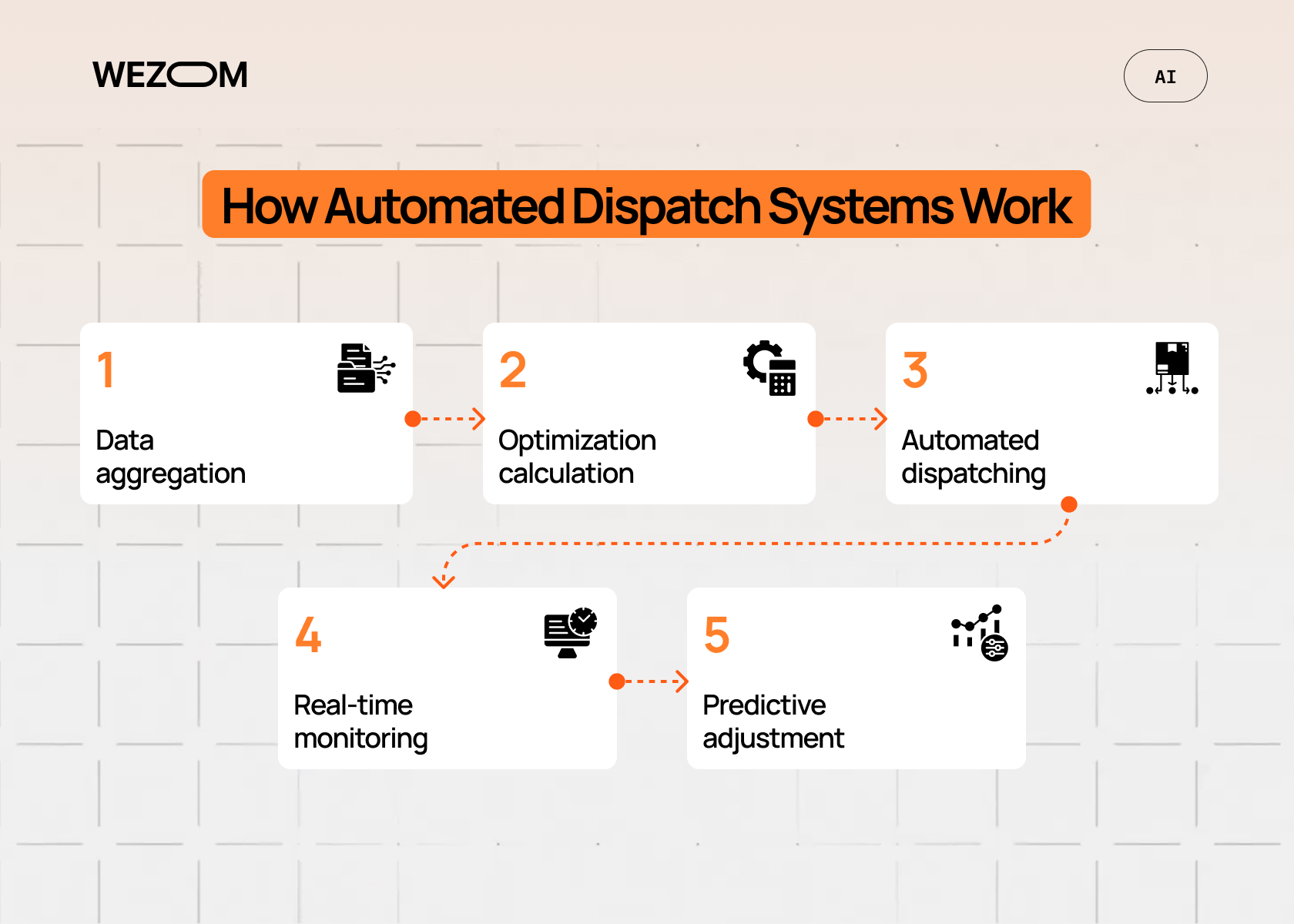
An automated dispatch system typically follows a structured operational cycle:
- Data aggregation – Orders, fleet capacity, driver availability, and tracking data are collected in real-time.
- Optimization calculation – The algorithm evaluates assignment and routing scenarios.
- Automated dispatching – Vehicles and drivers receive optimized assignments.
- Real-time monitoring – The system tracks performance and deviations.
- Predictive adjustment – The AI agent recalculates routes or assignments if risks are detected.
This closed-loop workflow enables continuous optimization of logistics operations, improving efficiency, reducing downtime, and strengthening scalability without increasing dependency on individual dispatchers.
Business Cases Where AI Reduces Human Dependency
Intelligent Route Optimization
Route optimization is one of the most impactful areas for AI integration. An AI agent for intelligent route dispatch software analyzes:
- Real-time traffic.
- Road restrictions.
- Fuel efficiency models.
- Driver performance history.
For example, in a mid-sized fleet of 120 vehicles, implementing AI-based route optimization reduced fuel consumption by 12% and cut average delivery time by 18%. Predictive rerouting minimized downtime caused by congestion.
Automated Load Planning
Load planning directly impacts capacity utilization. An automated dispatch system calculates optimal load distribution based on:
- Vehicle type.
- Weight limits.
- Delivery sequence.
- Warehouse dock availability.
In practice, AI-driven load planning increased capacity utilization from 68% to 85% in one logistics operation, significantly improving profitability.
Real-Time Adjustments & Delay Prediction
AI enables predictive analytics. Instead of waiting for a driver to report delays, the system forecasts:
- Traffic-related slowdowns.
- Weather impact.
- Driver rest requirements.
- Dock congestion.
This predictive model reduces cascading delays and protects SLAs.
Mobile Dispatch Automation
An AI agent for mobile dispatch software integrates directly with driver applications. Drivers receive:
- Automated assignment notifications.
- Optimized route updates.
- Real-time scheduling adjustments.
This reduces dispatcher-driver communication overhead and increases workflow transparency.
AI Dispatch Automation vs Traditional Dispatch Model
When logistics operations grow, differences between manual dispatching and AI dispatch software become operationally measurable. The comparison is not theoretical – it directly impacts fuel consumption, downtime, capacity utilization, and scalability.
Below, we break down the core operational areas where AI-powered dispatch software changes business outcomes.
Route Planning
In a traditional model, route planning is dispatcher-driven. A human specialist reviews orders, considers experience, checks traffic maps, and manually assigns routes. Even experienced professionals cannot evaluate all variables simultaneously: traffic density, fuel optimization models, time windows, vehicle capacity, road restrictions, and driver performance history.
As fleet size increases, route quality becomes inconsistent. Decisions are reactive rather than predictive.
In contrast, an AI agent for intelligent route dispatch software uses optimization algorithms that:
- Analyze historical and real-time traffic patterns.
- Calculate fuel-efficient sequences.
- Predict congestion risks.
- Adjust routes dynamically.
The result is consistent route quality across the entire fleet – not dependent on individual dispatcher expertise.
Load Assignment
Manual load assignment often relies on the dispatcher's familiarity with vehicles and drivers. This leads to common inefficiencies:
- Underutilized capacity.
- Mismatched vehicle types.
- Imbalanced workload distribution.
- Last-minute reassignments.
An automated dispatch system calculates load compatibility using structured data:
- Weight and volume constraints.
- Delivery sequence logic.
- Vehicle type suitability.
- Capacity optimization models.
Instead of subjective decision-making, the system applies data-driven planning, improving load utilization and reducing empty mileage.
Dependency on Staff
Traditional dispatch creates structural dependency. If a key dispatcher is absent, performance drops. Knowledge concentration becomes a bottleneck.
With dispatch AI software, operational intelligence is embedded in the system:
- Routing logic.
- Assignment patterns.
- Delay forecasting models.
- Performance analytics.
The organization no longer depends on a single person’s experience – knowledge becomes institutional rather than individual.
Scaling
Scaling a traditional dispatch department requires proportional hiring. Doubling fleet size often means doubling dispatch workload.
With an AI agent for dispatch automation software, scalability is infrastructure-based. Once algorithms and workflows are configured, additional vehicles increase data volume – not staffing pressure.
This makes scaling predictable and financially sustainable.
Downtime Reduction
Manual dispatch is reactive. Delays are typically addressed after they occur.
AI-driven systems use predictive analytics to detect:
- Traffic congestion trends.
- Risk of SLA breaches.
- Driver schedule conflicts.
- Warehouse bottlenecks.
Proactive rerouting reduces vehicle idle time and operational downtime, directly improving fleet utilization.
Real-Time Updates
Traditional dispatch relies on phone calls, messaging apps, and manual coordination. This introduces communication delays and information gaps.
An integrated AI agent for mobile dispatch software enables:
- Automatic route updates.
- Real-time driver notifications.
- Live tracking and visibility.
- Immediate exception alerts.
Real-time orchestration improves workflow transparency and operational control.
Error Rate
Human-driven dispatch is prone to errors, especially under workload pressure:
- Incorrect address input.
- Overlapping schedules.
- Capacity miscalculations.
- Missed time windows.
Automated dispatch software reduces error rates by validating assignments algorithmically and applying rule-based safeguards.
While no system eliminates all errors, algorithm-driven validation significantly lowers operational risk.
Knowledge Retention
In traditional models, operational intelligence leaves when employees leave.
With a dispatch automation system, decision-making logic is stored within algorithms and analytics models. Historical performance data continuously refines dispatch strategies.
This creates long-term knowledge retention and continuous optimization.
Comparison Table
| Parameter | Traditional Dispatch | AI Dispatch Automation |
|---|---|---|
| Route Planning | Manual, reactive | Algorithm-driven, predictive |
| Load Assignment | Dispatcher decision | Capacity-based optimization |
| Dependency on Staff | High | Low |
| Scaling | Requires hiring | System-based scalability |
| Downtime Reduction | Reactive | Predictive minimization |
| Real-time Updates | Manual communication | Automated tracking & updates |
| Error Rate | Human-dependent | Algorithm-controlled validation |
| Knowledge Retention | Employee-based | System-based learning |
For logistics companies aiming to improve operational efficiency, the shift from manual coordination to intelligent automation is not simply a technical upgrade. It is a structural transformation of dispatch operations – moving from human-dependent workflows to scalable, predictive, and data-driven decision orchestration powered by AI dispatch software.
How AI Dispatch Software Reduces Operational Costs
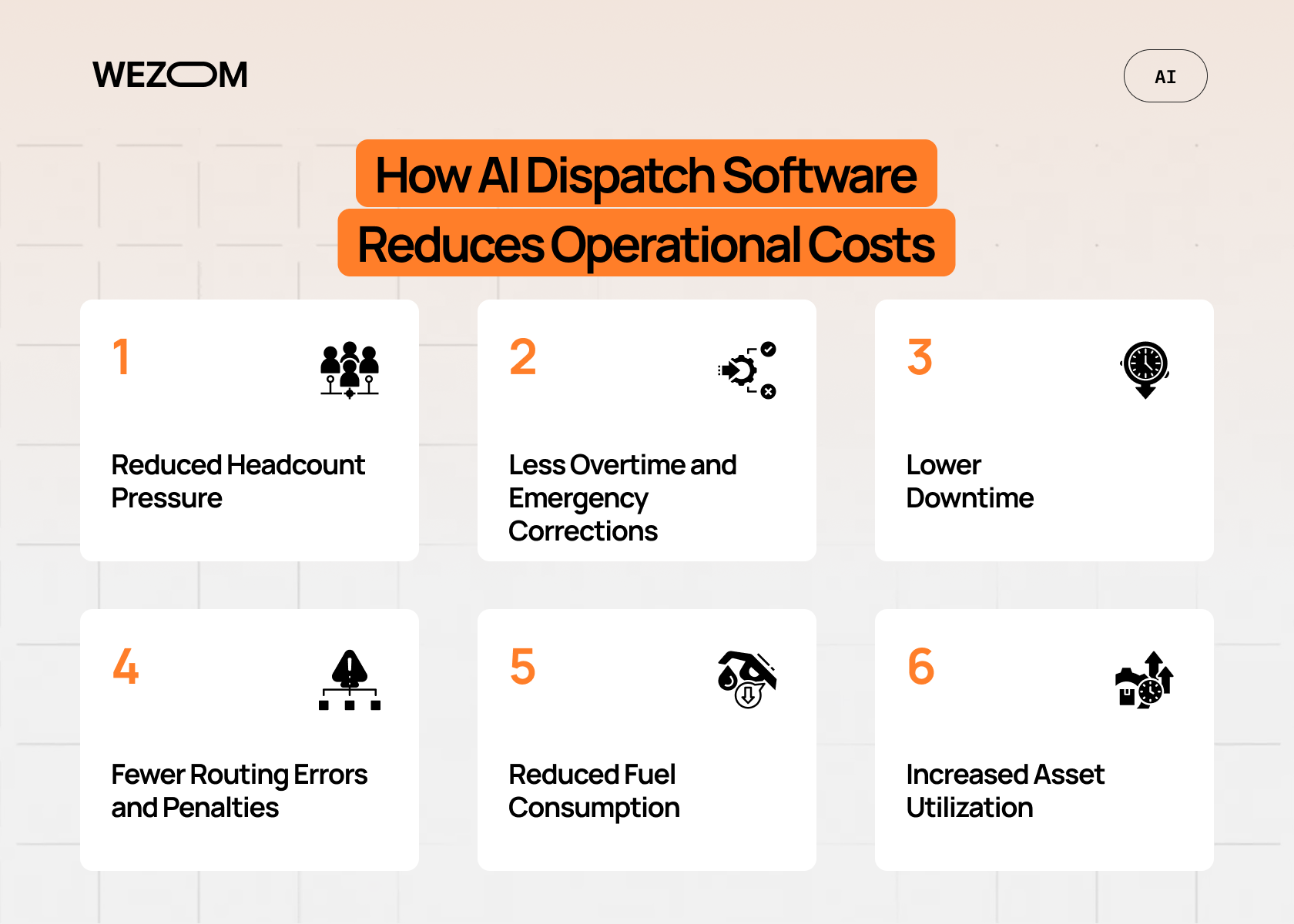
Cost reduction is one of the primary business drivers behind implementing AI dispatch software. However, the savings do not come from a single factor. Instead, they accumulate across multiple operational layers – fleet utilization, fuel efficiency, workforce optimization, and downtime reduction. When analyzed together, these improvements significantly impact overall logistics margins.
Reduced Headcount Pressure
In traditional dispatch environments, scaling operations requires proportional staffing increases. As the fleet grows, dispatch workload grows with it – more routes to plan, more drivers to coordinate, more exceptions to manage.
With AI-powered dispatch software, route planning, scheduling, and load assignment are automated. Dispatchers shift from performing calculations manually to supervising and managing exceptions. This allows companies to scale fleet size without linear growth in administrative headcount. Over time, this reduces payroll pressure and improves operational leverage.
Less Overtime and Emergency Corrections
Manual dispatch often leads to reactive adjustments. When routes are inefficient or delays are not predicted early, dispatchers must work overtime to reassign loads, communicate with drivers, and coordinate rescheduling.
An automated dispatch system proactively calculates optimized routes and predicts risks before they escalate. By minimizing last-minute corrections, companies reduce overtime expenses and stabilize workforce schedules. Predictive scheduling also improves driver shift planning, which lowers compliance risks and the administrative overhead.
Lower Downtime
Vehicle downtime is one of the most expensive hidden costs in transportation. Idle trucks, waiting at warehouses or stuck in congestion, reduce asset utilization and profitability.
A dispatch automation system leverages predictive analytics to minimize these inefficiencies. By analyzing traffic data, warehouse capacity, and delivery windows, the system reduces idle time and avoids bottlenecks. Proactive rerouting prevents vehicles from entering congestion zones, protecting delivery timelines and increasing operational throughput.
Fewer Routing Errors and Penalties
Routing errors directly affect costs through fuel waste, SLA penalties, and missed delivery windows. Under pressure, manual dispatchers may assign overlapping schedules or miscalculate travel time.
With dispatch AI software, route validation is algorithm-based. Constraints such as vehicle capacity, delivery priority, road restrictions, and driver hours are automatically verified. This reduces costly mistakes and strengthens service reliability, which is particularly important for contract-based logistics operations.
Reduced Fuel Consumption
Fuel is often the largest variable expense in fleet operations. Even small improvements in route optimization can generate substantial savings across large fleets.
An AI agent for intelligent route dispatch software calculates the most fuel-efficient sequences by analyzing road gradients, traffic density, historical travel times, and stop sequencing. By reducing unnecessary mileage and idle time, companies lower fuel consumption while simultaneously decreasing environmental impact.
Increased Asset Utilization
Capacity underutilization reduces profitability. When vehicles operate below optimal load levels or return empty, margins shrink.
An AI agent for dispatch automation software improves load planning through algorithm-driven capacity optimization. It assigns deliveries based on volume, weight, sequence, and vehicle compatibility. As a result, companies increase fleet utilization rates without expanding physical infrastructure.
The Role of AI Agents in Dispatch Automation Systems
An AI agent for dispatch automation software functions as a continuously learning optimization engine.
Decision-Making Logic
The AI agent evaluates multiple constraints simultaneously:
- Capacity.
- Delivery priority.
- Cost.
- Risk.
- Historical performance.
Self-Learning Optimization
Through machine learning, the system refines scheduling and routing decisions based on operational data.
Data-Driven Dispatch Improvement
Advanced analytics allow performance monitoring across:
- Fleet efficiency.
- Driver utilization.
- SLA compliance.
- Load optimization.
This creates a feedback loop that improves long-term logistics performance.
How to Transition from Manual to AI Dispatch
Transitioning from manual coordination to AI dispatch software should be structured and phased, not disruptive. The most effective approach begins with targeted automation – typically route optimization or load planning – before expanding into full dispatch automation system deployment.
First, operational data must be centralized and standardized. AI models rely on clean inputs from TMS, fleet tracking systems, and order management platforms. Integration ensures real-time visibility and eliminates workflow fragmentation.
Second, companies should run pilot projects on a limited fleet segment. This allows performance benchmarking, downtime comparison, and validation of predictive accuracy without risking full-scale disruption.
Driver adoption is also critical. Integrating an AI agent for mobile dispatch software simplifies communication and reduces resistance by delivering clear, optimized assignments directly to mobile devices.
Finally, dispatcher roles evolve rather than disappear. Teams shift toward supervision, analytics, and exception management – transforming dispatch from manual coordination into intelligent operational orchestration.
FAQ
What is AI dispatch software?
AI dispatch software is an intelligent automation system that optimizes route planning, load assignment, and scheduling using algorithms and machine learning to reduce manual dispatcher dependency.
How does an AI dispatcher work?
An AI dispatcher analyzes real-time fleet data, traffic conditions, and operational constraints to automatically assign loads, optimize routes, and predict delays.
Can AI replace human dispatchers?
AI does not eliminate human roles but reduces dependency by automating repetitive and optimization-heavy tasks. Dispatchers transition to monitoring and exception management.
How does AI improve route optimization?
AI evaluates thousands of route variables simultaneously, selecting the most fuel-efficient and time-efficient paths while predicting potential disruptions.
How does AI dispatch software reduce downtime?
Through predictive analytics and real-time monitoring, AI detects potential delays and reroutes vehicles proactively, minimizing idle time and operational disruption.
