
The UAV market is no longer focused on entertainment only – it presents highly specialized devices for military, industrial, and other sectors as well. While the physical components of these systems have barely evolved, their firmware has made significant progress and determines 90% of mission success. But which firmware should you choose – a market leader’s SDK or custom development?
What Is a Software Development Kit?
So, what is an SDK in software? In the context of UAS, it’s a software development kit, needed to build solutions that interact with the drone's hardware. SDKs create the connection between high-level software code and low-level flight processes.
A standard one includes an API (a set of endpoints for gimbal/camera/telemetry/flight mission control, etc.), driver libraries (ready-made code for working with video streams/sensors/communication protocols), and emulators/simulators (they enable code testing in a virtual environment). Additionally, the SDK includes documentation with code examples for typical scenarios.
In terms of types, DJI offers the following:
- DJI mobile SDK, for creating mobile apps for iOS/Android;
- PSDK, for integrating custom lidars, gas analyzers, and other sensor types into the drone's data bus;
- OSDK, for controlling the drone from the onboard computer.
Advantages of the DJI SDK
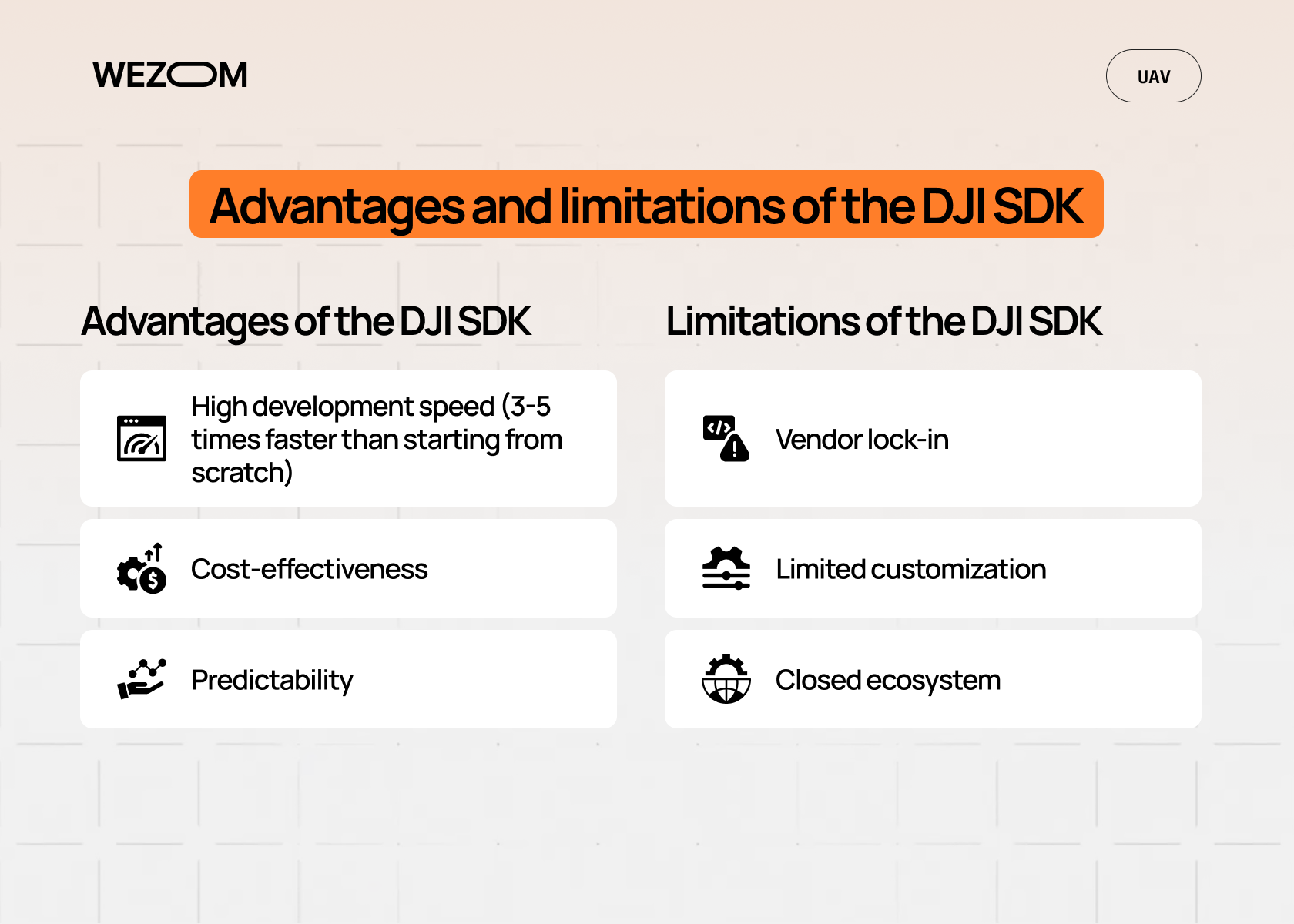
Now, when you already know the answer to the question: “What is a software development kit?”, you should consider the advantages that choosing the DJI SDK offers:
- High development speed (3-5 times faster than starting from scratch) – your DJI SDK development team won't have to write code from scratch for common tasks like flight stabilization/GPS signal processing/video stream decoding, as high-level commands have already been available for all of these tasks.
- Cost-effectiveness – when choosing a ready-made SDK, the budget goes toward implementing logic and the interface only (instead of creating basic UAS scenarios).
- Predictability – the likelihood of your drone crashing due to a bug in this SDK is minimal, as DJI has conducted tens of thousands of tests to ensure the stability of the flight controller and radio communication.
Limitations of the DJI SDK
Convenience comes at a price. Here's what we mean:
- Vendor lock-in – your software will be tied to a specific brand, and if at any point, DJI discontinues your drone model, changes its licensing, or falls under sanctions, your business process will require a radical transformation (while migrating to another SDK platform would require a complete rewrite of the code).
- Limited customization – if one of DJI's built-in algorithms doesn't work as intended for your application, you won't be able to rebuild it.
- Closed ecosystem – DJI controls its security, which creates difficulties for government or military applications where code auditing and access to documentation describing data transfer principles are essential.
Custom Drone Software Development: Benefits and Challenges
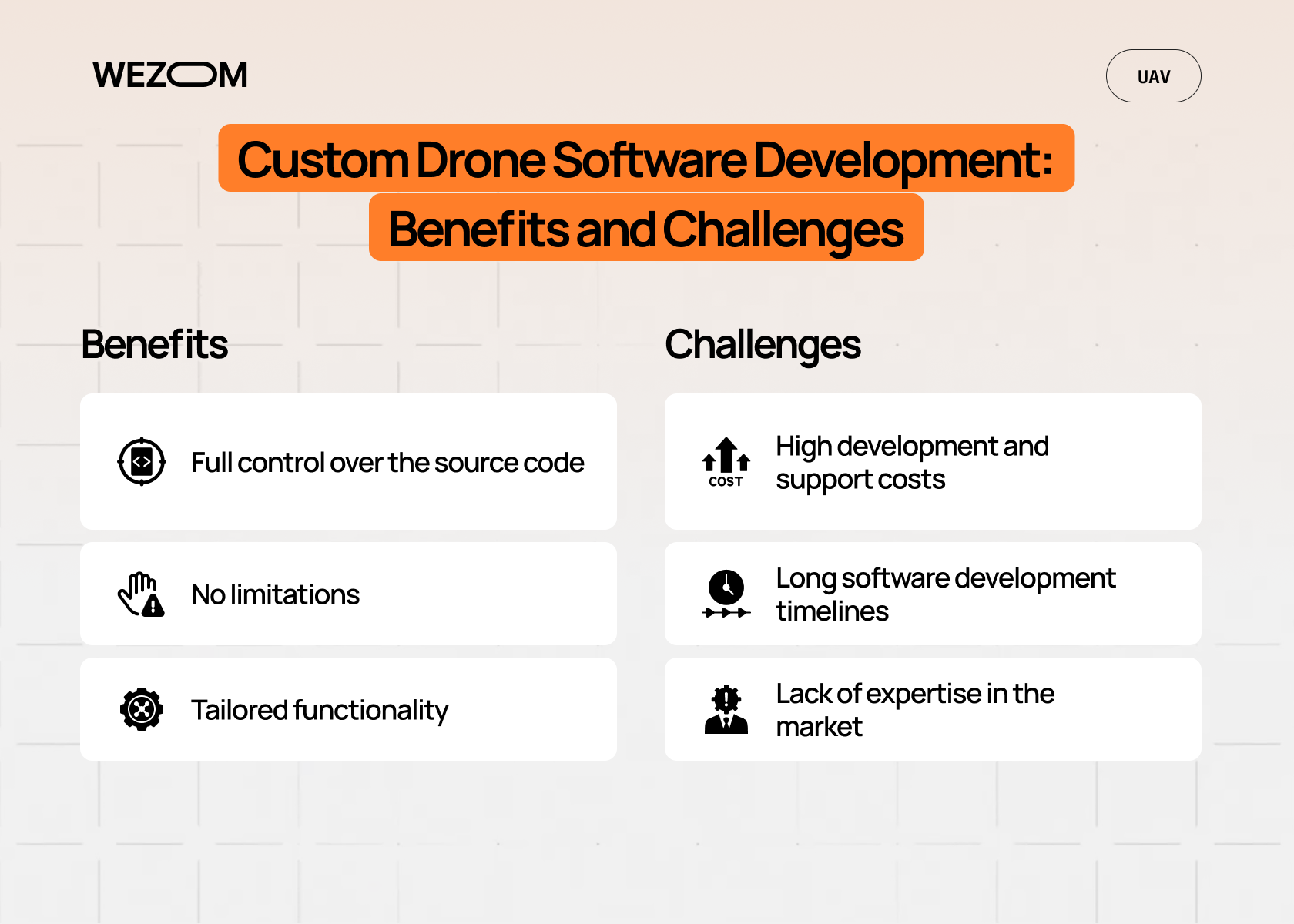
Developing custom software for drones (without relying on the DJI software development kit) means creating something unique, tailored to specific needs.
Benefits
- Full control over the source code, eliminating the risk of sudden privacy policy changes or account blocking (so, it is the only viable option for government and critical infrastructure tasks).
- No limitations, meaning you can work with any frame/motor/communication protocol, etc.
- Tailored functionality, for example, based on unique AI algorithms for autonomous navigation in GPS-deficient areas.
Challenges
- High development and support costs due to the need for senior embedded developers on the team.
- Long software development timelines – for example, creating a stable flight stack from scratch can take up to two years to launch a stable solution.
- Lack of expertise in the market for specialists with knowledge of RTOS/radiophysics/computer vision/etc.
DJI SDK vs Custom Software: Main Differences
To better understand what to expect when choosing one approach or another, let's briefly evaluate the most important selection criteria from a business perspective.
| Criteria | DJI’s platform software development kit | Custom development |
|---|---|---|
| Time to market | Fast (1-3 months to the MVP launch) | Low (from 1 year) |
| Initial investments | Low/moderate | Very high |
| Hardware flexibility | Only DJI’s ecosystem | Any hardware |
| Integration capabilities | Easy with mobile apps (thanks to availability of the mobile software development kit) | In-depth with enterprise solutions |
| Scalability | Limited by the vendor's model range | Unlimited, thanks to compatibility with any vendor’s hardware |
When Should Businesses Choose DJI SDK?
The choice of an SDK is justified in 8 out of 10 commercial use cases where the drone is a tool for solving specific problems (and not the company's primary product). Specifically, this applies to:
- MVP development, when you need to quickly test a hypothesis and demonstrate its implementation to investors.
- Fast solution deployment, when it needs to be launched, say, yesterday.
- Standard scenarios, such as photogrammetry, mapping, thermal monitoring of power lines, etc. (since DJI offers 95% ready-made functionality for these tasks).
When Is Custom Drone Software a Better Choice?
The choice of a custom approach is usually justified by the following project requirements:
- Complex workflows, for example, when a drone must interact with robotic manipulators on the ground, operate in a swarm, or perform missions autonomously.
- Unique business logic, for example, for automatic defect detection systems based on third-party gas analyzers/multispectral cameras/etc. (since all of these require low-level, real-time access to the data bus).
- Creation of corporate fleets, where data shouldn’t leave the company's contour (while the software itself should seamlessly integrate with a custom ERP/CRM/any other system).
Cost Comparison: SDK vs Custom Development
The first thing to consider is short-term costs. In this context, using the DJI SDK allows you to launch an MVP for approximately $15,000-$50,000 (with the main expenses on licenses for tools like DJI Terra for approximately $1,000-$2,000/year and the salaries for UI developers). With custom development, the budget will start at $150,000, as you’ll need to pay for the architecture, hardening, and a number of integrations.
Next, long-term costs and maintenance come, where SDK-based solutions will require regular updates to new firmware versions (which amounts to approximately 15% of the development cost annually). At the same time, custom software needs a full-fledged DevOps team; otherwise, the technical debt will make your solution inoperable within a couple of years, given constantly changing standards (for example, new regulations like EU STS-01/02).

How to Choose the Right Approach for Your Business
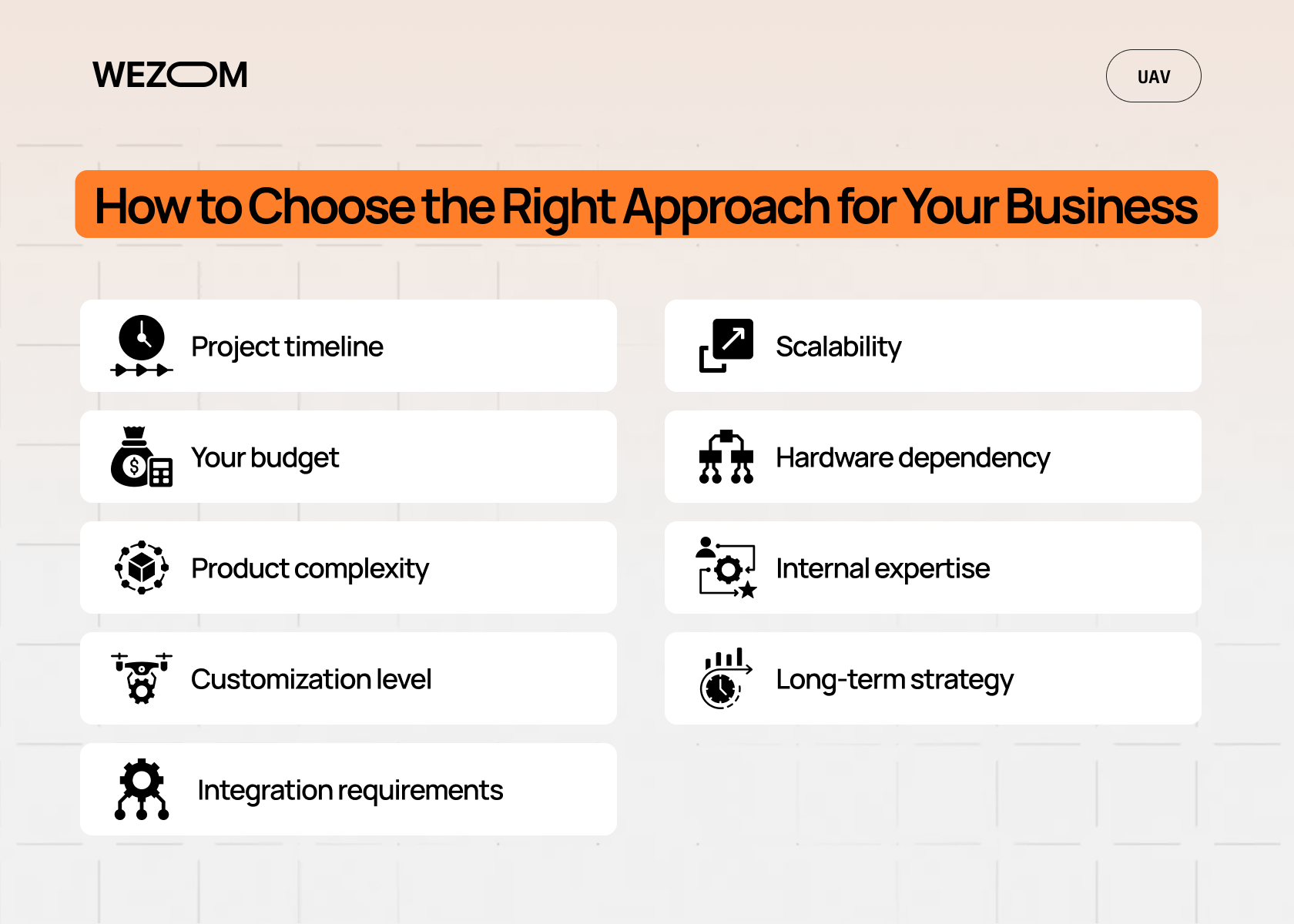
When making a final decision, we recommend using the following nine-factor checklist:
- Project timeline – if you need a field-ready product in, say, three months, an SDK will be the only viable option (but if you have about a year and a half for R&D, you can choose a custom approach).
- Your budget – here, it's important to understand whether you're ready to spend $50,000+ annually on supporting a proprietary solution.
- Product complexity – if you need swarm intelligence or operation in areas without GPS, you should consider custom development.
- Customization level – here, we mean whether you need specific sensors, as an SDK often limits your choice.
- Integration requirements – that is, should the drone be part of a closed enterprise security system (in which case the custom approach is the only option) or not (in which case you can consider an SDK)?
- Scalability – if you’re going to use drones from different brands, a custom approach is your only choice to avoid software incompatibility.
- Hardware dependency – if the risk of sanctions or loss of the DJI framework’s support is critical, then a custom approach is worth considering again.
- Internal expertise – it's important to understand whether you have the resources to staff a team with at least one senior embedded developer.
- Long-term strategy – you have to decide whether you're building a service solution (a SDK would be better suited here) or a technology platform (in which case, custom development would be optimal).
FAQ
What is the DJI SDK used for?
DJI SDK development tools were created for building mobile/onboard applications aimed at automation of flight tasks, involving camera control and telemetry processing for DJI UAVs. Most importantly, developers don't have to delve into low-level flight controller programming.
What is the difference between SDK and API?
The API provides a set of commands for a specific task (such as “fly”) via a standardized interface, while the SDK software development kit is a comprehensive set of tools that, in addition to that API, also includes libraries, documentation, code samples, utilities, and much more that may be needed for building and deployment of an application.
How scalable are SDK-based drone applications?
Scalability is always limited by the ecosystem of a single vendor. This means that if you need to add a drone from another manufacturer to your fleet, you will have to develop a separate application for it from scratch.
How long does custom drone software development take?
The minimum timeframe is 12 months to deliver a stable version (an MVP alone typically requires about 4 months, while most of the time is spent fine-tuning the software's performance in various weather and radio conditions).
What industries benefit most from DJI SDK development?
This primarily applies to agriculture, solar panel inspection, and surveying/navigation – here, the standard DJI platform SDK functionality is sufficient for 99% of tasks.
When is custom drone software development the best decision?
This is the optimal choice if your business requires full ownership of intellectual property, operation in conditions of extreme interference, the use of unique hardware modules, or you represent the public sector (or any other sector with strict requirements for code safety and transparency).
