
Today, aerial survey solutions perform a much broader range of tasks than simply monitoring large areas and collecting data from them. And all this is thanks to the drone data processing software they run on, because infrastructure monitoring drones with even a primitive design can generate colossal amounts of unstructured information, which is valuable for businesses.
Why Drone Data Matters for Business
In the industrial sector, the evolution of drone-based systems is primarily manifested in the transition from episodic inspections to digital twin creation, which provides:
- High speed of inspection (this is due to automated overflights of large areas, allowing for drone data collection with an accuracy of 1-3 cm for an orthophotomap in tens of minutes, which is 10-12 times faster than traditional geodetic surveying).
- Elimination of inspector bias, with the provision of a verifiable database.
- Transition from thermal imaging maps to 3D terrain modeling, making it possible to identify hidden defects that human inspectors might miss.
In general, when developing aerial imaging software, tech teams must deal with a complex stack of input streams, each requiring specific software processing, including:
- RGB and drone photogrammetry (essentially a set of 2D images with 70-80% overlap, from which structure-from-motion algorithms construct a 3D scene).
- LiDAR, which involves laser scanning to create a point cloud (unlike photogrammetry, this approach enables spatial data visualization under tree canopies).
- Multispectral/hyperspectral UAV data processing in narrow bands of the electromagnetic spectrum (necessary for calculating vegetation indices in crop health monitoring).
- Thermal drone mapping with analysis at each pixel (which, however, requires radiometric calibration to obtain accurate absolute values).
If the drone flight data isn’t subsequently filtered, organized, and processed, it will remain just numbers, regardless of the advancement of the equipment you use.
Understanding the Inputs
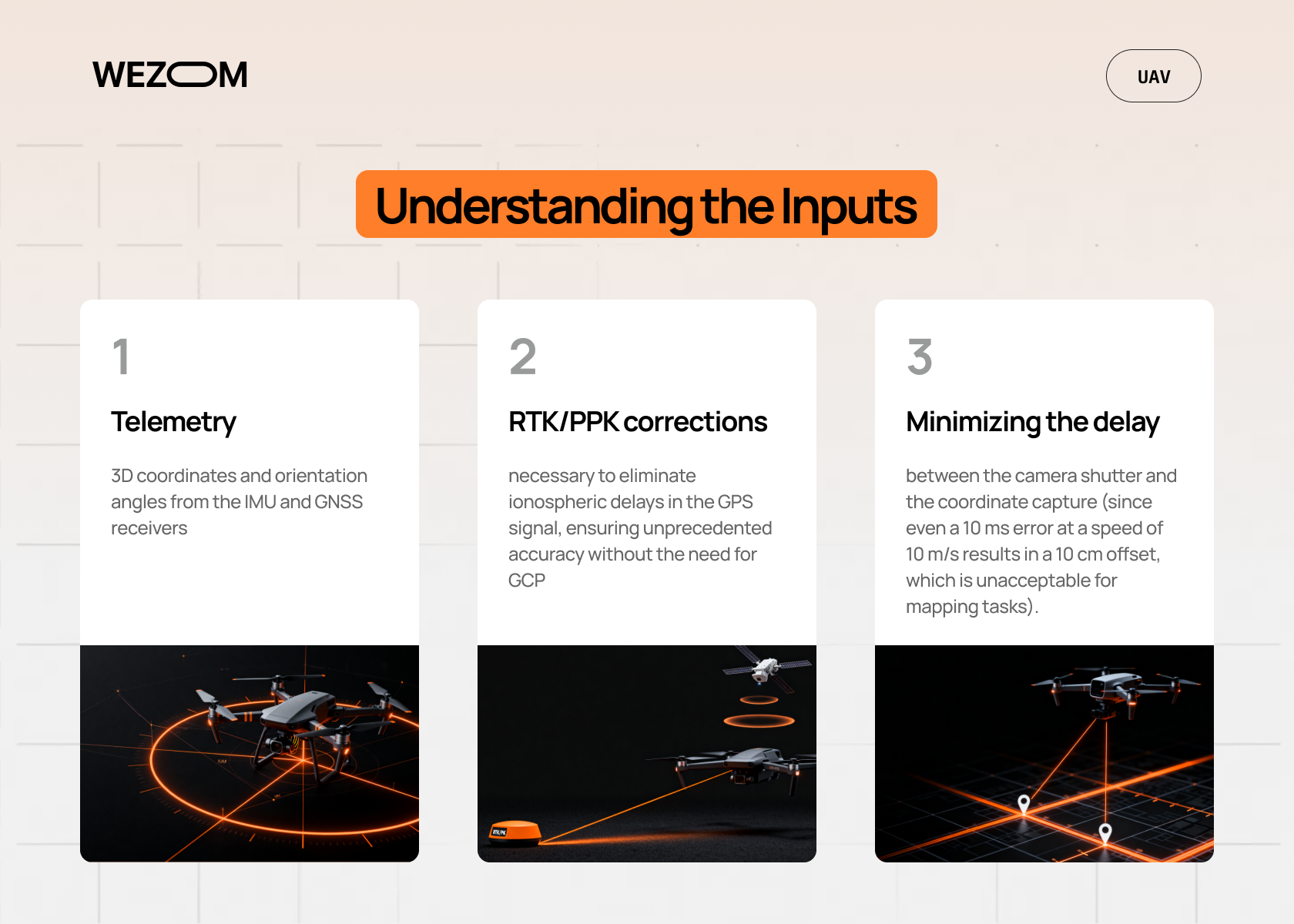
The main task of drone image processing software is to ensure the precise georeferencing of each UAV sensor data packet, meaning each image/laser pulse must be logged via:
- Telemetry (3D coordinates and orientation angles from the IMU and GNSS receivers);
- RTK/PPK corrections (necessary to eliminate ionospheric delays in the GPS signal, ensuring unprecedented accuracy without the need for GCP);
- Minimizing the delay between the camera shutter and the coordinate capture (since even a 10 ms error at a speed of 10 m/s results in a 10 cm offset, which is unacceptable for mapping tasks).
Furthermore, it’s important to initially build a software architecture that can handle colossal workloads. For example, a typical drone mission can generate as much as 20-50 GB of raw data in TIFF/.LAS formats. It must also support RAW images (to preserve dynamic range during shadow drone data analysis), binary point cloud files, and flight controller logs.
Finally, no matter how perfect the software code, the external environment still introduces noise, such as:
- Rolling shutter, so the drone mapping software must compensate for this effect, for example, through dewarping correction;
- Signal degradation, which is typical in urban areas or near power lines (this causes electromagnetic interference, meaning the software must be able to switch to inertial navigation or use visual odometry);
- Ground sample distance, which means the software must automatically adjust the flight altitude based on the terrain to maintain a constant resolution.
From Raw Data to Insights: The Role of Processing Software
To bring real business value, drone data management software must undergo sophisticated drone data processing, from signal cleaning to constructing topological structures. Let's analyze these stages in more detail.
Preprocessing
First, the UAV mapping software data must be cleaned through:
- Noise reduction and stabilization, which is crucial for video streams and LiDAR data (Kalman filters and motion compensation algorithms come in handy here to remove artifacts caused by flying birds/debris/dust).
- Radiometric and geometric calibration to eliminate the fish-eye effect and normalize illumination (important for multispectral imaging analysis to obtain absolute reflectance values).
- Alignment (necessary for matching telemetry data with photographs to associate coordinates with the pixel grid).
3D modeling and mapping
Here, the technical team uses photogrammetry and point cloud processing engines to generate three data types:
- Orthomosaics, where hundreds of images are stitched together into a single perspective-corrected canvas, and when each pixel is referenced to a coordinate system.
- Dense point clouds, obtained by using dense matching algorithms to calculate the position of points in 3D space.
- Digital models (DEM/DTM/DSM), which are needed to separate the ground from objects.
Data analysis and calculation
Once drone inspection tools have collected the geometry, the tech team must implement its analysis, including:
- Volumes and areas (particularly for calculating the volume of fills in warehouses or excavations in quarries).
- Object detection, for example, using computer vision (which is necessary for inventory, defect detection, etc.).
- Change detection, with pixel-by-pixel comparison of two time slices to assess construction progress.
Automation and AI/ML for processing large datasets
Modern drone software for mapping often uses AI in the following contexts:
- Automatic classification, so that the software system can automatically determine the location of a road/power line/vegetation/etc., in a point cloud.
- Semantic segmentation, to enable the identification of soil erosion zones or the classification of crop types based on multispectral indices.
- Edge AI (with analytics transferred to a drone or ground station), which is necessary for real-time object detection, without resorting to point cloud analysis.
Advantages of Using Specialized Drone Processing Software
Using specialized drone mapping applications instead of basic solutions offered by industrial drone manufacturers offers the following advantages:
- High processing time, achieved, for example, by using specialized engines with CUDA/OpenCL to parallelize tasks on GPUs (meaning that instead of waiting for days, with such drone data analytics software, you’ll be able to process the data in hours in cloud clusters).
- Sub-centimeter accuracy, thanks to the use of RTK/PPK algorithms and support for ground control points (this allows the drone processing software to achieve accuracy optimal for cadastral work/design).
- Integration with GIS/ERP systems you already use (custom software for drone mapping can output data in formats suitable for seamless import into ArcGIS/QGIS/AutoCAD/Revit).
- Scalability, as turn-key geospatial intelligence solutions are often cloud-based, making it possible to process simultaneously data from dozens of drones.
Turning Data into Business Decisions
As for titans in the drone software market, they include Pix4D, DroneDeploy, Propeller, and DJI Terra. Still, the specific sector for which the drone survey technology is being developed determines how raw data is converted into business insights. Actually, this dependence drives companies to develop tailored solutions for their own needs.
Agriculture
Here, custom software can perform the following tasks:
- Crop monitoring, using NDVI/NDRE indices to identify fertile zones and areas of vegetation inhibition;
- Yield forecasting, including analysis of seedling density and biomass, as well as optimization of fertilizer application;
- Disease detection, using neural networks that can identify infestations/weeds at early stages, resulting in savings of up to 30% on herbicides.
Construction
In this niche, tailored construction site monitoring software can handle the following processes:
- Progress tracking, where weekly point clouds are overlaid on a BIM model, with subsequent deviation detection;
- Estimation of volumes of building materials, such as sand/crushed stone/soil, eliminating typos in contractor reports.
Infrastructure
Here, turn-key remote sensing analytics software can replace industrial climbers thanks to the following capabilities:
- Bridge and power line inspection, with automatic concatenation of thousands of images into a detailed 3D model with identified defects in concrete/metal/insulators/etc.;
- Pavement degradation index analysis through highly intelligent recognition of potholes and cracks.
Choosing the Right Drone Data Software
Choosing the right software for automated mapping workflows will be easier if you follow our checklist:
- What data types should it support (for example, can the solution combine RGB, LiDAR, and thermal imaging data in a single project?)?
- How deep should the analytics be – do you just need images or automatic reports on volumes and defects?
- How quickly can the system process 5,000 images (here, it's important to understand whether a local supercomputer is required or whether the software supports cloud rendering),
- Is there an API for transferring data to your ERP/GIS system?
If you're considering custom development (for example, because no off-the-shelf solution allows you to add specific functionality or you can't afford to store your data on third-party servers), you need to understand that you'll face significant development and engineering support costs. On the other hand, for large corporations with a fleet of hundreds of drones, implementing their own platform, even based on a ready-made SDK, is guaranteed to pay for itself within 3-5 years, at least due to the absence of licensing fees for each processed hectare and absolute data security.
Conclusion
Speaking of the future of UAV software, we're confidently moving toward real-time analytics, enabled by 5G networks and powerful onboard processors like NVIDIA Jetson. This means that in the coming years, drones will produce ready-made reports immediately after landing, rather than just performing topographic data generation only.

FAQ
What is drone data processing software?
These are digital solutions using photogrammetry, computer vision, and/or GIS that transform disparate sensor data into accurate 2D/3D models.
How is raw drone data converted into business insights?
First, data is collected and georeferenced, then preprocessed (i.e., cleaned), then the images are stitched together, and finally, they are analyzed.
What industries benefit most from drone data analytics?
These are construction, agriculture, mining, and energy.
How do AI and automation improve drone data processing?
They can detect cracks or classify object types in seconds, which would take a human specialist hours or even days.
How does UAV data processing work?
It identifies common points in overlapping images, determining their spatial position and creating a point cloud for subsequent mapping and modeling.
Can drone data analytics predict trends or risks?
Yes, thanks to change detection algorithms, such software can predict landslides in quarries or, for example, structural deterioration before an accident occurs.
