
Today, drone-based mapping solutions are widely used in precision engineering and are comparable in accuracy to laser scanning for large-scale topographic tasks (in particular, drones can form point clouds and orthophotomaps with a resolution of several millimeters per pixel). However, it's not enough to simply create software with mathematically perfect algorithms and purchase a few drones – it's important to build a system that seamlessly integrates with existing software solutions.
Core Business Applications of Drone Mapping
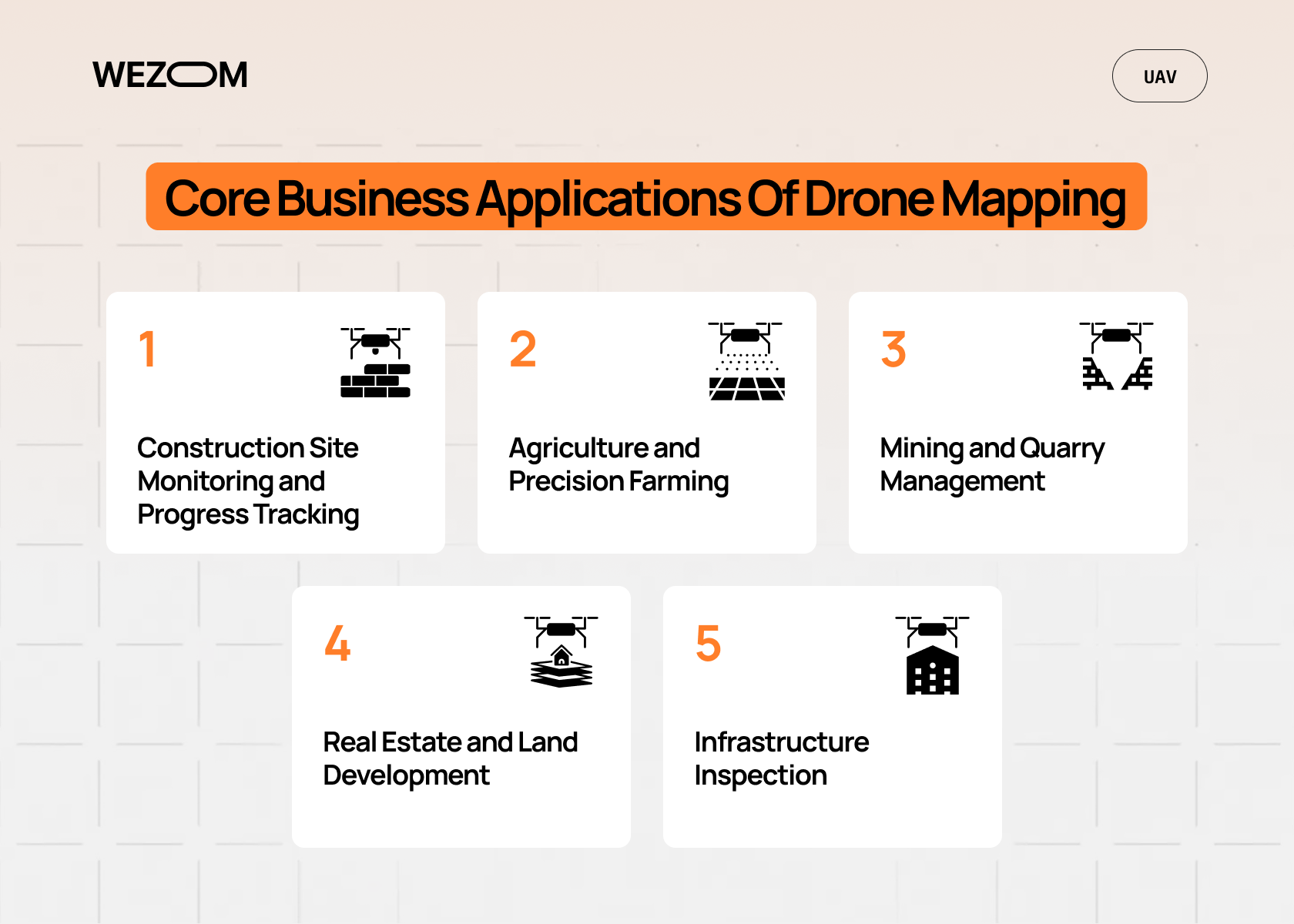
For a modern enterprise, a drone is an advanced surveying tool that can fly. So, what is drone mapping used for? Let's consider how the use of UAVs can help in a number of industries.
Construction Site Monitoring and Progress Tracking
In construction, drones help document the current state of a site in a legally binding manner. This is achieved through:
- Volume calculations. Using photogrammetric algorithms, developers can implement software for creating digital surface models. In particular, these algorithms can quickly calculate the volume of excavated soil or crushed rock fill with an error of less than 2%, eliminating human factors.
- Timeline control. Drones allow for weekly (or even more frequent) inspections, overlaying the actual site condition on the schedule. As for software, solutions that create time-lapse maps can be helpful, allowing the construction progress to be tracked in 2D/3D space.
- Integration with BIM systems. The collected point cloud can be imported into Revit/ArchiCAD for subsequent clash detection – comparison of the actual location of building elements with the design information model.
Agriculture and Precision Farming
The agricultural sector can use UAVs to implement a differentiated approach to field management thanks to:
- Crop condition analytics. Multispectral sensors can be helpful here – they calculate vegetation indices and allow unfavorable plant conditions to be identified weeks before changes become obvious.
- Irrigation planning. Datasets collected by drones can form the basis of microrelief maps, which, in turn, can then be used to implement water runoff modeling to identify areas of stagnant water or soil erosion in real time.
- Yield forecasting. Combining multispectral imaging data with machine learning algorithms allows for the construction of predictive yield models, taking into account planting density and biomass per square meter of the field.
Mining and Quarry Management
In the mining industry, UAVs demonstrate cutting-edge efficiency in mine surveying and industrial safety, specifically through:
- Stockpile measurement. Automated overflight of ore piles enables companies to obtain reports on stockpiles with an accuracy impossible to achieve with manual total station measurements.
- Terrain analysis. Creating digital elevation models can be useful for road design in uneven terrain.
- Safety monitoring. Regular inspections conducted using UAVs make it possible to monitor the stability of quarry walls and, for example, the condition of tailings dams.
Real Estate and Land Development
In development, UAV mapping significantly reduces pre-project surveys, thanks to:
- 3D property visualization. Developers can create photorealistic 3D models using photogrammetry algorithms. This allows you to integrate the future architectural model into the real landscape, allowing investors to assess the visual characteristics of floors not yet built.
- Land surveying. Equipped with RTK modules, UAVs can create orthophotomaps with an accuracy of 2-3 cm per pixel, which is beneficial for clarifying plot boundaries, inventorying existing buildings, and can generally be used for official cadastral registration.
- Marketing materials. In addition to geospatial data, mapping provides great content for the sales department. Specifically, it can be used to create 360° tours and interactive maps to fully showcase a property without the need to visit it and to show construction progress dynamically.
Infrastructure Inspection
Drone mapping can help critical infrastructure providers implement a kind of digital asset passport, where each defect has its own development history. Specifically, this applies to:
- Bridges, roads, and power lines. For bridges, point clouds can be useful, as they allow for analyzing superstructure deflections and support deformations; for roads, developers can create digital surface models to identify ground subsidence and roadbed defects; and for power lines, 3D models of power line corridors can come in handy, as they help to calculate the dangerous proximity of wires to the surrounding environment.
- Risk reduction. Using UAVs minimizes the need for physical personnel in hazardous areas, indirectly reducing the amount of fieldwork.
- Predictive maintenance. This involves accumulating historical data and comparing maps of the same location over different years using the change detection method to track deterioration dynamics and implement proactive maintenance.
Advanced Drone Mapping Use Cases
Now, let’s delve into specific use cases on how to use drones for mapping.
Disaster Response and Emergency Mapping
UAVs provide a timely picture of what's happening, replacing satellite data that can be difficult to obtain due to orbital delays. For example, mapping data is used to build highly accurate hydrological models needed to predict water distribution paths or to determine evacuation routes based on the terrain (particularly through the use of AI, which helps locate people and coordinate heavy equipment in real time).
Environmental Monitoring
Mapping enables continuous digital monitoring of the planet's condition by tracking deforestation (implemented by comparing multispectral maps over different periods and using LiDAR to help estimate forest biomass), wildlife population census (by planning migration routes and habitats using thermal-visual methods), and coastlines (by creating highly accurate 3D models of the coastline, enabling the design of risk-based infrastructure protection structures).
Urban Planning and Smart Cities
In megacities, drone mapping helps perform zoning analysis, assessing building density, the percentage of land used, and so on. Furthermore, this technology is effective in transportation planning, enabling the creation of dynamic traffic models (based on which traffic lights can be optimized and new interchanges designed). Also, drones can be useful in creating digital twins of cities – 3D models that include building geometry, utility/road surface/light data, and more.
Archaeology and Cultural Heritage
Drone technology enables site preservation (by capturing microdeformations and erosion, thereby enabling restoration specialists to intervene when needed). Photogrammetric data can also be used here, as they help in creating virtual copies of ancient artifacts, making this technology a powerful scientific tool and a modern solution for AR/VR tours.
How to Use Drone for Mapping: Step-by-Step Workflow
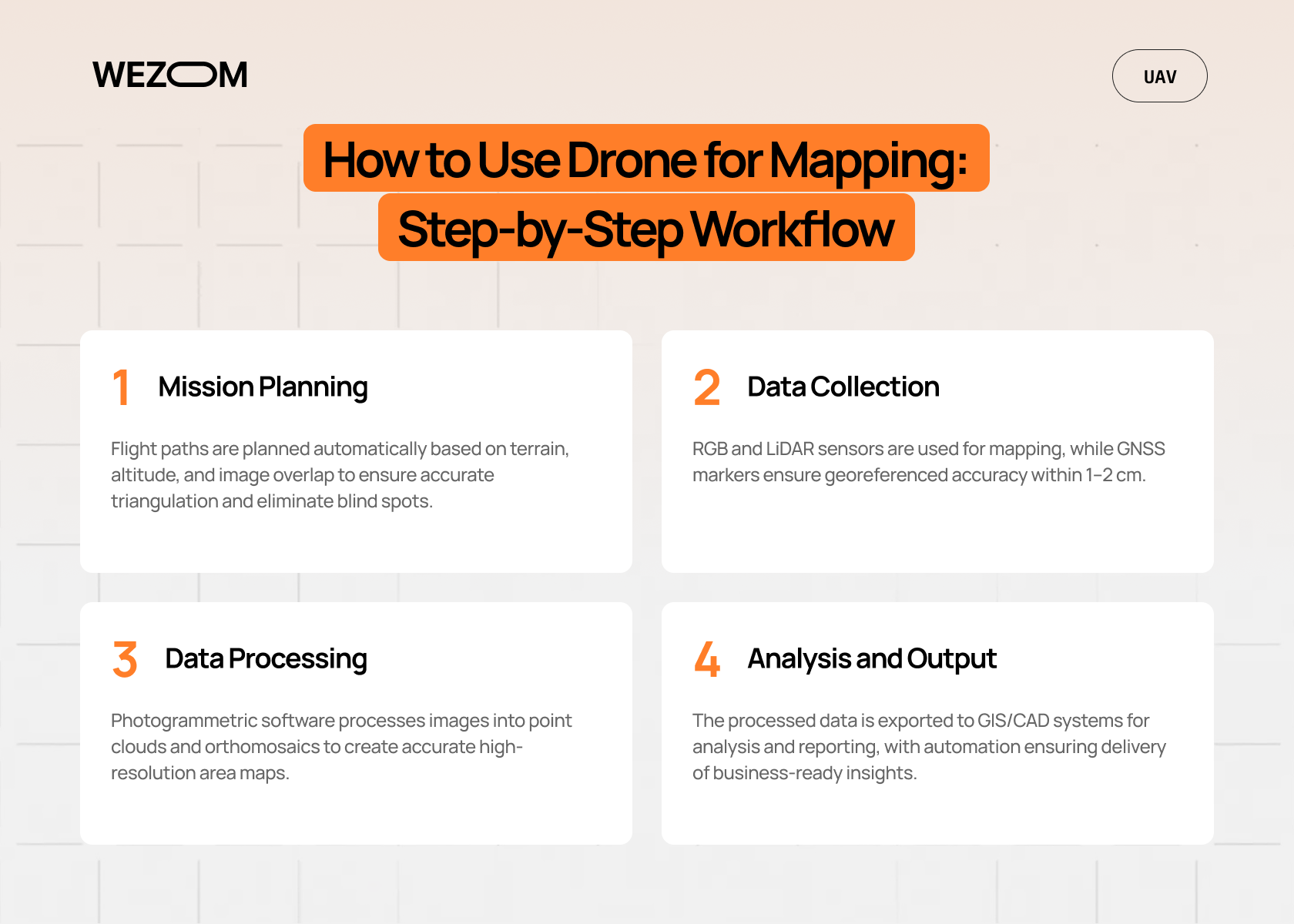
An effective mapping workflow typically has the following structure.
Mission Planning
It all starts with flight path planning, which is where grid/double grid planning software for 3D models comes into play. The route itself is generated automatically, taking into account the terrain. Also, it's important to calculate the altitude, as it determines the resolution. Specifically, for high-precision mapping, we set overlaps of at least 80% longitudinal and 70% transverse, which ensures the correct operation of triangulation algorithms and eliminates blind spots.
Data Collection
Here, sensors such as RGB and LiDAR are used (ultimately, it all depends on the task). For example, RGB cameras with a resolution of 45 MP and higher are effective in photogrammetry, while LiDAR is usually indispensable when capturing an object or surface hidden by vegetation. To achieve geodetic accuracy, developers place special markers on the ground whose coordinates are measured by high-precision GNSS receivers, thereby guaranteeing precise georeferencing with real-world coordinates (with an error of no more than 1-2 cm).
Data Processing
Now, it's time to use photogrammetric software, such as those based on Pix4D or RealityCapture, which aligns images by creating a point cloud (arrays of millions of points with coordinates) and performing triangulation. Orthomosaics are also applied at this stage as they are needed to produce a seamless, high-resolution image of the area.
Analysis and Output
After conversion, the data is exported to geographic information systems such as ArcGIS/QGIS/CAD for engineering design. This enables the generation of reports – for example, on project deviations or crop status. It's important to ensure full automation so that company employees ultimately receive business-valuable data.
Main Technologies Behind Drone Mapping
Now, it's time to consider the list of technologies most commonly used in drone mapping software.
The first is photogrammetry, which determines the geometric properties of objects from photographs. Structure-from-motion algorithms come to the rescue here, as they can reconstruct 3D scenes from frames. The second technology is LiDAR, which enables remote sensing using laser pulses, thus collecting data on the structure of objects even in the complete absence of a direct line of sight.
Another solution is GPS/RTK/PPK technologies, or a combination of them. Essentially, they help determine coordinates; RTK provides centimeter-level accuracy in real time, while PPK allows for the same result to be achieved without a stable radio channel, performing post-processing of the data.
Finally, artificial intelligence is worth mentioning – it will be useful for automatically classifying objects on maps and identifying defects without direct human intervention.
Benefits of Drone Mapping for Businesses
The first and most obvious advantage is cost reduction, as drone mapping is, on average, 40-60% cheaper than traditional ground-based surveying (especially when covering large areas). Next, the increased speed of data collection comes: where a surveyor with a total station would spend a week, a drone can complete the task in a few hours, while maintaining accuracy of 1-3 cm horizontally and up to 5 cm vertically.
If we add to this the safety (guaranteed by remote surveys) and scalability (drone-assisted mapping is equally effective in small areas as it is in quarries covering thousands of hectares), it becomes clear that such solutions are far more effective than traditional methods.
Limitations and Challenges
Despite all the aforementioned advantages, even the most advanced mapping technology faces a number of limitations. This applies in particular to weather dependency, as standard UAV photogrammetry is sensitive to light levels and precipitation. It's also important to understand that strong gusty winds create an additional risk of crashes and also cause measurement distortions due to vibrations.
Furthermore, there are regulatory restrictions, as mapping often involves flying over critical infrastructure or within city limits, requiring airspace use permits and compliance with data protection laws.
Another equally important limitation is the complexity of processing raw data, as creating a high-quality orthomosaic or point cloud requires significant computing power and solid expertise in topography (this is necessary for model calibration). Otherwise, your calculations will have unacceptable errors, making the software ultimately unsuitable for engineering calculations.
Finally, it's worth noting the high cost of the equipment, as a complete system (say, a drone with RTK, a LiDAR sensor, and a base GNSS station) will cost several thousand dollars, not counting licenses on drone mapping applications and the cost of storing terabytes of data in the cloud.
Choosing the Right Drone Mapping Solution
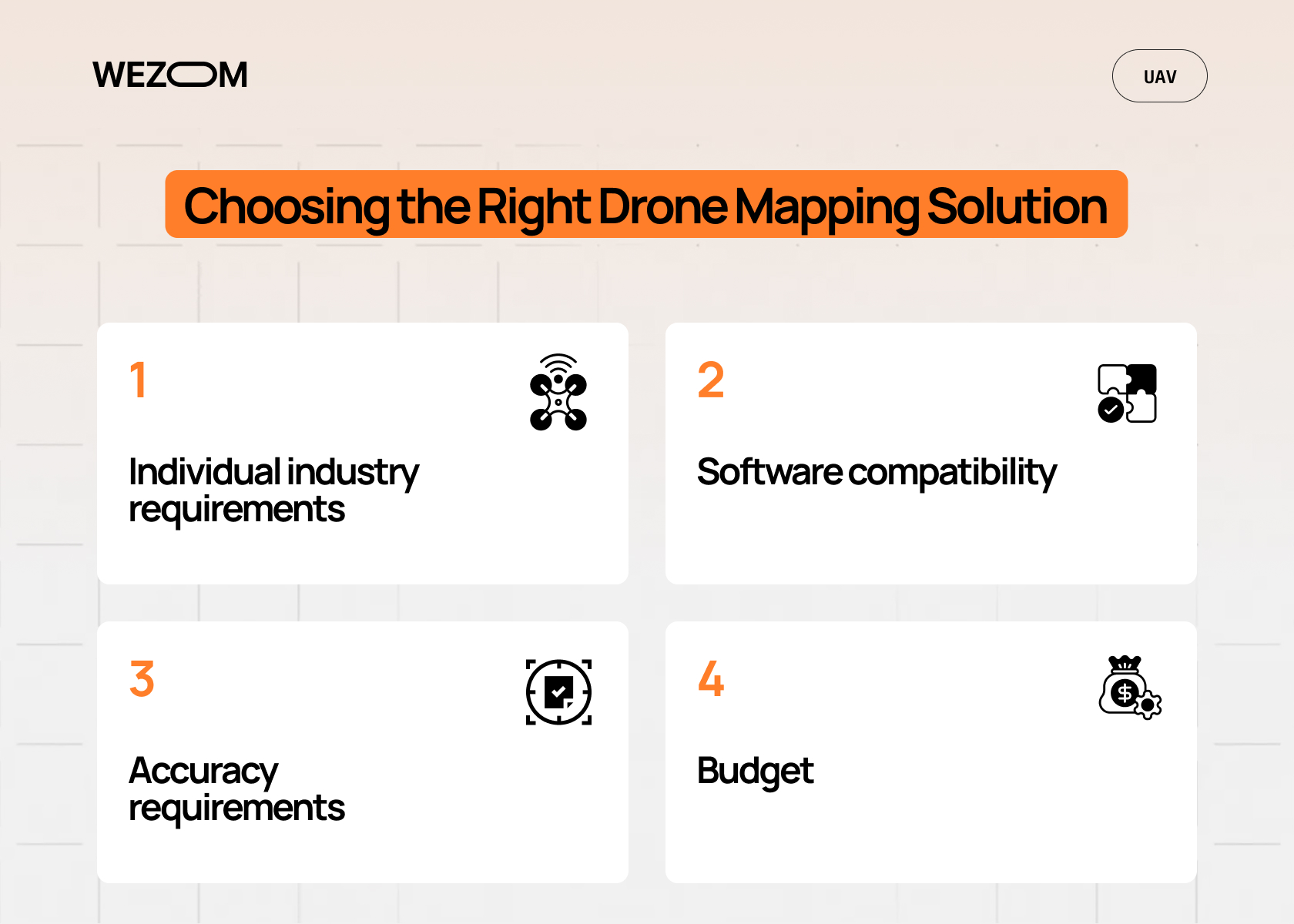
When choosing a specific solution, it makes sense to focus on the following aspects:
- Individual industry requirements – while multispectral sensors are commonly used in agriculture, lidars are applied in mine surveying, and high-precision RGB cameras with a mechanical shutter are good for cadastral surveying;
- Software compatibility – it's important to find a platform that supports export to your company's specific formats and can seamlessly integrate with your systems;
- Accuracy requirements – you should have a defined error threshold: for example, if you need an accuracy of 1-3 cm, an RTK kit will be suitable, while for visual progress monitoring, more budget-friendly solutions will suffice;
- Budget – it's important to evaluate the total cost of ownership, which includes maintenance, training of operators, and, optionally, cloud subscriptions.

FAQ
What is drone mapping used for in business?
The most common drone mapping use cases include creating precise digital copies of terrain and objects, calculating material volumes, monitoring construction work, conducting land inventory, and enabling predictive infrastructure maintenance.
How accurate is drone mapping?
With RTK/PPK systems and ground control points, drone software can easily achieve an accuracy of 1–3 cm in coordinates along the X and Y axes and up to 5 cm along the Z axis.
What industries benefit most from drone mapping?
The industries that benefit most from drone mapping include construction, mining, agriculture, energy, real estate development, and smart cities.
What software is used for drone mapping?
DJI Terra and DroneDeploy are commonly used for mission planning, while Pix4D is often used for data processing. QGIS and Autodesk Civil 3D are widely used for analysis, visualization, and further processing of mapping data.
How much does drone mapping cost?
The cost starts at a few thousand dollars for a basic drone kit with sensors and proprietary software, while custom solutions can cost hundreds of thousands of dollars depending on project requirements and system complexity.
