
Do you have a proprietary corporate platform collecting aerial survey data that needs to be transformed into a single source of truth without extra effort? In that case, you should consider integrating the DroneDeploy API – it will help you reduce rework and ensure centimeter-level accuracy in your calculations. Below, we'll explore the potential of this API and describe the integration process.
What Is DroneDeploy API?
In simple words, the DroneDeploy API enables management of the world's largest repository of drone data. It essentially acts as a middleware between aerial data capture solutions and specialized ERP and BIM environments for construction companies. In addition to simple image storage and photogrammetry orchestration, the API facilitates automated map processing and triggering server-side events via Webhooks. The following data types are supported by the DroneDeploy API:
- Orthomosaic images, such as georeferenced maps for 2D planning;
- 3D meshes and pointclouds exported to .LAS/.OBJ/.RCP formats and then processed in Autodesk Revit or Navisworks;
- NDVI layers and heat maps;
- Telemetry logs, GPS coordinates, and flight path timestamps.
Ultimately, instead of data sitting idle in the DroneDeploy app for a long time, the API makes it available to the company's internal systems.
Key Use Cases in Construction & Inspection
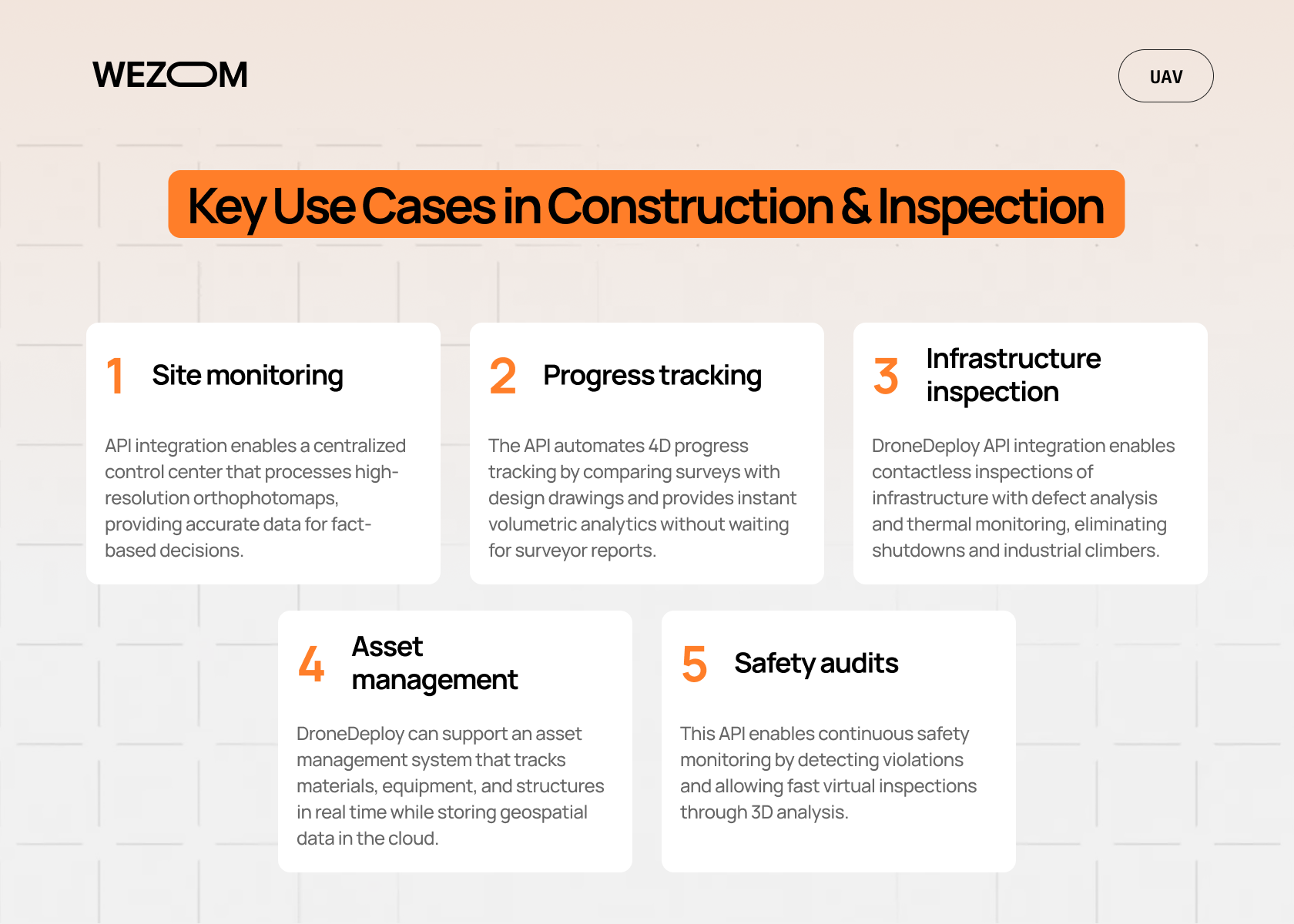
DroneDeploy API integration allows developers to create predictive control systems. Specifically, this covers the following deployment scenarios.
Site monitoring
On large-scale construction projects, physical inspections on endpoints take hours. API integration, in turn, will enable the implementation of a centralized control center processing ultra-high-resolution orthophotomaps. This means the company will have an environment with accurate imagery data that will help make informed decisions based on facts (instead of the opinions of often biased contractors).
Progress tracking
In the progress tracking scenario, the API helps automate the 4D visualization process through layer comparison, specifically by overlaying current surveys on design drawings, allowing the company to determine the project's state of completion. This API also enables instant volumetric analytics, for example, to calculate excavation volumes or aggregate fills. This means no longer having to wait weeks for surveyor reports.
Infrastructure inspection
While previously inspecting bridges/pipes/communication towers/power lines required industrial climbers and a complete shutdown of these facilities, now, thanks to the DroneDeploy API integration, the audit can be conducted contactlessly, with accompanying defect analysis and thermal monitoring (if thermal camera drones for inspection are used).
Asset management
DroneDeploy can also serve as the foundation of an information management system. Specifically, it can be used to create a digital asset passport that tracks building materials, temporary structures, equipment, and other assets in real time, recording them on a map and synchronizing them with the inventory system. This integration is also suitable for operating organizations that need to track the depreciation of structures – this API allows all geospatial data to be stored in the cloud and be accessible with a single click.
Safety audits
This API ensures continuous occupational safety monitoring, instantly identifying violations in critical areas and enabling virtual inspections of multiple terrains per day through 3D modeling and analysis. It’s worth noting that such speed is physically impossible with in-person visits.
How DroneDeploy API Integration Works
Enterprise-level integration always involves building a fault-tolerant data pipeline, where DroneDeploy serves as the backend for initial processing, while the company's existing platform is a fully functional interface. Such industrial drone inspection solutions are typically built on an event-driven data flow, eliminating delays and the need for manual map readiness checks. Here's how they work:
- First, data is captured – an operator runs a drone to collect RAW images, which are instantly uploaded to the DroneDeploy cloud;
- Next, cloud processing occurs, where DroneDeploy's photogrammetric servers transform thousands of images into orthophotos and point clouds;
- Once rendering is complete, DroneDeploy sends Webhook to the corporate platform server;
- Finally, the platform automatically requests metadata and tile links via an API, updating the digital twin of the asset in the interface.
Core API Capabilities
DroneDeploy has a GraphQL-based interface, allowing developers to request only the necessary data without overloading network bandwidth and computing resources.
Data retrieval
This API can be used for access to photogrammetry results, including layer export with automatic generation of GeoTIFF/.DXF/.LAS files, as well as integration of interactive maps directly into the enterprise platform dashboard via URL tile templates for viewing high-resolution maps without lag.
Media access
The API provides access to original 360° panoramas, as well as progress videos and photos. For example, developers can link photos to specific milestones or zones on a site plan using GPS metadata.
Annotations/field notes
The integration also allows developers to turn the map into an interactive messenger. This is accomplished through edit synchronization, whereby an on-site engineer first makes edits in the DroneDeploy mobile app and then instantly appears in the project management system. Also, annotations can be created from an external system.
Reporting
Finally, the API allows for the generation and download of summary reports, which are automatically attached to weekly stakeholder emails. This ensures workflow transparency without the need for a secretariat.
Authentication & Security
In the context of processing drawings and site plans, security is a crucial aspect.
In particular, to safely transfer this data, developers must use OAuth 2.0 authorization, limiting app access to only the data it needs. Also, access to drone data should always be linked to a corporate account so the company can manage access rights when a specific specialist leaves or changes roles.
Regarding SOC2 (Type II) and GDPR compliance, DroneDeploy officially states that data is processed in accordance with these global standards, meaning the cloud infrastructure and the processes occurring within it are protected, and faces and license plates captured in the frame are blurred.
Step-by-Step Integration Process
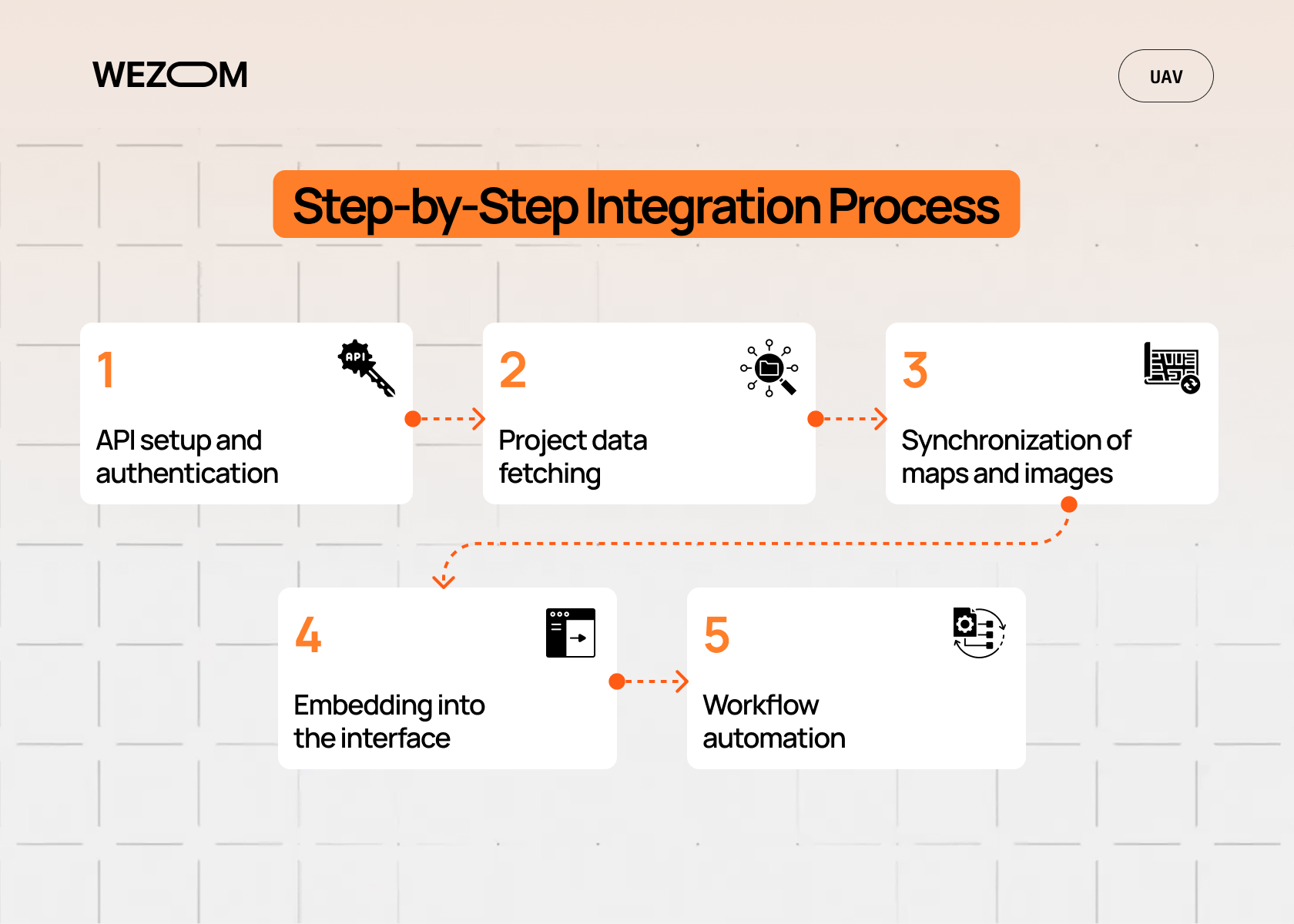
To ensure seamless integration, WEZOM follows a five-step protocol.
API setup and authentication
The integration process always begins with accessing the DroneDeploy App Market or GraphQL API (i.e., directly). Specifically, for authentication, we use the OAuth 2.0 protocol, which allows the enterprise platform to request access permission to specific projects. This ensures enterprise-grade security, guaranteeing that data is never accessed by third parties without a specific access token.
Project data fetching
After authorized data transfer to the cloud, the system must perform an initial query to structure the data hierarchy. To achieve this, it's crucial to use GraphQL queries that extract only the data structure – specifically, the list of sites, flight dates, available map types, and so on – instead of downloading all the data. This ensures efficient operation with minimal latency, even with terabytes of information.
Synchronization of maps and images
In our experience, this is the most resource-intensive stage, where software engineers implement a connection to the DroneDeploy storage for displaying visual assets. Here, it's important to ensure that the API transfers dynamic layers (instead of loading large files), meaning when the user zooms in on the map in the corporate system interface, only the required image fragments are loaded. Also, at this stage, original images and 3D models in .obj/.las formats are synchronized – this is needed for further analysis in specialized software.
Embedding into the interface
At this stage, the development team begins integrating DroneDeploy visualization directly into the corporate platform's UI. This eliminates the need for company employees to switch between browser tabs, as the site map becomes part of their dashboard, right next to the work schedule and budget.
Workflow automation
The automation is the final stage, which includes setting up Webhooks. This means that once the drone has completed processing the data, the system will automatically recalculate the volumetric analysis, update the task status in the corresponding corporate system, and generate a PDF report (which will then be sent to the project manager).
Integrating Drone Data into Construction Platforms
The main advantage of using this drone deployment API is its seamless synchronization with the management tools already in use within a given company.
This primarily applies to CRM and ERP systems (including custom drone inspection software) – integration with them allows aerial photography to be linked to financial indicators, meaning each drone photo or video will now serve as the legal basis for paying the contractor for each stage of work. BIM tools like Procore and Autodesk can also be used – this integration will allow DroneDeploy data to be transferred via API for subsequent point cloud overlay on 3D projects. This will help them instantly identify clashes (for example, columns misaligned by a few centimeters). Finally, integration can be implemented with custom construction inspection software – particularly for top management. This will allow the status of all company assets nationwide to be viewed on a single screen and means that disparate drone surveys will now be displayed on a centralized analytical panel.
Benefits of DroneDeploy API Integration
Let's highlight the business results that justify investing in API integration:
- Real-time site visibility, achieved because management sees the site as it is, without bias or distortion in foremen's reports;
- Reduction in on-site inspection costs by 40-50% (since most issues can now be resolved through a detailed analysis of the digital twin);
- Safety optimization, achieved through the detection and classification of hazardous areas – all this can now be done remotely, thereby minimizing the risk of industrial injuries;
- Accelerated decision-making, since information will be received in the office within 15 minutes of the drone landing (instead of the usual three days after the paper report is issued);
- Automated reporting eliminates risks associated with human error (the system can now automatically generate reports on volumes and progress, guaranteeing data accuracy for all company departments).
Challenges and Limitations
Integrating heavy geospatial data into corporate systems always faces technical challenges, including:
- Data processing latency. Despite automation, photogrammetry remains a resource-intensive process, with converting thousands of images into a point cloud taking anywhere from several hours to a day. To optimize this, we implement a status notification system via Webhooks, which helps manage wait times and enable effective work planning.
- API rate limits. DroneDeploy imposes request limits to ensure server stability. While the limit can be, for example, 500 requests per minute, it can quickly be exhausted during mass data synchronization across hundreds of objects. To overcome this challenge, we use message queues and exponential backoff algorithms, thus guaranteeing data delivery without packet loss.
- Large datasets. Given that a single project can contain gigabytes of point clouds or large orthophotos, their transmission and storage can require significant resources and bandwidth on the company's end. Therefore, to ensure the platform remains fast, it makes sense to follow a number of rules:
- Optimize data pipelines by eliminating data copying “just in case” – instead, we configure the integration to download only the final artifacts, leaving the original RAW files in the cloud until needed;
- Use multi-level caching to avoid users having to wait for the map to load each time they log in (in this case, the list of projects and their statuses are stored in a fast database like Redis), and tile caching for frequently used map fragments (they are stored client-side or in a CDN);
- Normalize geospatial data through automatic real-time coordinate system transformation;
- Ensure high UI performance regardless of the user's graphics card specifications, achieved through the integration of lightweight viewers like Potree, which support Level of Detail technology.
Future Trends in Drone API Integration
The main trend observed in the drone API market this year is the shift from data transfer to Agentic AI with the goal of achieving full autonomy in decision-making. For developers, this means building highly intelligent systems that, for example, can take over the role of specialists who previously had to manually search for cracks in structures. Furthermore, API integration allows such artificial intelligence and machine learning platforms to automatically scan thousands of images to detect corrosion, thermal anomalies, and other factors with over 95% accuracy.
It's also worth noting that this year will be a turning point for ground robotics and docking stations. In particular, drones for roof inspections equipped with intelligent software no longer require a pilot – they can dock directly at construction sites, taking off on a schedule via API commands and automatically uploading data. Another promising area in this context is ground robots for photographing interiors. Integrating them with the DroneDeploy API will enable the creation of a single digital twin of the building's exterior and interior.
Finally, the potential of digital twins and IoT is worth noting. For example, by integrating data from IoT sensors directly into a 3D model captured by a drone, companies will be able to obtain dynamically updated images of assets. Linking the API to the work schedule will also allow companies to visualize both what has been built and how much money is being spent at any given moment.
By the way, you can read more about autonomous drone operations and mission planning software here.
Conclusion
Ultimately, DroneDeploy API integration allows companies to undertake a significant technological upgrade with minimal resource expenditure, thereby eliminating the inefficiencies that have for years consumed up to 30% of the profit margins of drone deployment projects. This drone mapping API integration can also become an essential step in developing a custom platform (which we can also implement) aimed at transforming the data captured by the drones for construction inspection into an effective tool tailored to specific regulations and business goals.

FAQ
What is DroneDeploy API used for?
This drone software API is required for automated and, crucially, secure transfer of aerial survey data to corporate CRM/ERP/BIM systems without using the DroneDeploy interface. This integration enables the extraction of maps, 3D models, volumetric measurement reports, and more – everything needed to manage data captured by corporate inspection drones.
What are the benefits of drone API integration?
The first advantage is the time savings achieved through automatic drone inspection data upload without the involvement of human specialists. This integration also eliminates human error in volume calculations and inspections, making them centralized, as all asset data will now be stored in corporate software.
How secure is DroneDeploy API?
This drone data integration uses the OAuth 2.0 protocol and guarantees SOC2 Type II and GDPR compliance. It's important to note that access to the data from UAV inspections is restricted, meaning the corporate platform will only “see” projects for which it has received permission.
What industries use drone APIs?
The leaders for whom the DroneDeploy API integration is a priority are construction, agriculture, energy (in particular, for solar panel and power line inspection by drone), mining, and the insurance sectors. However, if you don't represent any of these sectors but believe this API is suitable for your business needs, please contact us directly, and we'll discuss the optimal technology stack for your project.
How much does DroneDeploy API cost?
This year, pricing for this drone API integration depends on the chosen plan (either Enterprise or Industry). Specifically, prices start from $329-$599 per month for individual licenses. It's important to note that end-to-end integration via API still requires Enterprise packages, the cost of which is calculated individually based on the scale and needs of a specific business.
