
Today, the effectiveness of UAV missions is largely determined not by their design but by the software they run on. At the same time, not all off-the-shelf software solutions are flexible enough to cover the needs of specific businesses, which is when they have to consider custom development. So, how much does drone software development cost?
Average Cost of Drone Software Development in 2026
The cost of a project depends entirely on the complexity of the architecture. Specifically, three price segments can be formally distinguished:
- Simple apps. These range in price from $15,000 to $45,000 and are used to solve narrow-focused tasks, such as controlling a specific drone model. They can also be MVPs (for example, for basic field monitoring). The development period for such projects is approximately 2-3 months.
- Mid-level solutions. The cost of such projects starts at $50,000 and can reach $150,000. They are typically based on custom data processing algorithms and require a number of integrations, including cloud storage. Their implementation period is approximately 4-7 months.
- Enterprise systems. These solutions cost from $200,000 and up. They are highly scalable and are typically used to control drone swarms (meaning they require complex AI-based analytics modules and GIS integration). Additionally, developers also ensure compliance with leading security standards such as SOC2/GDPR.
At the same time, it's important to understand that the final project cost is also affected by the development team’s location. For example, in the US, hourly rates for developers start at $230/hour, driven by legal compliance and practical expertise in military standards. Developers in the UK are cheaper, starting from $87/hour. However, if you're looking for a real bargain, you should definitely consider developers from Ukraine, whose rates average $55/hour, but they also have excellent opportunities (unfortunately, for the country itself) to test their software in the field. Specifically, if you need practical skills for creating solutions for electronic warfare, you should definitely look for your technology partner here.
Cost Breakdown by Software Type
Now, let's look at the approximate pricing for individual types of UAV software.
Drone Control Software
Its budget is typically around $30,000-$80,000. Here, the primary focus is on minimizing latency and positioning accuracy, and the development itself includes controller firmware, implementation of communication protocols, and a user interface. The cost may be higher, depending on whether flight functions in GPS negative zones via visual odometry need to be implemented.
Drone Mapping Software
The price for drone mapping software is approximately $60,000-$120,000. These systems are complex and usually require the integration of photogrammetric engines, the implementation of algorithms for stitching images into orthophotos, the generation of 3D models, and the processing of point clouds.
Drone Fleet Management Systems
The cost of drone software of such a type can reach $200,000 or more, as it includes joint mission planning, traffic dispatching, battery monitoring, and, overall, the implementation of a complex backend that must withstand high workloads.
Drone Data Processing Software
In this case, the drone software development cost is typically limited to $50,000-$150,000. It’s aimed at converting raw files into business reports, so it needs the development of focused calculators and the implementation of data visualization for the end user.
AI-Based Drone Solutions
Finally, the cost of drone software development of this type starts at $100,000, as they include training neural networks – whether for automatic object recognition, infrastructure defect classification, autonomous obstacle avoidance, or other purposes. The final budget depends heavily on the volume and quality of the training datasets.
Key Factors That Affect Drone Software Development Cost
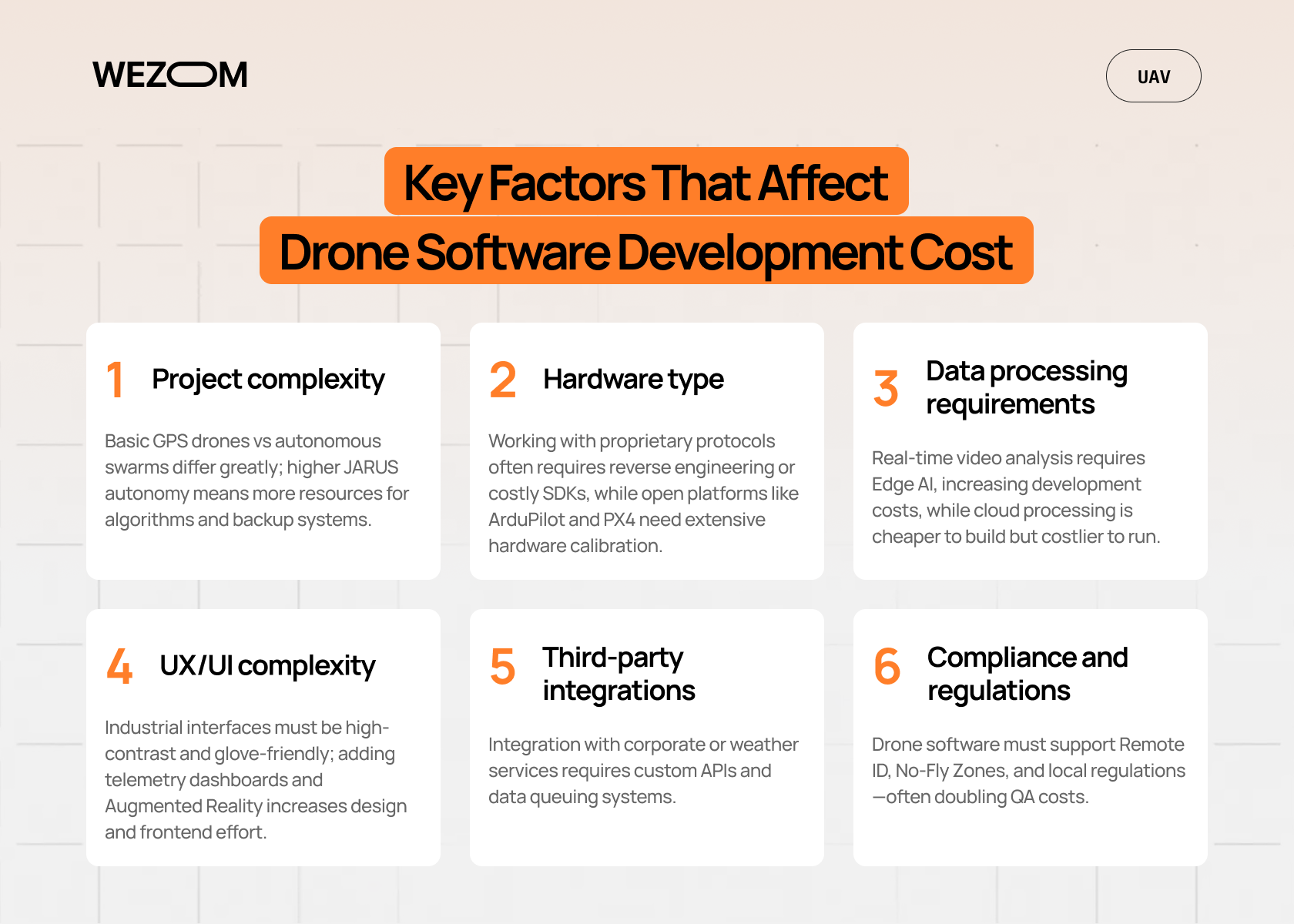
This section is dedicated to understanding what ultimately determines the final drone software development price.
- Project complexity. The difference between software for a drone flying using GPS waypoints and providing autonomous swarm control, which must be able to avoid obstacles using computer vision, is colossal. Therefore, the higher the level of autonomy (for example, according to the JARUS classification), the more technical team resources will be devoted to developing decision-making algorithms and backup systems.
- Hardware type. Working with proprietary protocols of a number of Chinese or American brands needs reverse engineering or, alternatively, purchasing expensive SDK licenses. At the same time, open architectures such as ArduPilot and PX4 still exist, but they require extensive calibration for specific hardware.
- Data processing requirements. If the software needs to analyze a video stream in real time, Edge AI implementation will be required, which will increase the project cost (since the development team will have to perform optimization of neural networks for mobile chips). Cloud post-processing is cheaper, but ultimately more expensive to operate due to server costs.
- UX/UI complexity. An industrial interface for field operators must have high contrast, be glove-friendly, and not create unnecessary cognitive load. If custom telemetry dashboards and augmented reality video streams are also required, you'll need to add hundreds of hours of designer and front-end developer time to the estimate.
- Third-party integrations. Synchronization with corporate systems (especially proprietary ones) or, for example, weather services, requires the development of custom APIs and data queuing systems.
- Compliance and regulations. Today, drone navigation software needs support for Remote ID systems, integration with No-Fly Zone, and local standard compliance, which can easily double the cost of the QA phase.
Cost by Development Approach
Choosing between using ready-made tools and building a solution from scratch can be simple if you thoroughly understand the differences between these approaches.
In particular, ready-made SDKs like the DJI SDK allow you to quickly bring a product to market without worrying about the drone it controls behaving unpredictably (since your tech team will use stabilization/navigation/safety modules that have been tested thousands of times). At the same time, no matter how flexible a specific SDK is, you will still sooner or later encounter the problem of vendor lock-in. So, if the manufacturer decides to restrict API access or leaves the market entirely, your software will become useless.
Now, about custom development – it allows you to implement any, even the most sophisticated, functionality on any hardware without any vendor dependency. You also gain absolute ownership of your intellectual property and unlimited scalability. However, you should understand that you'll need a significant budget at the start, and the development cycle will be long (usually over 12 months).
Ultimately, it's important to evaluate the TCO – the fact is that using an SDK is actually only cheap during the MVP stage. In the long term, you'll be dependent on pricing and the often inconvenient policies of the vendor. In contrast, custom software is a one-time, large investment that, however, turns into a business asset.
Team Structure and Hourly Rates
UAV software development cost remains dependent on geography. While AI assistants have accelerated coding, demand for highly specialized specialists – for example, in Edge AI and computer vision – keeps rates for this talent segment high enough.
| Region | Junior | Middle | Senior |
|---|---|---|---|
| USA/Canada | $90-$110 | $130-$160 | $180-$250+ |
| UK/Germany | $70-$90 | $100-$140 | $150-$190 |
| Ukraine/Poland | $35-$50 | $60-$85 | $90-$130 |
| India/China | $20-$30 | $35-$55 | $60-$90 |
Regarding team composition, to build an enterprise-grade solution with analytics capabilities, you will need the following specialists:
- Two or more C++/Python/Swift developers with a salary of $14,000 per month or more each;
- At least one QA engineer with hardware testing skills, whose salary will be between $4,500 and $6,000 per month;
- One Data/AI engineer to process telemetry and implement computer vision algorithms (with a salary of about $7,000-$10,000);
- One part-time project manager with a salary of approximately $3,000.
Hidden Costs You Should Consider
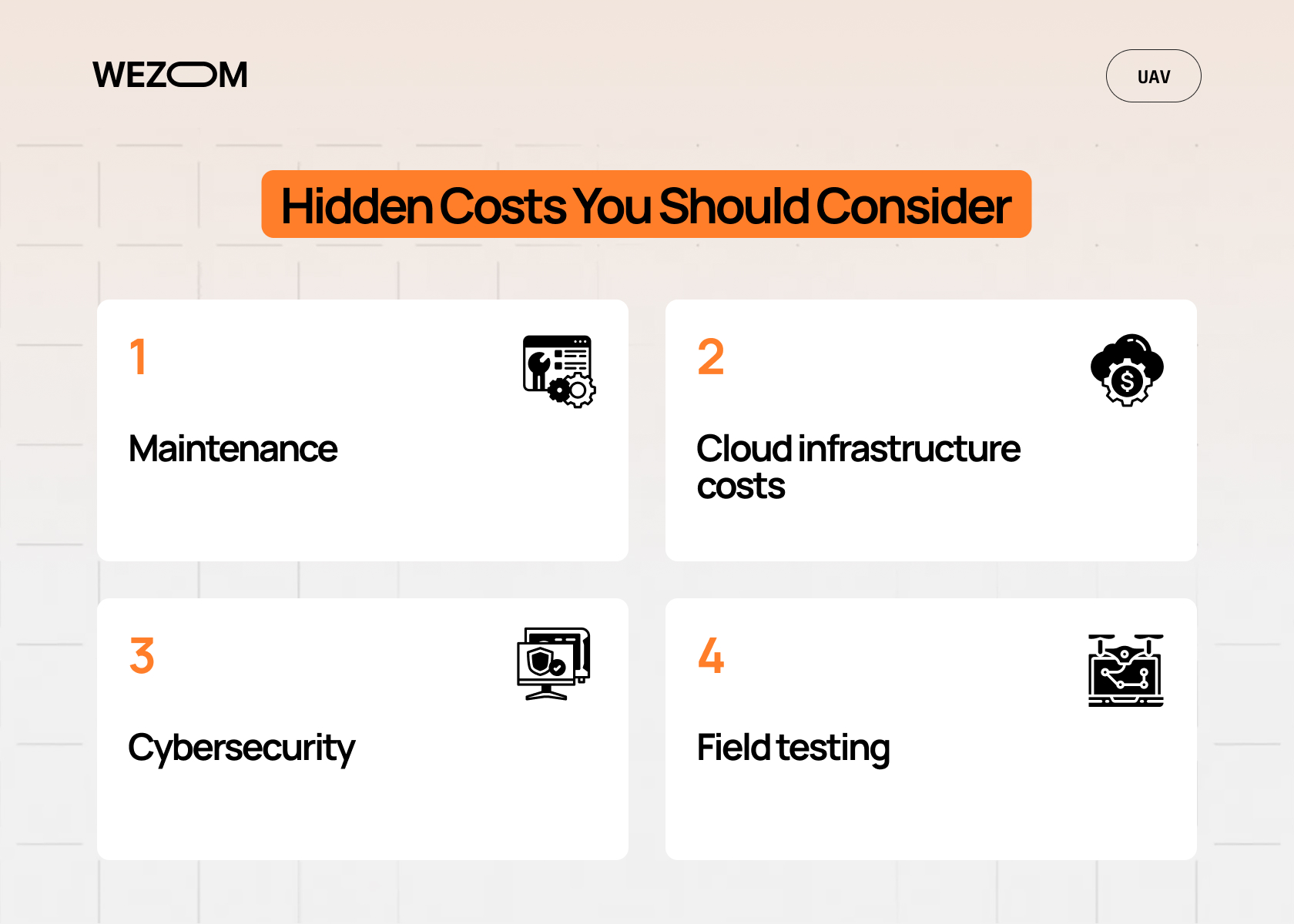
The total custom drone software cost isn't just the resources spent writing code. When assessing cost, it's also important to consider:
- Maintenance – today's firmware lifecycle has become even shorter, meaning that if you use ready-made SDKs, updates and security patches will require 15-20% of the initial development budget annually;
- Cloud infrastructure costs – this is required for transmitting and storing video streams and processing LiDAR data, which can cost from $500 to $3,000 per month for a fleet of just ten active drones;
- Cybersecurity – here, we mean implementing end-to-end encryption and protecting communication channels from GPS signal spoofing, which further increases development costs by 10-15%;
- Field testing – it involves renting testing grounds and the risk of prototype failures during the testing of new features before the full-fledged version deployment.
How to Estimate Your Drone Software Budget
The first thing you need to do when calculating the drone software development price is to understand what exactly your software should do. It's quite possible that a simple interface (for example, based on the DJI SDK) will suffice, and it will cost 3-4 times less than a custom, PX4-based one for an autonomous swarm system.
Next, move on to choosing the architecture. It could be SDK-based (quick and cheap to launch, but subject to vendor lock-in), custom (high entry threshold, but complete independence and flexibility), or hybrid (the optimal solution for most startups).
Finally, analyze the location of your future contractor. The cost difference between a team in, say, San Francisco and Kyiv could be $150,000+ over a six-month period, with identical code quality. And, of course, don't forget to add at least 25% of the final cost for support, cloud computing, and certifications such as FAA/EASA.
To be more precise, you can use the following formula:
Budget = (Hours*Rate) + Hardware_testing + (Cloud + Support)*12
When to Invest in Custom Drone Software
To summarize, custom development is justified if ready-made solutions begin to hinder your future business growth. More precisely, the game is worth the candle when:
- Your software architecture must grow synchronously with your drone fleet, without the limitations of third-party platforms;
- Standard features (for example, those provided by the DJI SDK) don’t allow for the implementation of specific tasks;
- You need to protect yourself from hidden license fees and gain full ownership of the software code (both to preserve intellectual property and for security);
- You need proprietary integrations, such as custom communication protocols or highly specialized AI models.

FAQ
What affects UAV software development pricing the most?
These are the complexity of the functionality, the technology stack, and the team's geography.
Is custom drone software expensive?
Yes, the initial investment is 3-5 times higher than using a ready-made SDK, but in the long run, it pays off due to the lack of licensing.
Is it cheaper to use a drone SDK?
At the MVP stage, yes; moreover, you can present a finished product in just 2-3 months.
How much does maintenance cost for drone software?
Typically, this is around 15-20% of the development cost per year.
Is drone software development worth the investment?
Yes, if the software creates a unique selling proposition for your business or provides end-to-end automation of workflows, thereby saving thousands of man-hours.