
A churn score that reaches an account manager two weeks before renewal, a demand forecast that sets tomorrow's replenishment order, and a fraud probability attached to a card authorization before it clears are all outputs of predictive analytics software. They rely on different data, models, and serving infrastructure, and the market reflects that variety: AutoML suites, cloud machine learning platforms, visual statistical workbenches, lakehouse platforms, and low-code products for analysts. This guide compares twelve of the best predictive analytics tools available in 2026, maps them to use cases and team profiles, and covers implementation, costs, and when custom development becomes the better option.
What Are Predictive Analytics Tools and How Do They Work?
Predictive analytics tools estimate the probability or value of a future outcome from historical patterns, usually as a number attached to a record: churn likelihood, next week's SKU volume, or default risk.
How predictive analytics software turns historical data into future predictions
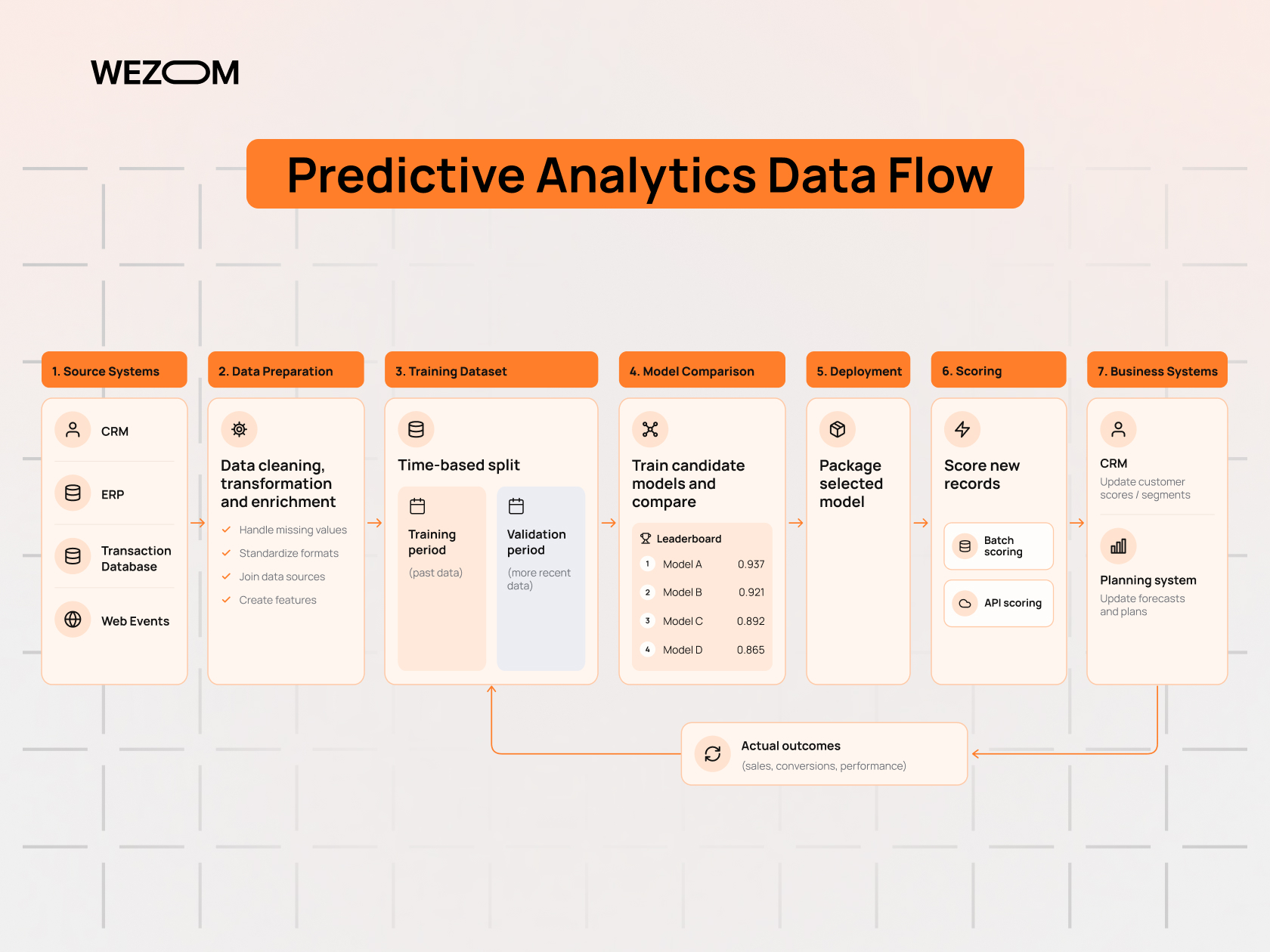
Every project starts with a target and a point in time. For churn, the team takes customers active on a given date, labels whether each cancelled within the next 90 days, and builds features only from earlier data. Using information from after the cutoff (leakage) produces models that test well and fail in production.
The software then runs model training and validation: it fits candidate algorithms on one part of the history, tests them on a later held-out period, and reports metrics such as AUC, precision and recall, or mean absolute error. The selected model scores new records in scheduled batches or on request through an API. Scores flow back into a CRM, ERP, or planning system, and actual outcomes are collected for evaluation and retraining.
Core technologies behind predictive analysis tools: machine learning, AI, and statistical modeling
Statistical modeling remains the foundation of many predictive analysis tools: regression analysis relates inputs such as price or tenure to an outcome, and ARIMA or exponential smoothing handle time series forecasting. Both are interpretable and work with modest data volumes.
Machine learning algorithms add nonlinear relationships and interacting variables; gradient-boosted trees and random forests are the classification algorithms behind most churn, fraud, and lead scoring models. Deep learning matters mainly for text, images, sensor signals, and forecasting across thousands of related series. The AI-powered analytics layer vendors emphasize in 2026 sits on top: automated machine learning (AutoML) searches algorithms and hyperparameters, and generative AI assistants turn business questions into model definitions.
Predictive vs. descriptive vs. prescriptive analytics
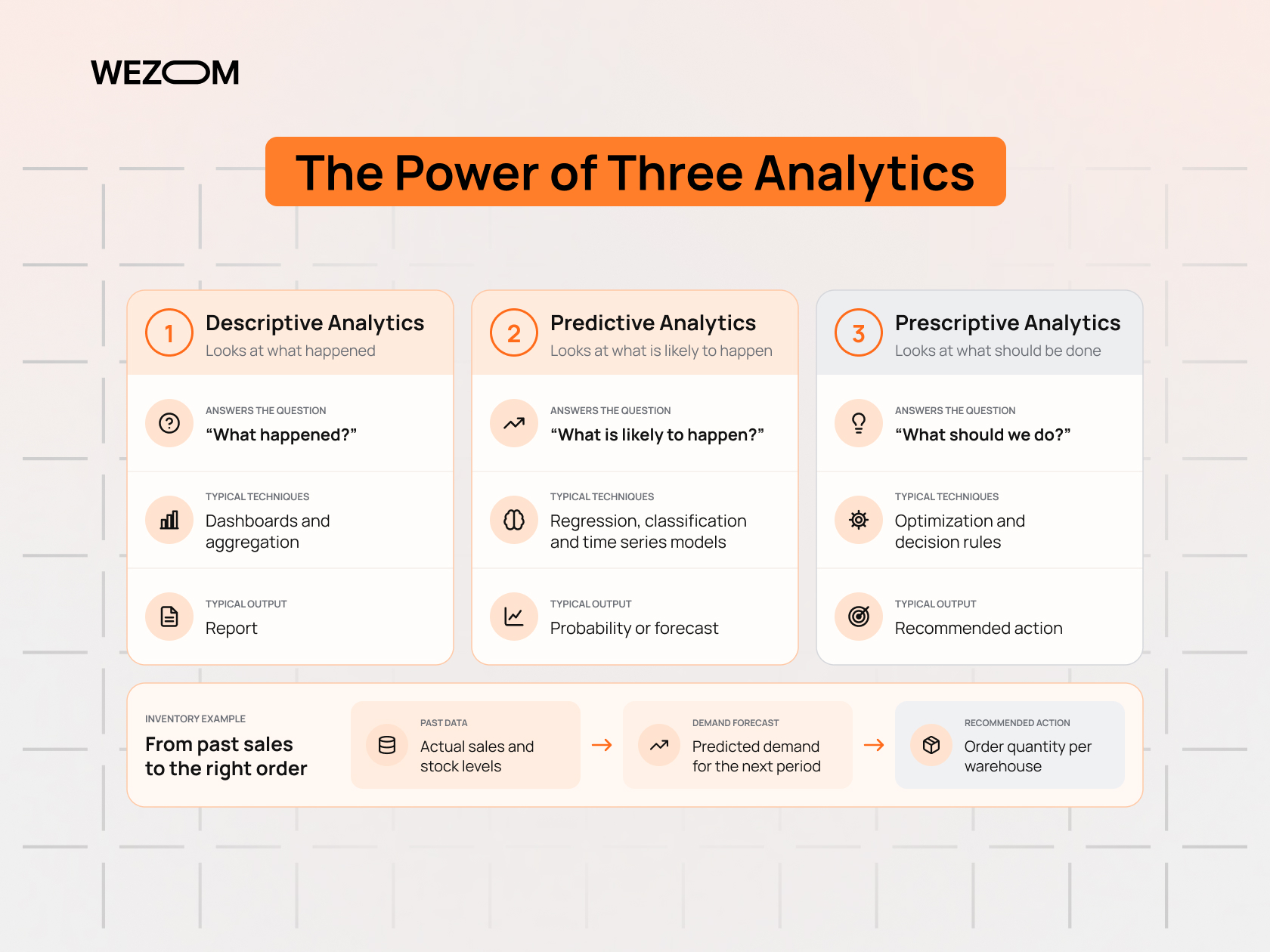
Descriptive analytics reports what happened and is the core of BI tools. Predictive analytics estimates what is likely next. Prescriptive analytics recommends an action by combining a prediction with optimization and business constraints.
In inventory planning, a dashboard shows that a product sold 4,000 units last month, a forecasting model estimates next month's demand with an uncertainty range, and a prescriptive layer calculates order quantities per warehouse given lead times and service-level targets. Many products labeled "predictive" only extend a trendline, which is descriptive analytics with a forecast label.
Common business applications of predictive analytics platforms
Predictive analytics platforms concentrate where decisions are frequent and outcomes measurable: lead scoring, customer churn prediction and customer lifetime value prediction, demand forecasting, credit scoring and fraud detection models, predictive maintenance, and patient risk estimation. Each has a different tolerance for error and latency, so no single platform leads in all of them.
How We Selected the Best Predictive Analytics Tools for 2026
The evaluation relied on public product documentation, published pricing, and the requirements that repeatedly surface in enterprise predictive analytics implementation projects. No vendor paid for placement.
Predictive modeling capabilities and forecasting accuracy
The first filter was native modeling: the platform must train, validate, and score models rather than only visualize trends. Breadth mattered (classification, regression, time series, anomaly detection), but so did validation discipline, including time-based backtesting, holdout handling, and metrics that make forecasting accuracy comparable across models.
Ease of use, no-code interfaces, and AutoML functionality
Platforms were assessed for how far a domain analyst can get without writing code, and how much control a data scientist retains when they do. Strong AutoML exposes the search process and its results instead of returning a single opaque model.
Data integration, scalability, and deployment options
Data integration capabilities covered native connectors to warehouses, lakehouses, and business applications, plus the ability to push computation to where the data lives. Deployment options included SaaS, private cloud, on-premises, and container-based serving.
Model explainability, security, and compliance
Model explainability tools (feature importance, per-prediction explanations, fairness checks), role-based access, audit trails, and support for enterprise data governance were weighted heavily, because regulated buyers cannot deploy a model they cannot document.
Pricing transparency, support, and total cost of ownership
Published prices scored better than quote-only models, but the main question was total cost of ownership: licenses, compute, storage, implementation services, training, and the internal staff needed to keep models running.
12 Best Predictive Analytics Tools and Software in 2026
The list starts with enterprise AutoML and statistical suites, moves through cloud machine learning platforms and the lakehouse, and ends with visual and low-code options. The order reflects category, not an overall score.
1. DataRobot – Best for enterprise AI and automated predictive modeling
DataRobot automates feature engineering, algorithm selection, and tuning, ranks models on a validated leaderboard, handles multiseries forecasting with automated backtesting, and monitors drift for deployed models, including those built elsewhere. Generated compliance documentation helps banks and insurers submit model evidence to risk teams. It runs as SaaS, in a private cloud, or on-premises, with quote-based enterprise pricing that is heavy for a team needing one or two models.
2. SAS Viya – Best for advanced statistical analytics and regulated industries
SAS Viya is a cloud-native, Kubernetes-based platform. Model Studio provides visual ML pipelines, Visual Forecasting handles large hierarchical forecasts, and Model Manager governs versions, champion and challenger tests, and monitoring. Python and R run alongside SAS procedures. Its statistical depth and history in credit risk make it a standard in banking, insurance, pharma, and government. The trade-offs are cost, a learning curve for teams without SAS experience, and quote-based licensing.
3. IBM SPSS Modeler – Best for statistical analysis and visual predictive workflows
SPSS Modeler builds models on a visual flow canvas following CRISP-DM, with decision trees, neural networks, regression, clustering, time series, and auto-classifier nodes that compare algorithms at once. It is available as a desktop client and as a service in IBM Cloud Pak for Data and watsonx.ai, connected to IBM's deployment and governance tooling. It suits statistics-minded analysts who prefer visual work over notebooks; organizations outside the IBM ecosystem may find the cloud packaging complex.
4. Alteryx – Best for data preparation and no-code predictive analytics
Alteryx is strongest before the model is trained: drag-and-drop workflows join and cleanse data, and the predictive palette adds regression, trees, forest models, and time series forecasting without code. Since 2025 the product has been sold as Alteryx One in Starter, Professional, and Enterprise editions; the Starter edition has a published price of around $250 per user per month billed annually, while larger editions are quote-based. It is batch-oriented and not built for low-latency scoring.
5. H2O.ai – Best for scalable machine learning and automated predictions
H2O.ai offers two layers. H2O-3 is an open-source, distributed in-memory machine learning engine with AutoML, usable from Python, R, and Spark. Commercial Driverless AI adds automatic feature engineering, interpretability reports, and portable Java or C++ scoring artifacts. Data science teams get open-source flexibility plus an enterprise path to production; business users without coding skills will struggle, and enterprise pricing is quote-based.
6. Dataiku – Best for collaborative enterprise predictive analytics
Dataiku puts visual recipes, code notebooks, and AutoML in one project, so analysts and data scientists share a pipeline, with governance tracking approvals and deployment status. It pushes computation down to Snowflake, Databricks, or BigQuery. A free edition covers small-scale use; enterprise licensing is quote-based.
7. Microsoft Azure Machine Learning – Best for cloud-based predictive analytics and MLOps
Azure Machine Learning offers AutoML for classification, regression, and forecasting, a visual designer, MLflow-compatible tracking, managed endpoints, and a Responsible AI dashboard. Microsoft states there is no additional charge for the service itself: customers pay for compute, storage, container registry, and other Azure resources consumed. It is the natural choice for organizations standardized on Azure, Microsoft Fabric, and Power BI.
8. Google Vertex AI – Best for large-scale AI-powered predictive modeling
Vertex AI combines tabular AutoML and forecasting, custom training, a feature store, monitoring, and online and batch prediction; BigQuery ML lets teams start in SQL. Pricing is consumption-based for training, prediction nodes, and storage. It is strongest where large event or transaction datasets already sit in BigQuery.
9. Amazon SageMaker AI – Best for AWS-based machine learning and model deployment
SageMaker AI covers the ML lifecycle on AWS: Canvas for no-code machine learning and forecasting, Autopilot, managed training, Model Monitor, and real-time, serverless, asynchronous, and batch inference. Pricing is pay-as-you-go by instance type and usage, with a limited free tier during the first two months. Configuration overhead is significant without cloud engineering capacity.
10. Databricks – Best for predictive analytics on large datasets
Databricks runs predictive workloads in the lakehouse: Spark for feature engineering at scale, MLflow for tracking, Unity Catalog for governance, and Mosaic AI Model Serving for endpoints. AutoML generates editable notebooks. Pricing is based on Databricks Units plus cloud infrastructure, and business users usually need a separate low-code layer.
11. Altair RapidMiner – Best for visual data science and predictive modeling
RapidMiner offers a visual workflow designer with hundreds of operators plus Auto Model. Altair acquired RapidMiner in 2022, and Siemens completed its acquisition of Altair in 2025, so RapidMiner now sits within the Siemens Xcelerator portfolio with growing emphasis on industrial data, IoT, and process mining. Buyers should confirm the roadmap and licensing terms under the new ownership.
12. Pecan AI – Best for business-focused, low-code predictive analytics
Pecan serves analysts without a data science team: a guided chat and SQL notebook define predictions such as churn, LTV, and demand, and the platform automates training and schedules results to a warehouse or CRM. Pecan publishes tiered pricing starting at roughly $950 per month, with limits on prediction batches and storage. The trade-off is less control over algorithms and architecture.
Comparison of the Best Predictive Analytics Software in 2026
The best predictive analytics software for one organization can be wrong for another, so the comparison focuses on fit.
Predictive analytics tools comparison table: features, use cases, and deployment
| Platform | Predictive strengths | Deployment |
|---|---|---|
| DataRobot | AutoML, time series, MLOps, compliance documentation | SaaS, VPC, on-premises |
| SAS Viya | Advanced statistics, large-scale forecasting, model governance | Cloud, on-premises (Kubernetes) |
| IBM SPSS Modeler | Visual modeling flows, automated classifiers | Desktop, Cloud Pak for Data, watsonx.ai |
| Alteryx | Data preparation with no-code predictive tools | Desktop, cloud, hybrid |
| H2O.ai | Distributed ML, AutoML, portable scoring | Open source, cloud, on-premises |
| Dataiku | Collaborative pipelines, visual ML, governance | Cloud, on-premises |
| Azure Machine Learning | AutoML, forecasting, MLOps, managed endpoints | Azure cloud, hybrid compute |
| Google Vertex AI | AutoML, BigQuery integration, online prediction | Google Cloud |
| Amazon SageMaker AI | Full lifecycle, Canvas no-code, flexible inference | AWS |
| Databricks | Lakehouse-scale features, MLflow, model serving | AWS, Azure, Google Cloud |
| Altair RapidMiner | Visual workflows, Auto Model, IoT and process data | Desktop, server, cloud |
| Pecan AI | Low-code churn, LTV, and demand models | SaaS |
Predictive analytics software pricing: subscriptions, usage-based costs, and enterprise licenses
Analytics software pricing falls into three patterns. Per-user or per-edition subscriptions (Alteryx, RapidMiner, Pecan) are predictable but scale with headcount or plan limits. Usage-based pricing (Azure Machine Learning, Vertex AI, SageMaker AI, Databricks) charges for compute hours, prediction nodes, storage, and processing units, so costs track workload but can spike during heavy training or when endpoints are left running. Enterprise licenses (DataRobot, SAS Viya, IBM, Dataiku, and H2O.ai's commercial products) are negotiated by capacity, users, and deployment model.
License price is rarely the largest line. Data engineering, integration with source systems, cloud infrastructure, model monitoring, and the staff time to maintain models typically decide the multi-year total.
Best predictive analytics platforms by company size and technical expertise
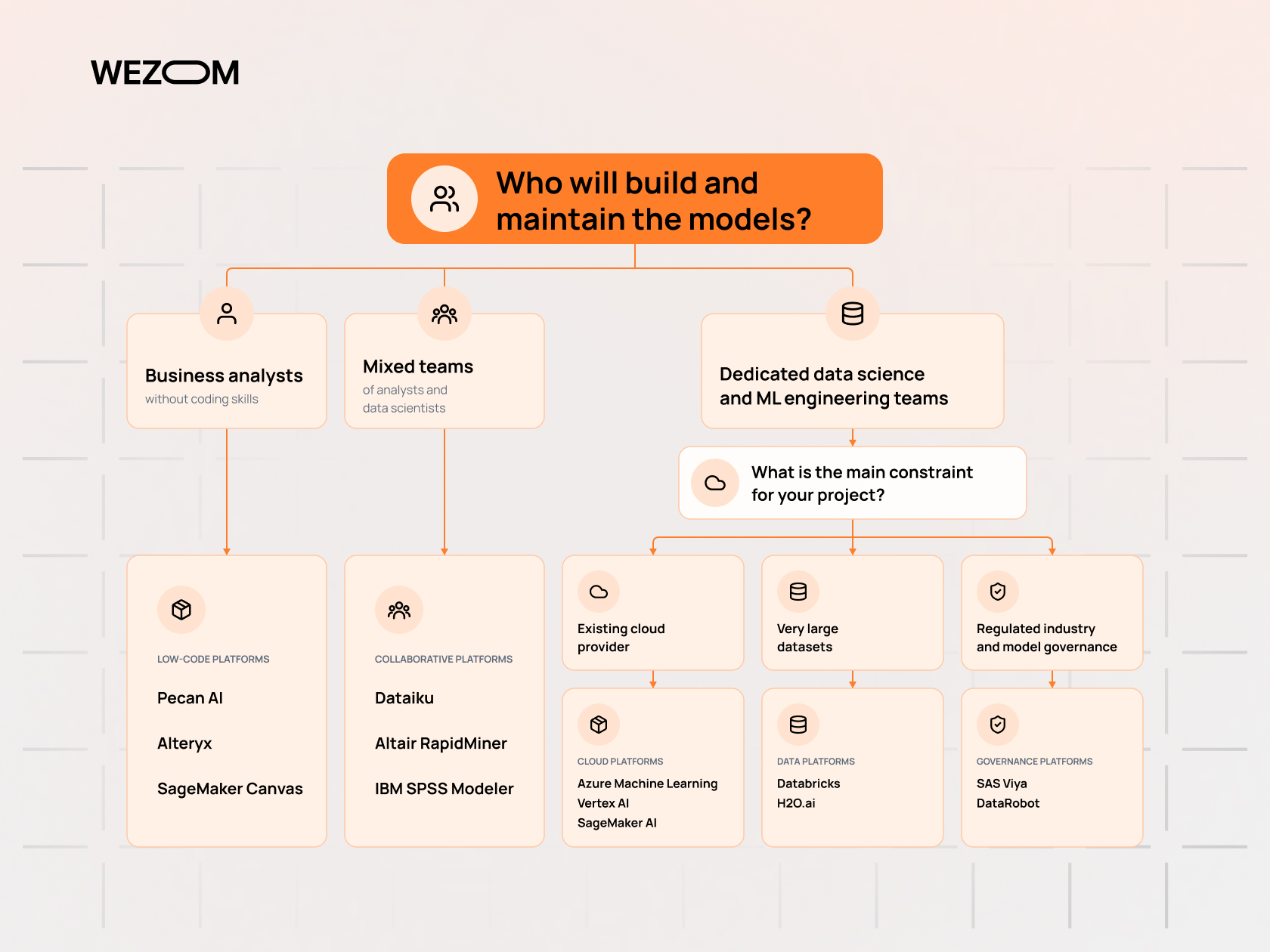
Small companies without data scientists usually get results fastest from low-code products such as Pecan, Alteryx Starter, or SageMaker Canvas, ideally on top of a cloud data warehouse they already use. Mid-sized teams benefit from Dataiku, RapidMiner, or AutoML in their existing cloud. Large enterprises with ML engineering standardize on a cloud platform or Databricks and add DataRobot or SAS Viya where regulated modeling dominates.
Which platforms offer the strongest AutoML, forecasting, and model monitoring capabilities?
DataRobot, H2O.ai Driverless AI, and Azure Machine Learning offer the most complete AutoML for tabular data, with transparent leaderboards and automated feature engineering. For forecasting automation across many related series, SAS Visual Forecasting, DataRobot time series, and the forecasting modes of Vertex AI and Azure AutoML are the strongest. For MLOps and model monitoring, DataRobot, SageMaker Model Monitor, Databricks Lakehouse Monitoring, and SAS Model Manager provide drift detection and alerting in production.
Best Predictive Analytics Tools by Business Use Case
Use case requirements narrow the field faster than feature lists.
Best predictive analytics software for sales forecasting and lead scoring
Lead scoring is classification on CRM and engagement data; Pecan and Dataiku can push scores into Salesforce or HubSpot. For pipeline and revenue forecasting, sales forecasting software must handle deal stages and seasonality; Azure AutoML and Vertex AI forecasting work well when CRM data already lands in the respective cloud. Inconsistent CRM stage definitions are the usual failure point.
Best tools for customer churn prediction and customer lifetime value
Churn models depend on behavioral features such as usage decline, support tickets, and payment events, aligned to a clear churn definition. Pecan offers templates for both churn and lifetime value, DataRobot and H2O.ai provide stronger control for data science teams, and Databricks fits product analytics data at large scale. Customer lifetime value prediction is a regression on future revenue, and validating it means waiting for that revenue to accumulate.
Predictive analytics platforms for demand forecasting and inventory optimization
Demand forecasting spans thousands of SKU and location series distorted by promotions and stock-outs. SAS Visual Forecasting, DataRobot time series, and the forecasting capabilities of Azure Machine Learning and Vertex AI handle hierarchical, multiseries problems. Forecasts become valuable only when they feed replenishment logic in an ERP or WMS, which is why integration effort often exceeds modeling effort.
Predictive modeling software for financial risk and fraud detection
Financial risk prediction requires documented, explainable models; SAS Viya and DataRobot generate the governance artifacts model risk teams expect. Fraud detection models add a latency requirement: scoring must occur during authorization. That favors platforms with low-latency endpoints, such as SageMaker AI, Azure Machine Learning, and Databricks Model Serving, often combined with rules for known fraud patterns.
Predictive maintenance tools for manufacturing and IoT
Predictive maintenance uses vibration, temperature, and pressure signals; because failures are rare, teams often start with anomaly detection. Altair RapidMiner has a clear advantage in industrial contexts through its integration with Siemens IoT and edge offerings, while Azure Machine Learning and SageMaker AI connect to their providers' IoT ingestion services.
Best predictive analytics solutions for healthcare and patient risk prediction
Patient risk models, such as readmission, deterioration, and no-show prediction, operate under privacy rules such as HIPAA and may fall under medical device regulation when they influence clinical decisions. SAS Viya, the major cloud platforms with healthcare compliance commitments, and Dataiku with on-premises deployment are typical options. Bias testing across patient groups is mandatory here.
Real-Time Predictive Analytics Software: Features and Leading Solutions
Some predictions lose value within seconds. A fraud score after a payment settles, or a delivery estimate after the customer has abandoned the cart, has little use. Real time predictive analytics software addresses these cases by scoring events as they occur.
How real-time predictive analytics differs from batch forecasting
Batch forecasting scores a full dataset on a schedule and writes results to a table. Real-time analytics scores individual events on request within milliseconds, using features from the current event and recent history. Real-time systems additionally need online feature stores, always-on endpoints, autoscaling, and fallback behavior when the model service is down.
Real-time data streaming, event processing, and low-latency model inference
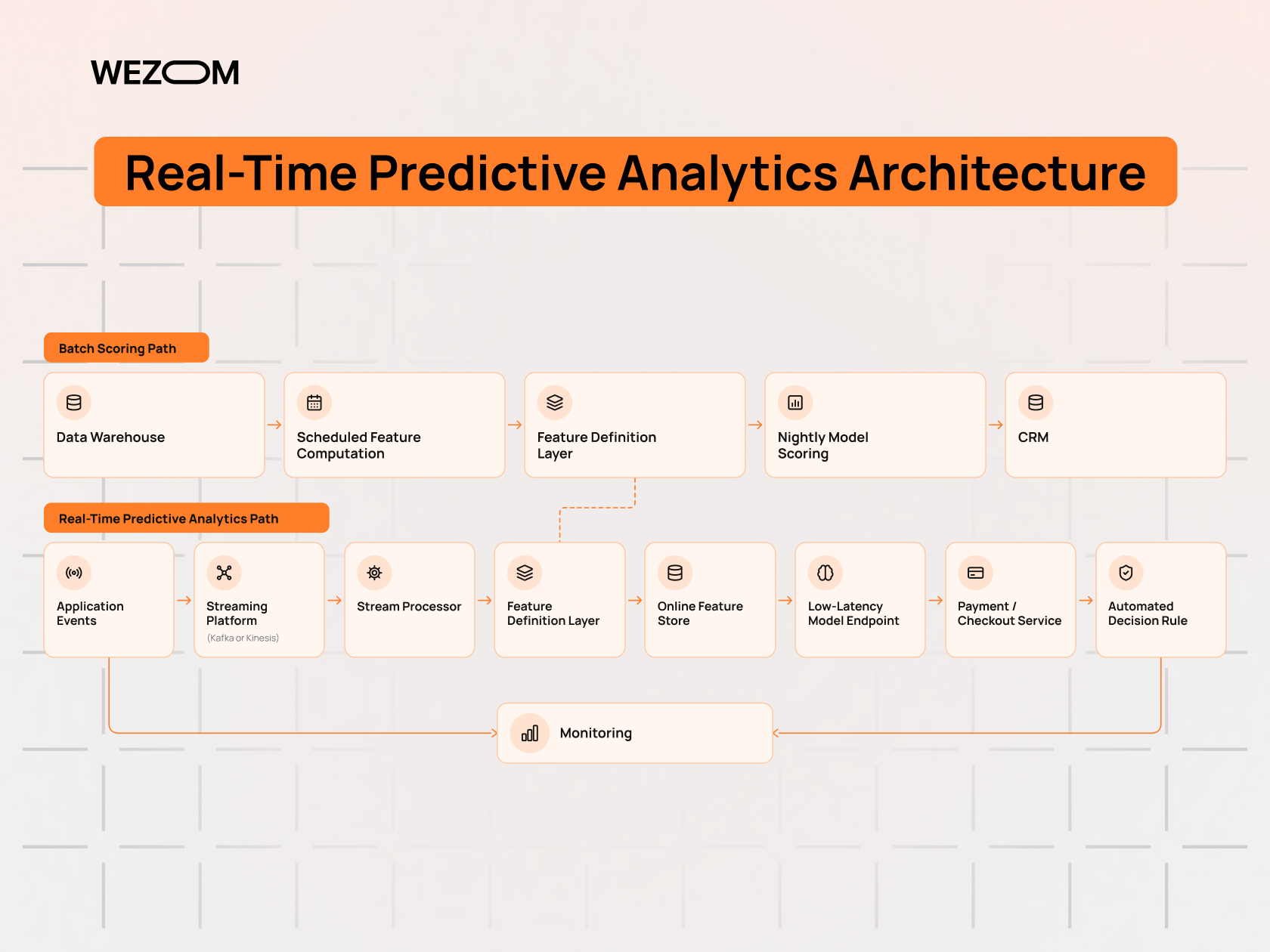
A typical architecture uses Apache Kafka, Amazon Kinesis, or Azure Event Hubs to carry events, and a stream processor such as Apache Flink or Spark Structured Streaming to compute rolling features, for example the number of transactions on a card in the last ten minutes. These features are written to an online feature store. When a scoring request arrives, the model endpoint retrieves the stored features, combines them with the incoming payload, and returns a prediction through real-time inference. Streaming data processing and model serving must share feature definitions with training, otherwise production inputs diverge from what the model learned.
Best platforms for real-time predictive analytics and automated decision-making
SageMaker AI, Azure Machine Learning, and Vertex AI provide autoscaling online endpoints tied to their streaming services, and Databricks combines streaming features with Model Serving. H2O.ai's portable scoring artifacts can be embedded directly into Java applications when network latency must be eliminated. SAS Viya supports real-time decisioning through its event stream processing and decision management components. For automated decision-making, scores usually pass through a rules layer that applies thresholds before any action.
Real-time predictive analytics use cases in eCommerce, fintech, and logistics
eCommerce models estimate in-session purchase intent and flag suspicious orders before fulfillment. Fintech companies score authorizations, logins, and transfers while pending. Logistics models update arrival times from GPS and traffic feeds and trigger rerouting before a delay occurs.
Free and Open-Source Predictive Analytics Tools vs. Enterprise Software
Open-source machine learning powers much of the commercial market, so the choice is less about capability than about who supplies the surrounding infrastructure.
Popular open-source predictive modeling frameworks: Python, scikit-learn, XGBoost, and H2O-3
Python is the default language for predictive work, with pandas for data handling and scikit-learn for regression, classification, clustering, and validation utilities. XGBoost, along with LightGBM and CatBoost, provides gradient-boosted trees that perform strongly on tabular data. H2O-3 adds distributed training and AutoML. For forecasting, statsmodels and Prophet are common, and MLflow handles experiment tracking and model registry. Licensing is free, but the team must build pipelines, serving, monitoring, and access control.
No-code and low-code predictive analysis tools for nontechnical teams
Low-code analytics platforms such as Pecan, Alteryx, SageMaker Canvas, and the visual interfaces of Dataiku and RapidMiner let analysts define targets, select data, and train models through guided interfaces. No-code machine learning reduces the time to a first model, but it does not remove the need to define the target correctly, avoid leakage, and validate against business outcomes.
Cloud-based vs. on-premises predictive analytics platforms
Cloud-based analytics offers elastic compute and faster setup. On-premises deployment remains common where data residency, plant latency, or regulation restricts data movement. DataRobot, SAS Viya, Dataiku, H2O.ai, and RapidMiner support self-managed deployment; the hyperscaler platforms are cloud-only, though some offer hybrid compute options.
When free predictive analytics software is sufficient and when enterprise solutions make sense
Free tools suffice for a Python-capable team with few models, batch scoring, and existing infrastructure. Enterprise solutions make sense once dozens of models need governance, teams share work, auditors require documentation, or real-time serving needs support. Many combine open-source modeling with a managed service for deployment and monitoring.
How to Choose the Right Predictive Analytics Software for Your Business
A structured evaluation prevents buying a platform for its demo and then struggling with real data.
Define business objectives, prediction targets, and measurable KPIs
Start with the decision the prediction will change and define the target precisely: "customers who cancel within 60 days of scoring" is usable, "at-risk customers" is not. Attach a business KPI, such as retention in the treated segment, not only model metrics.
Evaluate data quality, available datasets, and integration requirements
Data quality management determines model quality. Check whether the history is long enough to cover seasonality, whether outcomes are recorded consistently, and whether identifiers link across CRM, ERP, and transactional systems. List where predictions must be delivered, since writing scores back into operational systems often needs custom APIs or middleware.
Match platform capabilities to your team's technical expertise
A code-first platform without data scientists produces no models; a low-code tool in the hands of an experienced ML team frustrates them with limited control. Match the platform to whoever will maintain models two years from now.
Assess model accuracy, explainability, and ongoing maintenance requirements
Ask how the platform validates time-dependent data, explains individual predictions, and handles drift detection, retraining, and versioning. Predictive model performance declines as behavior changes, so maintenance features matter as much as initial accuracy.
Compare licensing, infrastructure, implementation, and operating costs
Build a three-year cost model covering licenses, cloud compute and storage, integration development, training, and the internal roles needed to operate models. Consumption pricing should be estimated with realistic training frequency and endpoint uptime.
Run a proof of concept before committing to a predictive analytics platform
A proof of concept should use the organization's own data and one real use case, with success criteria agreed beforehand: accuracy against a baseline, time to first model, effort to integrate scores into a target system, and usability for the intended team.
How to Implement Predictive Analytics Software in Your Organization
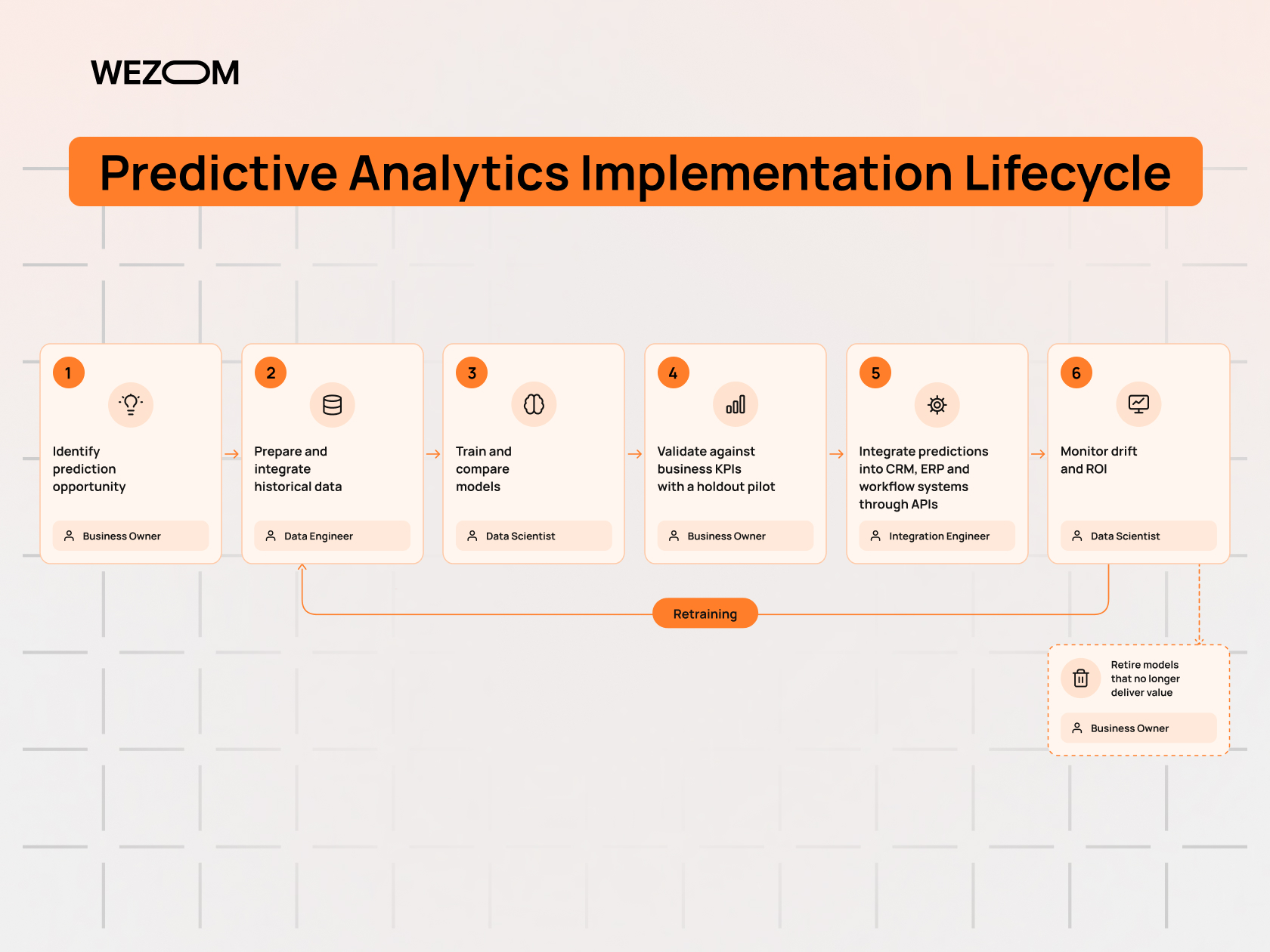
Selecting a predictive analytics tool is the smaller part of the work.
Step 1 – Identify high-value prediction opportunities
Prioritize frequent, measurable decisions currently made on intuition or static rules, such as which accounts to call or which transactions to review. Rank candidates by value per better decision multiplied by volume.
Step 2 – Prepare, clean, and integrate historical business data
Extract data from source systems, resolve identifiers, correct obvious errors, and document the meaning of every field used. Handle stock-outs, returns, and system migrations explicitly, since these events distort history. Feature engineering then converts raw records into model inputs such as rolling averages, recency, and frequency measures.
Step 3 – Select algorithms and train predictive models
Train a simple baseline first, such as a logistic regression or a seasonal naive forecast, then compare more complex predictive modeling techniques against it. AutoML accelerates this comparison, but the team should still review the leading models for leakage and implausible feature importance.
Step 4 – Validate model performance against business KPIs
Validate on a later time period than training, and translate model metrics into business terms: how many churners are captured in the top decile, or how forecast error affects safety stock. Where possible, run a controlled pilot with a holdout group to measure real impact.
Step 5 – Integrate predictions into existing applications and workflows
Deliver predictions where people work. Scores can populate a CRM field, create tasks in a work queue, adjust replenishment parameters in an ERP, or trigger automated actions through an API. Business intelligence integration helps monitoring, but a score visible only in a separate dashboard rarely changes behavior.
Step 6 – Monitor data drift, retrain models, and measure business ROI
MLOps and model monitoring track input distributions, prediction distributions, and accuracy against actual outcomes. Data drift detection flags when inputs move away from training conditions, triggering investigation or retraining. ROI is measured against the pre-launch baseline.
Predictive Analytics Trends Shaping Software Development in 2026
Generative AI and natural-language interfaces for predictive analytics
Vendors now let users describe a prediction in plain language, generate SQL for training data, and read written explanations of results. Generated target definitions still need review by someone who knows the data.
Automated machine learning and AI-assisted feature engineering
AutoML is moving beyond algorithm search into suggesting features from relational data, detecting leakage, and recommending validation schemes. The practical effect is shorter experimentation cycles, with more effort shifting to problem framing and integration.
Real-time and streaming predictive intelligence
More predictions are moving from nightly batches to event-driven scoring as streaming platforms and managed endpoints mature. The constraint is less the model than the feature pipeline and the cost of always-on serving.
Explainable AI, model governance, and responsible predictions
Regulation, including the EU AI Act's obligations for high-risk uses such as credit scoring, pushes model documentation, bias testing, and human oversight into the platform. Model registries, approval workflows, and per-prediction explanations are becoming standard requirements in enterprise purchases.
Embedded predictive analytics in CRM, ERP, and business intelligence systems
Salesforce, Microsoft Dynamics, SAP, and major BI tools increasingly ship built-in forecasting and scoring. Embedded analytics covers common use cases inside the application, while dedicated platforms remain necessary for custom targets, cross-system data, and full control over models.
Off-the-Shelf Predictive Analytics Software vs. Custom Development
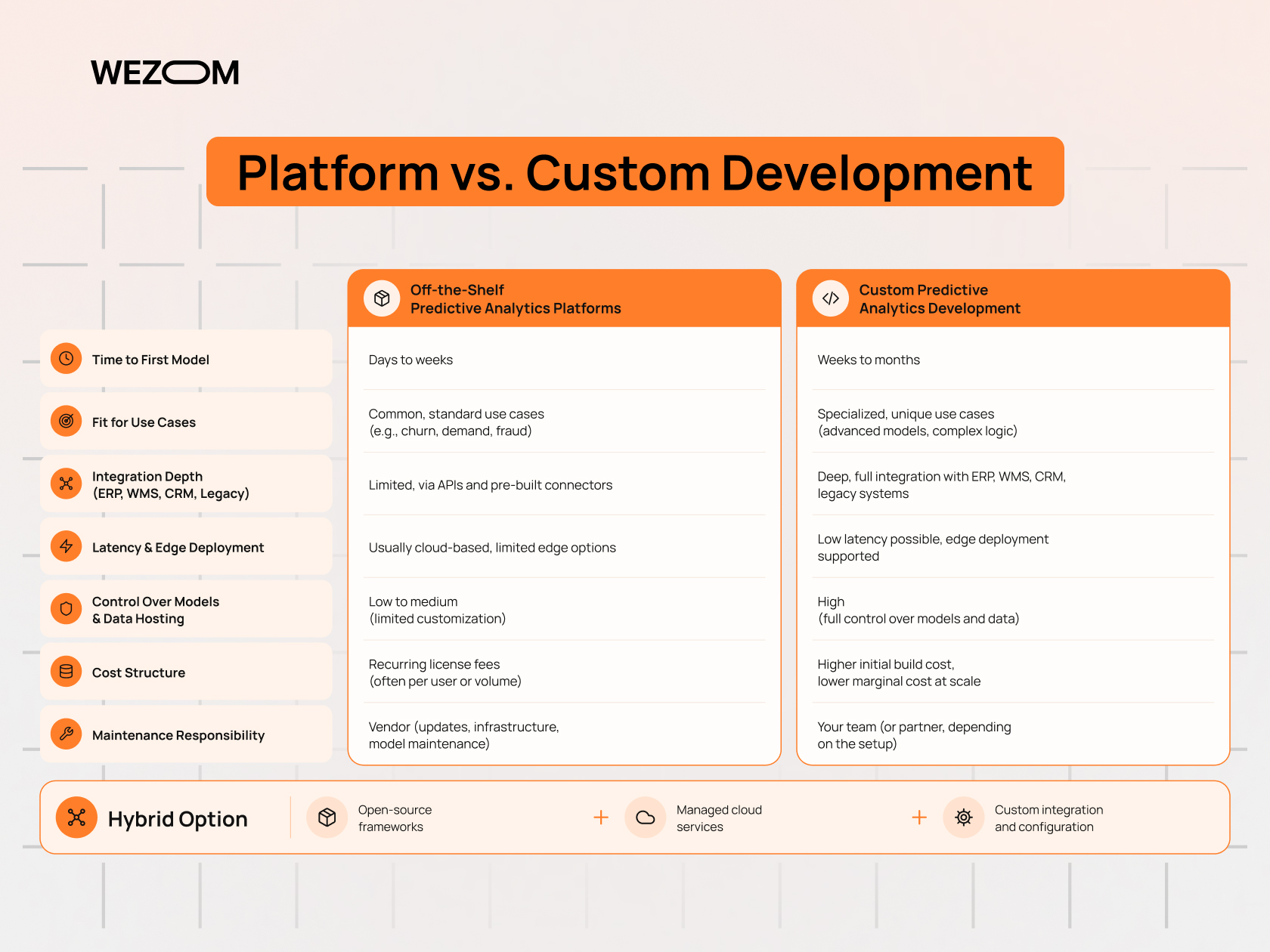
When ready-made predictive analytics platforms meet business requirements
Commercial platforms fit well when the use case is common (churn, demand, lead scoring), data already sits in a supported warehouse, predictions can be delivered through standard connectors, and the team's skills match the product's interface. The vendor carries infrastructure and maintenance.
Limitations of commercial software for specialized prediction workflows
Limits appear with unusual data such as telemetry joined to maintenance logs, strict in-transaction latency, edge inference, and legacy platforms without connectors. Per-user or per-prediction pricing can also become expensive at high volume, and proprietary model formats create lock-in.
Benefits of custom predictive analytics software development
Custom AI development builds the pipeline around the business process: features from proprietary sources, models tuned to domain-specific error costs, scoring embedded directly into the ERP, WMS, TMS, or customer-facing application, and hosting chosen for compliance. A common approach uses open-source frameworks and managed cloud infrastructure, so the organization owns the models and code without building every component from scratch.
How to evaluate the cost and ROI of a custom predictive analytics solution
Costs include discovery, data engineering, model development, integration, testing, scalable AI infrastructure, and ongoing monitoring and retraining. Return on investment (ROI) should be estimated from the value of improved decisions, such as avoided stock-outs, reduced fraud losses, or lower churn, multiplied by decision volume, then compared with the multi-year cost of a commercial license plus integration. A pilot on one high-value use case gives measured inputs for this comparison before a full build.
FAQ
What is the best predictive analytics software for small businesses?
Small businesses usually do best with low-code platforms such as Pecan, Alteryx Starter, or SageMaker Canvas, or with forecasting built into their CRM, ERP, or BI tool. The deciding factors are connectivity to existing systems and whether results reach daily workflows.
Can predictive analytics tools work without historical data?
Supervised models need past outcomes, so churn cannot be predicted without past churn events. Without history, teams can start with rules, use industry benchmarks, apply pretrained models for generic tasks, or use anomaly detection, which needs only normal behavior.
What skills are required to use predictive analytics platforms?
Low-code platforms require data literacy, basic SQL, and process knowledge; code-first platforms add Python or R, statistics, and ML experience. Production also needs data engineering, integration, and MLOps skills, which are often underestimated.
How much data do you need to build an accurate predictive model?
There is no universal threshold. It depends on the number of outcome events, signal noise, and feature count: classification needs enough examples of the outcome itself, and forecasting needs several seasonal cycles.
What is the difference between predictive analytics software and business intelligence tools?
Business intelligence tools aggregate and visualize historical data to explain what happened. Predictive analytics software trains models that estimate future outcomes for individual records or periods. The two are usually combined, with scores feeding BI dashboards.
Can predictive analytics software connect to existing CRM and ERP systems?
Yes. Most platforms connect to major CRM and ERP products and warehouses. Reading data is straightforward; writing predictions back and triggering workflows usually requires integration work, especially with legacy or heavily customized systems.
How often should predictive analytics models be retrained?
It depends on how fast behavior changes: fraud and demand models need frequent updates, some risk models stay stable longer. Retraining triggered by monitored drift and accuracy thresholds is more reliable than a fixed calendar.
How long does it take to see ROI from predictive analytics software?
Timing depends on data readiness, integration effort, and how long outcomes take to materialize. Lead scoring shows results sooner than lifetime value or credit risk models, whose outcomes accumulate over months. A controlled pilot against a pre-launch baseline establishes ROI most reliably.
