
Artificial intelligence is no longer reserved for large enterprises with dedicated innovation teams. Today, organizations of all sizes use AI to improve productivity, automate repetitive workflows, enhance decision-making, and strengthen their competitive position. However, adopting AI successfully requires more than deploying new tools. Without a clear strategy, businesses often face disconnected initiatives, poor integration, and limited return on investment.
An AI adoption roadmap provides a structured approach to planning, prioritizing, and scaling AI initiatives. Instead of pursuing isolated experiments, companies can align technology investments with business objectives, existing infrastructure, and organizational readiness. This guide explains how can businesses create an AI adoption roadmap, outlines how to build an AI adoption roadmap, and highlights the key steps that help mid-sized organizations implement AI efficiently while reducing implementation risks and preparing for long-term transformation.
Why Mid-Sized Businesses Need a Structured AI Roadmap
Many companies begin experimenting with AI by introducing individual tools into different departments. While these initiatives may solve specific problems, they often create fragmented workflows, inconsistent governance, and duplicate technology investments. A structured AI adoption roadmap for businesses helps organizations coordinate AI implementation across the company and focus on initiatives that support measurable business outcomes.
For mid-sized organizations, strategic planning is especially important because budgets, technical resources, and implementation capacity are more limited than in large enterprises. Every AI project should contribute to broader business goals while minimizing operational disruption and integration challenges.
A well-defined AI adoption roadmap for mid-sized companies enables leadership teams to:
- prioritize AI initiatives based on business value rather than technology trends;
- balance innovation with day-to-day operations;
- avoid isolated AI deployments that increase complexity;
- align AI implementation with long-term business strategy;
- establish governance, security, and scalability from the beginning.
Rather than treating AI as a standalone technology initiative, organizations should view it as part of a broader digital transformation strategy. This structured approach creates a stronger foundation for sustainable adoption, simplifies future expansion, and reduces the risk of costly implementation mistakes.
Assess Business Readiness Before Investing in AI
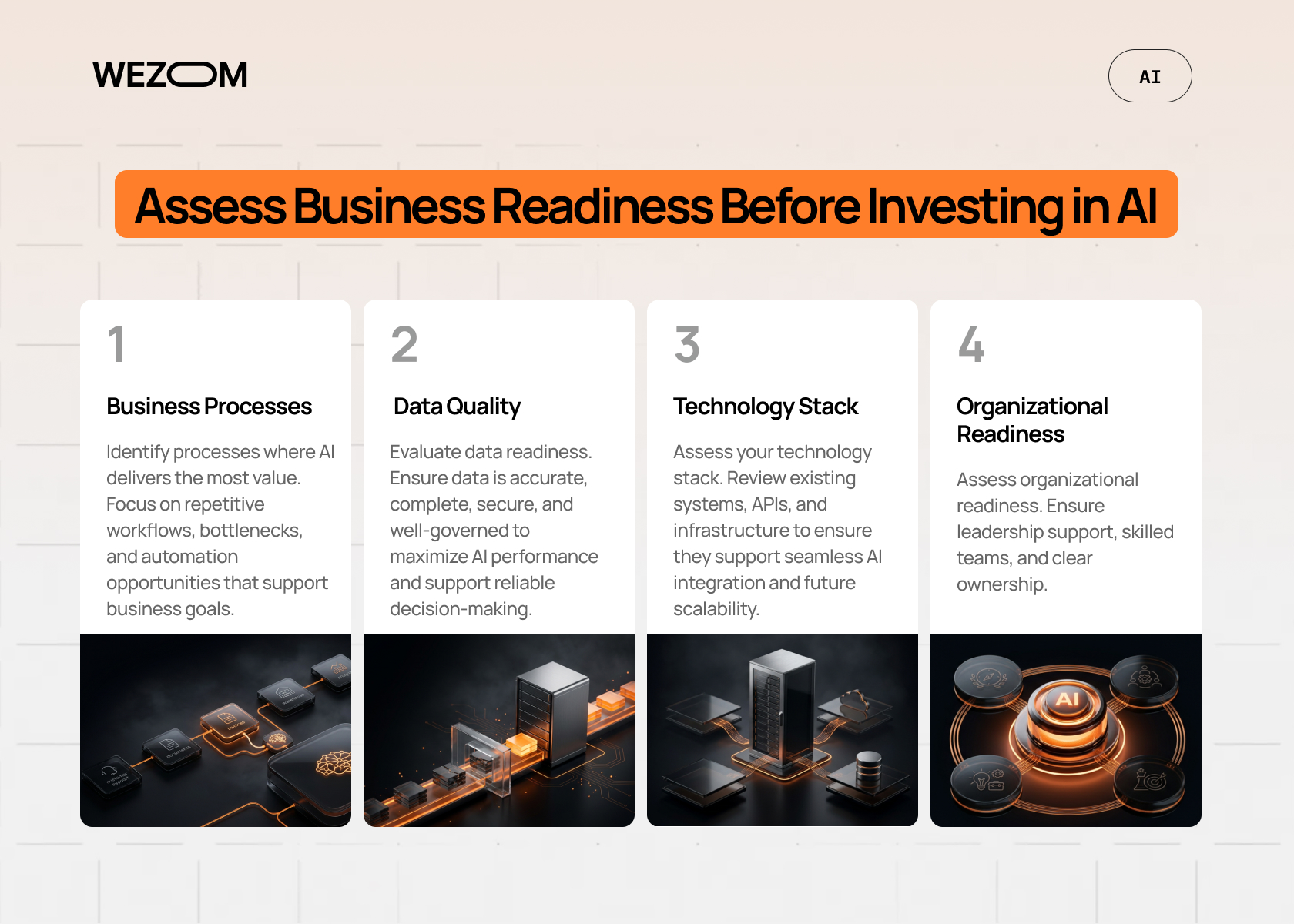
Before investing in AI technologies, organizations should determine whether they have the necessary business, technical, and organizational foundation to support successful implementation. Many projects fail because companies focus on selecting AI tools before evaluating their existing capabilities. Assessing readiness helps identify potential risks early, prioritize investments, and create a realistic implementation plan.
1. Business Processes
The first step is identifying processes where AI can deliver measurable value. Rather than trying to automate every activity, businesses should focus on repetitive, time-consuming workflows that follow predictable patterns and consume significant employee resources.
Examples include customer support, invoice processing, document classification, sales lead qualification, inventory planning, and reporting. Mapping these workflows also helps identify operational bottlenecks, manual tasks, and opportunities for automation that align with broader business goals.
2. Data Quality
AI systems are only as effective as the data they use. Before implementation, companies should evaluate whether their datasets are accurate, complete, consistent, and properly governed. Duplicate records, missing information, or siloed databases can significantly reduce model performance and limit the value of AI-driven analytics.
A readiness assessment should also review data ownership, governance policies, compliance requirements, and privacy controls to ensure information can be used securely throughout the AI lifecycle.
3. Technology Stack
Existing infrastructure plays a major role in AI implementation. Organizations should review their ERP, CRM, cloud environment, APIs, and internal software to understand how new AI capabilities will integrate with current systems.
A modern, well-connected architecture simplifies deployment and future scalability, while outdated legacy systems may require modernization before advanced AI solutions can be introduced efficiently.
4. Organizational Readiness
Successful AI adoption depends on people as much as technology. Leadership support, clearly defined stakeholders, employee skills, and willingness to embrace new ways of working all influence implementation outcomes.
Organizations should assess internal AI maturity, identify potential skill gaps, and prepare change management initiatives before deployment. Establishing ownership and involving business and technical teams from the beginning also helps reduce resistance while encouraging long-term adoption.
Define Clear Business Goals and AI Priorities
After assessing readiness, organizations should define where AI can create the greatest business value. Instead of implementing AI across multiple functions simultaneously, businesses should prioritize initiatives that align with strategic objectives and deliver measurable results.
Each potential use case should be evaluated against four criteria:
- expected ROI;
- implementation complexity;
- data availability and quality;
- strategic importance.
Projects with high business impact and manageable implementation effort typically provide the fastest return while helping build internal confidence for future AI initiatives.
Common priorities include:
- Customer service: AI assistants, intelligent routing, and knowledge retrieval.
- Internal operations: document processing, workflow automation, and administrative tasks.
- Forecasting: demand planning, financial forecasting, and inventory optimization.
- Document processing: extracting, classifying, and summarizing business documents.
- Sales: lead scoring, pipeline analysis, and sales forecasting.
- Marketing: customer segmentation, personalization, and campaign optimization.
- Manufacturing: predictive maintenance and quality inspection.
- Logistics: route optimization, warehouse operations, and supply chain analytics.
Rather than pursuing every opportunity at once, organizations should focus on use cases that solve real business problems and can be scaled over time. This approach creates a stronger foundation for a successful AI adoption roadmap and long-term AI adoption.
Build an AI Adoption Roadmap Step by Step
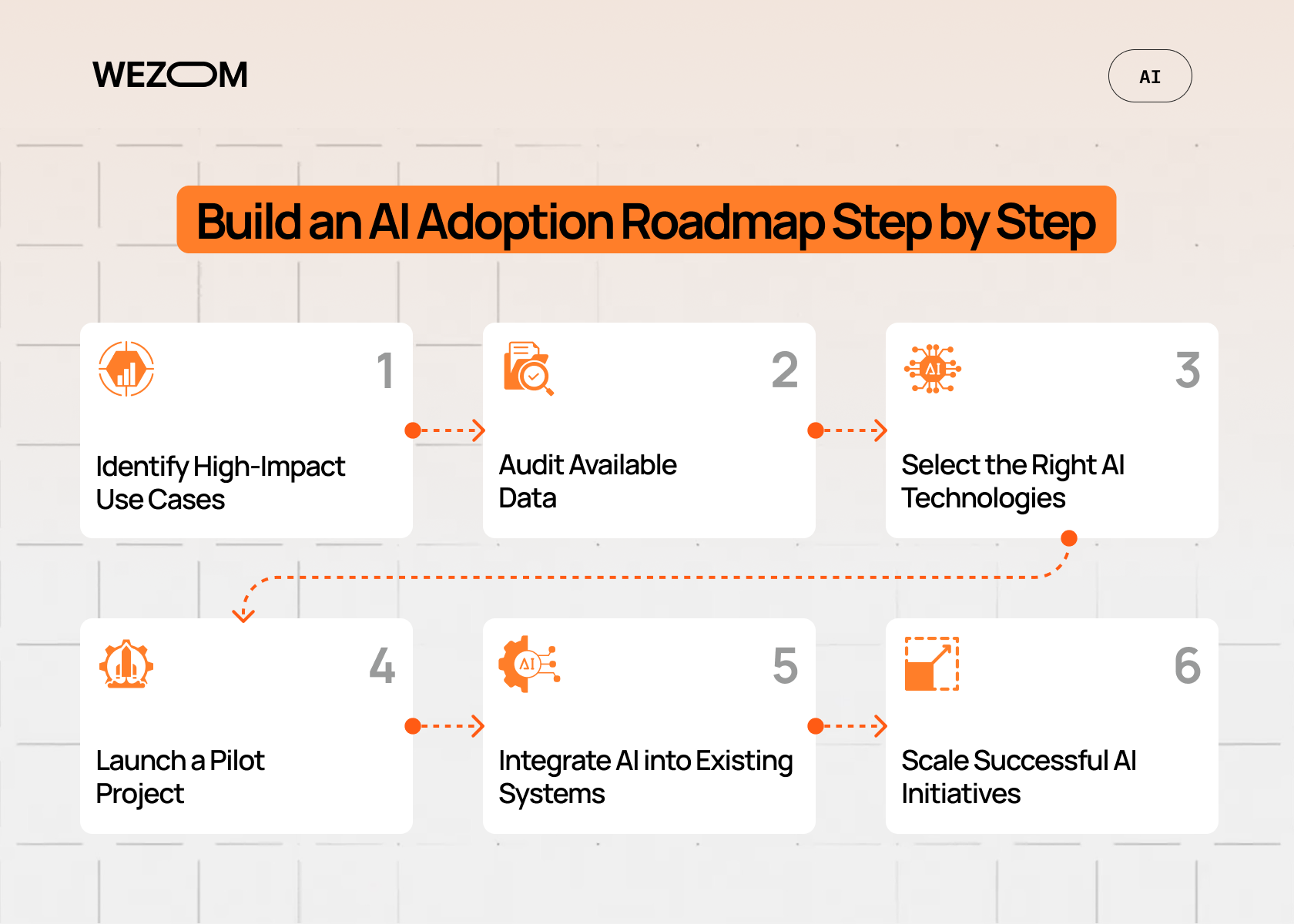
Once priorities have been established, companies can begin building a structured implementation plan. An effective AI adoption roadmap breaks AI adoption into manageable phases, allowing organizations to validate results, reduce risks, and scale gradually instead of attempting enterprise-wide deployment at once.
1. Identify High-Impact Use Cases
Start by selecting business problems where AI can deliver measurable improvements within a reasonable timeframe. Prioritize initiatives that address operational bottlenecks, improve customer experience, or increase productivity while requiring manageable implementation effort.
2. Audit Available Data
Review the datasets required for each use case. Evaluate data quality, accessibility, ownership, governance, and integration requirements. Addressing data issues early reduces implementation delays and improves model performance after deployment.
3. Select the Right AI Technologies
Technology selection should depend on business requirements rather than market trends.
Different AI capabilities support different objectives:
- LLMs for knowledge management, document analysis, and conversational assistants.
- Machine Learning for forecasting, classification, and predictive analytics.
- Computer Vision for image recognition, quality inspection, and visual automation.
- Predictive Analytics for planning and operational optimization.
- Generative AI for content creation, document generation, and internal productivity.
- AI Agents for automating multi-step workflows and supporting complex business processes.
Choosing the appropriate technology ensures implementation remains aligned with business objectives while avoiding unnecessary complexity.
4. Launch a Pilot Project
Rather than rolling out AI across the entire organization, businesses should begin with a controlled pilot project. A pilot validates technical assumptions, demonstrates business value, and provides practical insights before larger investments are made.
Each pilot should have clearly defined success metrics, such as reduced processing time, improved accuracy, lower operational costs, or higher customer satisfaction. Leadership should also establish a realistic timeline, allocate an appropriate budget, and identify potential implementation risks in advance. This structured approach makes it easier to evaluate results objectively and decide whether the initiative is ready for broader deployment.
5. Integrate AI into Existing Systems
Successful AI implementation depends on seamless integration with existing business applications rather than operating as a standalone solution. AI should work within employees' daily workflows by connecting with CRM platforms, ERP systems, internal software, document management solutions, and automation tools.
Well-planned integration improves user adoption while ensuring AI-generated insights can be used immediately within existing business processes. Organizations should also consider API capabilities, security requirements, data synchronization, and long-term architecture to support future expansion.
6. Scale Successful AI Initiatives
Once a pilot delivers measurable results, organizations can gradually expand AI across departments and business functions. Scaling should be driven by governance rather than simply deploying additional models.
A successful AI adoption roadmap includes continuous monitoring of model performance, regular optimization, ongoing employee training, and clearly defined governance policies for security, compliance, and data management. Businesses should also review adoption metrics and user feedback to ensure AI continues delivering value as operational requirements evolve.
Following this phased approach demonstrates how businesses create AI adoption roadmap that supports sustainable growth instead of isolated technology projects.
Common Challenges During AI Adoption and How to Overcome Them
Even with a well-defined AI adoption roadmap, organizations often encounter obstacles that can delay implementation or reduce business value. Identifying these challenges early allows businesses to minimize risks and improve long-term adoption.
The most common challenges include:
- Poor data quality. Incomplete, inconsistent, or outdated datasets reduce model accuracy. Establishing strong data governance and improving data quality should be a priority before deployment.
- Unclear ownership. AI projects involve multiple stakeholders across business and IT. Assigning clear responsibilities and executive sponsorship helps keep implementation aligned with business objectives.
- Employee resistance. Uncertainty about AI may slow adoption. Transparent communication, training, and involving employees early encourage acceptance and improve productivity.
- Unrealistic expectations. AI is not an instant solution. Setting realistic goals and implementing projects in phases helps demonstrate measurable progress while reducing risk.
- Weak governance. Organizations should establish policies for AI governance, monitoring, security, and responsible use to support consistent decision-making and long-term scalability.
- Cybersecurity and compliance risks. AI systems often process sensitive information, making privacy, regulatory compliance, and secure infrastructure essential throughout implementation.
- Integration complexity and hidden costs. Connecting AI with existing ERP, CRM, and internal systems often requires more effort than expected. Planning integration, maintenance, and ongoing optimization from the beginning helps avoid budget overruns and implementation delays.
Addressing these challenges proactively enables organizations to scale AI more efficiently while maximizing long-term business value.
KPIs to Measure AI Adoption Success
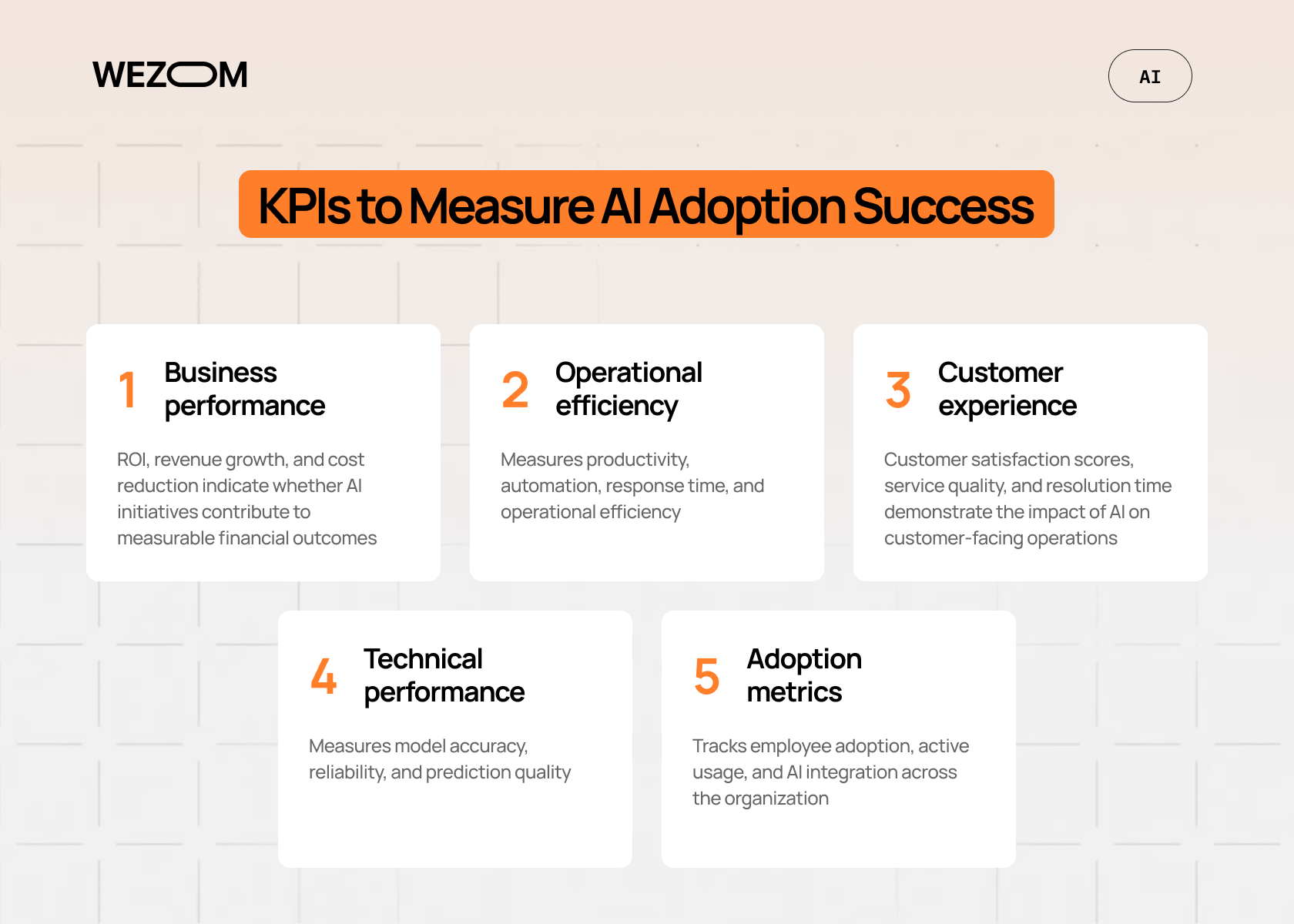
Measuring AI performance is essential for understanding whether implementation delivers real business value. Rather than relying on a single metric, organizations should track a combination of financial, operational, technical, and adoption KPIs to evaluate progress and identify opportunities for continuous optimization.
Key metrics include:
- Business performance: ROI, revenue growth, and cost reduction indicate whether AI initiatives contribute to measurable financial outcomes.
- Operational efficiency: Employee productivity, automation rate, response time, and overall operational efficiency help measure how AI improves day-to-day business processes.
- Customer experience: Customer satisfaction scores, service quality, and resolution time demonstrate the impact of AI on customer-facing operations.
- Technical performance: Model accuracy, prediction quality, reliability, and monitoring metrics ensure AI systems continue delivering consistent and trustworthy results.
- Adoption metrics: Employee adoption rate, active usage, and department-wide implementation show whether AI has become part of everyday workflows rather than remaining an isolated technology initiative.
Tracking these KPIs regularly allows organizations to optimize AI models, justify future investments, and ensure their AI adoption roadmap continues to support long-term business objectives.
Best Practices for Long-Term AI Adoption
Successful AI implementation does not end after deployment. To generate long-term business value, organizations should continuously refine their strategy, improve governance, and adapt AI initiatives as business needs evolve. Companies that treat AI as an ongoing capability rather than a one-time project are more likely to achieve sustainable operational improvements and higher ROI.
The following best practices help businesses maximize the success of their AI adoption roadmap:
- Start with small, high-value projects. Pilot initiatives allow organizations to validate assumptions, reduce implementation risks, and build internal confidence before expanding AI across multiple business functions.
- Prioritize business outcomes over technology. Every AI initiative should address a measurable business objective, whether improving productivity, reducing costs, or optimizing customer experience.
- Continuously monitor and improve AI models. Regular performance reviews, model retraining, and ongoing optimization help maintain accuracy as business processes and datasets evolve.
- Establish strong AI governance. Define policies for data governance, security, compliance, responsible AI usage, and model monitoring to ensure consistent implementation across the organization.
- Invest in employee adoption. Training employees and involving stakeholders early increases trust in AI systems and encourages wider adoption throughout the business.
- Measure performance and plan for scalability. Regularly review KPIs, maintain high-quality datasets, and build an architecture that supports future integration and business growth.
A structured approach to continuous improvement ensures AI remains aligned with business strategy while enabling organizations to scale successful initiatives with confidence as their digital transformation matures.
Conclusion
A successful AI adoption roadmap is built on strategy rather than technology alone. Organizations that assess their readiness, prioritize high-value use cases, establish measurable business goals, and implement AI in structured phases are more likely to achieve sustainable results while minimizing operational risk.
For mid-sized businesses, this approach is especially valuable because it enables innovation without overwhelming existing resources or disrupting daily operations. A phased implementation supported by strong governance, quality data, and continuous monitoring creates a scalable foundation for long-term growth.
Whether the objective is automating internal workflows, improving customer service, optimizing forecasting, or increasing operational efficiency, a well-defined roadmap helps transform AI from isolated experiments into a strategic business capability. Companies that invest in planning today will be better positioned to adapt, scale, and remain competitive as AI continues to reshape modern business.
FAQ
What is an AI adoption roadmap?
An AI adoption roadmap is a strategic plan that outlines how an organization will evaluate, implement, integrate, and scale AI technologies. It typically includes business objectives, implementation priorities, technology selection, governance, timelines, resource planning, and success metrics. A structured roadmap helps reduce implementation risks while ensuring AI initiatives support long-term business goals.
Why do mid-sized businesses need an AI adoption roadmap?
Mid-sized companies often have limited budgets, smaller technical teams, and fewer resources than large enterprises. An AI adoption roadmap for mid-sized companies helps prioritize investments, focus on high-value use cases, and avoid fragmented AI deployments. It also provides a structured approach for balancing innovation with ongoing business operations.
How can businesses create an AI adoption roadmap?
Organizations should begin by assessing business readiness, evaluating existing processes, data quality, and technology infrastructure. The next steps include defining business objectives, prioritizing AI use cases based on ROI and strategic importance, selecting appropriate technologies, launching pilot projects, integrating AI with existing systems, and continuously measuring performance. This phased approach demonstrates how businesses can create an AI adoption roadmap while minimizing implementation risks.
How long does AI adoption usually take?
Implementation timelines vary depending on project scope, organizational maturity, and integration complexity. A focused pilot project may take several weeks or a few months, while enterprise-wide AI transformation often evolves over multiple implementation phases. Rather than attempting a complete rollout at once, businesses typically achieve better results through gradual deployment and continuous optimization.
What departments should adopt AI first?
The best starting point depends on business priorities, but organizations often begin with departments that have repetitive, data-driven workflows. Customer service, sales, marketing, finance, operations, document management, manufacturing, and logistics frequently deliver early ROI because they offer well-defined use cases with measurable business impact.
How do you measure AI implementation success?
Success should be evaluated using a combination of financial, operational, technical, and adoption metrics. Common KPIs include ROI, cost reduction, employee productivity, automation rate, response time, customer satisfaction, model accuracy, adoption rate, revenue growth, and operational efficiency. Monitoring these indicators regularly helps organizations optimize AI initiatives and identify opportunities for further improvement.
