
Chaos in Excel spreadsheets, minute-by-minute calls to drivers, lost margins… These are the realities of modern transport companies that have outgrown manual processes but are still slow to automate. Meanwhile, the global dispatch software market is steadily growing – specifically, it will continue to grow at a 7.9% CAGR through 2030. But which option will yield more profit – custom development or purchasing a SaaS solution license? Let's find out right now.
How Much Does Dispatch Software Cost?
Dispatch software providers often confuse users with their pricing policies – many offer free solutions that, even without minimal customization, suddenly become overloaded with hidden fees. Therefore, to understand dispatch software pricing, it makes sense to divide the market into three segments:
- Low-end solutions. These are solutions with a basic set of features that cost approximately $50-$150 per user per month. They allow companies with 5-10 trucks to implement basic automation with almost no implementation costs.
- Mid-market solutions. These solutions often have a pricing model tied to assets. The average bill is $20-$60 per truck per month, meaning that for a fleet of 50 trucks, the annual cost for such software would be approximately $30,000, not including implementation costs (training, integrations, deployment, etc.).
- Enterprise solutions. For industry giants, out-of-the-box solutions are rarely sufficient for achieving end-to-end automation, so they are forced to focus on modular platforms with enterprise plans and sometimes even develop custom modules separately, with unit prices starting at $5,000.
So what exactly influences the cost of ownership for a dispatch automation system? Obviously, the most important thing is the pricing model:
- Per-user pricing is convenient for small businesses, but becomes too expensive as the logistics department expands;
- Per-truck pricing is the most reliable model for SaaS, under which the system load increases proportionally to the fleet;
- Per-load pricing is a model popular with brokers, according to which the company pays a fee (usually $0.50 to $5) for each order.
Besides licenses, expenses are also affected by staff onboarding, premium support with minimal response times, and cloud storage fees. For example, for large companies, a difference of $5-10 per truck per month over a year translates into the cost of purchasing a new truck.
Custom development from scratch, however, starts at $50,000, but this also includes the cost of computing power, support, and updates. Given the elimination of the need for regular license fees, a regular flow of orders, and gradual fleet growth, this approach pays for itself, on average, within the third year of ownership.
What Is Included in Dispatch Software for a Trucking Company?
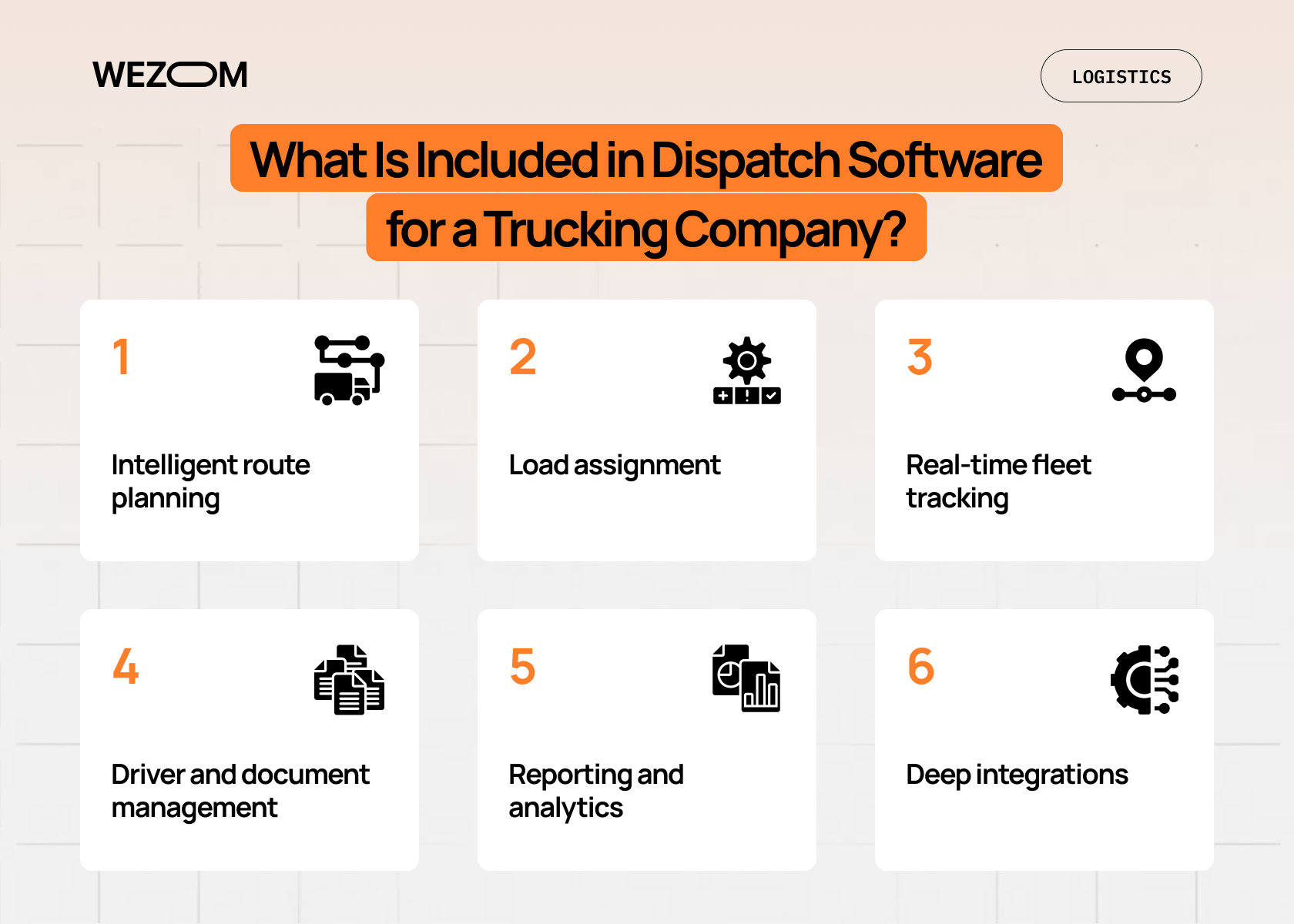
Dispatch software is a complex ecosystem that must cover 100% of the operational cycle. Therefore, when investing in development or a subscription, you're typically paying for automation of the following components:
- Intelligent route planning. The system should take into account distance, cargo specifics, road weight restrictions, delivery windows, and even weather forecasts.
- Load assignment. Your software should automatically select the optimal driver based on their current location, remaining hours, and equipment type.
- Real-time fleet tracking. This typically involves integration with GPS and electronic logging devices to enable 24/7 monitoring of truck location and driver behavior on the road.
- Driver and document management. This component includes the creation of digital waybills, automatic payroll calculation, monitoring license expirations and health insurance policies, etc.
- Reporting and analytics. Your system should be able to instantly calculate the profitability of each mile, downtime, and the efficiency of each dispatcher or driver.
- Deep integrations. It's highly desirable for the system to ensure seamless data exchange with ELD providers, accounting systems like QuickBooks and SAP, and fuel cards – otherwise, your dispatchers will still have to spend countless hours manually entering data.
It's important to note that when choosing a solution, you shouldn't sacrifice any of the above points, because ultimately, the main value of specific software is process standardization. Indeed, in companies without high-quality dispatch software, the success of a trip often depends on the skills of a single dispatcher. Therefore, if you suddenly lose this specialist (even temporarily, due to illness, for example), your work will be paralyzed.
In turn, implementing the system allows you to:
- Minimize the use of spreadsheets (meaning all data will be entered once and synchronized across all other nodes, without manual intervention);
- Remove routine workloads from staff (meaning just one dispatcher can effectively manage 20-30 trucks instead of 10);
- Reduce dependence on human resources (since the system will store the entire interaction history, client preferences, optimal routes, and much more, new employees will be able to get up to speed in a matter of days).
This leads you to the need to not only choose the best (read: fully-featured) software, but also one whose cost of ownership won't offset the profits generated by automation.
SaaS Dispatch Software Pricing Model
SaaS has been the dominant model in the market for years, and this is unsurprising given its affordability at the outset. Indeed, instead of purchasing the right to own the dispatch tracking software, you simply lease it, paying for access to the vendor's servers. On the other hand, instead of a large initial investment, your operating costs will steadily increase as you use such software.
How SaaS pricing works
TMS dispatch pricing for the SaaS format is typically based on a combination of several metrics:
- Monthly or annual subscription. This is a basic fee for using the platform, which is usually lower for longer periods.
- Per-user pricing. Companies using SaaS often have to pay for each new dispatcher. This creates a barrier to staff expansion, as hiring a new logistics specialist automatically increases the software bill.
- Per-vehicle pricing. This model is tied to the number of active trucks in the system. However, it doesn’t take into account the efficiency of your business – the fee for an idle truck is the same as for a profitable one.
- Per-load pricing. Here, payments are charged for each issued waybill or closed transaction. This model can be profitable at low volumes, but as the business grows, it becomes a significant tax on turnover.
- Tiered packages and add-ons. Most providers divide their software into packages such as Basic, Pro, and Enterprise. However, it's important to understand that a critical feature may only be available in the most expensive package. Furthermore, the vendor positions anything beyond that (such as additional APIs) as an add-on for a separate fee.
So, as you can see, SaaS is profitable for SMBs only.
Advantages of SaaS dispatch solutions
Despite hidden costs, SaaS has undeniable advantages for certain stages of business development:
- Fast implementation – you can get started literally within an hour of purchasing a license.
- Lower upfront cost – you don't need to take $60,000+ out of your budget – a couple of hundred dollars is enough for the first subscription.
- No infrastructure management – security compliance, server maintenance, and updates are the vendor's responsibility, meaning you don't need in-house IT specialists to maintain the system.
Overall, SaaS is considered an ideal solution for businesses just starting out in the market.
Long-term cost risks of SaaS
The main risk of SaaS is the lack of control over long-term ownership costs, and here's why:
- Scaling costs as the fleet grows. As your fleet grows from 100 to 200 vehicles, your software costs will also double. SaaS typically doesn't offer discounts – actually, the cost of scaling often increases per truck.
- Add-on modules and API fees. If you need to connect a new fuel monitoring system or implement data exchange with a brokerage platform, the vendor will charge you for an API connection or a monthly fee for each third-party connector.
- Vendor lock-in. Your data, route history, and driver/customer database will be stored inside someone else's system, so if the vendor decides to raise prices upon contract renewal, you'll either have to pay more or freeze your business for months while migrating to a new platform.
It's also important to note that if your business ever needs a unique solution for a specific type of cargo, the vendor won’t change the code for you. This means you'll have to adapt your processes to the software you're already using, not the other way around.
Custom Dispatch Software Development
When standard SaaS features are no longer sufficient to support growth, businesses should consider building their own digital solution.
What is custom dispatch software?
Custom dispatch software is a product created from scratch for a specific business model and unique processes. Specifically, here are its advantages:
- Fully tailored solution – you get only the features you actually use, meaning your dispatchers won't have to deal with cluttered interfaces with tons of unnecessary buttons.
- Custom route planning logic – you can implement your own cargo prioritization algorithms, taking into account specific customer requirements or transportation conditions.
- Unique workflow automation – you'll be able to automate specific tasks that SaaS typically overlooks, including an internal driver bonus system, unique reporting forms for taxes or contractors, and more.
At the same time, this approach requires significant initial investment and an in-house IT department, so for small and medium-sized businesses, this option may be unavailable or simply irrational.
Advantages of custom dispatch solutions
Overall, the main advantage of this approach is complete independence from third-party vendors, meaning you decide when to update the system, what features to add, which external services to integrate with, and so on. Furthermore, owning your own software increases the company's capitalization, so when selling a business or raising investment, having your own unique software will be a significant intangible asset. And yes, it's also worth mentioning that you always have the option to transform your system over time into a SaaS product comparable to those of established vendors. Therefore, with custom dispatch software for trucking, you'll get another source of income.
Development cost breakdown
Investing in a custom system can be divided into several stages:
- Business analysis – at this stage, analysts identify your business pain points and translate them into technical specifications.
- Architecture – this refers to designing a database and server logic capable of supporting fleet growth tenfold without performance loss.
- UX/UI – this stage involves creating a dispatcher interface to ensure intuitive operation so that training a new employee takes hours.
- Core development – this includes writing code, as well as creating functionality for scheduling, tracking, and document management.
- Integrations – this stage typically involves connecting ELDs, GPS, fuel cards, and your accounting system via an API.
- Infrastructure and maintenance – this ongoing stage includes server/cloud setup, as well as regular support, which typically costs a fixed fee.
Ultimately, you can plan these stages so as not to cause a huge hole in your budget (for example, you could start with an MVP).
Pricing Comparison Table
To visualize the difference in truck dispatch software pricing, let's compare costs over a three-year horizon for a company with an average fleet of 100 trucks.
| Parameter | SaaS dispatch software | Custom dispatch software |
|---|---|---|
| Upfront cost | $2,000-$5,000 | $60,000+ |
| Monthly/annual fees | $25,000+ per year | $0 (no licence is required) |
| Cost per truck | Rises along with your fleet | Tends to $0 with fleet growth |
| Cost per dispatcher | You pay for each user | You can add new dispatchers for free |
| Integration fees | Extra costs for each third-party API | Included in the development budget |
| Expenses on scalability | High | You pay for expanding your server infrastructure only |
| Maintenance | Included in subscription | About 10-15% from the initial development budget per year |
| 3-year total cost | $105,000-$130,000+ | $110,000-$140,000 |
| Cost predictability | Low, as the vendor can rise pricing | Absolute, as its your budget (and your rules as well) |
Ultimately, the total cost of ownership of both systems typically equals by the end of the third year, but if you have to pay for the SaaS licence forever, having a custom dispatch software will save you tens of thousands of dollars annually.
When Should a Trucking Company Choose SaaS?
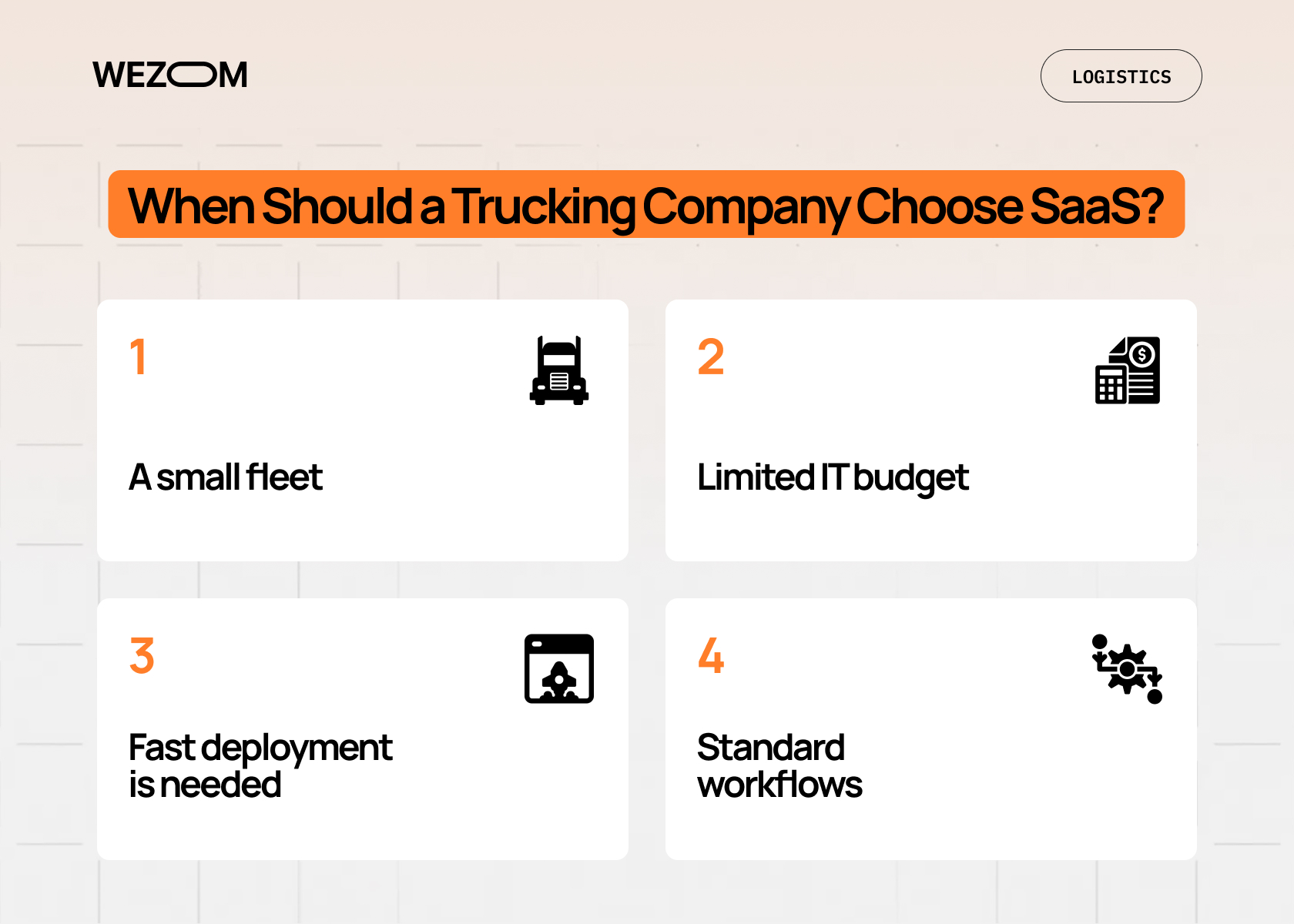
Despite all the long-term benefits of custom development, the SaaS model remains the optimal choice for a significant portion of the market, particularly for:
- A small fleet. If your fleet has fewer than 20-30 vehicles, the cost of developing your own product will take too long to pay off, while SaaS plans of $30-$50 per truck allow you to achieve fairly deep automation at a reasonable price.
- Limited IT budget. If you don't have the resources to invest tens of thousands of dollars in development and maintain an in-house or outsourced support team, SaaS is optimal.
- Fast deployment is needed. If automation needed to be implemented yesterday, this SaaS approach will also be fully justified, as launching a custom system takes 4-8 months.
- Standard workflows. If your business processes are similar to those of most competitors and you don't need specific algorithms or unique integrations, the basic functionality of SaaS will be more than sufficient.
Ultimately, if you have a development company in mind, you can always consult with them about ROI before ordering a custom solution. Specifically, you can contact us for this.
When Does Custom Dispatch Software Make Financial Sense?
Custom development becomes almost the only viable option if your software will serve as your main competitive advantage. This is generally typical for companies with:
- Growing fleets with 100+ vehicles. At this stage, the savings on licenses begin to offset the costs of maintaining in-house software, so with a fleet of 100+ vehicles, a custom solution becomes 30-50% more cost-effective than SaaS within the first 3-5 years.
- Complex routing logic. If you transport hazardous loads, operate under specific temperature conditions, or are involved in complex cross-docking where standard SaaS navigators and scheduling systems produce errors, custom development will be optimal.
- Multi-location operations. If you need to integrate several branches and warehouses with hundreds of external contractors with varying levels of data access into a single ecosystem, you should also consider a custom approach.
- Need for deep integrations. If you need a seamless connection with your custom or legacy ERP, WMS, or specific IoT equipment onboard your vehicles, custom development is the only right solution.
Ultimately, custom development will allow you to know exactly how much you'll be spending on your system in two years, without the fear of the vendor raising prices.
Are you increasingly unsure about the feasibility of custom development? Then write or call us right now, and we’ll help you to make a well-thought-out decision!
FAQ
How much does truck dispatch software cost?
SaaS dispatch software for trucking companies typically costs between $20 and $60 per truck per month. Custom dispatch system development starts at $60,000 and increases with the complexity of the functionality.
Is custom dispatch software more expensive?
In the first year, yes, but due to the absence of monthly license fees and scaling overhead, the total cost of TMS dispatching software in the custom format becomes lower than that of SaaS by the third year for medium and large fleets.
What affects dispatch software pricing?
Primarily, this is the number of active vehicles, the complexity of route optimization algorithms, the depth of integration with third-party systems, and the availability of a mobile app for drivers.
Does dispatch software pricing increase with fleet size?
In the SaaS model, this almost always happens as the fleet grows; conversely, with custom solutions, the cost of ownership is almost independent of the number of vehicles, requiring only the cost of expanding server capacity.
Can dispatch software replace manual spreadsheets?
Yes, automated fleet dispatching reduces human error by ~30% and ensures route planning optimization, allowing one dispatcher to maintain a high productivity level and effectively manage 2-3 times more vehicles.
