
Modern vehicles are becoming increasingly software-driven, with embedded systems controlling everything from power management and safety functions to connectivity and advanced driver assistance features. As automotive complexity grows, reliable software development becomes critical for ensuring vehicle performance, security, and compliance with industry requirements.
Automotive embedded software development requires specialized engineering expertise because it combines real-time programming, hardware integration, functional safety, and strict validation processes. Development teams must work with standards such as ISO 26262, AUTOSAR, and ASPICE while managing challenges related to cybersecurity, scalability, and long-term maintenance.
This article explores the key standards, development processes, technologies, and best practices behind modern automotive embedded systems. It also explains how embedded automotive software development helps organizations create reliable, secure, and scalable vehicle solutions while meeting modern industry requirements.
Why Automotive Embedded Software Requires Specialized Development
Automotive embedded software development has become significantly more complex as vehicles evolve into software-driven platforms. Modern cars include numerous ECUs, advanced sensors, connectivity systems, and intelligent features that require precise coordination between hardware and software components.
The growth of ADAS, electrification, and connected vehicles has increased the demand for reliable embedded systems capable of processing large amounts of data while meeting strict real-time requirements. Software must control critical functions such as power management, diagnostics, safety systems, and communication between vehicle components with minimal latency and predictable behavior.
Unlike traditional software applications, automotive systems operate under strict reliability and safety expectations. A software failure can affect vehicle performance and user safety, which is why development must follow industry standards such as ISO 26262, AUTOSAR, ASPICE, and ISO/SAE 21434.
Specialized teams combine embedded programming expertise with knowledge of microcontrollers, firmware, vehicle networks, and hardware integration. They understand how software interacts with sensors, actuators, and controllers while considering limitations related to memory, processing power, and energy consumption.
A structured automotive development approach helps organizations reduce technical risks, improve compliance readiness, and create scalable solutions that support future vehicle updates, cybersecurity requirements, and evolving mobility technologies. Companies often rely on specialized automotive embedded systems solutions to integrate software, hardware, connectivity, and safety requirements into a unified vehicle platform.
Key Automotive Software Standards and Frameworks Every Development Team Must Follow
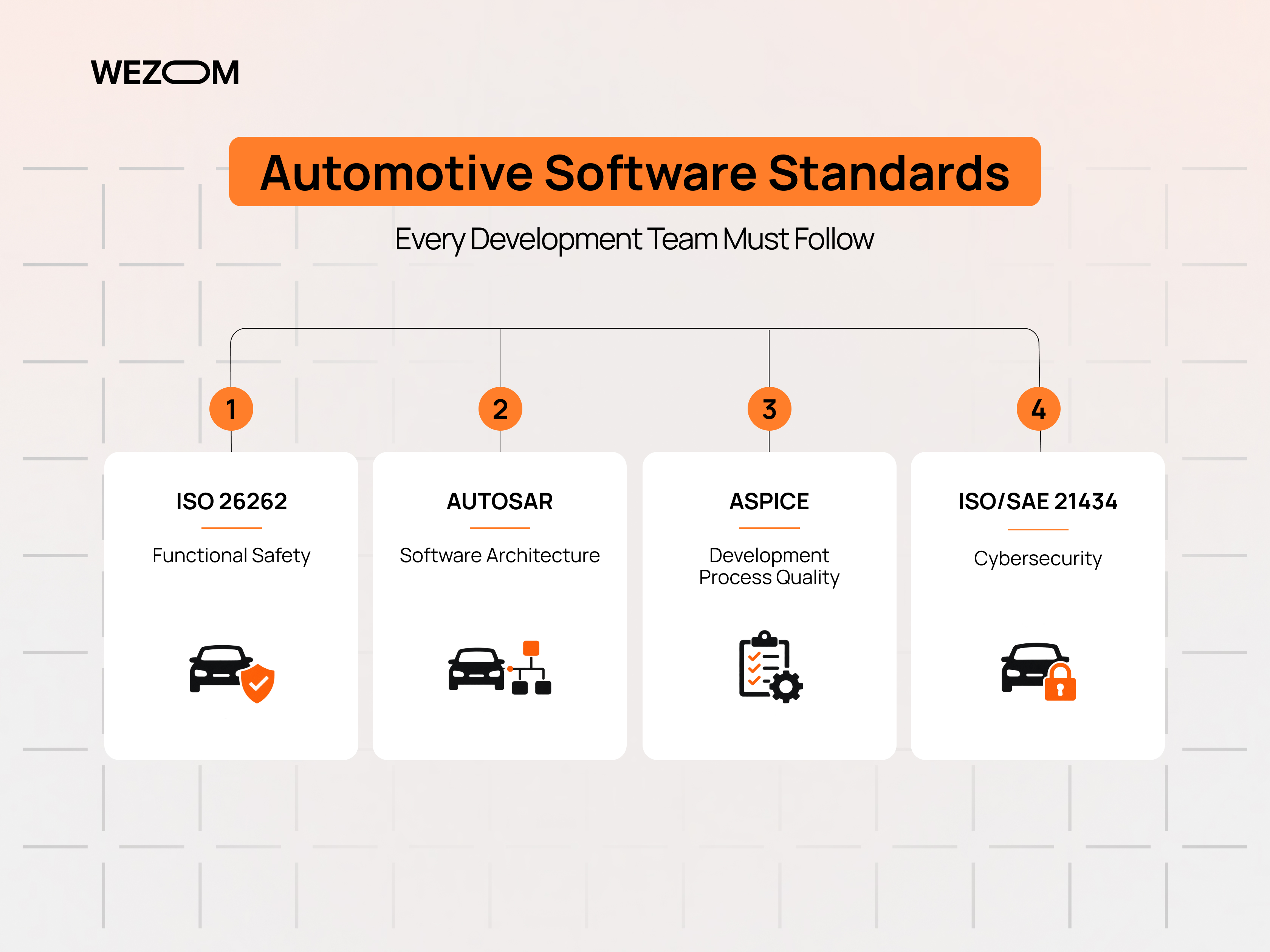
Automotive software standards define the engineering practices required to build safe, reliable, and maintainable vehicle systems. As modern cars become more dependent on software, development teams must follow industry frameworks that help manage complexity, reduce risks, and ensure compliance throughout the software lifecycle.
These standards cover different areas of automotive engineering, including functional safety, software architecture, development process quality, and cybersecurity. They help teams maintain traceability between requirements, implementation, testing, and validation while improving collaboration between manufacturers, suppliers, and software partners.
ISO 26262
ISO 26262 is the main functional safety standard for automotive electronic systems. It defines processes for identifying risks, analyzing potential failures, and developing safety mechanisms throughout the vehicle software lifecycle.
The standard introduces Automotive Safety Integrity Levels (ASIL), which determine the level of safety requirements based on the potential impact of system failures. Higher ASIL levels require stricter verification, additional safety measures, and more detailed documentation.
ISO 26262 is especially important for systems that directly affect vehicle operation, such as braking, steering assistance, power management, and advanced driver assistance functions.
AUTOSAR
AUTOSAR is a standardized automotive software architecture designed to improve modularity, scalability, and software reuse. It separates application logic from hardware-specific components, making software easier to maintain and adapt across different vehicle platforms.
The Classic Platform is commonly used for traditional ECUs that require deterministic performance and real-time operation. The Adaptive Platform supports more advanced applications, including connected services, autonomous driving features, and high-performance computing systems.
ASPICE
ASPICE focuses on improving automotive software development processes and evaluating supplier maturity. It covers areas such as requirements engineering, architecture design, implementation, testing, and quality management.
Following ASPICE practices helps teams create predictable development workflows, improve documentation, and identify issues earlier in the project lifecycle.
ISO/SAE 21434
ISO/SAE 21434 addresses cybersecurity risks in automotive software development. It defines processes for threat analysis, vulnerability management, secure development, and protection of connected vehicle systems.
With the growth of telematics, OTA updates, and connected vehicles, cybersecurity has become an essential part of automotive software engineering. Integrating ISO/SAE 21434 practices helps organizations build more secure and resilient vehicle platforms.
Automotive Embedded Software Development Process
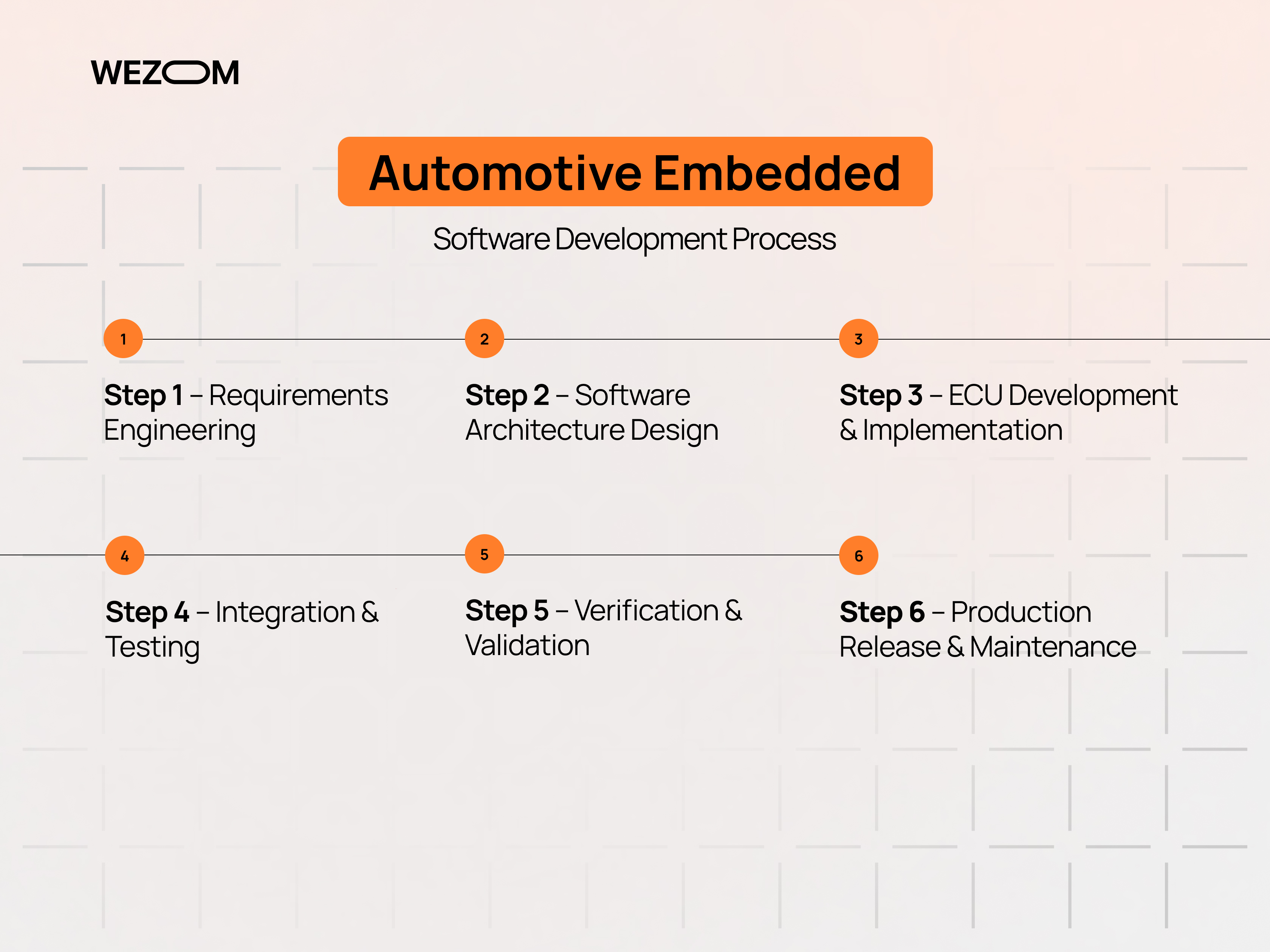
Automotive embedded software development follows a structured lifecycle to ensure reliability, safety, and compliance with industry standards. Since vehicle software interacts directly with hardware components and safety-critical systems, each stage requires careful planning, testing, and validation.
The process typically includes:
- Requirements Engineering
Teams define functional requirements, safety objectives, performance expectations, hardware limitations, and compliance requirements. Clear requirements help prevent costly changes during later development stages. - Software Architecture Design
Engineers design the system structure, define software components, communication interfaces, and resource allocation. Architecture decisions influence scalability, maintainability, and future updates. - ECU Development and Implementation
Developers create firmware, drivers, communication modules, and control logic using technologies such as C, C++, RTOS, and embedded Linux. The focus is on reliable performance within hardware constraints. - Integration and Testing
Software components are integrated with ECUs, sensors, actuators, and vehicle networks. Teams perform functional testing, communication checks, and system-level verification. - Verification & Validation
Engineers validate that the software meets technical, safety, and performance requirements using methods such as simulation, SIL, HIL, and automated testing. - Production Release and Maintenance
After deployment, teams provide ongoing support through diagnostics, firmware updates, cybersecurity improvements, and OTA maintenance to ensure long-term system reliability.
Best Practices for Automotive Embedded Software Development
Reliable automotive embedded software requires a structured engineering approach focused on safety, scalability, and long-term maintainability. Development teams use proven practices to reduce risks, improve software quality, and simplify future updates.
Key practices include:
- Modular architecture: Separating software components improves maintainability, reuse, and integration across different vehicle platforms.
- Model-based design: Simulation helps validate control logic and identify issues before deploying software to physical hardware.
- Traceability and documentation: Linking requirements, code, and tests supports compliance with ISO 26262 and ASPICE processes.
- Code reviews and static analysis: These practices help detect defects, security issues, and reliability risks early.
- Continuous integration and automated testing: Automated workflows improve development speed and reduce integration problems.
- Configuration and risk management: Proper version control and risk analysis help maintain software consistency throughout the vehicle lifecycle.
Following these practices allows teams to build automotive embedded systems that are safer, more scalable, and easier to maintain.
Automotive Software Testing and Validation
Testing and validation are essential parts of automotive embedded software development because vehicle systems must operate safely, reliably, and predictably under different conditions. Unlike traditional software, automotive systems require verification of not only functionality but also performance, timing, fault handling, and compliance with safety requirements.
Key testing approaches include:
- Unit and integration testing: Verify individual software components and communication between ECUs, sensors, and vehicle networks.
- MIL, SIL, and HIL testing: Simulation methods used to validate models, software behavior, and hardware interaction before production.
- Regression testing: Ensures that software updates do not introduce new issues into existing vehicle functions.
- System validation: Confirms that the complete system meets functional, safety, performance, and compliance requirements.
- Fault injection and safety testing: Evaluates how systems respond to failures and unexpected conditions.
A structured testing process helps identify defects early, reduce development risks, and ensure reliable operation throughout the vehicle lifecycle.
Cybersecurity in Modern Automotive Embedded Systems
As vehicles become more connected, cybersecurity has become a critical part of automotive embedded software development. Connected cars, telematics, OTA updates, and cloud integration create new risks that require protection throughout the software lifecycle.
Modern automotive systems use security mechanisms such as secure boot, encryption, authentication, secure communication, and intrusion detection to protect vehicle functions and sensitive data. Threat analysis and risk assessment (TARA) help teams identify potential vulnerabilities and define appropriate security measures.
Key cybersecurity practices include:
- Secure firmware and OTA updates: Prevent unauthorized software modifications and ensure safe remote updates.
- Data protection: Use encryption and authentication to secure communication between ECUs and external systems.
- Vulnerability management: Continuously monitor, test, and address security weaknesses.
- Penetration testing: Identify potential attack paths before systems are deployed.
Integrating cybersecurity from the early design stages helps organizations build safer connected vehicles and maintain long-term protection against evolving threats.
Technologies and Tools Used in Automotive Embedded Development
Automotive embedded software development relies on a combination of programming languages, operating systems, communication protocols, and engineering tools. The technology stack depends on vehicle requirements, hardware architecture, safety level, and system complexity.
C and C++ remain the primary programming languages for automotive systems because they provide efficient performance, direct hardware access, and reliable resource management. C is commonly used for firmware and low-level ECU software, while C++ supports more complex and modular applications.
Operating systems are selected based on performance requirements. RTOS platforms are widely used for safety-critical systems that require deterministic execution and low latency. Embedded Linux is often applied in advanced automotive solutions such as infotainment, telematics, and high-performance computing platforms.
Communication technologies enable interaction between vehicle components:
- CAN: Used for reliable communication between ECUs and control systems.
- LIN: A cost-effective protocol for simpler vehicle components.
- FlexRay: Supports high-speed and deterministic communication for advanced systems.
- Ethernet: Enables high-bandwidth applications such as autonomous driving and connected services.
Automotive teams also use specialized tools for development and testing. AUTOSAR platforms help create standardized software architectures, while MATLAB/Simulink supports modeling and simulation. Tools from Vector and ETAS are widely used for ECU diagnostics, calibration, communication analysis, and validation.
Version control systems such as Git and automation platforms like Jenkins support collaboration, continuous integration, and automated testing. Together, these technologies help teams build scalable, reliable, and secure automotive embedded systems.
Common Challenges in Automotive Embedded Software Projects
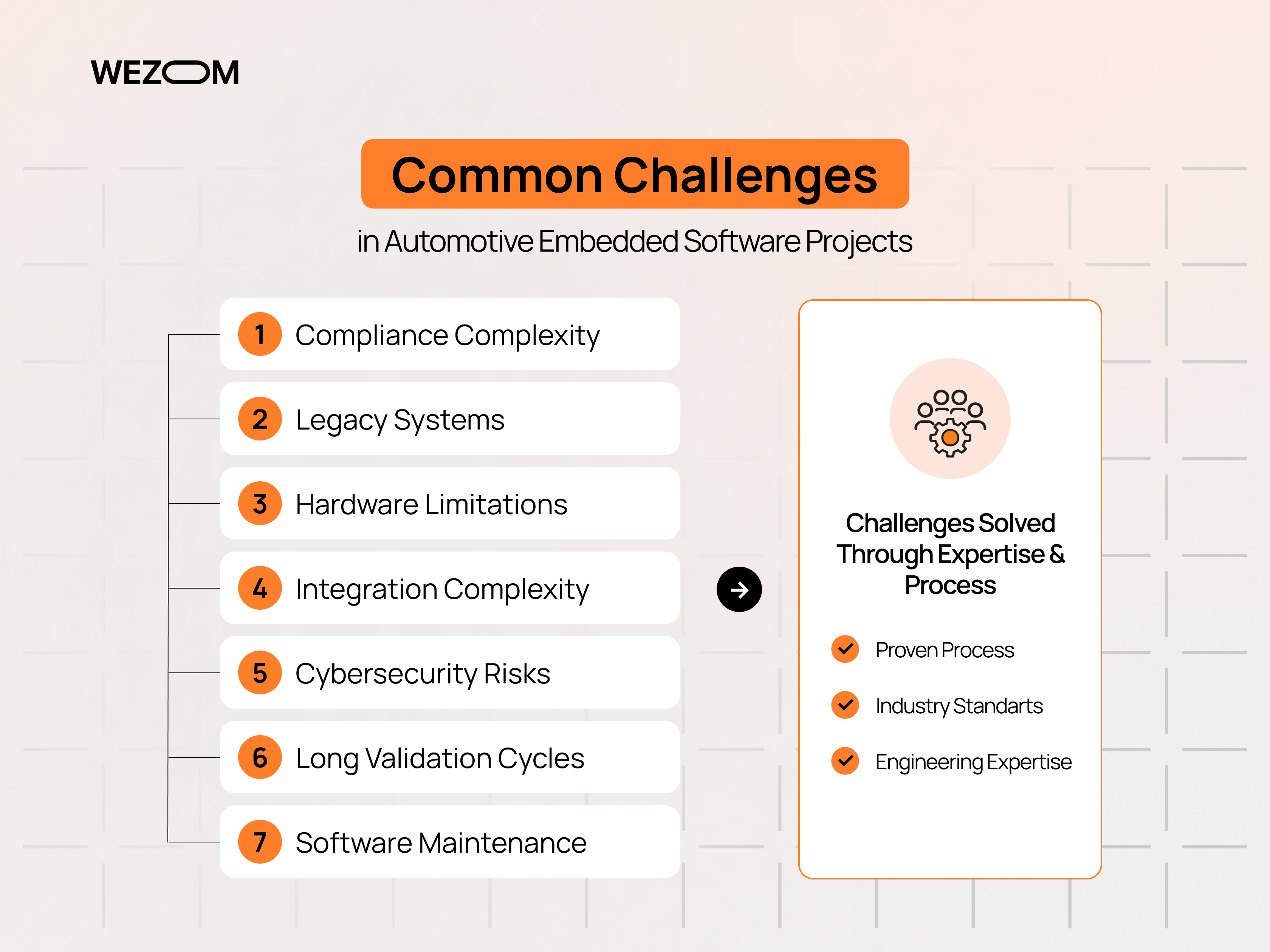
Automotive embedded software projects involve complex engineering challenges caused by strict safety requirements, hardware limitations, long product lifecycles, and increasing system complexity. Successful development requires careful planning, mature processes, and strong collaboration between software, hardware, and automotive teams.
The main challenges include:
- Compliance complexity: Meeting standards such as ISO 26262, AUTOSAR, ASPICE, and cybersecurity requirements requires extensive documentation, testing, and traceability.
- Legacy systems: Many manufacturers rely on older architectures that can be difficult to modernize while maintaining compatibility with existing hardware.
- Hardware limitations: Embedded systems must operate within restrictions related to processing power, memory, and energy consumption.
- Integration complexity: Multiple ECUs, sensors, actuators, and communication networks must work together reliably without timing or compatibility issues.
- Cybersecurity risks: Connected vehicles require continuous protection against vulnerabilities, unauthorized access, and software threats.
- Long validation cycles: Automotive software requires extensive testing and verification before production release, which can increase development timelines.
- Software maintenance: Vehicles require long-term support, including firmware updates, diagnostics, security improvements, and OTA capabilities.
Addressing these challenges requires experienced engineering teams that understand embedded technologies, automotive standards, and the complete software lifecycle. A structured development approach helps reduce risks, improve reliability, and support future vehicle evolution.
How to Choose an Automotive Embedded Software Development Partner
Choosing the right automotive embedded software development partner is critical because software quality directly affects vehicle reliability, safety, and long-term maintenance. A strong partner should provide not only development skills but also knowledge of automotive engineering processes and industry requirements.
Key factors to consider include:
- Automotive expertise: The partner should understand ECU development, firmware, embedded architectures, diagnostics, and vehicle communication protocols.
- Safety standards knowledge: Experience with ISO 26262, ASIL requirements, and functional safety processes helps ensure compliance with automotive regulations.
- AUTOSAR and ASPICE experience: Familiarity with standardized architectures and mature development processes improves scalability and software quality.
- Cybersecurity capabilities: The team should understand secure development practices, threat analysis, encryption, authentication, and vulnerability management.
- Testing infrastructure: Access to simulation tools, HIL testing, automated testing, and validation processes reduces development risks.
- Embedded engineering team: A multidisciplinary team of developers, QA engineers, architects, and security specialists can better handle complex projects.
- Long-term support: The partner should be able to provide maintenance, firmware updates, OTA support, and software improvements after deployment.
A reliable automotive software partner combines technical expertise, compliance knowledge, and lifecycle support to help companies build secure, scalable, and future-ready vehicle solutions.
Future Trends in Automotive Embedded Software
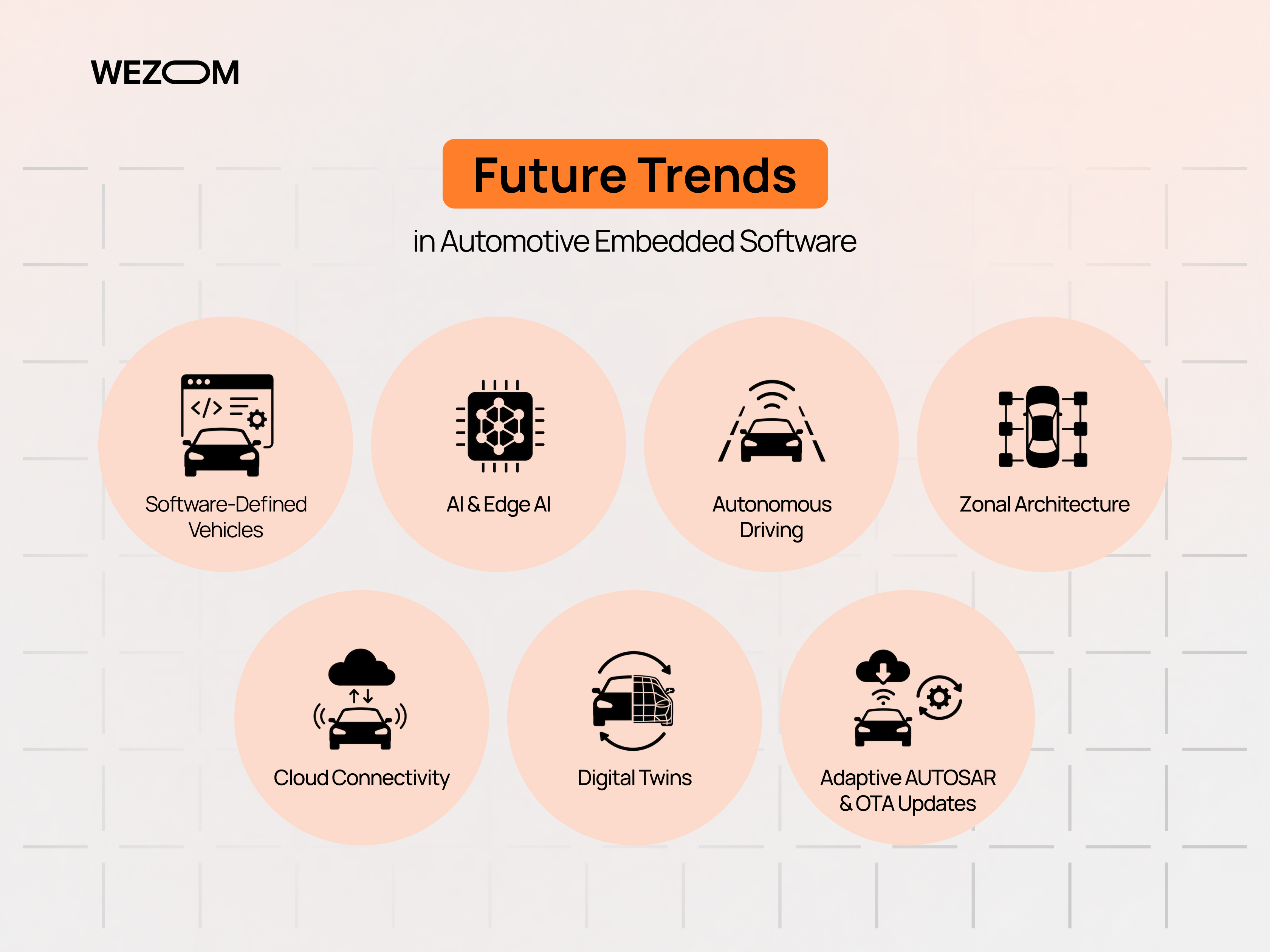
Automotive embedded software is becoming the foundation of modern vehicle innovation. As the industry moves toward software-defined vehicles, manufacturers are shifting from fixed hardware systems to flexible software platforms that can be continuously updated and improved.
Key trends shaping the future include:
- Software-defined vehicles: Centralized computing architectures and advanced software platforms allow manufacturers to introduce new features through updates instead of hardware changes.
- AI integration and edge AI: Artificial intelligence is improving driver assistance, autonomous systems, predictive maintenance, and real-time decision-making directly inside vehicles.
- Autonomous driving: Advanced sensors, powerful controllers, and intelligent algorithms require highly reliable embedded architectures capable of processing large amounts of data.
- Zonal architecture: Grouping vehicle functions by physical zones helps reduce wiring complexity and supports more scalable electronic architectures.
- Cloud connectivity and vehicle data platforms: Connected vehicles enable new services through data collection, analytics, and remote management.
- Digital twins: Virtual vehicle models help engineers simulate performance, optimize systems, and identify issues before physical testing.
- Adaptive AUTOSAR and OTA updates: Flexible software platforms and secure remote updates support faster innovation and long-term vehicle evolution.
Future automotive systems will require a combination of embedded engineering, cybersecurity, AI capabilities, and scalable architectures. Companies that invest in modern software foundations will be better prepared for the next generation of intelligent and connected vehicles.
Conclusion
Automotive embedded software development has become a key driver of modern vehicle innovation, enabling advanced features such as connectivity, automation, electrification, and software-defined architectures. Building reliable automotive systems requires expertise in embedded engineering, industry standards, cybersecurity, and rigorous testing processes.
Successful projects depend on modular architecture, strong validation practices, compliance with standards such as ISO 26262 and AUTOSAR, and long-term software lifecycle management. As vehicles become more intelligent and connected, organizations need experienced development partners that can help create scalable, secure, and reliable automotive software solutions.
FAQ
What is automotive embedded software development?
Automotive embedded software development is the process of creating software that controls vehicle hardware components such as ECUs, sensors, actuators, and communication systems. It includes firmware development, diagnostics, control algorithms, and connectivity features. Unlike traditional software, it requires strict reliability, real-time performance, safety compliance, and long-term maintainability.
What standards are required for automotive embedded software?
The main standards include ISO 26262 for functional safety, AUTOSAR for software architecture, ASPICE for development process quality, and ISO/SAE 21434 for cybersecurity. These standards help teams build reliable automotive systems, manage risks, ensure traceability, and meet requirements for safety-critical vehicle applications.
What is ISO 26262 and why is it important?
ISO 26262 is a functional safety standard for automotive electronic systems. It defines processes for identifying risks, developing safe software, and validating safety-critical functions. The standard introduces ASIL levels that determine required safety measures. It helps manufacturers reduce failures and ensure reliable vehicle operation.
What is AUTOSAR and when should it be used?
AUTOSAR is a standardized automotive software architecture that enables modular, reusable, and scalable embedded systems. It is used for ECU development, especially when manufacturers need consistent software structures across multiple vehicle platforms. AUTOSAR Classic supports traditional ECUs, while Adaptive supports advanced connected and autonomous systems.
What is ASPICE in automotive software development?
ASPICE is a process assessment framework used to evaluate automotive software development maturity. It focuses on requirements management, architecture, implementation, testing, and quality processes. Automotive companies use ASPICE to ensure suppliers follow structured engineering practices and can consistently deliver reliable software solutions.
