
Our experience shows that often companies implement IoT for the first time without an understanding of the architectural specifics. Because of this, the costs of cloud infrastructure and sensor integration eventually begin to exceed initial estimates. Since each IoT ecosystem is unique, there is no universal pricing, but we will nevertheless attempt to estimate the upcoming expenses. We will also analyze the feasibility of using ready-made platforms in terms of quick launch and potential for further scaling.
Average IoT Software Development Cost in 2026
The investment volume depends on whether you're building a proof-of-concept prototype or, for example, a fully-fledged distributed platform with a high level of fault tolerance. Furthermore, you need to distinguish between software development (usually including the implementation of a cloud-based dashboard, API integration, and, optionally, a mobile version) and the creation of a comprehensive IoT ecosystem, including firmware design, edge computing setup, hardware and software integration, and everything else that goes into software development.
For example, in MVP projects designed to quickly test hypotheses, we connect a small number of devices with basic telemetry and implement a simple dashboard. Mid-range solutions additionally require scalability, a multi-user cloud backend, access control, automated alerts, and sometimes even cross-platform mobile software development. Finally, when it comes to implementing an enterprise-grade platform, there are added requirements for security and compliance with a number of industry standards, as well as the ability to manage a fleet of 1,000+ different devices, real-time data processing and synchronization, analytics, and more. Let's look at some rough estimates for IoT software development cost in numbers:
Project type Budget Time-to-market MVP solution $25,000-$50,000 2-4 months Middle-level solution $50,000-$150,000 4-8 months Enterprise-grade ecosystem $150,000-$300,000+ 8-12+ months
Main Factors That Affect IoT Software Development Cost
The price of a ready-to-use product is determined by a number of variables. The following project attributes must be taken into account first:
- Project complexity, including business logic, data processing protocols used, etc.;
- Number of connected devices (since managing hundreds of endpoints is different from orchestrating millions of devices);
- Hardware integration, including the choice of communication protocols and the implementation of proprietary low-level firmware for microcontrollers and sensors;
- Cloud infrastructure, which implies a choice between managed cloud services and hybrid architectures;
- Mobile and web app development (it typically requires real-time data visualization, push notification integration, and offline support, which directly impacts frontend complexity);
- Real-time data processing with the accompanying implementation of event-driven architecture;
- Integration of AI and analytics for anomaly detection and predictive maintenance, which implies additional expenses;
- Security, including end-to-end encryption, role-based access control, and vulnerability management;
- Third-party integrations, including ERP/CRM/SCADA systems, which often require the implementation of custom APIs and middleware orchestration;
- Regulatory compliance, with adherence to industry standards and associated audits;
- Horizontal scalability, which involves designing the system to handle upcoming peak loads without performance degradation;
- Implementing UX/UI for operators and other end users to simplify the understanding of telemetry (this, in turn, requires time spent researching user scenarios).
IoT Software Cost by Project Complexity
The project's budget varies depending on its scale.
For example, an MVP, which typically includes real-time device telemetry tracking, basic user authentication, a simple dashboard for data visualization, the ability to manually send notifications, and remote team management, requires a team of five specialists (one full-stack developer, one embedded developer, one QA engineer, one project manager, and one UX/UI designer). The project timeline for such a project is 2-4 months, and the budget is $25,000-$50,000.
If we're talking about amedium-sized platform (typically with a multi-user architecture, RBAC, analytics, reporting, multi-channel alert routing, historical data storage, and API connectors), it will require a team of 7 specialists (two backend developers, one frontend developer, one mobile app developer, one embedded systems engineer, one QA automation engineer, and one systems architect). The project timeline is 4-8 months, and the estimated budget is $50,000-$150,000.
Finally, if we estimate an enterprise solution with a large device fleet, edge computing, real-time data processing pipelines, predictive maintenance (e.g., AI-based), end-to-end encryption, CI/CD pipelines, multi-regional scaling, and integration with enterprise systems, it will require a team of 12+ specialists (system architects, embedded systems engineers, cloud infrastructure specialists, DevOps engineers, full-stack developers, data scientists, security auditors, QA specialists, etc.). The project duration for such projects ranges from 8 to 12+ months, and the budget is $150,000-$300,000+.
Development Costs by Project Stage
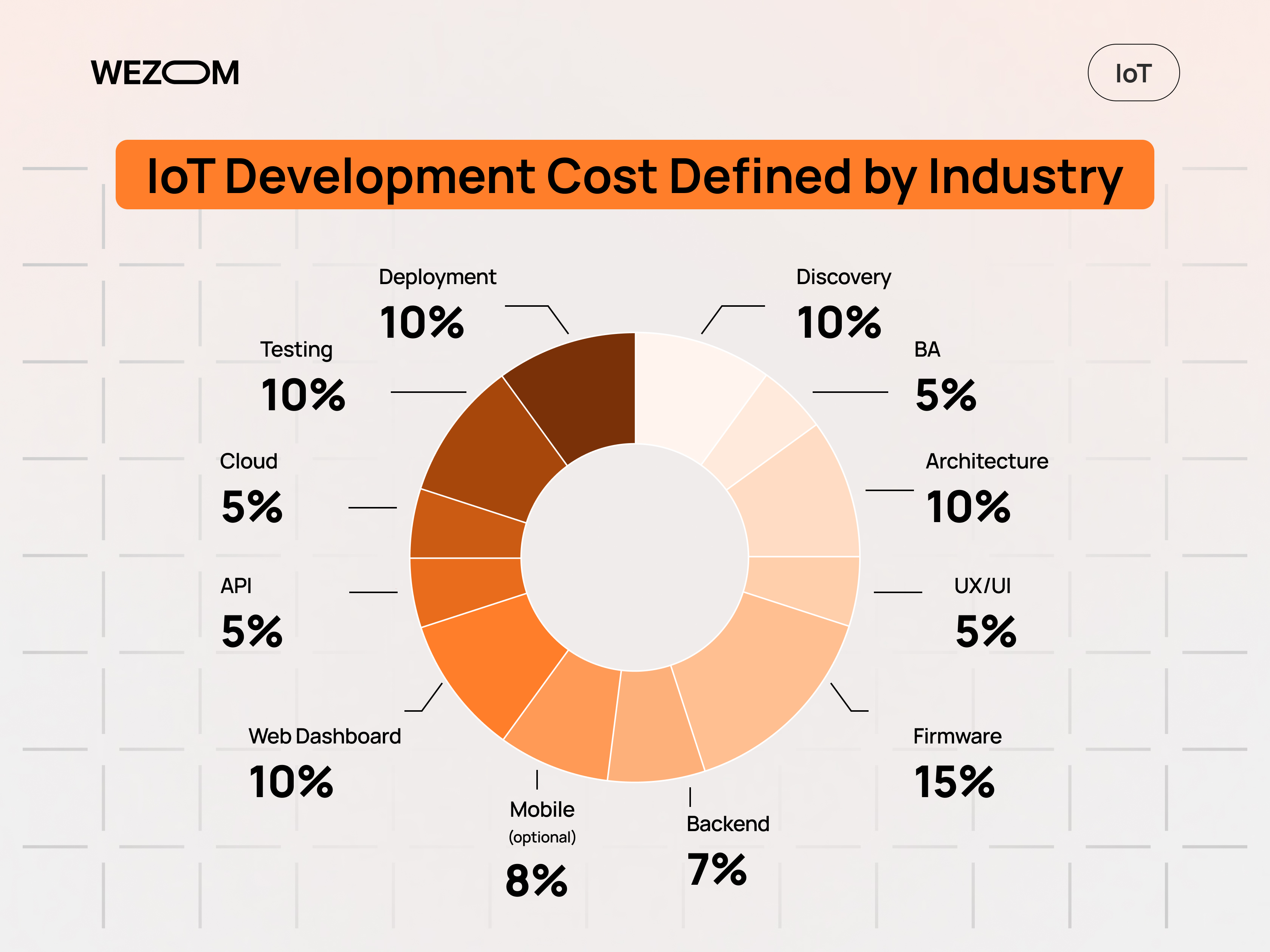
Here, we would like to describe how the IoT platform budget is allocated depending on the project stage (please note that these are very rough estimations):
- Discovery phase (about 10%). At this stage, the team defines the project scope by conducting stakeholder interviews, analyzing its viability (in both technical and business contexts), and formulating its business objectives.
- Business analysis (about 5%). It implies translating operational requirements into a list of specifications and user stories. Acceptance criteria are also defined.
- Architectural design (about 10%). Now, the design of the overall system topology begins. Also, the team selects communication protocols and data transfer patterns.
- UX/UI design (about 5%). This includes creating user scenarios and telemetry-monitoring dashboards.
- Firmware integration (about 15%). This stage requires coding for microcontrollers and sensors.
- Backend (7%). The team implements server logic and database schemas brokers to handle device connections.
- Mobile app development (optional, about 8%). It requires implementing native/cross-platform software for operators.
- Web dashboard development (about 10%). Here, the team creates web interfaces with real-time charts.
- API implementation (about 5%). This stage involves creating secure endpoints to enable interoperability with third-party software/services.
- Cloud infrastructure (about 5%). It includes deploying and configuring cloud environments to ensure maximum uptime.
- Testing (about 10%). During this stage, the team performs unit, integration, and vulnerability testing.
- Deployment (about 10%). Finally, the team deploys the software, pre-preparing the hardware included in the system.
Hidden Costs Businesses Often Forget
Now, let's analyze the hidden expenses that are often overlooked in the initial stages of budgeting:
- Cloud hosting, which includes recurring costs for servers and computing power, which grow directly proportional to data volumes;
- Device management, implying the budget for provisioning/decommissioning your hardware assets;
- Firmware updates, which are necessary for patching vulnerabilities and deploying updates remotely;
- Security monitoring, including real-time threat detection and audit logging;
- Compliance audits performed by third-party experts, which are necessary for compliance with industry standards;
- Use of APIs to connect to cloud services, gateways, etc.;
- Third-party licenses for proprietary SDKs and UI component libraries;
- Data storage in high-speed time-series databases;
- DevOps services, required to support deployment pipelines and availability monitoring;
- Technical support for handling user requests and emergency system recovery;
- Scaling, including expanding server clusters and database throughput.
IoT Software Maintenance Costs
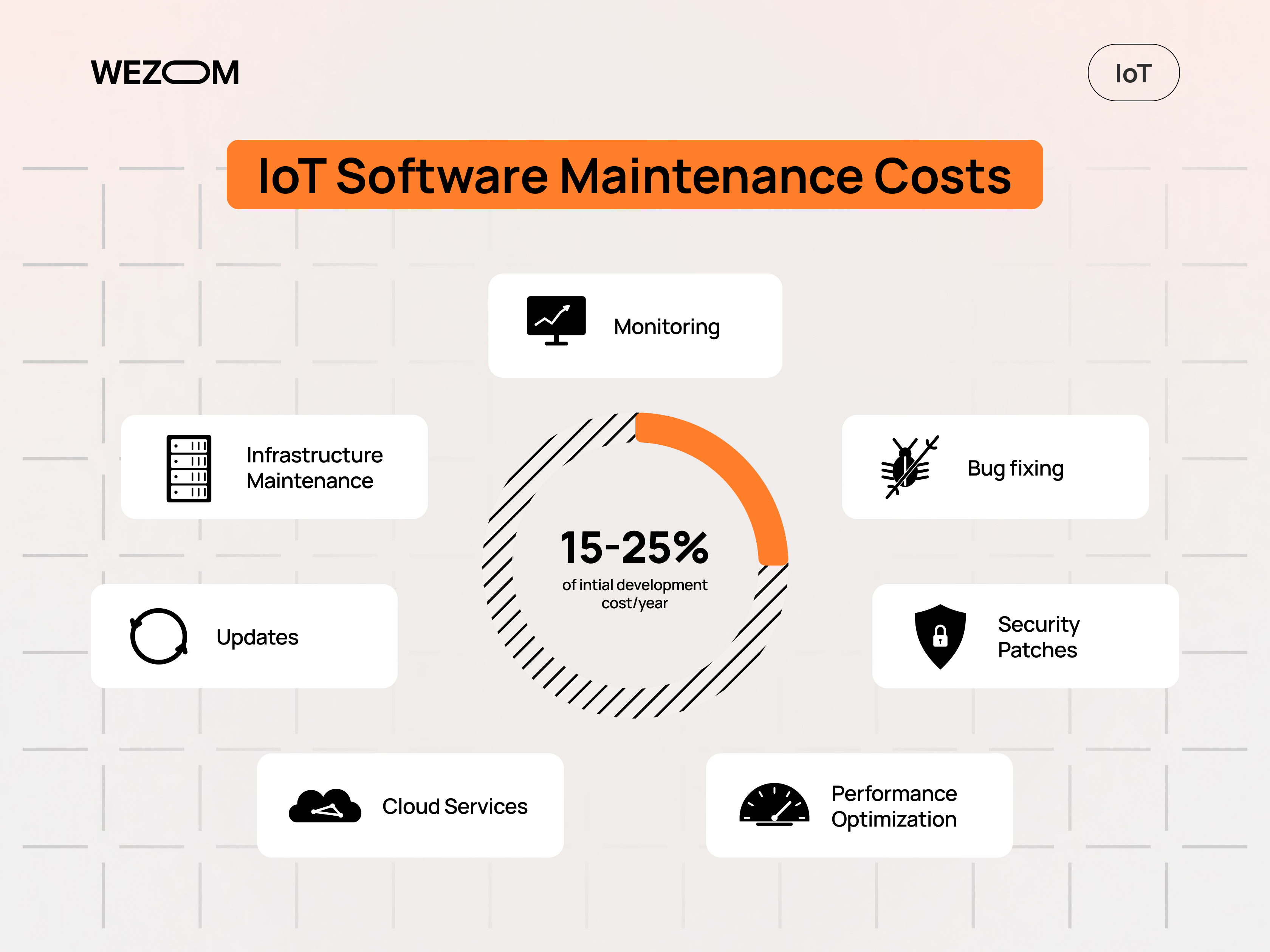
Maintaining the operability of IoT solutions often accounts for a huge portion of their budgets. Unlike other software types, such projects are tied to physical hardware with their own unique firmware. If we add the fact that they must implement data transmission in real time, it becomes obvious that regular support becomes the main factor in their effectiveness. For example, based on our experience, the average annual maintenance cost of Internet of Things solutions ranges from 15% to 25% of the initial expenses. This includes:
- Monitoring. Ensuring the 24/7 operation requires the implementation of automatic failure monitoring and performance metric collection to prevent costly downtime in business’ workflows.
- Bug fixing. It's important to promptly resolve software errors; some of them are only discovered during the software's operational phase, when it spans a large number of different devices.
- Security patches. This involves regular audits to fix vulnerabilities in software and network protocols; otherwise, the security of sensitive data and access to devices can be compromised.
- Performance optimization. It includes fine-tuning network requests, time-series databases, and data processing rules. All this is necessary to reduce latency and computing load.
- Cloud services. You will also face monthly bills from cloud vendors, provisioning data storage and computing power.
- Updates. This includes developing new features and adapting the system to new business requirements.
- Infrastructure maintenance. This implies server administration, which often also includes container management, backups, and CI/CD pipeline support.
IoT Development Cost Defined by Industry
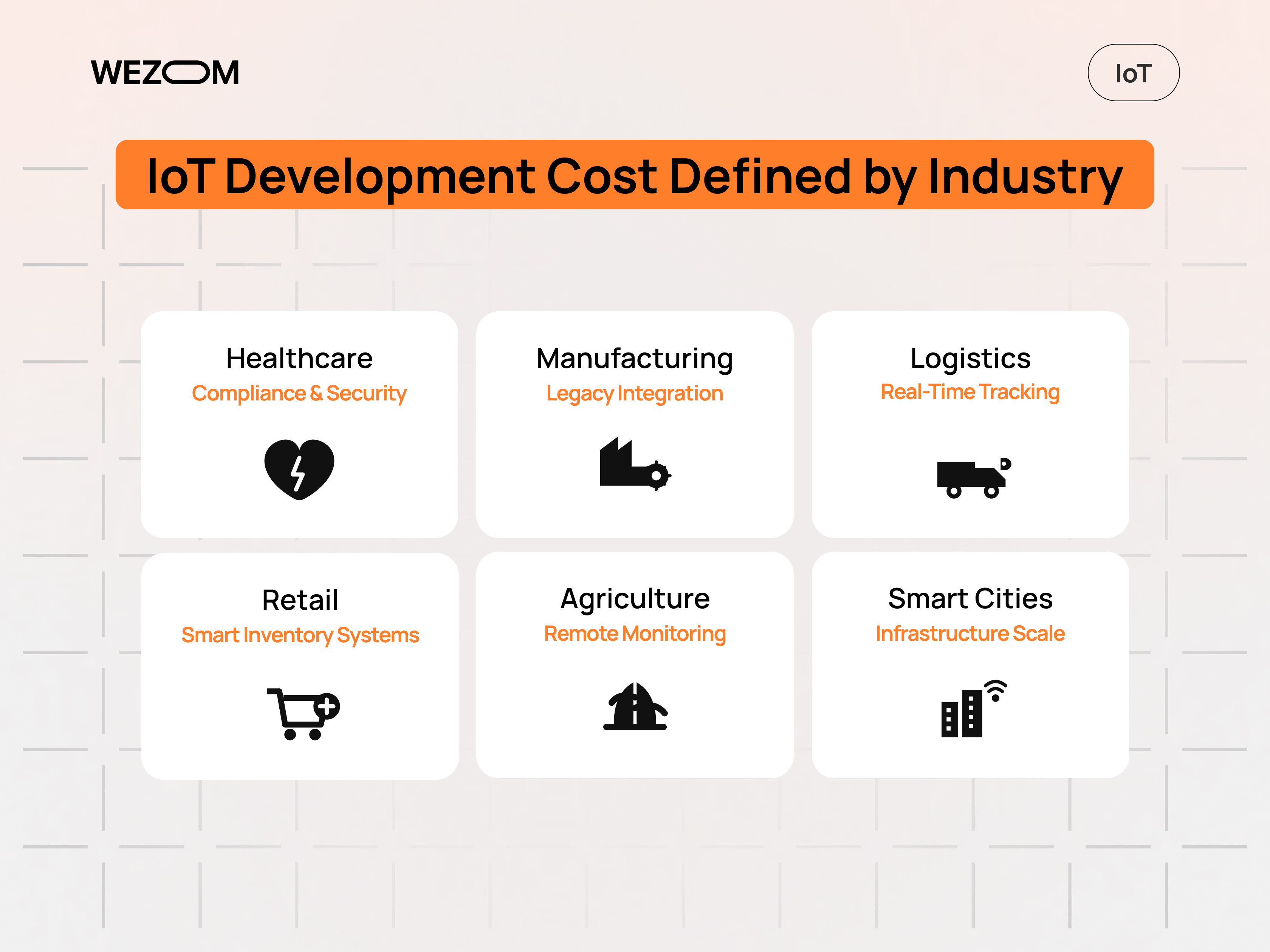
The specific industry a business belongs to determines the architecture, security requirements, and a number of other project aspects, which inevitably impacts its budget. Let's consider the most popular industries using IoT solutions:
- Healthcare. Projects in this area require the highest level of security, including encryption of patient data and compliance with standards. Furthermore, such software is unacceptable for errors, so pentesting and security audit expenses will be high.
- Manufacturing. Here, teams focus on integrating software with industrial equipment, which is often legacy. They must also ensure fault tolerance and continuous operation of systems in harsh conditions and typically equip them with predictive analytics to prevent emergencies.
- Logistics. In this sector, the budget is largely determined by the implementation of real-time geolocation and asset tracking in areas with unstable mobile connection, as well as ensuring the autonomous operation of remote devices.
- Retail. In this niche, developers often need to integrate highly specialized devices like smart shelves and sophisticated inventory systems, which requires creating user-friendly interfaces and ensuring instant data exchange with PoS terminals.
- Agriculture. This industry involves developing smart systems for field monitoring and irrigation management, which presents challenges in ensuring energy-efficient data transmission over vast territories.
- Smart cities. Such projects are usually large-scale, as they consolidate thousands of diverse sensors. They must be highly fault-tolerant and have a distributed architecture, which directly impacts their budget as well.
Custom IoT Software vs Off-the-Shelf Platforms
The choice between developing a custom solution and purchasing a ready-made one should be made considering the following aspects:
- Initial budget. Off-the-shelf platforms require minimal upfront investment thanks to the subscription model, whereas custom development requires significant upfront budget on architecture and custom code.
- Long-term expenses. Off-the-shelf solutions increase in price as the business scales (i.e., as the number of devices and/or functions increase). Custom software, on the other hand, incurs costs only for internal support and scaling.
- Flexibility. Custom systems are created for specific business processes and can be further enhanced with new functionality. In this context, ready-made platforms are much less flexible, so businesses using them must adapt their workflows to the vendor's constraints.
- Security level. Custom development enables compliance with any security requirements, including end-to-end encryption (however, it needs vulnerability monitoring, too). With off-the-shelf platforms, security is entirely the vendor's responsibility.
- Integrations. Turnkey software can seamlessly integrate with any internal corporate systems. Out-of-the-box solutions are limited by the list of available connectors.
- Ownership of code and business logic. With a custom product, its source code is your company's intellectual property. With ready-made platforms, you are merely a tenant.
- Scalability. The architecture of custom software is designed with future peak loads in mind, while ready-made platforms are limited by the vendor's pricing plans.
- Vendor dependency. Turnkey development frees you from the risk of unfavorable changes in a third-party vendor's roadmap; still, ready-made platforms create a strict vendor lock-in.
- ROI. A custom solution takes longer (approximately 2-3 years) to achieve a return on investment. However, if your business is constantly growing, you will achieve tremendous returns. If we're talking about ready-made platforms, they guarantee a quick MVP launch and don't require significant expenses.
Let's summarize the insights above in the table below.
| Criteria | Custom-made software | Off-the-shelf software |
|---|---|---|
| Initial budget | High (from $25,000 up to $300,000+) | Low (due to the SaaS or licence-based model) |
| Long-term expenses | Moderate (tech maintenance and support are required) | Grow as your business scales |
| Flexibility | High, tailored to your business processes | Is limited by the vendor’s roadmap |
| Security | Customized | Depends on the vendor’s reliability |
| Connectivity | Any custom systems (including legacy ones) | Are limited by existing connectors |
| Intellectual property ownership | Full (code and IP belongs to you) | Licence-restricted |
| Scalability | Unlimited | Is limited by your pricing plan |
| Vendor lock-in | No | Yes |
| ROI | Long-term | Enables quick start (perfect for MVPs) |
How to Reduce IoT Development Costs Without Sacrificing Quality
Budget optimization during the custom system development process shouldn't come at the expense of this system’s security. Here's how we recommend approaching long-term project planning:
- Start with an MVP. Creating a minimum viable product allows you to test your hypotheses with a real target audience. By connecting a limited number of devices, you can quickly validate or disprove the value of the selected functionality long before your team of contractors begins full-scale development.
- Prioritize functionality. Start with critical features, leaving secondary ones for implementation in future versions.
- Use cloud services. Ready-made cloud components protect you from building your own server infrastructure from scratch.
- Choose reusable components. Using proven libraries and frameworks significantly reduces the number of engineering hours.
- Select the right tech stack. Utilizing common programming languages and protocols simplifies hiring developers and minimizes support costs.
- Build a scalable architecture from the start. Designing a flexible structure early prevents costly refactorings as computational load increases.
- Automate testing. Implementing CI/CD with automated tests allows you to identify bugs early, saving your QA engineers time and minimizing the risk of production outages.
- Reuse proven APIs. Integrating ready-made interfaces for authorization, notifications, and other tasks speeds up the development process.
- Plan integrations in advance. Considering how the platform will interact with external systems eliminates the possibility of redesigning the architecture later in the project.
- Choose an experienced contractor. Collaborating with a team with extensive experience in the IoT niche helps you avoid common architectural mistakes and unreasonable budget inflation.
How to Estimate Your IoT Project Budget
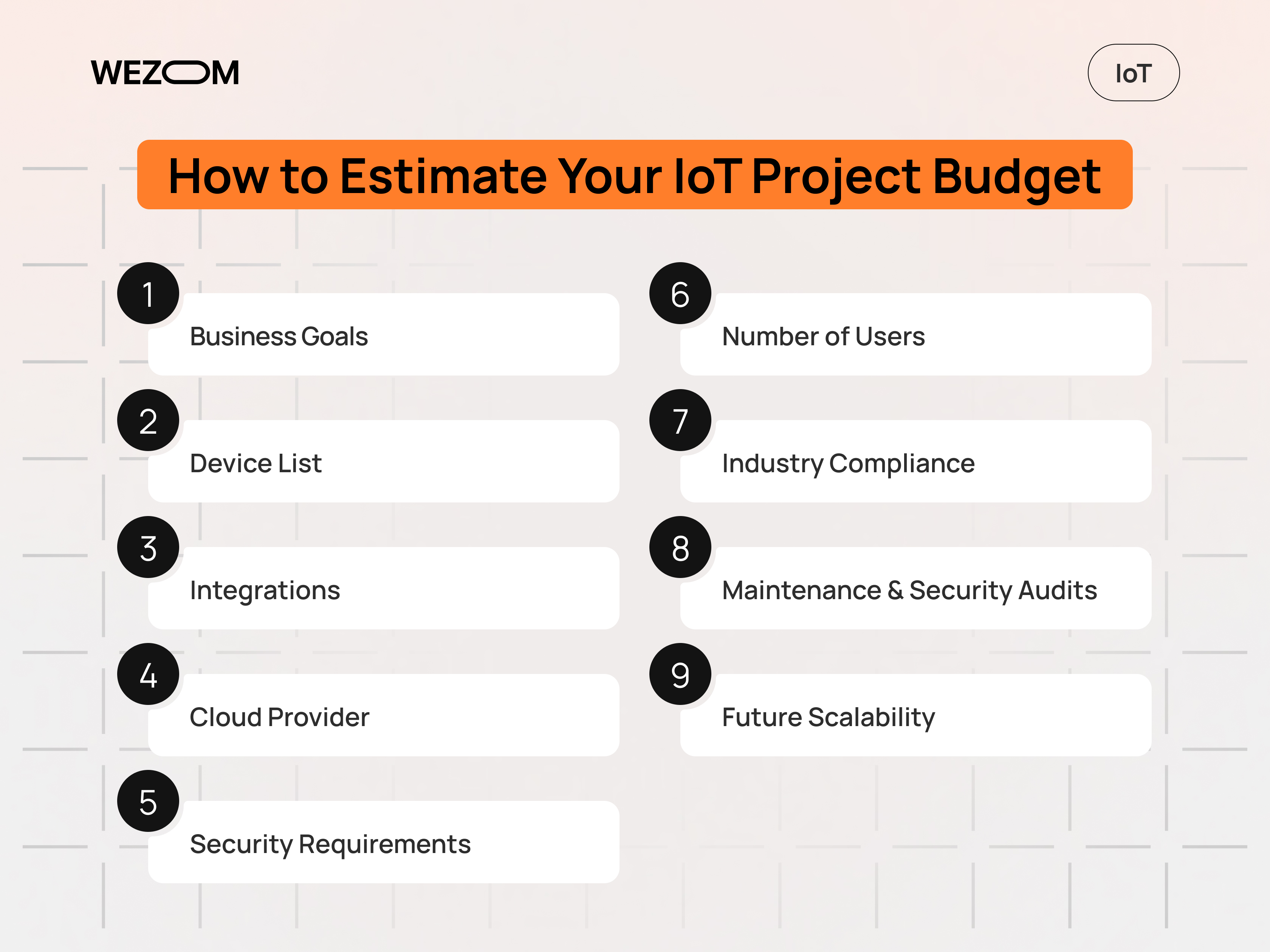
Proper budget planning and assessing the long-term value of custom solutions requires carefully reviewing each costing step and analyzing the business benefits of this approach against off-the-shelf alternatives. Specifically, you need to consider:
- Your primary business goals. It's important to understand the commercial goal or operational challenge the system should address. This will allow you to filter out redundant functionality and make the value of your solution measurable in specific KPIs.
- List of devices. This aspect involves accurately or nearly accurately defining the number and types of sensors, hardware modules, and controllers that will comprise the system.
- Necessary integrations. It's important to identify the systems and services (including those you haven't used before) with which the system must exchange data.
- Cloud provider. This aspect requires comparing the capabilities and pricing policies of cloud vendors (it's important to consider the volume of incoming traffic and potential workloads).
- Required level of security. This parameter implies taking into account the requirements for encryption, authentication procedure, and other cybersecurity measures (including data isolation).
- Current and potential number of users. When assessing this aspect, it is important to evaluate the peak loads on interfaces/operator panels/mobile apps depending on the number of active users.
- Industry requirements. At this step, you must analyze which industry standards are mandatory for your industry/region – for example, compliance assessment always requires a third-party independent audit.
- Regularity of maintenance and security audits. You need to consider the frequency and cost of monitoring, bug fixes, security patches, and server infrastructure support.
- Future scalability. Finally, you need to build an architecture that is prepared for a multiple increase in the number of devices and the data volume.
Why Businesses Invest in Custom IoT Software Despite Higher Initial Costs
Despite significant initial investment, turnkey platforms offer companies a number of advantages, including:
- High ROI. While custom platforms require significant initial investment, the absence of license fees and precise customization to a specific company's workflow will pay for themselves within 2-3 years from initial deployment.
- Intellectual property rights. All intellectual property, including source code, is fully owned by your company.
- Unlimited scalability. The project architecture is tailored to your company's peak workloads, allowing you to expand capacity in the future without being limited by third-party platforms.
- Unique selling proposition. Custom device logic gives you the opportunity to outperform competitors using off-the-shelf solutions.
- Security at the right level. You can ensure compliance with the strictest security standards, implement end-to-end encryption, and conduct vulnerability audits tailored to the specific requirements of your industry.
- Seamless integration. You get the opportunity for seamless integration of the IoT ecosystem with your internal corporate systems (including legacy ones) and custom hardware.
- Relatively low long-term operating costs. The absence of fees for each new user or connected device allows you to minimize platform operational expenses as your business grows.
Conclusion
To make the whole project budget predictable, you must adopt a thoughtful approach to architecture design and tech stack selection. This applies regardless of project size, as hidden costs can always arise from poor planning. Therefore, we strongly recommend carefully selecting a contractor who will help you coordinate your budget with maximum precision – this is the only way to protect yourself from unplanned expenses and budget gaps.

FAQ
How much does IoT software development cost in 2026?
The IoT app development cost and timeline depend on the application's scale and architectural complexity. A reasonable starting budget is around $25,000, although total investment can increase significantly depending on specific business requirements and technical scope.
What factors have the biggest impact on IoT development cost?
Major cost factors include business logic complexity, the number and type of connected devices, low-level firmware development, cloud platform selection, real-time data processing requirements, integration complexity, and compliance with security and regulatory standards.
How much does an IoT MVP typically cost?
An IoT MVP typically costs between $25,000 and $50,000. This usually includes connecting a limited number of sensors, user authentication, a telemetry dashboard, basic notifications, and remote device management functionality.
How long does it take to develop an IoT software solution?
Development timelines vary by project scope. An MVP generally requires 2–4 months, a mid-sized platform typically takes 4–8 months, and a large enterprise IoT ecosystem often requires 8–12 months or longer.
What is included in the cost of IoT software development?
IoT software development costs generally cover discovery, business analysis, solution architecture, UX/UI design, firmware development, backend engineering, mobile application development, web dashboard implementation, API integrations, cloud infrastructure deployment, testing, and production release.
