
Many logistics companies spend millions on equipment repairs, despite the fact that most breakdowns could be prevented and/or made predictable. The optimal solution to this problem today lies in the digital realm and is implemented through fleet management and maintenance software.
Why Reactive Maintenance Is Costing Fleets More Than Ever
Operating on a "fix it when it breaks" principle leads to huge budget holes, which becomes especially evident as the fleet gradually grows. Here are the risks that logistics companies face:
- Sudden breakdowns, when equipment fails mid-trip, disrupting the supply chain;
- Road accidents and the need to tow heavy commercial vehicles, which requires colossal unplanned expenses for lawyers and tow trucks;
- Emergency repairs, which often result in the need to purchase spare parts and pay mechanics at inflated prices;
- Staff shortages due to a lack of highly qualified diagnosticians;
- Downtime due to faulty equipment while trucks are sitting at service stations awaiting parts and repairs;
- Disrupted deliveries, leading to fines and reputational damage;
- Customer dissatisfaction and loss of trust;
- Inflation of repair budgets due to unplanned spare parts purchases.
How Predictive Fleet Maintenance Software Detects Problems Before They Become Failures
Fleet management predictive maintenance software addresses all of the above risks. It consolidates disparate digital data into single analytics to predict breakdowns before they occur. This is achieved through the following technological solutions:
- Telematics, i.e., data collected during real-time tracking of the vehicle's condition and driving parameters;
- IoT sensors installed on critical vehicle components for continuous monitoring of vibrations, pressure, etc.;
- ECU data obtained through a direct connection to the vehicle's onboard computer system;
- Diagnostic trouble codes with automatic interception and decoding of onboard electronics errors;
- AI/ML algorithms that analyze vehicle wear patterns;
- Historical breakdown data for similar vehicles, used for comparison with the current vehicle’s indicators;
- Driver behavior analysis, including driving patterns and maneuvers that affect the wear of vehicle parts;
- Engine monitoring, including compression, oil pressure, engine temperature, and more;
- Real-time alerts on mechanics' dashboards;
- Maintenance forecasting with precise calculations of remaining component life.
Fleet Components Where Predictive Maintenance Delivers the Biggest Savings
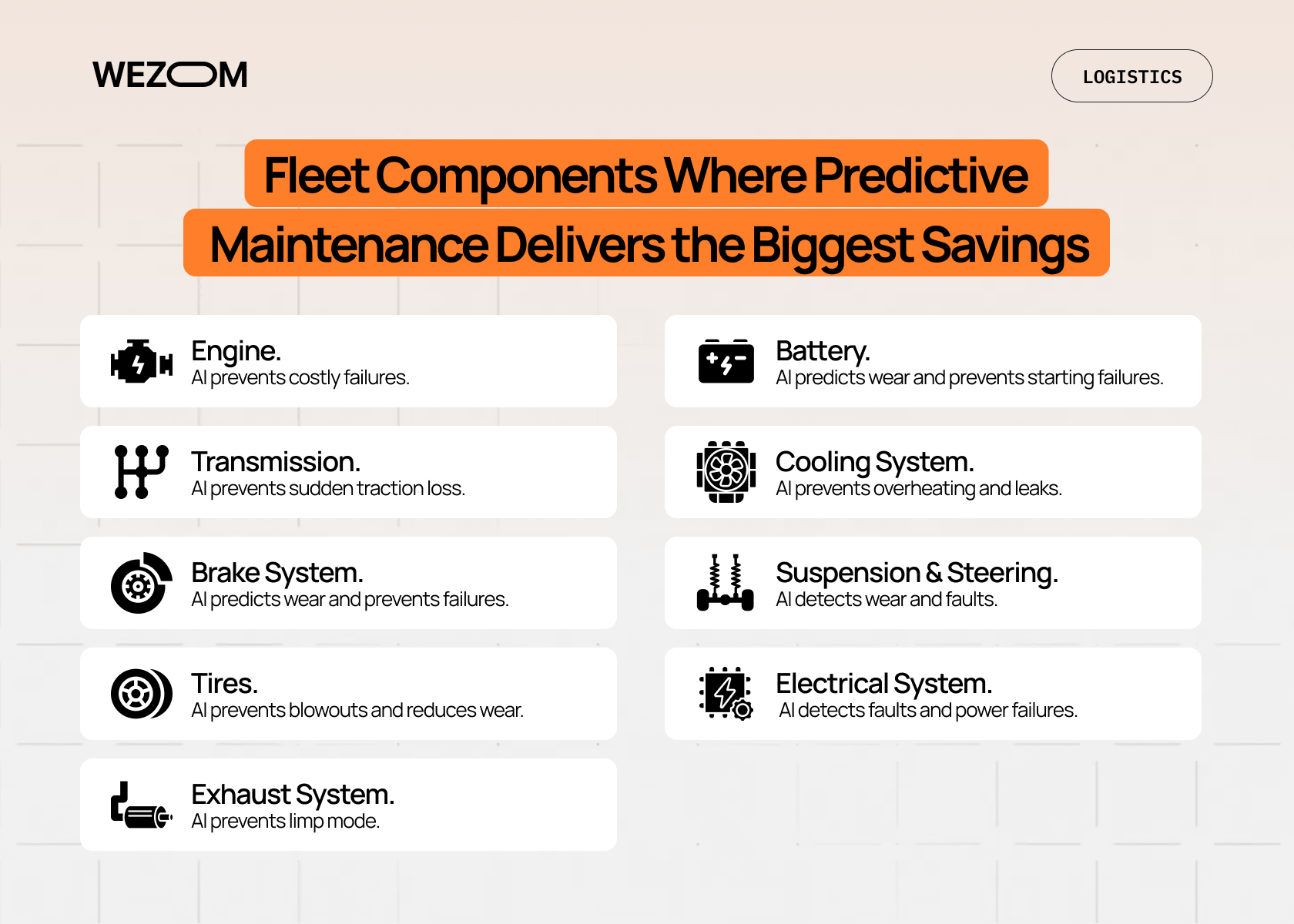
Integrating predictive maintenance algorithms into critical vehicle components enables targeted prevention of costly breakdowns. Typically, these components include:
- Engine. Here, algorithms can detect early signs of compression loss, piston wear, microcracks in the cylinder block, fluid leaks, and more. Specifically, they analyze oil pressure fluctuations, temperature anomalies, fuel consumption, and other parameters, allowing businesses to replace seals or filters instead of major repairs;
- Transmission. Real-time monitoring of gearbox temperature, the percentage of metal microparticles in the oil, gear shift dynamics, and more allows transport companies to minimize the risk of sudden loss of traction in commercial vehicles during cargo transportation;
- Brake system. Monitoring brake pad and disc wear, as well as detecting even minimal leaks in the circuits and pressure drops in the pneumatic system using IoT sensors, enables accurate prediction of the remaining life of materials based on the specific driving style of each driver;
- Tires. Real-time analysis of tire pressure and temperature while driving allows the software to alert drivers and dispatchers of unacceptable heating or damage to the carcass. This prevents tire blowouts at high speeds and reduces overall tread wear;
- Battery and starting electrical equipment. AI makes it possible to predict battery capacity degradation, brush wear, and other failures based on charge-discharge cycles. This completely eliminates engine starting problems at the base and disruptions to schedules in the morning;
- Cooling system. Specialized software prevents severe engine overheating in summer and under extreme loads by monitoring the performance of the water pump, thermostat, antifreeze, and radiator heat transfer efficiency. Furthermore, fluid leaks are detected early, protecting the expensive piston group from excessive thermal stress;
- Suspension and steering. Instant detection of play, wear in shock absorbers and bushings, and faults in steering components becomes possible using data from vibration sensors and stabilization systems.
- Electrical components and on-board network. AI automates diagnostics of wiring, contacts, fuse boxes, relays, etc., by detecting resistance surges and micro-failures in power circuits.
- Exhaust gas cleaning systems. The fleet management maintenance software monitors the AdBlue level, exhaust gas temperature, diesel particulate filter regeneration frequency, and other aspects that influence whether the vehicle enters limp mode.
How Predictive Maintenance Reduces Fleet Operating Costs
Minimizing the need for reactive repairs through the implementation of predictive technologies benefits the fleet management budget. When breakdowns are identified in advance, businesses avoid losses due to unforeseen circumstances and their consequences, such as:
- On-the-road repairs – proactive troubleshooting using predictive analytics eliminates the need for emergency repair crews to dispatch to the road;
- Rush mechanic labor compensation – scheduled maintenance requires fewer man-hours and eliminates overtime payments for technicians;
- Excessive spare parts waste – replacing parts based on actual wear and tear eliminates the premature disposal of serviceable ones;
- Extended asset life – timely detection of micro-stresses and component degradation extends the life of each vehicle by an average of 20-30%;
- Low fleet utilization – thanks to fleet maintenance software for trucking, trucks spend the maximum possible time on the road, generating profit;
- High number of warranty claims – monitoring operating parameters allows for timely detection of manufacturing defects and filing claims with suppliers, which are covered by warranty cards;
- High fuel consumption – serviceable components and properly tuned engines ensure optimized fuel consumption across the entire fleet;
- Overly frequent maintenance – a customized maintenance schedule for each vehicle reduces the workload of in-house mechanics, preventing them from burning out;
- Truck towing costs – the software prevents roadside failures, completely eliminating towing costs from the budget.
Predictive Maintenance Across Different Fleet Types
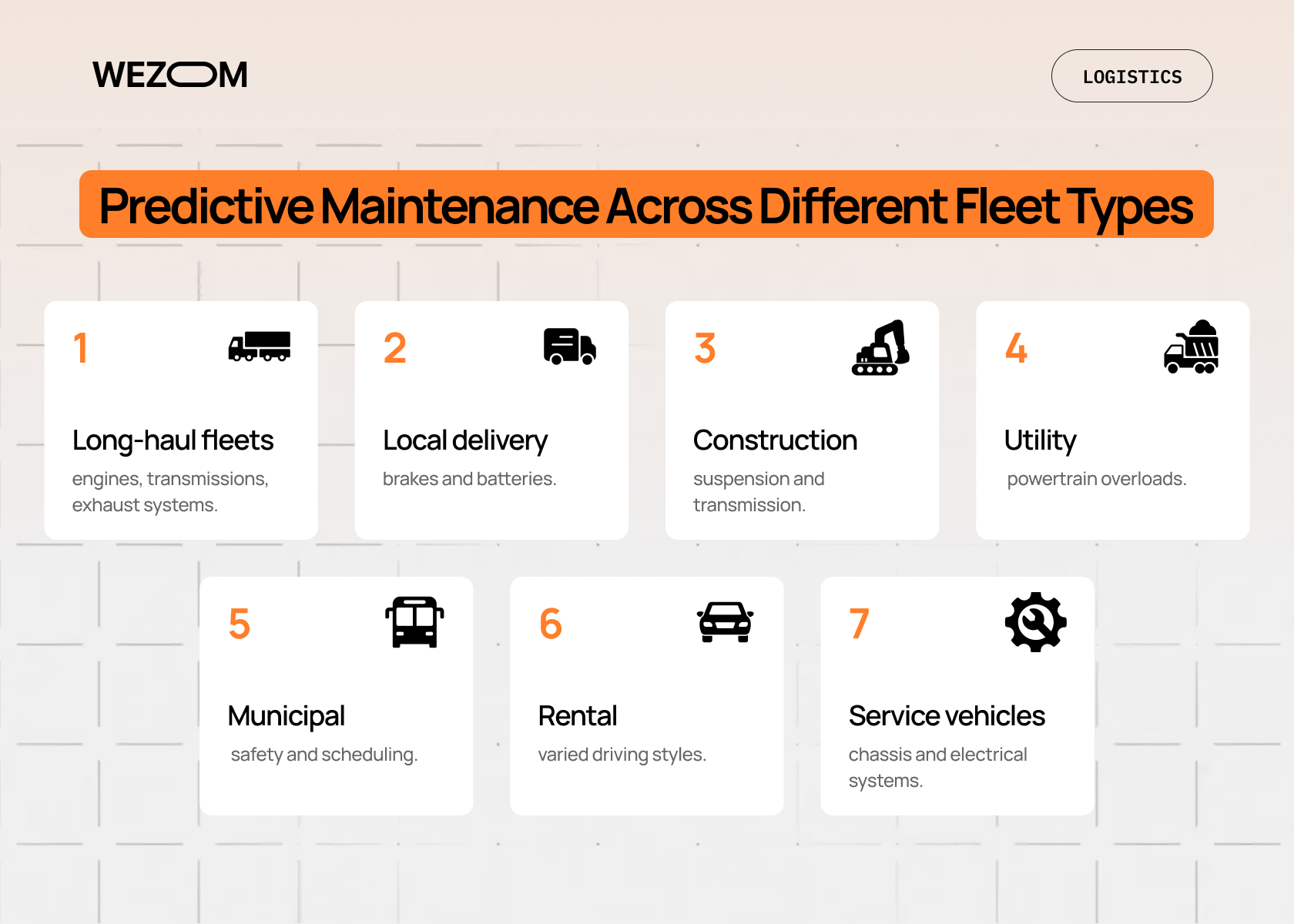
The specifics of equipment wear and tear depend on the nature of its use. From this perspective, it's better to consider trucking company fleet maintenance software with algorithms that can be customized to the design and utilization characteristics of a specific type of commercial vehicle:
- Long-haul trucking with the need to monitor the condition of engines, transmissions, and cleaning systems to prevent unexpected breakdowns far from base stations;
- Local delivery fleets, with their frequent acceleration and braking cycles, placing high stress on brake systems and batteries;
- Construction fleets, operating in dusty and off-road conditions, leading to accelerated wear of suspension and transmission components;
- Utility fleets, with their frequent attachment changes, requiring rapid detection of powertrain overloads;
- Municipal fleets, which require predictability for passenger safety and strict scheduling;
- Rental fleets, where vehicles are operated by different drivers with individual driving styles;
- Service vehicles, which are constantly in motion on different routes, making monitoring the chassis and electrical system crucial.
Calculating ROI From Predictive Fleet Maintenance
Implementing predictive maintenance systems requires investment in sensors, telematics, and, optionally, custom development. At the same time, the transition from reactive to predictive maintenance reduces the total cost of ownership within the first few months of system deployment. This is achieved through the following:
- Maintenance savings, through eliminating premature part replacement and switching from standard schedules to condition-based maintenance. Ultimately, this reduces the budget for consumables and related repairs by 20-25%;
- Downtime reduction, allowing trucks to operate for the longest possible shifts. In this sense, preventative troubleshooting during night shifts eliminates unscheduled downtime at service stations;
- Labor savings, achieved by eliminating the need for urgent repairs. This logically reduces the need for overtime mechanics and the redundancy of mobile repair crews;
- Parts optimization, thanks to real-time analysis of parts wear. This allows for keeping only the necessary minimum inventory items on the balance sheet;
- Fuel savings, caused by hidden power losses and fixed by adjusting tire pressure and engine tuning using predictive algorithms. This reduces fuel consumption by an average of 3-7% across the entire fleet;
- Extended asset life, thanks to the timely elimination of micro-loads and chain failures. This increases the overall service life of each vehicle by several years;
- Avoided roadside repairs and towing of heavy vehicles off the road, which are several times more expensive than scheduled procedures. Predictive solutions eliminate these unexpected costs from the budget;
- Increased fleet utilization, thanks to the technical readiness of vehicles for deployment. This means the business can fulfill more orders with the same fleet, ultimately maximizing profitability.
Common Challenges During Implementation and How to Avoid Them
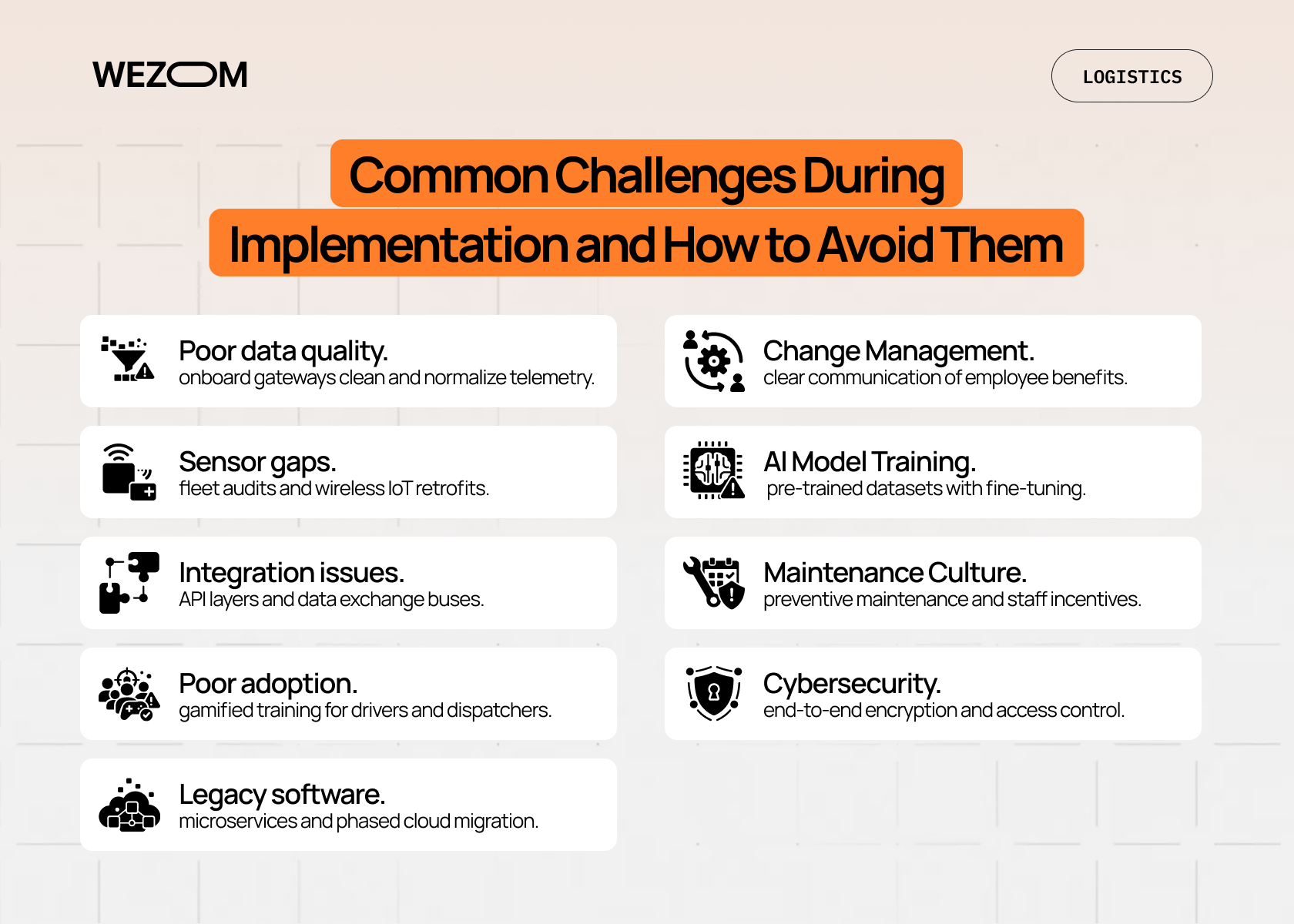
Digitalization of fleets based on predictive algorithms has a number of pitfalls. However, recognizing them at the outset of the project allows development teams to minimize risks:
- Poor data quality. Inaccurate or insufficient telemetry distorts the performance of AI models. This problem can be solved by implementing gateways for initial data cleansing and normalization onboard the vehicle;
- Sensor coverage issues. The lack of sensors on vehicle components is addressed through a phased fleet audit and retrofitting the vehicles with wireless IoT modules;
- Integration issues. The isolation of trucking fleet maintenance software from corporate systems is overcome by designing an API layer and data exchange buses;
- Poor user adoption. Driver and dispatcher resistance to the new interface can be addressed through gamified training;
- Existing legacy software. Attempts to implement AI on top of monolithic databases are resolved through a transition to a microservice architecture and a phased migration of modules to the cloud;
- Poor change management. The transition to advanced software often causes stress within the team, so management communication on how the system facilitates each employee's work is crucial;
- Improper AI model training. The lack of historical data for training neural networks can be compensated for by using ready-made, pre-trained industry datasets (it's only important to implement their subsequent fine-tuning);
- Lack of maintenance culture. The principle of "while the car is running, it's better not to mess with its internals" should be replaced by the implementation of preventative maintenance regulations and incentives for technical personnel to prevent accidents and unscheduled repairs;
- Cybersecurity issues. Securing communication channels between the vehicle and the cloud server requires end-to-end traffic encryption and access rights management.
How to Choose Predictive Fleet Maintenance Software
There are many out-of-the-box solutions on the market, but to ensure a system delivers maximum ROI for your specific business, you need to consider a number of criteria during evaluation, including:
- AI capabilities. The platform should utilize machine learning algorithms and artificial intelligence to identify hidden correlations in large data sets and, thus, accurately predict future auto part failures;
- Scalability. The software architecture should allow for the scaling of connected vehicles, drivers, operators, and even offices to support your business growth;
- Integrations. The software should be able to seamlessly exchange data with third-party systems and services via open APIs with time-proven reliability;
- Reporting. The software should feature analytical dashboards that update in real time and instantly generate reports based on the KPIs your company relies on;
- Mobile support. In addition to the web version, the vendor must also provide a mobile app for drivers and field technicians so they can receive notifications in real time and track completed work, regardless of internet connection quality;
- Customization. The vendor must allow companies to adapt interfaces and notification logic to their unique business processes (all this must be accessible without rewriting code);
- Compliance. This includes support for regional/industry standards for road safety, environmental regulations, regulations for storing confidential customer data, and labor code standards for drivers;
- Cloud architecture. Cloud hosting guarantees high system availability (up to 99.9% uptime), provides backup capabilities, and enables remote access to all data from anywhere in the world;
- Pricing. The pricing model must be flexible and take into account the number of vehicles and/or the volume of data processed;
- Vendor experience. You must ensure that the developer's portfolio includes case studies from your industry;
- Implementation support. Here, we mean the level of assistance during the launch phase, including employee onboarding, assistance with data migration, purchasing and configuring sensors, etc. This also includes 24/7 technical support during software operation.
Why Custom Predictive Fleet Maintenance Software Can Deliver Greater ROI
Off-the-shelf solutions, although offering a fairly broad feature set, are rarely used by large transportation companies due to the need to pay for excess functionality, implement numerous integrations with legacy systems, and adapt the solution to changing workloads. Custom development of trucking maintenance software, on the other hand, successfully addresses all of these issues, making it the only viable solution for:
- Enterprise fleets with thousands of vehicles – for them, out-of-the-box software is too slow and inflexible. They require a custom architecture designed to account for seasonal workloads and the ability to parallelize huge amounts of telemetry data;
- Unique maintenance workflows, with sophisticated regulations, complex employee shift schedules, multi-stage repair approval procedures, and other nuances that cannot be covered by out-of-the-box products;
- Complex integrations, for which connectors are not provided in SaaS solutions. In this case, only custom development will enable seamless data transfer back and forth with legacy ERP systems, proprietary warehouse databases, and other narrow-focused software;
- Proprietary business logic, which incorporates unique know-how, includes proprietary formulas for calculating equipment wear and tear, and in-house developed route distribution algorithms. Only custom development will allow you to protect your intellectual property;
- Fleets of specialized equipment, such as construction, agricultural, utility, and other vehicles, where standard (and those provided by most vendors) vehicle sensors are of no use. In this context, custom software is tailored to analyze these specific components;
- Multi-location operations, which occur when your business is distributed across regions with different climate conditions and legal requirements. In this case, a custom system will allow you to consolidate the management of local fleets.
Conclusion
The transition to predictive maintenance through the implementation of specialized fleet operations software makes fleet management more resilient. This is achieved through the timely detection of microdefects in vehicle components using telematics and AI/ML algorithms. Ultimately, thanks to this, businesses gain the ability to eliminate unexpected downtime and significantly extend the lifespan of each vehicle.

FAQ
How does predictive fleet maintenance software reduce vehicle downtime?
A fleet maintenance management system analyzes telematics and sensor data in real time to detect micro-anomalies in vehicle components before they develop into failures. This allows maintenance teams to address issues during planned service intervals instead of dealing with unexpected roadside breakdowns, emergency repairs, and costly vehicle downtime.
What is the difference between predictive and preventive fleet maintenance?
Preventive maintenance follows predefined schedules or mileage intervals, such as replacing engine oil every 10,000 kilometers. Predictive maintenance, by contrast, relies on real-time vehicle condition data and analytics to determine when maintenance is actually needed, helping reduce unnecessary part replacements while minimizing the risk of unexpected failures.
Is predictive maintenance suitable for small trucking fleets?
Yes. Cloud-based predictive fleet maintenance solutions are well suited for small fleets because they can be deployed with relatively low upfront investment. Companies often begin by monitoring critical vehicle components and gradually expand functionality as their fleet and operational needs grow.
How does AI improve fleet maintenance scheduling?
AI algorithms analyze historical maintenance records, telematics data, sensor readings, and component wear indicators to estimate the remaining useful life of vehicle parts. These insights help generate optimized maintenance schedules, reduce manual inspections, and improve fleet availability.
Can predictive maintenance software integrate with existing fleet management systems?
Yes. Most predictive maintenance platforms support integration through APIs and data exchange gateways, allowing them to connect with existing fleet management, ERP, or telematics systems. Older legacy platforms may require custom connectors to enable seamless and reliable data synchronization.
